If you manage a mid-to-large property portfolio, you know the numbers never stop. Rent collections, vendor invoices, maintenance costs, owner disbursements, and somehow your finance team is still bouncing between spreadsheets and three different tools to put a single monthly report together.
That kind of fragmentation is expensive. It slows your close cycle, increases error risk, and leaves you making decisions on financial data that's already a week old.
The right property management accounting software changes all of that. It brings your financial data, leasing records, and operational activity into one place, so your team spends less time assembling reports and more time acting on them.
This guide covers the platforms worth your attention in 2026, evaluated on accounting depth, integration capability, scalability, and real-world fit for property management finance teams.
Key Takeaways
- Fragmented software stacks are a major cost; finance teams using disconnected tools spend significantly more time on manual data entry, reconciliation, and report assembly.
- The best property management software for financial reporting in 2026 combines built-in property accounting capabilities, lease management, vendor payments, centralized financial views on a single platform.
- RIOO stands out for enterprise and mid-market portfolios because it handles both residential and commercial properties within a single, unified system built for scale.
- Different platforms suit different portfolio sizes. Smaller landlords may be fine with entry-level tools, but firms managing hundreds or thousands of units need deeper accounting infrastructure.
- Real-time financial visibility, the ability to see income, expenses, and performance metrics at the property and portfolio level simultaneously, is now a standard expectation, not a premium feature.
Common Challenges in Property Management Accounting
Before looking at which platform fits your operation, it helps to name exactly what's breaking down for most property finance teams today.
-
Fragmented systems and outdated spreadsheets
Most property management firms don't have one accounting problem, they have several, spread across multiple tools. Leasing data lives in one system, maintenance costs in another, and vendor payments in a spreadsheet someone built three years ago. By the time your team pulls everything together for a monthly report, the numbers are already stale.
-
Managing large portfolios across residential and commercial properties
Residential and commercial properties have different lease structures, different cost categories, and different reporting requirements. Platforms built for one rarely handle the other well, and firms managing a mixed portfolio often end up running two separate systems, which doubles the reconciliation work.
-
Inefficient vendor and tenant communication
When your accounts payable workflow lives outside your property management system, invoices get missed, payments get delayed, and vendor relationships suffer. Similarly, when tenants can't access their payment history or lease details through a portal, your team handles those requests manually, every single time.
-
Manual rent collection, lease management, and financial tracking
Collecting rent through bank transfers, tracking lease expiry dates in spreadsheets, and updating financial records by hand are workflows that work at five units. At 500, they lead to errors, delays, and compliance risks. The finance team ends up doing data entry instead of financial analysis.
Also Read: Essential Guide to Property Management Accounting Basics
The 9 Best Property Management Accounting Software Platforms for 2026
Every platform on this list was evaluated on real accounting capability, not just whether it has a rent collection button. The focus is on what matters to finance teams: general ledger depth, reporting flexibility, vendor and AP management, and how well accounting connects to the rest of your operation. Here's how the leading options compare.
1. RIOO, Best for Mid-to-Enterprise Portfolios Needing Unified Financial Management
Best for: Property management firms managing residential, commercial, or mixed portfolios across multiple entities, teams that need accounting, leasing, and operations in one place.
If your finance team is tired of pulling data from multiple systems just to close the books, RIOO is built for exactly that problem.
RIOO is a property management platform that integrates property accounting, lease management, facility management, vendor payments, and financial reporting within a single, unified system. It supports both residential properties, multi-family, single-family, HOAs, student housing, condos, public/social housing, and commercial portfolios, including office buildings, retail malls, warehouses, industrial spaces, and shared workspaces.
What makes RIOO stand out from a finance team's perspective is that it doesn't treat accounting as a supporting feature. Accounting is a central part of the platform, not treated as an add-on.
Key accounting and financial reporting features:
- Property Accounting: Full income and expense tracking per property, with ledger adjustment transactions, and reconciliation tools built in.
- Income & Expense Management: Monitor all revenue streams and operational costs with individual financial records per tenant, property, and portfolio.
- Vendor Management & Accounts Payable: Record invoices, manage payments, and maintain financial records for vendor-related expenses within the platform.
- Financial & Operational Expenses: Consolidated financial views within the platform showing your complete cost picture, maintenance, utilities, management fees, and more, in one view.
- Real-Time Dashboards & Reports: Configurable financial reports by property, timeframe, expense category, or property type. Export-ready and shareable across teams.
- 30+ Integrations: Connects with other tools your team already uses, so financial data stays connected across modules without repeated manual entry.
The difference property managers actually feel is in the day-to-day. When lease details are updated, the financial records reflect those changes within the platform. When a vendor invoice gets processed, it hits the AP module and updates your expense reports.
RIOO also supports tenant and community manager portals, so users can access relevant information through the tenant and community manager portals.
Explore RIOO's Finance & Accounting Module, See how it works for portfolios like yours.
2. AppFolio Property Manager, Best for Residential-Focused Firms Prioritizing Smart Workflows
Best for: Professional property management companies with residential-heavy portfolios of 50+ units looking for strong workflows and mobile-first operations.
AppFolio is one of the most widely referenced names in property management software, and its accounting features are consistently rated above the industry average. In G2's Fall 2025 Grid Report, AppFolio earned the top G2 Score among property management platforms.
Its accounting suite natively covers income and expense tracking, rent rolls, and P&L statements. The owner portal allows investors to pull their own reports, reducing your team's reporting workload.
Key accounting features:
- Native double-entry accounting with full general ledger
- Online rent collection via ACH or credit card
- Owner reporting and investor portal access
- AI-powered workflows through AppFolio Realm-X
Limitations to note: AppFolio is primarily built for residential management. Its CAM reconciliation capabilities were added only in the Plus tier in 2025, meaning firms with significant commercial portfolios may find the depth limited. Pricing is per-unit and requires a minimum monthly spend, which can be prohibitive for smaller teams.
3. Yardi Breeze, Best for Non-Technical Teams Managing Smaller Portfolios
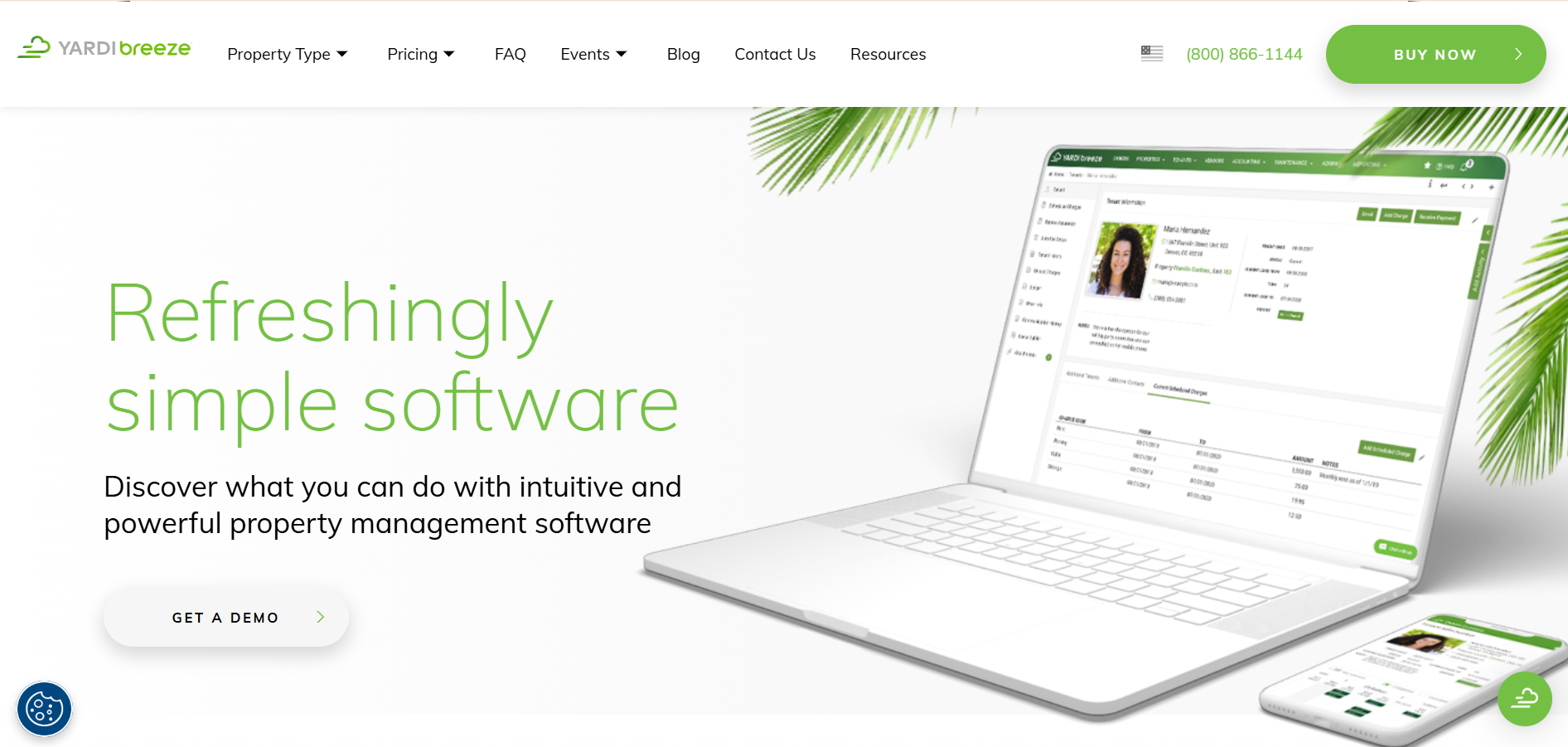
Best for: Small-to-mid-sized property management firms that want an easy-to-use system without a steep learning curve.
Yardi Breeze is the lighter, cloud-based version of the Yardi ecosystem, designed for teams that need solid property accounting without the implementation complexity of Yardi Voyager.
The accounting tools cover accounts payable, accounts receivable, and general ledger functions. It supports rent collection, maintenance tracking, and owner reporting from a single dashboard. Users consistently highlight its clean interface and straightforward navigation.
Key accounting features:
- AP, AR, and general ledger management
- Financial reporting and owner statement generation
- Owner portal with customizable reports (Breeze Premier)
- Support for multiple property types: residential, commercial, affordable housing, self-storage
Limitations to note: Users have flagged limited reporting flexibility, you can't always pull the exact custom reports you need without workarounds. Advanced features like custom lease documents and enhanced owner reports are locked behind the Breeze Premier tier.
4. Buildium, Best for Residential Property Managers Wanting an All-in-One System
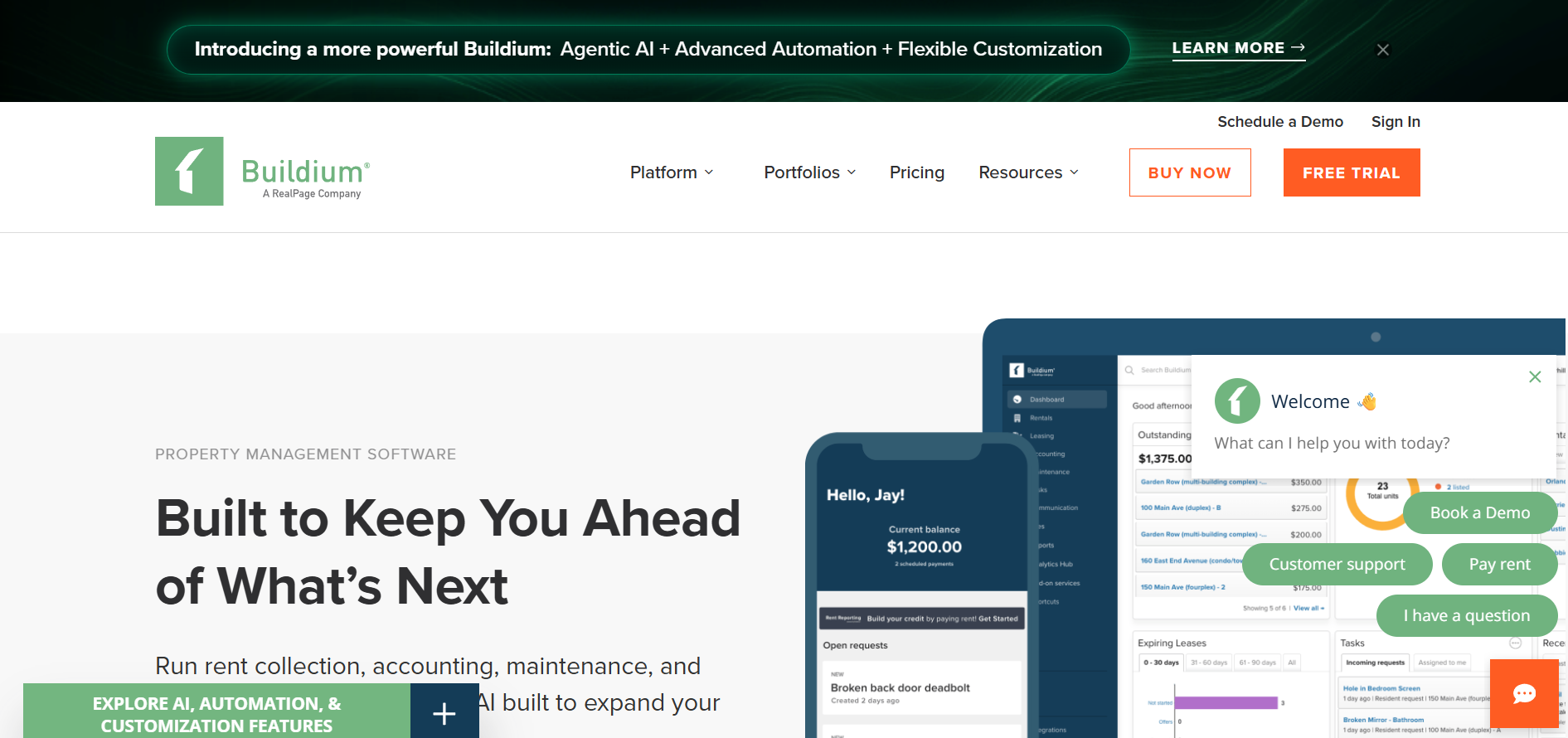
Best for: Residential property management teams managing small- to mid-sized portfolios who want a clean, structured platform with reliable accounting and tenant management tools.
Buildium is a well-established residential platform with built-in accounting, maintenance coordination, and a tenant portal. Its accounting module covers the core needs well, bill entry, expense tracking, financial reports, and 1099 e-filing. Users frequently mention that it simplifies day-to-day bookkeeping without requiring accounting expertise.
Key accounting features:
- Chart of accounts customized for property management
- Rent collection, trust accounting, and bank reconciliation
- 1099 e-filing included at no additional cost
- Owner portals with financial statement access
- Analytics Hub with performance insights (Growth and Premium plans)
Limitations to note: Buildium is primarily built for residential management. Report customization is limited compared to more advanced systems, and there is no native CAM reconciliation, a clear gap for commercial portfolios.
5. MRI Software, Best for Commercial and Mixed-Use Enterprise Portfolios
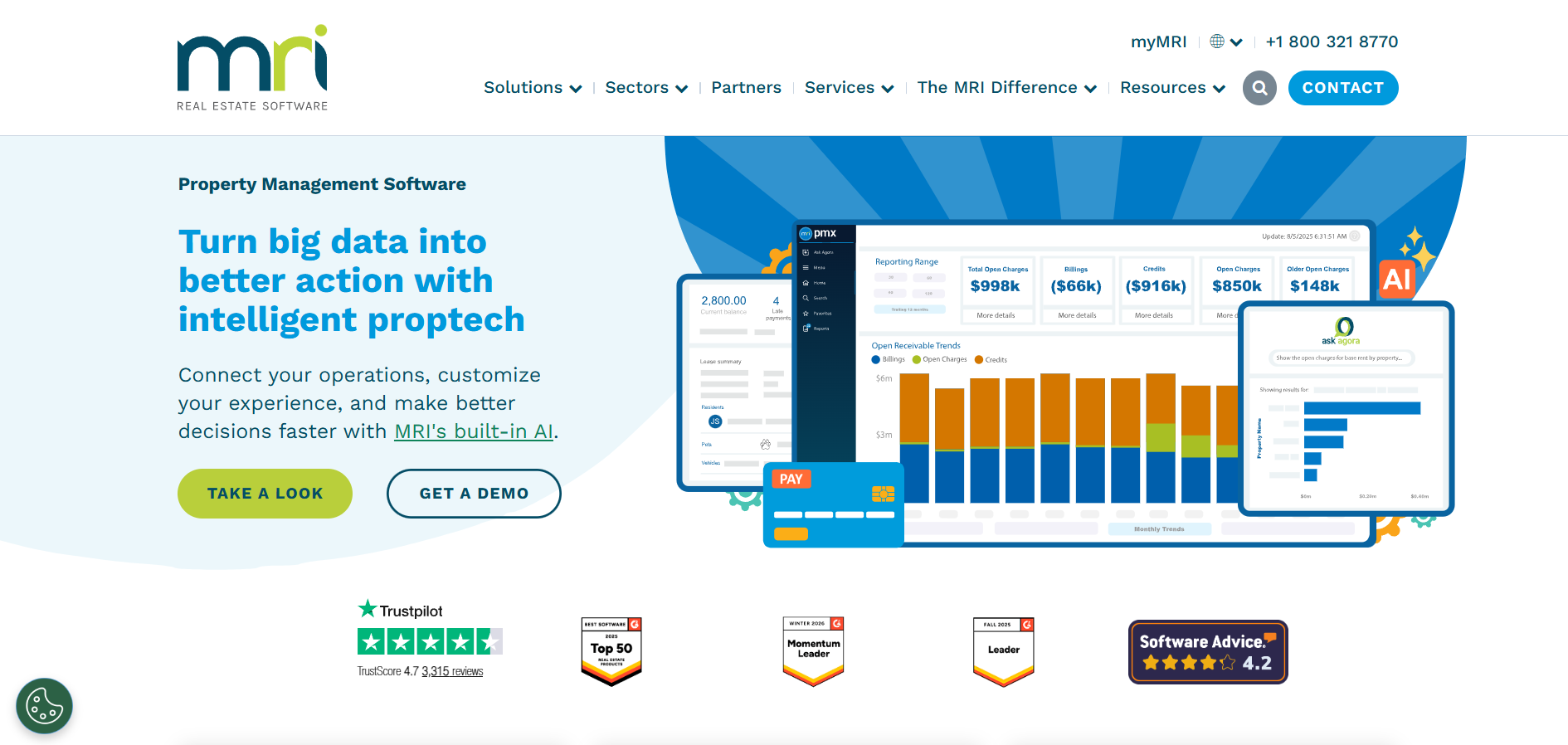
Best for: Enterprise-level firms managing complex commercial portfolios requiring deep configurability, compliance-grade accounting, and institutional reporting.
MRI Software is a long-standing enterprise platform with significant depth on the commercial accounting side. It handles CAM reconciliation, multi-entity accounting, and investment portfolio reporting in ways that smaller platforms don't support natively.
For firms managing office towers, retail assets, or mixed-use developments, particularly those reporting to institutional investors, MRI provides the financial infrastructure to handle that complexity.
Key accounting features:
- Full commercial lease accounting with CAM reconciliation
- Multi-entity consolidation and investor-grade reporting
- Accounts payable management and vendor workflows
- Support for IFRS and GAAP compliance
Limitations to note: MRI carries a steep learning curve. Implementation is complex, often requiring partner support, and the cost structure is generally above mid-market budgets. It rewards teams with dedicated IT and finance resources.
6. Rent Manager, Best for Large Portfolios Needing Customizable Accounting
Best for: Established property management companies managing large mixed-use or residential portfolios that need deep accounting customization.
Rent Manager is a professional-grade platform with built-in general ledger, trust accounting, and bank reconciliation tools. It's particularly well-suited for teams that manage both residential and commercial properties and need detailed, configurable financial reporting.
Key accounting features:
- Full general ledger and double-entry bookkeeping
- Trust accounting and bank reconciliation
- Vendor payment management
- Portfolio-level financial reporting
Limitations to note: The user interface is functional but less intuitive than newer platforms. Teams without prior experience in dedicated property management software can find the initial setup demanding.
7. DoorLoop, Best for Simplicity and Speed Across Portfolio Sizes
Best for: Property managers of any portfolio size who want fast onboarding, clean design, and solid accounting without a long learning curve.
DoorLoop is a newer platform that has grown quickly due to its clean interface and quick setup. Its accounting module covers the core functions well, reconciliation, income and expense tracking, and financial reporting. The QuickBooks Online integration is a strong point for teams whose CPAs already work in QBO.
Key accounting features:
- Complete general ledger with reconciliation
- Trust accounting tools
- Rent collection with payment reminders
- QuickBooks Online one-click integration
- Financial reporting across the portfolio
Limitations to note: DoorLoop lacks some of the depth in commercial accounting, CAM reconciliation and multi-entity consolidation that larger enterprise portfolios require. Pricing increases with unit count, and additional fees apply for screening and payment processing.
8. Stessa, Best for Residential Investors Focused on Portfolio Performance
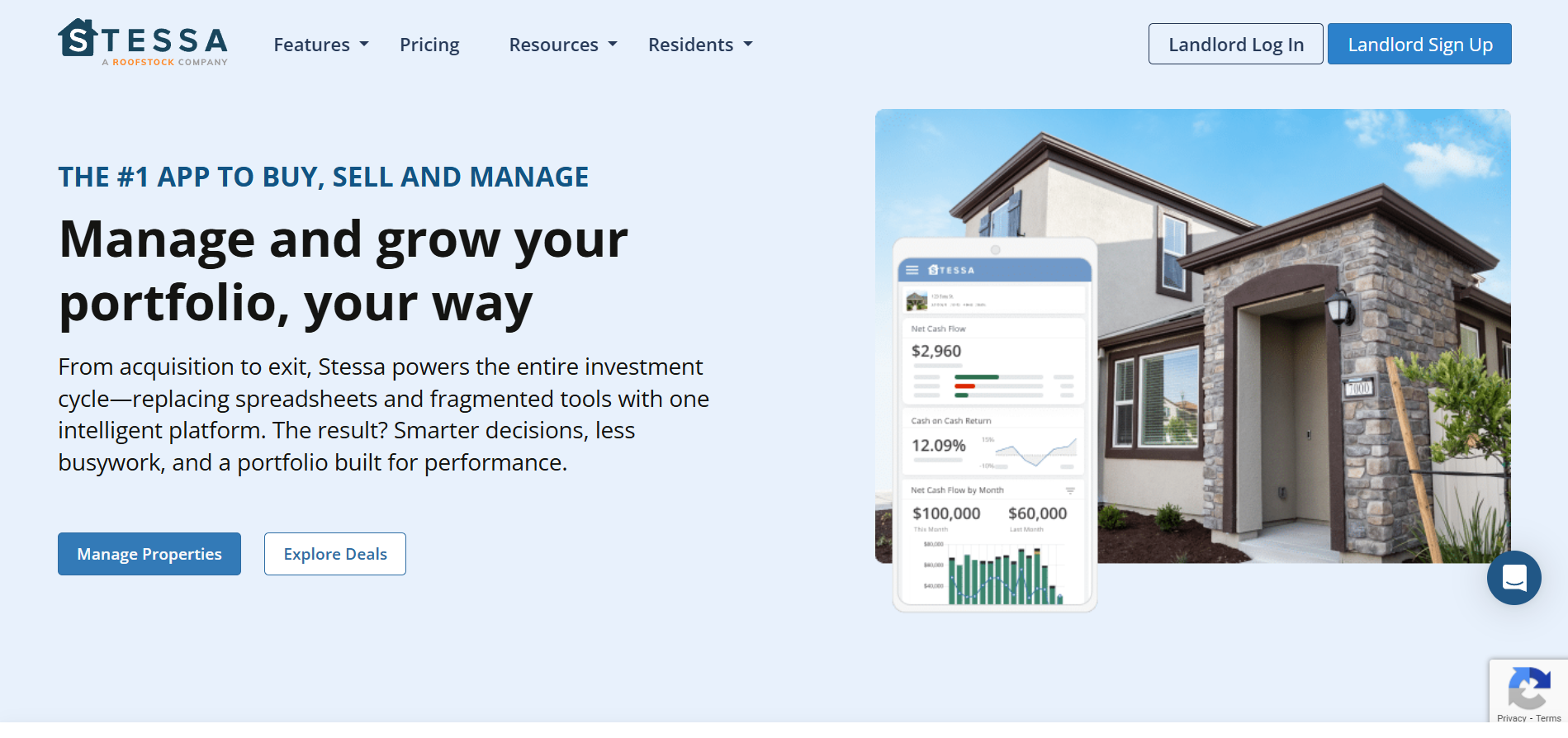
Best for: Individual landlords and residential investors managing smaller portfolios who want strong financial analytics without heavy operational features.
Stessa positions itself as asset management software rather than traditional property management. Its strengths are financial reporting and portfolio performance analytics, income and expense tracking, cash flow visibility, and tax-ready report generation. It's used by over 250,000 landlords and focuses heavily on helping investors understand how each property is performing financially.
Key accounting features:
- Income and expense tracking with bank import
- Real-time cash flow visibility and net operating income tracking
- Tax-ready financial reports
- Portfolio performance dashboards
Limitations to note: Stessa is built for residential investors, not professional property management firms. It lacks the operational depth, tenant portals, vendor management, facility management, and multi-entity accounting that growing management companies need. It has a clear ceiling for scaling operations.
9. QuickBooks Online, Best as a Supporting Accounting Tool for Smaller Operations
Best for: Smaller landlords or property managers who already use QuickBooks for business accounting and want to extend it to track rental properties.
QuickBooks Online is not purpose-built for property management, but it remains a widely used tool for tracking rental income and expenses at the smaller portfolio level. Property managers who handle fewer than 20 units and primarily need bookkeeping can make it work. Its strength is in its familiarity: most CPAs and accounting professionals already know it.
Key accounting features:
- Income and expense tracking with categorization
- P&L statements, cash flow reports, and balance sheets
- 1099 module for contractor payments
Limitations to note: QuickBooks has no native property management features, no tenant portals, no lease management, no maintenance tracking, no trust accounting, no CAM reconciliation. For anything beyond a handful of properties, you'll need a separate property management tool alongside it, which creates exactly the kind of fragmentation that dedicated platforms eliminate.
Also Read: A Complete Guide to Property Management Financial Statements
How to Choose the Right Platform for Your Portfolio
Not every tool on this list serves the same type of operation. Here's a quick guide to help you narrow it down.
|
Your Situation |
Recommended Platform |
|
Enterprise firm, residential + commercial mixed portfolio |
RIOO |
|
Residential-heavy firm, 50+ units, wants smart workflows |
AppFolio |
|
Small team, wants easy setup and clean interface |
Yardi Breeze or DoorLoop |
|
Residential PM company, mid-sized portfolio |
Buildium |
|
Complex commercial portfolio, enterprise accounting |
MRI Software |
|
Large portfolio, deep accounting customization needed |
Rent Manager |
|
Residential investor tracking personal portfolio |
Stessa |
|
Already using QuickBooks, managing under 10 properties |
QuickBooks Online |
CTA
Not sure which platform actually fits your portfolio structure and reporting needs?
Explore how RIOO brings accounting, leasing, and operations together in one platform, so your finance team can work with consistent, connected data across every property.
What the Best Property Management Software for Financial Reporting in 2026 Actually Needs
Picking a platform because it "has accounting" is not the same as picking one where accounting actually works for your operation at scale.
Here's what separates the best property management software for financial reporting in 2026 from platforms that just tick the box:
1. Accounting that connects to operations
When a maintenance job is completed, the cost should be reflected in your expense report. When a lease renews, the new rent amount should be reflected in your income tracking. The platforms where accounting is integrated, not bolted on, are the ones where your numbers stay accurate without manual effort.
2. Real-time visibility at every level
You need to see financial performance at both the property and portfolio levels simultaneously. Knowing your overall NOI is useful. Knowing which two properties are pulling it down is what drives decisions.
3. Multi-entity support for growing firms
If you manage properties across multiple legal entities or LLCs, you need a platform that handles consolidated reporting without requiring monthly spreadsheet assembly.
4. CAM reconciliation for commercial portfolios
If commercial leases are part of your portfolio, offices, retail, or industrial, CAM reconciliation is non-negotiable. Most residential-focused platforms handle this poorly or not at all.
5. Scalable integrations
Your accounting software should work with the rest of your tech stack. That means payment processing, and integration with reporting or ERP tools your finance team already uses.
Must Read: How to Build a Month-End Close Checklist for Property Management Finance Teams
Conclusion
There's no shortage of accounting software in the market. What's actually scarce is a platform that handles property accounting the way your finance team needs it, is connected to operations, is visible in real time, and is built to scale with your portfolio.
The platforms in this list each serve a different type of operation. If you manage a handful of residential units, Stessa or DoorLoop may be sufficient. If you run a large residential or commercial portfolio and your team is still pulling data from three different systems to close the books, a platform like RIOO is built for exactly that.
The best property management software for financial reporting in 2026 is not the one with the most features, it's the one where your numbers are always accurate, always accessible, and never require manual assembly.
See RIOO in action, Book a demo and explore how it fits your portfolio's accounting workflow.
Frequently Asked Questions
1. What is the best property management accounting software for large portfolios in 2026?
For large or enterprise portfolios that manage both residential and commercial properties, platforms with native multi-entity accounting, consolidated reporting, and integrated lease management, such as RIOO, are the strongest fit. Generic accounting tools and smaller platforms tend to lack the depth needed at scale.
2. Can I use QuickBooks for property management accounting?
QuickBooks handles basic bookkeeping well, but it was not built for property management. It has no tenant portals, lease management, trust accounting, or CAM reconciliation. Most growing property management firms use QuickBooks as a supplementary tool alongside a dedicated platform, or replace it entirely with a purpose-built solution.
3. What's the difference between property management software and property management accounting software?
Property management software handles tenant communication, leasing, and maintenance. Property management accounting software adds a full financial layer, income and expense tracking, general ledger, bank reconciliation, AP management, and financial reporting. The best platforms integrate both, so your operational and financial data live in the same system.
4. How do I track expenses across multiple properties efficiently?
The most effective approach is a platform where each property has its own financial record within a shared system, so you can view individual property performance and consolidated portfolio performance from the same dashboard. Tagging expenses by property, category, and vendor makes reporting and tax preparation significantly faster.
5. What features should property management accounting software have for commercial properties?
Commercial portfolios need CAM (Common Area Maintenance) reconciliation, support for complex lease structures, multi-entity accounting, and audit-ready financial statements. Most residential-focused platforms don't offer this natively; platforms like RIOO and MRI Software are built to handle the depth of commercial accounting.



.svg)
.svg)


.svg)