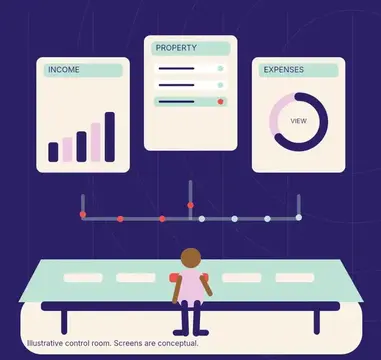
- Budgeting and forecastingOn track
- Tenant ledgersApproved
- Bank reconciliationLive
- Vendor and contractor paymentsSynced
- Real-time financial snapshotsPosted
Rioo Finances · Property Accounting
Property Accounting Software on NetSuite
Accounting at the level your properties live
RIOO is property accounting software built natively on Oracle NetSuite. Budgets, forecasts, tenant ledgers, bank reconciliation and vendor payments, all tracked by property, building and unit inside NetSuite. Every figure can be traced to the record that created it.
Property accounting on NetSuiteNetSuite
Posted
JE-10482CAM recovery · Retail pad 3
| Account | Debit | Credit |
|---|---|---|
| Accounts receivable | 3,120.00 | |
| CAM recovery income | 3,120.00 |
LeaseChargeInvoiceJournal
The problem with property accounting in a general ERP
A general ERP runs a ledger well but doesn't know what a lease, a unit or a tenant is. A property management system knows the lease but keeps its own books. Most teams live in the gap, re-keying rent, mapping properties to classes and reconciling tenant balances by hand. RIOO adds the property records NetSuite doesn't have natively, then lets property workflows post to NetSuite's ledger directly.
What is NetSuite property accounting software?
NetSuite property accounting software adds property concepts, such as properties, units, leases, tenants and recurring charges, to the NetSuite general ledger, so rent billing, receivables, deposits, payables and owner reporting run inside the ERP. RIOO is built natively on NetSuite, which means property transactions are NetSuite transactions rather than summaries imported from another system.
Property accounting differs from general accounting in its unit of analysis. A typical company reports by department or product line; a property business reports by building, unit and lease, often for many owners and entities at once. It also carries obligations most businesses do not, such as tenant deposits held as liabilities, recoverable expenses billed back to tenants and, for agents, client money held in trust.
How it works
How does property accounting work in RIOO?
Property accounting in RIOO runs inside Oracle NetSuite. The properties, units, leases, tenants and vendors it uses are native NetSuite records, so each step updates the same data finance reports on. There is no separate system to sync, and every action keeps an audit trail. The steps below show how the work flows.
- 01
Configure
the property dimensions, ledgers and chart-of-accounts mapping during implementation.
- 02
Operate
Leases, collections, bills and work orders post their transactions as they happen.
- 03
Review
tenant ledgers, receivables and property P&Ls at any time.
- 04
Reconcile
bank activity against transactions that already carry their property context.
- 05
Close and report
drilling from consolidated results down to a single property and the transaction behind it.
How it works
How does bank reconciliation work for property accounts?
Bank reconciliation for property accounts in RIOO matches bank statement lines to NetSuite transactions that already carry property, unit and tenant context: rent receipts, gateway settlement deposits, vendor payments and owner distributions. Matching happens per bank account and subsidiary, and unmatched items are investigated before the period closes.
- 01
Import the statement
Load or connect bank statement data for each operating, deposit and trust account.
- 02
Auto-match
Match receipts and payments on amount, date and reference.
- 03
Match settlements
Link gateway deposits, net of fees, to the batch of tenant payments they contain.
- 04
Investigate exceptions
Identify unknown receipts, returned payments and bank charges.
- 05
Post adjustments
Record fees, interest and corrections with clear descriptions.
- 06
Sign off
Reconcile to the statement balance and lock the period.
In detail
What can RIOO do for property accounting?
RIOO handles property accounting with capabilities built on NetSuite records rather than a separate database. Each capability below works with the same properties, leases, tenants and ledger, so operations and finance see one version of the data. Capabilities are configured to your policies during implementation, without custom code for routine changes.
Budgeting and forecasting
by property, building and unit, with actual-versus-plan comparisons.
Tenant ledgers
with full charge, payment and credit history. Notes and supporting documents can be attached to individual transactions for dispute resolution.
Bank reconciliation
against collections and disbursements.
Vendor and contractor payments
matched against purchase orders and work orders to prevent duplicate or unauthorized payments.
Real-time financial snapshots
by property and portfolio.
Tax-ready reporting
with alerts for relevant regulatory changes.
Consolidated and property-level reporting
in one place, with drill-down. Multi-entity consolidation uses NetSuite OneWorld.
Automated depreciation
through NetSuite Fixed Asset Management, where your account uses it.
Three-way matching for property costs
Vendor payments connect to purchase orders and maintenance records, so finance can confirm the work was ordered, done and billed correctly before paying. That control matters most for high-volume repair spend spread across many properties.
Tenant ledgers that settle disputes
When a tenant questions a charge, the answer should take seconds, not an afternoon. Each ledger line in RIOO links to the lease term or event that created it, and your team can attach evidence and notes directly to the transaction. The conversation moves from "let me look into it" to "here's the clause, the inspection photo and the date."
Reports finance teams rely on
Rent roll reconciled to the GL, receivables aging, deposit liability, income statement by property, budget versus actual and entity consolidation. In RIOO, each comes from the same NetSuite ledger, so the reports agree with each other.
Explore by topic
Holding other people's money: rules by market
United States
Property managers who hold rent and deposits for owners are usually subject to state real estate licensing rules on trust or escrow accounts, including separate accounts and regular reconciliation. Some states also regulate where tenant security deposits are held and whether interest is paid.
United Kingdom
Letting agents holding client money must join a client money protection scheme and keep client funds in designated client accounts. Tenancy deposits for assured shorthold tenancies are protected in government-approved schemes. See deposit protection and client money.
Australia
Licensed agents keep rent and other client funds in trust accounts governed by state legislation, with detailed record-keeping and annual audits. Residential bonds are lodged with the state bond authority rather than held in trust long term.
Singapore and the UAE
In Singapore, tenancy deposits are held under the terms of the tenancy agreement, and agents follow Council for Estate Agencies rules on handling client money. In the UAE, developer escrow rules apply to off-plan sales, while rental deposits follow the tenancy contract.
In detail
Property-specific liabilities finance teams track
Several balance sheet items are unique to property businesses. Keeping each one in its own NetSuite account makes reconciliation and audit straightforward.
Tenant security deposits
Held as a liability per property and reconciled to deposits on active leases.
01
Prepaid rent
Payments received before the charge period, released as rent income when due.
02
Owner funds held
Cash held on behalf of owners pending distribution, for managers of third-party property.
03
Recoverable cost balances
Estimates billed to commercial tenants compared with actual costs, settled at year-end.
04
Accrued maintenance
Work completed but not yet billed by vendors at period end.
05
Mapped to NetSuite
Native versus synced: how do the two models compare?
The native model keeps property transactions in NetSuite from the start, while the synced model runs a separate property management system and pushes summarised journals to NetSuite on a schedule. Both can work, but the native model removes the reconciliation between two ledgers and gives drill-down from the GL to the lease or work order.
Read more in why native matters.

- QuestionWhere do tenant charges live?Native on NetSuite (RIOO)NetSuite transactionsProperty system, summarised to NetSuite
- QuestionIs there a sync to monitor?Native on NetSuite (RIOO)No, for core recordsYes, usually daily or monthly
- QuestionDrill from GL to lease?Native on NetSuite (RIOO)Yes, linked recordsUsually stops at the journal
- QuestionWho administers access?Native on NetSuite (RIOO)NetSuite rolesTwo systems, two sets of users
- QuestionMonth-end reconciliationNative on NetSuite (RIOO)Within one ledgerBetween property ledger and ERP
- QuestionBest suited toNative on NetSuite (RIOO)Organisations standardised on NetSuiteOrganisations without NetSuite or with another ERP
Who is RIOO property accounting NOT for?
RIOO property accounting is not for organisations that do not use, or do not plan to use, NetSuite as their general ledger. Its design depends on property transactions posting directly to NetSuite, so teams committed to another ERP are better served by property systems that integrate with that ERP.
It is also more than a small landlord with a few properties typically needs. Licensing NetSuite and implementing RIOO makes sense when a portfolio has multiple entities, owners, property types or a finance team that needs controls, drill-down and consolidated reporting; individual landlords often manage well with simpler accounting tools.
What changes
What changes when property accounting runs on NetSuite?
When property accounting runs on NetSuite through RIOO, operational work and accounting stop being two separate jobs. Transactions post to the general ledger as they happen, reports use the same records as daily work, and controls come from NetSuite roles and approvals. The changes below are the ones teams usually notice first.
- A property P&L you don't have to assemble
- Faster dispute resolutionwith evidence on the ledger line.
- Stronger controlsover vendor payments.
- Audit traceabilityfrom statement to source document.
Talk to a specialist
See property accounting on your own portfolio.
Every figure can be traced to the record that created it.
Can managers attach documents to a tenant's transaction?
Yes. Notes and evidence, such as photos, signed agreements or correspondence, can be attached at transaction level on the tenant ledger. When a tenant disputes a charge, the manager opens the line and sees the lease term, the supporting document and any notes in one place, which shortens the conversation considerably.
Does RIOO calculate depreciation?
Depreciation runs through NetSuite Fixed Asset Management, which posts entries on schedule where that module is part of your NetSuite account. Buildings, improvements and equipment are fixed asset records with cost, method and useful life. Without the module, finance teams can calculate depreciation separately and post it by journal entry.
Can we see consolidated results and drill into one property?
Yes. Consolidated and property-level reporting work together, so you can start from a portfolio income statement and drill into a single property and then the transaction behind any figure. Multi-entity consolidation across property-owning companies requires NetSuite OneWorld, which also handles currency translation and intercompany eliminations.
Can vendor payments be matched to POs and work orders?
Yes. Payment workflows connect to purchase orders and maintenance records for three-way matching, so finance confirms the work was ordered, completed and billed correctly before paying. Mismatches go to an exceptions queue, and approved costs post to the right property, unit and expense category without re-coding.
Can we import historical financials?
Yes. Historical financial data can be migrated during implementation, typically as monthly balances by property and account, so year-over-year comparisons and budgets work from day one. Detailed historical tenant transactions are often summarised rather than loaded line by line, which keeps migration manageable. The approach is agreed during scoping.
Can RIOO produce a rent roll that reconciles to the general ledger?
Yes. Because rent charges are NetSuite transactions linked to leases and units, the rent roll and the receivables and income accounts draw on the same records. Reconciling them becomes a check rather than an investigation, and any difference points to a specific lease or transaction that can be opened directly from the report.
Does RIOO support accrual and cash basis reporting?
NetSuite records transactions on an accrual basis, and many property owners also want cash-basis statements showing rent actually received and bills actually paid. Cash-basis views can be produced through NetSuite reporting options and saved searches, so owners receive the basis they prefer while finance keeps accrual books.
Related
Related to property accounting