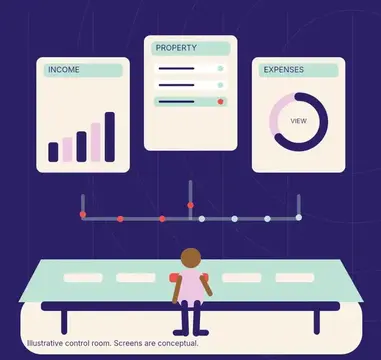














- ChargesReady
- CollectionsOn track
- PayablesApproved
- ExpensesLive
- DepositsSynced
Rioo Finances
Property accounting that's already in the ledger
Budgets, tenant ledgers, income and expense classification, shared costs and recoveries, rent collection and accounts payable. All of it lives natively in NetSuite, so operations and finance close from the same numbers.
JE-10482RIOO Finances
| Account | Debit | Credit |
|---|---|---|
| Accounts receivable | 2,450.00 | |
| Rental income | 2,450.00 |
Why property finance breaks in most stacks
Property operations create the transactions, but accounting records them somewhere else. Rent is billed in one system and posted in another. Repairs are approved in one tool and invoiced in a third. Month-end turns into reconciliation: matching the rent roll to the ledger, chasing unposted payments, re-coding repair costs. RIOO removes the gap. The property workflow creates the NetSuite transaction itself, so there's nothing to reconcile between the two.
What is property accounting software?
Property accounting software records the money side of real estate: rent and charges billed to tenants, payments received, deposits held, vendor bills paid, owner distributions and the general ledger for each property and entity. RIOO Finances does this inside NetSuite, so property accounting and corporate accounting share one ledger and one close.
How it works
How money moves through RIOO
- 01
Charges are created from the lease
including rent schedules, recurring fees, deposits and one-time charges.
- 02
Invoices go out
in your property's branding and through the tenant portal.
- 03
Payments arrive
through connected gateways and apply to the tenant ledger by your allocation rules.
- 04
Costs come in
through POs, vendor bills and work orders, coded to the property and expense category.
- 05
The GL is current
Property P&L, receivables and payables reflect what happened today, not last week's export.
In detail
Finance workflows in RIOO
Each workflow runs in NetSuite with property context attached, so finance reviews and approves instead of re-keying. The result is fewer reconciliations and faster answers.
Charges
generated from leases on schedule
Collections
posted and applied
Payables
with matching and approvals
Expenses
coded by property and category
Deposits
held and refunded
Reporting
from the same ledger
How are owner distributions calculated?
For third-party managed property, distributions start from cash collected for the owner, less operating expenses paid, management fees, reserves and any holdbacks the management agreement requires. RIOO calculates them per owner and property from posted NetSuite transactions and records the payment, so the owner statement and the ledger always agree.
How are security deposits accounted for?
Security deposits are accounted for as liabilities by lease, not income. In RIOO, the deposit posts to a liability account when received; at move-out, deductions are itemised and applied to charges, and the balance is refunded within the legal deadline, with every step on the NetSuite ledger.
Explore
Account for every property
Property accountingBudgets, forecasts, actual-versus-plan, tenant ledgers and bank reconciliation, by property, building and unit.

Income & expense managementClassify revenue and costs, track seasonal patterns and analyze profitability across the portfolio.Account for every propertyProperty accountingIncome & expense managementFinancial & operational expensesFinancial & operational expensesShared costs and recoveries, cash flow, P&L and budget reporting.Use cases
Which property-specific accounting does RIOO handle?
RIOO handles the property-specific accounting NetSuite lacks out of the box: rent rolls and receivables by property and unit, lease-driven billing, security deposits, recoveries and CAM, straight-line rent, owner statements and management fees, and property-level income statements, all posting to the NetSuite ledger.
Rent rolls and receivables
Every lease, charge and balance by property, unit and tenant.
Deposits
Held as liabilities, applied at move-out with itemised deductions.
Recoveries
CAM, service charges and utility recharges billed and reconciled. See CAM reconciliation.
Lease accounting
Straight-line rent and incentives for lessors. See lease accounting.
Owner accounting
Statements, management fees and distributions for third-party owners.
Multi-entity and multi-currency
Subsidiaries, intercompany and consolidation through NetSuite OneWorld.
Finance depth from NetSuite
Because RIOO runs inside NetSuite, you keep the controls finance already relies on, including roles and permissions, approval routing, period management and a system audit trail. Where your account includes them, NetSuite OneWorld supports multi-entity consolidation and NetSuite Fixed Asset Management supports automated depreciation.
Mapped to NetSuite
Which accounting records does RIOO create in NetSuite?
RIOO creates standard NetSuite records for property activity: invoices for rent and charges, customer payments for receipts, deposits for banking, vendor bills for maintenance and expenses, and journal entries for straight-line rent. The table shows each activity, its record and where it appears.

- Property activityRent and recurring chargesNetSuite recordInvoiceReceivables, income by property
- Property activityTenant paymentNetSuite recordCustomer paymentCash, receivables
- Property activitySecurity depositNetSuite recordDeposit liabilityBalance sheet by lease
- Property activityMaintenance costNetSuite recordVendor billExpenses by property
- Property activityOwner distributionNetSuite recordBill payment or journalOwner equity and cash
- Property activityStraight-line rentNetSuite recordJournal entryDeferred rent
What changes
Outcomes for finance teams
- Current receivablesrather than reconstructed ones.
- Property-level P&Lwithout spreadsheet bridges.
- Traceabilityfrom any number back to its lease, invoice or work order.
- Less re-keyingbetween operations and accounting.
- A calmer month-endbecause the ledger is kept current all month.
How does RIOO compare with keeping a separate property ledger?
Compared with keeping a separate property ledger, RIOO removes the sync, summary journals and month-end reconciliation between two systems. With a separate ledger, detail sits outside NetSuite; with RIOO, every rent charge and vendor bill is a NetSuite transaction that drills down to the lease.
With a separate property ledger
Leases, receivables and property expenses sit in a property management system, and summary journals are exported to the ERP. Finance reconciles the two each month and drills between systems to answer questions.
With RIOO in NetSuite
Property transactions are NetSuite transactions. There is no export, no summary journal and no second trial balance, and drill-down goes from the income statement to the lease charge in one place.
Who is RIOO Finances NOT for?
RIOO Finances suits organisations that run or will run NetSuite. It is not designed as standalone bookkeeping for individual landlords with a few units, and it is not a replacement for regulated trust accounting software where a licensing regime requires a specific product.
How it works
How does month-end close work for a property portfolio?
Month-end close for a property portfolio on RIOO starts by confirming all charges posted from lease schedules, then applying receipts, reconciling bank and deposit accounts, posting accruals and straight-line entries, reviewing receivables and variances, and running property and consolidated statements from the same ledger.
- 01
Confirm all charges for the month posted from lease schedules.
- 02
Apply payments and review unapplied cash.
- 03
Post late fees and concessions according to policy.
- 04
Match vendor bills to completed work and accrue unbilled costs.
- 05
Post straight-line, incentive and recovery adjustments.
- 06
Reconcile bank accounts and deposit liabilities.
- 07
Run property and owner reports, then close the period in NetSuite.
Checklist
Finance controls checklist
- Segregation of duties through NetSuite roles and approvals.
- Approval workflows for vendor bills and journals above thresholds.
- Locked periods after close.
- Audit trail on every lease and charge change.
- Bank reconciliation for every property account monthly.
- Deposit register reconciled to the liability balance.
Talk to a specialist
See RIOO Finances on your own portfolio.
All of it lives natively in NetSuite, so operations and finance close from the same numbers.
Every page
All of RIOO Finances, one page each.
Budgets & forecastingBudget and forecast by property, building and unit, compare actual to plan from live postings, and factor in known lease events and scheduled maintenance.Does RIOO replace NetSuite's general ledger?
No. RIOO uses NetSuite's general ledger rather than replacing it. Property workflows such as rent billing, receipts, deposits, vendor bills and recoveries post to it directly as NetSuite transactions, so there is no second ledger, no summary journal and no reconciliation between property and corporate books.
Can tenants pay online?
Yes. Tenants pay online through the RIOO portal using connected payment gateways such as Cardknox, AsiaPay and Cybersource, by bank transfer or card, including autopay. Each payment is a NetSuite customer payment applied to the tenant's open charges and posted to bank and receivables accounts automatically.
Does RIOO handle CAM and other recoveries?
Yes. RIOO supports shared costs and recoveries, allocating expenses across properties, units or cost centres by configurable rules, and billing tenants their share as estimates and year-end reconciliations. The recoverable expenses come straight from NetSuite, so recoveries reconcile to the general ledger. Confirmdepth of commercial CAM reconciliation features (gross-up, caps, statements)
How does RIOO handle depreciation?
RIOO handles depreciation through NetSuite Fixed Asset Management, where your account uses it. Buildings, improvements and equipment are fixed asset records linked to the property, depreciated on the methods and lives you set, and posted to the ledger each period, so property results include depreciation without a separate schedule.
Does RIOO replace NetSuite's accounting?
No. RIOO uses NetSuite's accounting, including the general ledger, receivables, payables, banking and financial reporting, and adds property records and workflows on top, such as properties, units, leases, work orders and portals. Finance keeps one NetSuite system, controls and close process for property and corporate activity.
Can RIOO handle owner statements for third-party management?
Yes. RIOO owner statements show income, expenses, management fees and distributions per owner and property for the period, drawn from NetSuite transactions. Third-party managers can share them through the owner portal or by email. Trust accounting rules vary by jurisdiction, so confirm the depth you need. Confirmtrust accounting scope
Can we close property and corporate books together?
Yes. Because property and corporate transactions live in one NetSuite ledger, a single month-end close covers both. Rent, receipts, vendor bills and deposits are already posted, so finance reviews, accrues and reconciles once, with no waiting for a property system export or posting summary journals before the close can finish.
Does RIOO support accrual and cash reporting?
Yes. NetSuite reports on an accrual basis, recognising rent when it is billed and expenses when they are incurred, which suits lenders and auditors. Cash-basis views can also be produced for owners who want income and expenses as they were paid. Confirm the cash-basis reports you need. Confirmcash-basis reporting
How are bank accounts handled per property?
Each property, entity or owner can use its own bank account in NetSuite, with receipts deposited and vendor payments made from the right account automatically. Bank reconciliation runs by account, so operators that need separate operating, deposit or trust accounts per property keep them cleanly separated.
Can RIOO post management fees automatically?
Yes. Management fees can be calculated from collected income according to each management agreement, such as a percentage of rent received, and posted for each owner as part of the period close. The fee appears on the owner statement and in the manager's income. Confirmfee automation
Related
Related to RIOO Finances