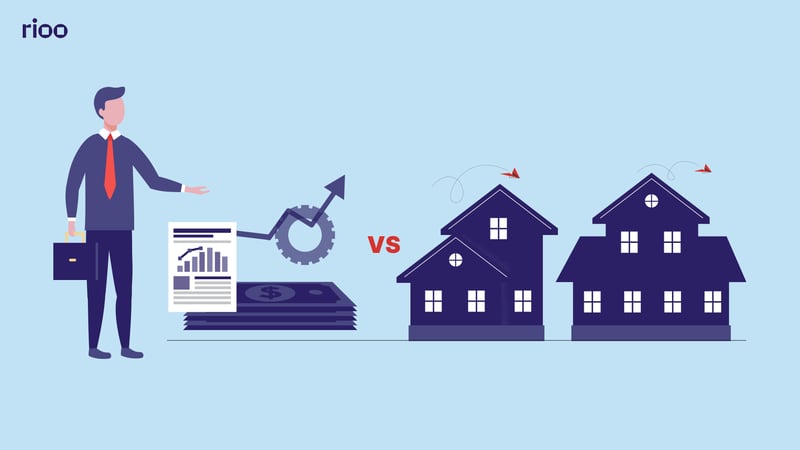
There is a moment in every AI pitch where the energy changes. The demo has gone well, the capabilities are impressive, the room is nodding, and then the CFO asks a plain question:
"What is the return?"
Not the capability, the return. What line of the P&L moves, by how much, and when?
The good vendors have an answer. The rest reach for the word "productivity," and the temperature in the room drops. Every experienced finance leader knows that "it saves time" is a description of activity, not a business case.
That question is the most valuable thing a CFO brings to an AI decision, and in 2026 it has teeth it did not have two years ago. For a while, AI spend got waved through on a single argument: move fast or your competitors will pull ahead permanently. Finance largely accepted it.
That era is over. The bills came due, the returns did not obviously arrive, and the CFO is now back in the room asking how the money turns into money. This piece is about that question, why most AI investments cannot answer it, and how a property CFO should press on it before signing rather than after the budget is gone.
The Numbers Every Property CFO Should Know
Start with the figures that reframe the whole conversation.
The AI reality check:
- 95 percent of generative AI pilots produced no measurable profit-and-loss impact. They worked technically, but they never showed up on the income statement. (MIT, via Fortune)
- 56 percent of CEOs could not point to any measurable business impact from their current AI spend. (PwC Global CEO Survey)
Read those numbers carefully. They are not saying AI does not work; they are saying most organizations cannot prove it worked, which for a CFO is nearly the same problem. An investment you cannot measure is an investment you cannot defend to your board, your lenders, or yourself at the next budget cycle.
The issue is rarely the technology. It is the near-total absence of the financial discipline that any other capital allocation of the same size would receive automatically. A CFO would never approve a seven-figure acquisition on a gut feeling that "it feels like it's working." Somehow AI has been getting exactly that pass, and the pass is being officially revoked.
The ROI Paradox: Why It Traps Finance
Here is the trap that catches even careful teams, and a CFO needs to see it clearly because it hides inside apparently good news.
The research literature calls this the ROI paradox: organizations claiming positive returns are usually measuring sentiment, adoption, or perceived productivity, not income-statement impact. When you ask people whether the AI tool feels useful, you get one number. When you ask whether it moved the P&L, you get a very different one. Most organizations measure the first and report it as the second.
For a property CFO, this is the whole game. A vendor showing that property managers "save four hours a week" is showing you saved hours, not saved dollars.
Saved hours only become a return if they convert into something the P&L recognizes:
- Fewer people needed for the same volume of work.
- More volume handled by the exact same headcount.
- A specific, documented cost avoided.
- A net-new revenue stream captured or risk reduced.
If those four saved hours are simply absorbed back into the day and nothing on the income statement changes, the return is zero, however real the time saving felt. The board has caught on to this, which is why finance leaders are watching the industry shift away from vague productivity claims and toward direct financial impact as the only ROI metric that survives scrutiny.
A Framework: The Three Questions That Kill a Weak AI Business Case
A CFO does not need to become a data scientist to separate a real AI business case from a hopeful one. These three questions do most of the work. If a proposal fails even one, keep your pen in your pocket.
1. What is the baseline, measured before we start?
This question quietly destroys most AI ROI claims because most organizations skip it entirely. You cannot prove AI improved anything if you never measured the "before."
Ask concretely: what does this process cost today, how long does it take, and how many errors does it produce? It must be measured right now, using the exact same method you will use to measure it later. If the answer is vague, there is no honest way to attribute future improvements to the AI rather than to luck. A large share of AI investments destroy value specifically because organizations deploy before agreeing on baseline metrics. No baseline, no defensible return. It is that simple.
2. Does the return land on a P&L line, or just in a feeling?
Push every claimed benefit until it reaches the income statement or admits it cannot.
- "Saves time" must become "lets us handle 20 percent more leasing volume without adding headcount," a cost-per-unit reduction you can trace.
- "Improves decisions" must become a named, measurable outcome: lower arrears, reduced tenant write-offs, or fewer emergency repair dispatches.
If a benefit cannot be walked all the way to a line on the P&L, it is not ROI. The most useful discipline here is tracking the fully loaded cost per unit of work, the exact cost to resolve one maintenance ticket, review one lease document, or process one invoice, measured the same way before and after.
3. What is in the denominator, honestly?
Most AI ROI calculations look attractive because they drastically undercount the cost. The software license fee is the small part.
The real denominator must include:
- Systems integration and API custom development.
- The extensive data cleanup the vendor assumes you have already done.
- Internal change management and staff training.
- Ongoing model maintenance, governance, and risk oversight.
Leaving out risk, data prep, and governance costs is one of the top reasons CFOs reject AI proposals. A CFO who insists on the full Total Cost of Ownership (TCO), not the sticker price, will watch many "high ROI" cases collapse into honesty.
Why Property CFOs Are Especially Exposed
Property finance has two structural features that make this discipline urgent:
The benefits are diffuse: the optimization metrics pitched for property AI, better tenant renewals, smarter preventive maintenance, faster collections, are exactly the hard-to-attribute benefits that most often fail to reach the P&L unless tracked deliberately. A property CFO is a prime target for a business case that feels quantified but isn't.
The denominator is inherently larger: much of the cost of a property AI initiative isn't the AI tool itself; it is preparing the data it runs on. Because property data is traditionally scattered across disconnected leasing, maintenance, and legacy accounting systems, consolidating it is expensive.
There is a quiet upside here: a property business whose data already lives in a single unified system has a real competitive advantage. It faces a much smaller denominator and a significantly faster path to a real return, because the most expensive prerequisite is already met. The state of your core accounting and property systems dictates your AI ROI.
Patience vs. Blind Faith: The Discipline Cuts Both Ways
Demanding ROI discipline does not mean demanding instant returns; a great CFO holds both ideas at once. The same research showing that AI struggles to reach the P&L also shows that real returns often take 12 to 36 months to materialize. Organizations that measure at month three almost always conclude, incorrectly, that the investment failed.
The discipline is not "show me a return this quarter." It is: "show me the baseline, the traceable metric, and the honest cost now, and let's commit to a realistic measurement schedule."
By setting pre-committed kill criteria, such as an adoption floor, an accuracy threshold, or a cost ceiling that triggers an automatic review, a disciplined CFO can fund patiently without funding blindly. You give the investment the time it actually needs to mature, while giving yourself the structural evidence required to cut it off if that time is being wasted.
Looking Ahead
The scrutiny is not going to relax; it is going to institutionalize. The CFO has moved from merely approving AI spend to actively owning its financial return, and that shift is permanent.
In the next few budget cycles, the property companies still funding AI on flashy capability demos and productivity slides will find those budgets stripped away. The board has stopped accepting activity as a substitute for outcomes. Conversely, the companies that build measurement discipline into their tech stack from day one will keep their budgets, protect their credibility, and pull ahead, precisely because they know which of their AI bets are actually working and can double down on them with confidence.
The question the vendors dislike is the exact question that protects your balance sheet. What is the return, on what baseline, net of what real cost, on what horizon?
A vendor with a genuine business case welcomes it. A vendor without one changes the subject back to the demo. Learning to tell those two apart before you sign the contract is the most valuable thing a property CFO can do this year.
Frequently Asked Questions
Q1. Why do most AI investments fail to show a return?
It's rarely a technical failure; it's a measurement failure. MIT found that 95 percent of generative AI pilots produced no measurable P&L impact. The most common cause is deploying software before establishing a strict baseline, meaning there is no clear before-and-after data to prove the AI caused the improvement.
Q2. What is the "ROI paradox"?
It describes a pattern where companies claiming positive AI returns are actually measuring soft metrics like user sentiment, platform adoption, or perceived productivity rather than hard income-statement impact. Asking if a tool "feels useful" yields a positive number; asking if it shifted a P&L line yields a completely different one.
Q3. Why isn't "it saves time" a sufficient business case?
Saved time is only an asset if it actively converts into a metric the P&L recognizes, such as reducing headcount for the same volume of work, handling scaling volume without hiring, or directly capturing leaked revenue. If the saved hours are simply absorbed back into the workday with no structural financial change, the actual economic return is zero.
Q4. What are the three core questions to ask before funding AI?
First, what is the baseline, measured before we start using the exact method we will use to evaluate success later? Second, does the benefit land on a specific P&L line, or does it live in a feeling? Third, what is honestly in the denominator, accounting for integration, data cleanup, change management, and governance rather than just the software license?
Q5. Why does the "denominator" matter so much in AI budgeting?
Most AI ROI financial models only look attractive because they undercount total costs. The software license is typically the smallest line item; the real expenses hide in data preparation, custom system integrations, and change management. Omitting these costs makes a business case look artificially high and financially unsophisticated.
Q6. Are property CFOs more exposed to weak AI business cases than other industries?
Yes, due to two factors. First, property AI pitches often rely on highly diffuse, hard-to-attribute benefits, like "better tenant relationships" or "smarter maintenance tracking," that easily dissolve before reaching the P&L. Second, property data is notoriously siloed across disconnected platforms, making the data-cleanup portion of the denominator exceptionally high.
Q7. Does demanding strict ROI metrics mean expecting immediate financial returns?
Not at all. Legitimate enterprise AI returns typically require 12 to 36 months to properly materialize, and tracking success at month three often leads to false negatives. The goal is to establish a clear baseline and honest cost up front, then track against a realistic timeline protected by pre-agreed operational milestones and kill criteria.
Q8. What is the single most useful metric to track for property AI?
The fully loaded cost per unit of work, measured the same way before and after deployment. That means the actual all-in cost to resolve one maintenance ticket, review one lease, or process one invoice. Because it ties directly to volume and headcount, it converts a vague "efficiency" claim into a number that either moves on the P&L or does not, which is exactly the evidence a board will accept.


.svg)
.svg)


.svg)