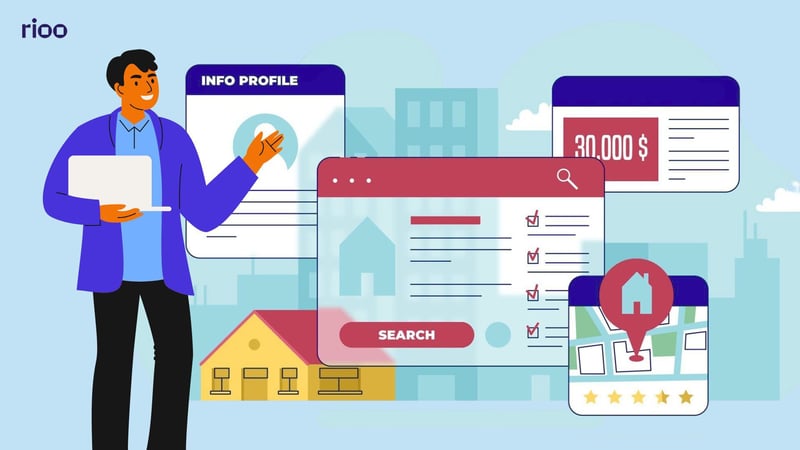
The U.S. property management market hit $134.2 billion in 2025 and is projected to reach $136.9 billion in 2026 . Yet underneath that growth, residential operators face a painful reality. Spreadsheets breed errors, standalone PM apps create data silos, and financial reporting becomes a monthly nightmare as portfolios scale.
That is where NetSuite changes the equation. In this guide, we cover how NetSuite, customized through solutions like RIOO's property management platform, transforms multifamily, apartment, and single-family operations into a streamlined, data-driven business for 2026 and beyond.
Why Residential Property Managers Face a Growing Technology Gap
Residential property management represents over 84% of total U.S. property management revenue. The scale is massive, with nearly 20 million rental properties containing 49.5 million units. Yet the technology serving these operators remains fragmented.
Most operators start with lightweight PM apps that handle basics. But past 50 to 100 units, the cracks appear fast.
-
Financial reporting lives separately:
Your PM app tracks rent rolls while accounting lives in QuickBooks. Monthly reconciliation introduces errors and audit risk. -
Maintenance costs are invisible:
Work order tools don't tie vendor costs to unit-level P&L or capital planning. And with repair and maintenance accounting for 33.5% of total PM revenue share in 2024 ,that's a huge blind spot. -
Scaling multiplies tools, not capability:
Every new property means another login, another export, another manual integration. -
Compliance tracking is manual:
Section 8 vouchers, rent control ordinances, HUD reporting: lightweight apps weren't built for this complexity.
The gap isn't between "no software" and "some software." It's between point solutions handling fragments and an integrated ERP running your entire operation from one database.
Why Multifamily Operators Outgrow Buildium, AppFolio, and Yardi Breeze
The Portfolio Complexity Threshold
Buildium and AppFolio were built for operators managing under 250 units with standardized leases. The 2026 multifamily landscape demands far more. In 2025 alone, 590,000 new apartments were delivered and 519,000 were absorbed ,making it the third-best absorption year of the past decade. Operators navigating this volume need enterprise-grade systems, not lightweight tools.
The specific breaking points:
Lightweight PM Apps vs. NetSuite ERP: Feature Comparison
| Capability | Buildium / AppFolio / Yardi Breeze | NetSuite + RIOO |
|---|---|---|
| Financial Reporting | Basic property-level P&L; no multi-entity consolidation | GAAP-compliant financials with fund-level, entity-level, and portfolio-wide reporting |
| Accounting Integration | Requires QuickBooks or Xero sync | Native general ledger, AP/AR, and bank reconciliation built in |
| Vendor Management | Simple work order list with notes field | Full procurement: POs, vendor scorecards, insurance tracking, competitive bidding |
| Portfolio Analytics | Property-by-property reports only | Cross-portfolio KPI dashboards: NOI per unit, occupancy trending, turnover by market |
| Lease Automation | Basic renewal reminders | Automated lifecycle: escalations, renewal offers, market rent comparisons, clause libraries |
| Section 8 / Affordable Housing | Limited or no support | Split payments, income recertification, HUD reporting, rent reasonableness documentation |
| API and Integrations | Restricted APIs, limited third-party connections | Open REST APIs, 600+ pre-built integrations, custom SuiteScript extensibility |
| Scalability | Designed for under 250 units | Scales from 50 to 5,000+ units with no platform migration |
Core NetSuite Capabilities: Unit Management, Tenant Onboarding, and Lease Automation
Hierarchical Unit Management
NetSuite models your entire portfolio in a hierarchy: Portfolio > Property > Building > Floor > Unit > Lease > Tenant. Every level carries its own financials, maintenance history, and compliance data. Pull a P&L for a single unit or the entire portfolio instantly, with zero manual consolidation.
This matters more than ever in 2026. The growing bifurcation between high-supply and supply-constrained metros means operators need granular, market-level analytics to make informed decisions across diverse portfolios.
Automated Tenant Onboarding
The moment a lease is signed, NetSuite triggers an automated sequence: tenant record creation linked to the correct unit and entity, move-in inspection checklists, state-compliant security deposit escrow entries, recurring rent charge scheduling (including concessions and Section 8 splits), tenant portal access provisioning, and utility transfer reminders.
This sequence, typically 2 to 4 hours of manual work per tenant, executes automatically. Across 100 annual move-ins, that's 200 to 400 hours recovered. The RIOO tenant management solution extends this with pre-built templates for market-rate, affordable, student, and senior housing.
Lease Lifecycle Automation
NetSuite handles full lease lifecycle management: creation with unit-linked terms and clause libraries, automated renewal workflows triggering at 90/60/30 days with market rent comparisons, rent escalation execution based on CPI or fixed percentages, and lease abstraction making every key term searchable across the portfolio.
Automated Rent Collection and Delinquency Management
Configurable Payment Processing
NetSuite supports ACH, credit card, and portal payments, all auto-reconciling against tenant ledgers. For mixed portfolios, it handles market-rate autopay, Section 8 split payments (HAP + tenant portion), and custom payment plans simultaneously.
This is critical in 2026's market. National average asking rents reached $1,741 in January 2026, with performance varying dramatically by region. Chicago led annual rent growth at 3.6%, followed by New York City at 3.3% , while Sun Belt metros with oversupply lagged. Operators need systems that handle this complexity automatically.
Intelligent Delinquency Workflows
When rent is past due, NetSuite initiates automated escalation:
Day 1 courtesy reminder, Day 5 late fee assessment per lease terms and state law, Day 10 second notice with manager notification, Day 15 pre-eviction notice template generated, Day 30+ collections escalation with full documentation. Every step is logged and time-stamped for legal compliance, which is essential in strict jurisdictions like California, New York, and New Jersey.
Maintenance Request Workflows and Vendor Dispatch
From Request to Resolution
The NetSuite workflow: tenant submits via portal with photos, then automatic triage by category and urgency, then vendor assignment checking availability and insurance status, then PO generation within spending limits, then work completion with tenant confirmation, then three-way invoice matching (request, PO, invoice), and finally cost allocation to correct unit, property, and GL account.
For scattered-site single-family operators, this provides centralized oversight without local staff in every market. The RIOO maintenance module adds preventive maintenance scheduling, make-ready checklists, and CapEx vs. repair classification.
Section 8 and Subsidized Housing Considerations
The U.S. faces a 600,000-unit apartment shortage created by underbuilding , and affordable housing compliance grows more complex annually. Most PM software treats it as an afterthought. NetSuite handles it natively: split payment processing for HAP and tenant portions with automatic reconciliation, income recertification tracking for LIHTC compliance, rent reasonableness documentation with comparable rent databases, and regulatory reporting for HUD REAC inspections and state housing agencies.
For mixed portfolios with both market-rate and affordable units, managing compliance within the same ERP eliminates parallel spreadsheet systems entirely.
Tenant Portal and Self-Service Features
Digital expectations are non-negotiable in 2026. 81% of property managers report a positive outlook for 2026, and 77% expect to increase their unit counts. But scaling requires reducing manual touchpoints with tenants.
NetSuite's portal provides: online rent payment with autopay and downloadable receipts, maintenance requests with photo upload and real-time tracking, lease document access, communication history, and community announcements. Most operators see a 40 to 60% reduction in inbound calls and emails, which is staff time that gets redirected to lease renewals and investor relations.
The AI Advantage: Why ERP Matters More in 2026
This is the defining shift of 2026. AI adoption among property managers surged from 21% in 2024 to 34% in 2025 , and the gap between adopters and non-adopters is widening fast.
The numbers are striking: firms that have broadly adopted AI expect average portfolio growth of 31% in 2026, nearly triple the 12% growth anticipated by those yet to implement the technology . Meanwhile, 77% of operators using AI report moderate to significant reductions in operating expenses.
Lightweight PM apps are scrambling to bolt on AI features, but 78% of survey respondents report they cannot yet rely on AI features in their legacy property management software . NetSuite's open architecture and API ecosystem allow operators to integrate best-of-breed AI tools, from predictive maintenance to automated leasing, without being locked into a single vendor's limited capabilities.
The RIOO platform leverages NetSuite's infrastructure to deliver AI-powered workflows specifically designed for residential operators managing at scale.
Scaling from 50 to 500+ Units on NetSuite
The Growth Phases
-
50 to 150 units (Foundation): Standardized workflows replace the spreadsheet patchwork. RIOO's implementation framework accelerates setup from months to weeks.
-
150 to 300 units (Optimization): Advanced procurement, preventive maintenance scheduling, portfolio dashboards, and investor reporting packages.
-
300 to 500+ units (Enterprise): Multi-entity consolidation, role-based access for regional teams, institutional API integrations, and audit-ready compliance.
The critical advantage is continuity. No migrations. No lost data. Compare this with operators who start on Buildium, outgrow it, migrate to Yardi, then face another migration, each costing $50K to $200K and months of disruption.
Residential KPI Dashboards: Occupancy, Turnover, and NOI Per Unit
The 2026 market demands data-driven management. National multifamily occupancy averaged 94.7% in 2025 , but performance varied dramatically by market and asset class.
High-performing operators track these KPIs in NetSuite:
Occupancy and Leasing: Physical and economic occupancy, average days to lease, renewal rate. Financial: NOI per unit, operating expense ratio, rent collection rate, delinquency aging. Maintenance: Cost per unit per year, work order completion time, vendor cost variance. Retention: Turnover rate, average tenant tenure, move-out reason categorization.
In 2025, 43% of property managers were concerned about maintaining high occupancy rates, up from 35% in 2024 . Real-time dashboards aren't a luxury anymore. They're the dividing line between operators who grow and operators who stagnate.
FAQ: NetSuite for Residential Property Management
Can NetSuite manage residential properties?
Yes. NetSuite is a full ERP configurable for multifamily, single-family, student, senior, and affordable housing. Extended through RIOO , it handles unit management, tenant onboarding, lease automation, rent collection, maintenance, and financial reporting in one integrated platform.
What makes NetSuite better than Buildium or AppFolio for larger portfolios?
Enterprise-grade financial consolidation, advanced vendor management, portfolio-level analytics, and deep API integrations. These are capabilities that lightweight PM apps lack. NetSuite scales from 50 to 5,000+ units without platform migration.
How does NetSuite handle tenant onboarding?
Fully automated. Lease signing triggers tenant record creation, move-in checklists, deposit processing, rent scheduling, portal access, and utility transfer reminders, reducing manual onboarding from 2 to 4 hours to near zero per tenant.
Can NetSuite handle Section 8 housing?
Yes. Split payment processing, income recertification tracking, rent reasonableness documentation, and HUD regulatory reporting are all supported natively.
What is the best ERP for residential landlords managing 100+ units?
NetSuite with RIOO is the leading option, combining property management with true enterprise accounting, reporting, and scalability on a single platform that grows with your portfolio.
Take Control of Your Residential Portfolio
The 2026 residential market is defined by supply tapering, improving rent growth, and tighter occupancy conditions . Operators who have the data to act on these shifts will outperform those still managing by spreadsheet.
Schedule a demo with RIOO to see NetSuite residential property management in action.
Explore our complete NetSuite Property Management Guide


.svg)
.svg)


.svg)