










Walk into any commercial lease negotiation today and there's a fair chance the word "abatement" will come up within the first thirty minutes. Free rent periods, partial rent concessions, stepped rent structures - these are standard tools in the leasing toolkit, especially when markets soften or when landlords are competing hard for anchor tenants.
But here's where many property teams run into trouble: the conversation that happens in the leasing room and the accounting entries that follow in the back office don't always speak the same language.
A leasing manager agrees to give a new tenant three months free on a five-year lease. The tenant moves in, pays nothing for ninety days, and then starts paying full rent. From the outside, that looks simple. From an accounting standpoint, however, that transaction needs to be spread carefully across the full lease term, tracked systematically, and reconciled month after month.
Get it wrong, and your financial statements misrepresent actual rental income. Get it right, and you have a clean, auditable paper trail that reflects the economic reality of the lease from day one.
This guide walks through the full picture - the accounting principles, the scheduling logic, the operational workflows, and the common traps - so your team can handle free rent periods and rent abatements with confidence.
What Are Free Rent Periods and Rent Abatements?
Before getting into the accounting treatment, it helps to be precise about definitions, because these terms are sometimes used interchangeably even when they describe different arrangements.
Free rent period refers to a block of time at the beginning (or occasionally middle) of a lease during which the tenant pays no rent at all. This is one of the most common lease concessions offered during tenant acquisition, particularly in commercial and industrial properties where fit-out time is significant. The tenant might spend the first six weeks building out the space before it's even usable, and the landlord agrees to waive rent during that window.
Rent abatement is a broader term. It can refer to a complete rent waiver (as above), or to a partial reduction -for instance, a tenant paying 50% of the contracted rent for the first four months. Abatements are also sometimes triggered by specific events during a lease, such as major building damage, failure of landlord-controlled utilities, or a global disruption (as many landlords encountered between 2020 and 2022).
Rent concession is the umbrella category. It includes free periods, abatements, reduced-rate periods, and any other negotiated deviation from the contracted rent schedule.
Each of these requires the same fundamental accounting discipline: the total economic value of the lease must be recognised evenly over the lease term, regardless of when cash actually changes hands.
The Core Accounting Principle: Straight-Line Rent Recognition
Under both US GAAP and IFRS, the governing principle for lease income recognition is straightforward in theory: rental income should be recognised on a straight-line basis over the lease term unless another systematic and rational basis better represents the time pattern in which the benefit is derived.
In practice, this means that even if a tenant pays nothing for the first three months and then full rent for the remaining fifty-seven months of a five-year lease, you do not record zero income for those first three months and elevated income thereafter. Instead, you calculate the total contractual rent over the lease term, divide it evenly, and recognise that average amount every single month.
For reference on how IFRS handles lease accounting obligations at a standard level, the IFRS Foundation's published guidance on IFRS 16 is the authoritative source.
A practical example:
Suppose a tenant signs a five-year commercial lease (60 months) at $10,000 per month, with three months free at the start.
Total contractual rent = 57 months × $10,000 = $570,000 Monthly straight-line rent = $570,000 ÷ 60 months = $9,500 per month
Every month, your income statement reflects $9,500 in rental income - including the first three months when no cash is collected. The difference between what's recognised and what's received creates a balance sheet entry.
The Balance Sheet: Straight-Line Rent Receivable
The straight-line calculation creates timing differences between income recognition and cash collection. These differences land on the balance sheet as a straight-line rent receivable (often referred to in practice as deferred rent receivable - terminology that carried over from the pre-ASC 842 era and remains widely used in the property management industry).
During the free rent period:
You're recognising $9,500 in income but collecting $0. The uncollected portion ($9,500 per month) accumulates as a straight-line rent receivable on the asset side of your balance sheet. This represents the economic benefit you've earned but not yet received in cash.
After the free period ends:
Once the tenant starts paying $10,000 per month, you're collecting $500 more per month than you're recognising as income ($10,000 collected minus $9,500 recognised). That $500 per month gradually reduces the straight-line rent receivable balance until it reaches zero by the end of the lease term.
In standard commercial lease structures - where rent is flat or modestly escalating - the receivable builds during the concession window and unwinds cleanly over the remaining term. In unusual back-loaded rent structures, where contracted rent steps up significantly in later years, a lessor-side deferred rent liability can technically arise, but this is not typical in the majority of commercial leases.
The key discipline is tracking this balance accurately on a lease-by-lease basis. At the portfolio level, the aggregate of these receivable positions gives you a true picture of your rental income profile - something that raw cash collections can never fully reveal.
Rent Abatement vs. Lease Incentive: Knowing the Difference Matters
This is a nuance worth pausing on because it affects how some concessions are categorised and recorded.
A rent abatement that forms part of the baseline lease structure - agreed upfront, built into the rent schedule - is generally treated as part of the total lease consideration. It flows through the straight-line calculation as described above.
A lease incentive, on the other hand, is something provided by the landlord in addition to rent concessions - for example, a tenant improvement allowance where the landlord funds the fit-out of the space. Under ASC 842 and IFRS 16, lease incentives paid by the landlord reduce the right-of-use asset on the tenant's books and the initial direct cost or lease income on the landlord's side.
In practice, many leases bundle both: three months free rent plus a $50,000 tenant improvement allowance. These need to be separated in your accounting, treated under their respective accounting frameworks, and tracked independently over the lease term.
If you're not already thinking about how this interacts with your security deposit accounting, it's worth reading How to Manage Security Deposit Accounting: Intake, Holding, and Reconciliation - another area where the line between collections and accounting entries creates frequent confusion in property management operations.
Building a Rent Abatement Schedule: Step by Step
A rent abatement schedule is the operational document that translates the legal lease terms into a month-by-month accounting and collection roadmap. Every commercial lease with any form of concession should have one. Here's how to build it properly.
Step 1: Extract the complete rent structure from the lease
Pull every rent-related clause: the commencement date, any free rent window, the base rent amount, escalation clauses (fixed percentage or CPI-linked), any partial abatement periods, and the lease expiry date. Don't rely on a summary - go to the executed lease document.
Step 2: Calculate total contractual rent
Add up the total rent that will be due over the full lease term, factoring in all escalations and excluding abated periods. This is your numerator for the straight-line calculation.
Step 3: Determine the straight-line monthly amount
Divide total contractual rent by the total number of months in the lease term. This is the amount you'll recognise as income each month, regardless of cash.
Step 4: Build the month-by-month schedule
Create a table with columns for: lease month, contractual rent due, straight-line rent recognised, cash collected, and the running straight-line rent receivable balance. During abated months, the receivable balance grows. During above-average collection months, it shrinks.
Step 5: Flag the crossover point
Identify the month when cash collections first exceed straight-line income recognition. This is where your receivable balance starts to unwind. Understanding this crossover point is important for cash flow forecasting.
Step 6: Reconcile quarterly
The schedule is a living document. Lease amendments, early terminations, or unexpected abatements triggered by events must be reflected immediately. Build a quarterly review into your accounting calendar.
Rent Abatements Triggered by Events (Mid-Lease Abatements)
Most of what we've covered so far deals with planned concessions negotiated at lease signing. But property managers also face situations where abatements arise mid-lease - often triggered by events outside anyone's control.
Common triggers include:
-
Significant property damage that renders part or all of the space unusable
-
Failure of critical landlord-controlled systems (HVAC, elevators, utilities)
-
Government-mandated closures that prevent a tenant from operating
-
Force majeure provisions in the lease
From an accounting standpoint, event-triggered abatements need to be assessed differently. If the abatement is likely to occur and can be estimated, it should be accrued. If it's uncertain, disclosure may be required before it's formally recorded.
The operational challenge is that these situations tend to unfold quickly and under pressure. Having a documented process for how your team assesses, approves, and records an emergency abatement - including who has sign-off authority and what documentation is required - is the difference between a clean audit trail and an accounting headache months later.
Operational Scheduling: Keeping Cash Collections Aligned with Accounting
One of the most common practical problems in managing free rent and abatements is that the property management team and the accounting team can fall out of sync. The lease operations side knows a tenant has two months free; the accounts receivable system doesn't know - and generates invoices anyway.
The solution is integration between your lease management records and your billing and collections workflows.
Concretely, this means:
Lease commencement checklists should include a mandatory step to configure the rent schedule in your property management system before the tenant's first billing cycle. The system should automatically suppress invoices during abated periods rather than requiring manual intervention month by month.
Straight-line rent receivable schedules should be uploaded or entered into your accounting system at lease inception, not created retroactively when an auditor asks for them.
Rent roll reports should clearly distinguish between contractual rent, abated rent, and straight-line rent for each active lease. If your rent roll only shows cash collected, you're missing the full picture.
Tenant statements should reflect the agreed rent schedule accurately. Sending an invoice for a period that was contractually free creates unnecessary friction and erodes trust - especially during the early months of a new tenancy when the relationship is still forming.
This is also worth connecting to how you manage the broader rent collection and payment reconciliation workflow. How to Automate Rent Collection: From Invoice Generation to Payment Reconciliation covers the mechanics of building an automated collection cycle - and many of the same principles apply when you're managing complex schedules with concession periods.
Common Mistakes Property Managers Make (and How to Avoid Them)
Even experienced teams trip over the same issues repeatedly. Here are the most frequent errors in rent abatement management:
Recording free rent periods as income gaps rather than averaging them. This leads to income statements that show zero revenue in early months and elevated revenue later - misrepresenting the actual economics of the lease and inflating perceived revenue growth.
Failing to create the straight-line rent schedule at lease inception. When a team skips this step, they often end up trying to reconstruct it later - sometimes years into the lease - which is both time-consuming and prone to error.
Not updating the schedule after lease amendments. If a tenant exercises an option to extend, if rent escalations are renegotiated, or if an abatement is granted mid-lease, the straight-line calculation changes. The schedule must be updated immediately.
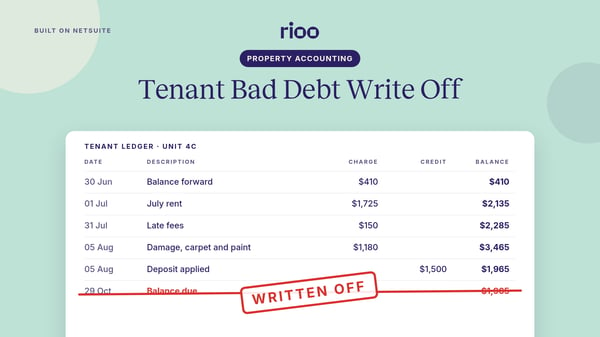
Confusing abatement with bad debt. An abatement is a contractually agreed concession. Bad debt is uncollected rent that the tenant was legally obligated to pay. These belong in different accounts and reflect entirely different operational situations.
Treating all abatements the same regardless of structure. A full three-month free period at the start of a lease is not the same as a 20% reduction spread across six months, even if the total dollar value is identical. The scheduling and accounting treatment differs, and the straight-line impact differs too.
Technology and Automation: Where Manual Processes Break Down
Managing one or two leases with concession periods is something an experienced accountant can handle with a spreadsheet. Managing twenty, fifty, or two hundred leases across a portfolio is a different exercise entirely.
Manual schedules create version control risks. When multiple team members are updating rent schedules and sharing them over email, outdated versions persist, discrepancies multiply, and audit readiness becomes a recurring crisis rather than a steady state.
Portfolio-level straight-line rent calculations - aggregating receivable balances, tracking the crossover points across dozens of leases, reconciling to the general ledger each period - require systematic automation to be done accurately and efficiently.
This is one of the areas where purpose-built property management and accounting platforms make a measurable operational difference. When your accounting system understands the lease the way your leasing team does, the gap between operations and finance closes significantly.
For portfolios managing both the lease operations and the financial accounting side of abatements, having these functions connected - rather than maintained in parallel silos - is increasingly a baseline operational requirement, not a nice-to-have.
Documentation and Audit Readiness
Rent abatements, handled well, should be completely transparent to an auditor. Handled poorly, they become a source of qualification findings and restatements.
What good documentation looks like:
-
At lease signing:
A copy of the executed lease, a lease abstract highlighting concession terms, the completed rent abatement schedule, and an accounting entry memo documenting how the straight-line calculation was derived. -
Monthly:
Journal entries recording straight-line rent income and the movement in the straight-line rent receivable balance, with reference back to the originating lease and schedule. -
At lease events (amendments, renewals, early exits):
Updated schedules, revised accounting memos, and clear documentation of what changed and why. -
Annually:
A reconciliation of the straight-line rent receivable balance by lease, tied to the balance sheet, with explanations for any material movements.
If your team can produce this package for any active lease within a few hours of being asked, your documentation practices are in good shape. If it would take days of reconstruction, that's the signal to tighten the process.
Free Rent and Abatements in the Context of CAM and Service Charges
One area that doesn't always get enough attention is the interaction between rent abatements and other lease charges - particularly CAM (common area maintenance) fees and service charges.
Free rent periods sometimes apply to base rent only, with the tenant still obligated to pay CAM, insurance, and property tax contributions throughout the abated period. In other cases, the entire occupancy cost is waived. The lease will specify this, but it's easy to configure billing incorrectly if the person setting up the schedule doesn't read the clause carefully.
This also matters for straight-line calculations. If CAM is excluded from the abatement, it should not be factored into the straight-line rent calculation - it continues to be recognised and billed on its actual amount. Mixing the two creates category errors in both your income statement and your tenant ledger.
For a deeper look at the downstream reconciliation challenges this creates, How to Manage CAM Reconciliation Disputes: Process, Documentation, and Tenant Communication is a useful companion to this piece.
A Note on ASC 842 and IFRS 16 for Landlords
Most of the conversation around ASC 842 and IFRS 16 focuses on the lessee - the tenant who now must capitalise operating leases on their balance sheet. But these standards have implications for lessors (landlords) as well, particularly around how lease incentives are classified and how variable rent components are treated.
Under ASC 842 (the US GAAP standard for leases), landlords classify leases as either operating or sales-type/direct finance leases. For operating leases - which cover the majority of standard commercial property arrangements - the straight-line recognition principle continues to apply. Lease incentives paid by the landlord are generally treated as a reduction in lease income, recognised on a straight-line basis over the lease term.
Under IFRS 16, lessor accounting was largely retained from the existing model under IAS 17 - the IASB deliberately preserved the lessor accounting framework while focusing the major changes on lessee treatment. The straight-line income recognition requirement for operating leases therefore continues unchanged from what IAS 17 established.
The practical implication for property managers: regardless of which framework applies to your organisation, the core discipline is the same. The complexity is in execution, not in principle.
Frequently Asked Questions
Q1. What is the difference between a free rent period and a rent abatement?
A free rent period is a specific timeframe- usually at the start of a lease- during which the tenant pays no base rent. It is typically offered as a leasing incentive or to allow time for space fit-out. A rent abatement is a broader term that includes full rent waivers, partial rent reductions, or concessions triggered by events during the lease, such as property damage or service disruptions.
Q2. Do I still need to record rental income during a free rent period even though no cash is collected?
Yes. Under US GAAP (ASC 842) and IFRS, rental income must be recognized on a straight-line basis over the full lease term. This means income is recorded each month even during free rent periods. The difference between income recognized and cash collected is recorded as a straight-line rent receivable on the balance sheet.
Q3. What happens to the straight-line rent receivable balance once the free period ends?
After the free rent period, the tenant begins paying the contracted rent, which is typically higher than the straight-line monthly average. The extra cash collected each month gradually reduces the straight-line rent receivable balance until it reaches zero by the end of the lease term.
Q4. How should a mid-lease rent abatement (triggered by an event like property damage) be recorded differently from a planned concession?
A concession agreed at lease signing is included in the original straight-line rent calculation. A mid-lease abatement, triggered by events such as property damage, must be evaluated separately. When the concession becomes probable and reasonably estimable, its financial impact should be recognized and properly documented in the accounting records.
Q5. Does a free rent period apply to CAM charges and service fees as well, or just base rent?
Not always. Many leases waive base rent only, while tenants still pay CAM, insurance, and property tax contributions during the free rent period. Always review the lease terms carefully to ensure billing is configured correctly.
Q6. How often should rent abatement schedules be reviewed and updated?
Rent abatement schedules should be reviewed at least quarterly and whenever a lease event occurs, such as amendments, rent renegotiations, tenant options, or early terminations. Any change to the lease structure can affect the straight-line rent calculation.
Q7. What documentation should a property manager maintain for rent abatements to stay audit-ready?
To stay audit-ready, property managers should maintain:
- The executed lease and amendments
- The rent abatement schedule
- Monthly journal entries showing income recognition and receivable movements
- An annual reconciliation of the straight-line rent receivable balance.
Conclusion
Free rent periods and rent abatements are tools that make commercial leasing work. They attract tenants, close deals, and build long-term occupancy. But they carry a genuine accounting obligation that doesn't disappear just because no cash is changing hands.
The property managers and finance teams that handle this well share a few common traits. They treat the rent schedule as a financial document, not just an operational one. They build straight-line rent receivable tracking into their standard processes from day one, not as an afterthought. They ensure their systems are configured to reflect the real structure of the lease - including every concession, escalation, and exception.
And they recognise that as portfolios grow, the manual approach stops working. The volume of leases, the variety of concession structures, and the frequency of amendments make systematic, technology-supported management not just more efficient but genuinely more accurate.
When your lease records, your billing system, and your general ledger all speak the same language - from lease inception through the full term - free rent periods stop being an accounting headache and become exactly what they should be: a well-understood, clearly reported element of your leasing strategy.
Explore how RIOO helps property teams manage lease accounting, rent scheduling, and financial reporting across complex portfolios: riooapp.com