








You don’t notice financial issues in a property portfolio all at once. They build quietly, one delayed rent payment, one missed invoice, one report that feels slightly off but gets pushed to later.
By the time you pause to look closely, the numbers aren’t telling a clear story anymore.
Managing properties across the US, UK, Canada, Australia, Singapore, or the UAE comes with a long list of responsibilities. But ask any experienced property manager what creates the most stress, and it usually comes down to finances, because that’s where small gaps turn into real losses.
Late rent payments. Unexpected maintenance costs. Vendor invoices are piling up. Month-end reports that don’t fully add up. It’s a lot to stay on top of, especially when your portfolio spans dozens or hundreds of units across different property types.
Strong property financial management isn’t just about tracking numbers. It’s about having the visibility, control, and systems to make confident decisions every single day. That’s where a property management platform makes a real difference.
Key Takeaways
- Fragmented financial tracking is one of the biggest killers of profitability in property management, and fixing it starts with centralizing your data.
- Cash flow management requires consistent rent collection, proactive expense tracking, and regular financial reconciliation.
- Preventive maintenance budgeting reduces surprise costs and helps protect long-term asset value.
- Real-time financial reporting across your portfolio gives you the clarity to act fast and plan ahead, not just react.
- Integrated platforms that connect leasing, accounting, facility management, and vendor payments eliminate data silos and manual work.
The Real Financial Challenges Property Managers Face Today
By mid-morning, you already have too much on your plate.
You’re managing 300 units across apartments, offices, and a retail space. A few vendor invoices need approval. A tenant is following up on a maintenance request from two weeks ago. An owner is expecting a financial report today. And your rent data is still sitting in a spreadsheet that hasn’t been updated.
This is a normal day for many property managers.
The issue isn’t just the number of tasks. It’s how everything is connected. When rent data isn’t up to date, your cash flow view is unclear. When maintenance is delayed, it leads to more follow-ups. Vendor payments, reports, and daily operations are all starting to overlap.
It becomes harder when you’re handling different types of properties. Each one has its own lease terms, costs, and reporting needs. Keeping everything organized and accurate at the same time is not easy, and that’s why property finance management often turns into a real challenge.
Related reading: USA Property Managers: Real Estate Reporting Simplified
The Problem with Fragmented Systems
Most property management companies don't fail because of poor intentions. They fail because their financial data lives in too many places.
Accounting in one tool. Lease data in another. Maintenance costs are tracked manually. Vendor payments are handled through email. When no single source of truth exists, errors multiply. Reports take hours instead of minutes. And by the time you spot a cash flow issue, it's already a problem.
Inconsistent practices, like variations in how expenses are recorded or reports are generated, can lead to errors and inefficiencies. Standardizing financial workflows isn't a luxury. For a growing portfolio, it's a necessity.
Manual Processes Are a Hidden Cost
Every hour your team spends manually entering data, chasing rent, or reconciling accounts is an hour not spent on decisions that grow your portfolio. Labor represents the biggest expense in property management, and wages for professionals increased steadily through 2024, making operational efficiency more financially critical than ever.
The fix isn't just working harder. It's working with better systems.
Must Read: Essential Guide to Property Management Accounting Basics
7 Core Principles of Strong Property Financial Management
Before jumping to tools and software, it's worth getting clear on the fundamentals. These are the financial practices that consistently separate well-run portfolios from the ones constantly playing catch-up.
1. Separate Your Finances by Property
This sounds basic, but it's one of the most common mistakes property managers make, especially when scaling quickly. Mixing income and expenses across properties makes it nearly impossible to evaluate individual performance.
Maintaining a record of every financial transaction related to the property helps identify opportunities to reduce costs and ensures accurate reporting for tax purposes. It is good to keep property management finances distinct from personal ones.
Each property in your portfolio should have its own income and expense tracking. That way, you know exactly which properties are performing and which ones need attention.
2. Track Every Revenue Stream
Rent is obvious. But many property managers leave money on the table by failing to consistently track supplementary income, including late fees, parking charges, pet fees, utility reimbursements, and amenity fees.
Recording these fees consistently ensures that all revenue streams are captured, contributing to a more complete understanding of the property's profitability.
A complete picture of revenue helps with accurate forecasting and prevents financial surprises at year-end.
3. Build a Predictable Maintenance Budget
Reactive maintenance is expensive. The average cost of property maintenance is about 1% of the property's value per year, but that number can spike significantly if preventive measures aren't in place.
Plan your maintenance budget annually. Include routine inspections, seasonal servicing, and a contingency reserve for unexpected repairs. Properties with documented maintenance schedules tend to hold their value better and generate fewer emergency costs.
4. Reconcile Accounts Regularly
Diligent recording and reconciliation of all financial transactions safeguards against discrepancies and ensures the integrity of financial records.
Monthly reconciliation is a minimum. For larger portfolios with multiple properties and vendors, weekly reconciliation is worth the time investment. Catching errors early prevents cascading issues that are much harder to fix at the end of a quarter.
5. Standardize Your Chart of Accounts
Develop a detailed chart of accounts tailored to your property type, categorizing income and expenses clearly to facilitate reporting and analysis.
Consistent categorization across all your properties makes financial comparisons meaningful. It also simplifies tax preparation and makes audits far less painful.
6. Use Cash Flow Statements, Not Just P&L
Many property managers focus only on profit and loss. But a property can show accounting profit while still having cash flow problems, particularly when large maintenance invoices or capital expenses hit at the wrong time.
Financial health requires clear visibility into cash flow, rental income, and future expenses. A cash flow statement gives you a more accurate picture of what money is actually moving in and out each month.
7. Monitor Your Vacancy and Turnover Costs
The average cost of tenant turnover is about $1,750. Multiply that across a large portfolio, and high turnover becomes one of your biggest financial risks.
Track your vacancy rate and average days-to-lease across each property. Longer-than-average vacancies signal a pricing, marketing, or screening issue that has direct financial consequences. Retention efforts, whether better communication, faster maintenance resolution, or lease renewal incentives, are almost always cheaper than re-leasing a unit.
Also Read: A Complete Guide to Property Management Financial Statements
Rent Collection: The Foundation of Property Cash Flow
Central to property management, efficient collection of rent payments and meticulous lease tracking ensure a steady cash flow and minimize vacancies.
Late rent is more than an inconvenience. It disrupts your ability to pay vendors, fund maintenance, and report accurate income to property owners. A few practices that make a real difference:
- Set clear expectations up front: Your lease should spell out due dates, grace periods, accepted payment methods, and late-fee policies.
- Offer digital payment options: Tenants who can pay online pay on time more consistently. It removes friction from the process.
- Send payment reminders: A simple reminder three days before the due date reduces late payments significantly without requiring any confrontation.
- Enforce late fees consistently: If you waive fees selectively, tenants will test the policy repeatedly.
Consistent rent collection isn't about being hard on tenants. It's about creating a system everyone understands and follows.
Also Read: The Impact of Property Management Software on Rental Efficiency
Vendor and Accounts Payable Management
Vendor relationships are a significant part of property financial management that often goes unstructured. Many property managers still rely on manual systems that can complicate finances.
Here's what structured vendor management looks like in practice:
- Centralize your vendor records: Keep contact details, contract terms, and payment histories in one place.
- Verify invoices before approval: Match every invoice against a work order or service agreement. Billing errors are more common than most managers expect.
- Track payment timelines: Paying vendors late damages relationships and can delay future service. Paying early when discounts are offered improves your cost position.
- Review vendor performance: Regularly evaluate whether your vendors are delivering value. High maintenance costs from underperforming contractors are a hidden drain on profitability.
Efficient accounts payable management is crucial for the smooth operation of property management businesses. As property managers handle increasing volumes of invoices, recurring expenses, and vendor relationships, timely and accurate AP processes matter.
Also Read: What to Look for in a Leasing Management Platform (That Actually Works)
Financial Reporting That Actually Tells You Something
A financial report is only useful if it answers the questions you're actually asking. For property managers, the most important questions are:
- Which properties are most profitable right now?
- Where are costs rising faster than expected?
- Are we on track against our annual budget?
- What does cash flow look like over the next 90 days?
A property management financial report is a structured document that summarizes a property's financial activities over a specific period. It records key financial data, including income, expenses, cash flow, and profitability, helping stakeholders understand the property's overall financial standing.
The reports that matter most:
|
Report |
What It Tells You |
|
Income Statement |
Revenue vs. expenses per property |
|
Cash Flow Statement |
Actual cash in and out each period |
|
Rent Roll |
Tenancy status and income potential |
|
Accounts Payable Summary |
Outstanding vendor obligations |
|
Budget vs. Actual |
Variance from your financial plan |
|
Owner Statement |
Performance summary for property owners |
Robust financial reporting comprising income statements, balance sheets, and cash flow statements provides a transparent overview of the property's financial performance, aiding in strategic planning and investor relations.
Also Read: Understanding Property Management Accounts Payable Basics
Budgeting and Forecasting for a Growing Portfolio
Best practices include setting realistic revenue goals, forecasting expenses, allocating funds for technology and staffing, and regularly monitoring cash flow.
For property managers overseeing large portfolios, budgeting can't be an annual exercise that gets forgotten. It needs to be a living document that you revisit at least quarterly.
A solid property management budget should include:
- Operating expenses by property (maintenance, utilities, insurance, staffing)
- Capital expenditure plan for major repairs or upgrades over the next 1 to 3 years
- Revenue projections based on current occupancy and anticipated renewals
- Contingency reserves for unexpected vacancies, repairs, or legal costs
- Technology and staffing costs that scale with portfolio growth
When budgets are built this way and compared regularly against actuals, you stop being reactive and start being strategic.
See how RIOO's Finance module works for large property portfolios. Book a demo now.
Why Centralized Property Financial Management Outperforms Fragmented Systems
Here's a side-by-side of what life looks like with and without a centralized system:
|
Area |
Without a Centralized Platform |
With RIOO |
|
Rent collection |
Manual follow-ups, missed payments |
Tracked, visible, streamlined |
|
Financial reporting |
Hours of manual compilation |
Real-time, consolidated dashboards |
|
Vendor payments |
Scattered invoices, approval delays |
Centralized AP workflow |
|
Maintenance costs |
Unpredictable, hard to budget |
Tracked per asset, planned proactively |
|
Lease data |
Disconnected from financials |
Integrated with accounting |
|
Portfolio visibility |
Delayed, incomplete |
Live view across all properties |
Technology adoption stands out among the defining property management trends of 2025, with efficiency ranking as property management companies' second-highest priority. The property management companies growing profitably right now are the ones that have invested in systems that give them real-time control, not end-of-month reports.
Also Read: Best Money Management Software for Real Estate Professionals 2025
How RIOO Supports Smarter Property Financial Management
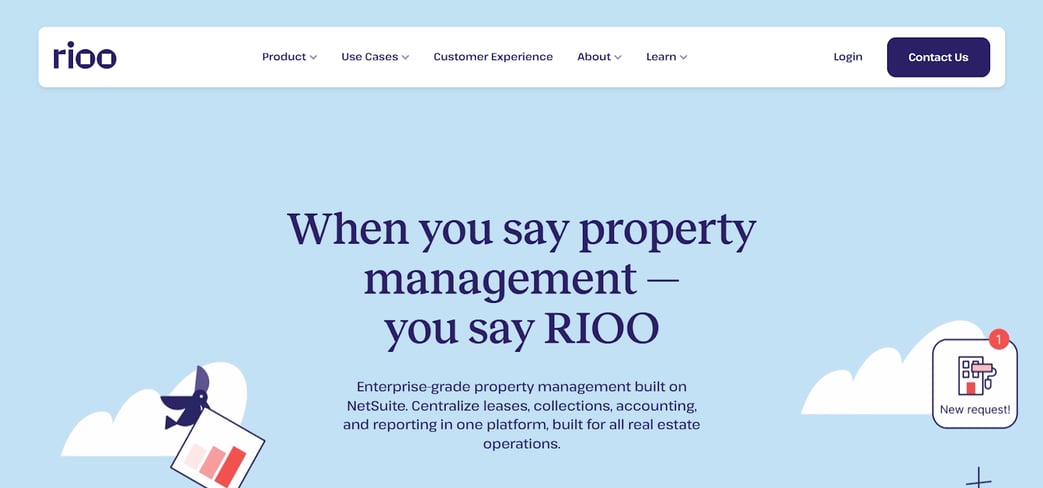
Managing all of this across a portfolio of hundreds or thousands of units, across residential apartments, commercial offices, student housing, retail malls, and industrial spaces, requires more than good habits. It requires the right platform.
RIOO is an all-in-one property management platform built for medium to enterprise-scale property management firms. Here's how it directly addresses the financial management challenges described in this blog.
Finance & Accounting
RIOO’s Finance & Accounting module brings structure to how financial data is captured, tracked, and reported across your portfolio.
For example, when a vendor invoice is submitted, it gets logged, matched to the relevant property or work order, and routed for approval, reducing delays and avoiding duplicate payments.
Similarly, rent collected across multiple properties flows into a single system. Instead of consolidating spreadsheets at month-end, your team already has an up-to-date view of income and expenses.
Income & Expense Management gives you a clearer view of your finances across all your properties, whether you're managing multi-family units in the US or commercial spaces in Singapore or Dubai.
Financial and Operational Expense tracking means knowing what's being spent, where, and why.
Leasing & Sales
Financial health in property management starts with lease management. RIOO's Leasing & Sales module handles everything from lease creation and renewals to move-ins, move-outs, and rent collection. When lease data and financial data live in the same system, the reconciliation headaches disappear.
Facility Management
Maintenance is one of the hardest costs to control because it’s often reactive.
RIOO brings more visibility and structure to this process.
For example, when a tenant raises a service request, it is converted into a trackable work order. That work order can be linked to costs, vendors, and assets. Over time, this helps you identify patterns, like which buildings or assets are driving the highest maintenance spend.
Instead of reacting to breakdowns, your team can plan preventive maintenance and avoid large, unexpected expenses.
Dashboards, Reports & Unified Customer View
RIOO's dashboards and reporting tools give you real-time consolidated financial reporting across your entire portfolio. Instead of pulling data from multiple systems, you have a single, live view of income, expenses, occupancy, and operational performance.
For example, instead of waiting for end-of-month reports, you can check occupancy, income, and expenses in real time and spot issues early, like a sudden dip in collections or a spike in maintenance costs.
The Unified Customer View lets you see the full picture of any tenant-or-owner relationship, including lease history, payment records, and communications, without switching platforms.
Portals & Integrations
A lot of financial friction comes from a lack of clarity and too many manual steps.
RIOO’s Tenant Portal simplifies this.
For example, when tenants have a clear view of their dues, payment history, and upcoming obligations, they are less likely to miss payments or raise disputes. Payments become more consistent without constant follow-ups.
Internally, the Community Manager Portal keeps teams aligned. Instead of chasing updates across emails and calls, everyone works from the same system with up-to-date information.
With over 30 integrations, RIOO also connects with your existing tools. This means financial data doesn’t have to be re-entered or reconciled across systems, reducing errors and saving time.
Also Read: How to Write a Property Management Business Plan That Works
Conclusion: Take Control of Your Property Finances
Strong property financial management is not about complexity. It's about clarity. Clarity on where your money is coming from. Clarity on where it's going. And clarity on what's working and what isn't across every property in your portfolio.
The strategies in this blog, from separating finances by property to building a predictive maintenance budget to using the right financial reports, are proven practices that profitable property managers use consistently. They work for residential portfolios in the UK and Australia, commercial assets in Singapore and Dubai, and mixed-use portfolios across the US and Canada.
But these practices are significantly easier to execute when you have a platform built for the job.
RIOO brings together property management, leasing, facility management, finance and accounting, and tenant communication into one unified platform. For medium to enterprise-scale property management firms managing hundreds or thousands of units, it's built to match the complexity of your operations without adding to it.
Ready to see how RIOO works for your portfolio? Book a demo today and explore how RIOO's Finance & Accounting tools can transform your property financial management.
Frequently Asked Questions
1. What is property financial management?
Property financial management refers to the processes involved in tracking, reporting, and optimizing the income and expenses of a real estate portfolio. It includes rent collection, expense tracking, budgeting, vendor payments, and financial reporting across all managed properties.
2. What financial reports should property managers produce regularly?
The most important reports are the income statement, cash flow statement, rent roll, budget-versus-actual variance report, and accounts payable summary. Together, they provide a clear view of financial performance and support decision-making.
3. How do you improve cash flow in property management?
Consistent rent collection, reducing vacancy periods, controlling maintenance costs through preventive planning, and managing vendor payments in a timely manner are the most direct ways to improve cash flow. Using a centralized platform to track all of these in real time is highly beneficial.
4. What is the biggest financial risk in managing large property portfolios?
High tenant turnover and unplanned maintenance costs are among the biggest financial risks. Both are manageable with the right systems, including strong lease management, tenant screening, and preventive maintenance planning.
5. How does property management software improve financial accuracy?
By centralizing lease data, rent collection, vendor invoices, and expense tracking on a single platform, property management software eliminates manual data entry, reduces errors, and produces real-time, accurate, and consistent financial reports.