










Quick Reference: D.C. Screening Rules at a Glance
|
Item |
Requirement |
Source |
|---|---|---|
|
Two statutes govern |
§ 42-3505.10, "Tenant screening," and Chapter 35B, the Fair Criminal Record Screening for Housing Act |
§§ 42-3505.10, 42-3541.01–.10 |
|
"Tenant screening," defined |
Any process used by a housing provider to evaluate the fitness of a prospective tenant |
§ 42-3505.10(j)(2) |
|
"Adverse action," defined |
Denial of an application, or approval subject to terms or conditions different and less favourable than those in any written notice, statement or advertisement for the unit |
§ 42-3505.10(j)(1) |
|
Pre-screening disclosure |
Before requesting any information or fees, notify the prospective tenant in writing, or by posting in a manner accessible to a prospective tenant, of the items in (a)(1) to (a)(9) |
§ 42-3505.10(a) |
|
Applicability caution |
The Law Library's applicability notes state the creation of subsections (a)(10), (f)(4) and (h) by D.C. Law 24-115 was subject to fiscal-effect inclusion and "has not been implemented" |
§ 42-3505.10, Applicability |
|
Application fee |
No more than $50, adjustable annually from 1 January 2024 by CPI-U. The RHC determined the maximum is $54 for 2026 |
§ 42-3505.10(b)(1), (2); RHC via OTA |
|
No other pre-lease fee |
A provider shall not charge any fee other than an application fee prior to signing a lease |
§ 42-3505.10(b)(3) |
|
Replacement fee |
Where a tenant is permitted to find a replacement, assign or sublet, the outgoing tenant's replacement fee shall not exceed the application fee amount |
§ 42-3505.10(b)(4) |
|
Voucher holding deposits |
A provider shall not require a holding deposit from a prospective tenant using a government-funded housing voucher |
§ 42-3505.10(b)(5) |
|
One fee per 30 days |
Where a prospective tenant applies to further units owned or operated by the same provider within 30 calendar days, charge only one application fee unless more than one screening is required |
§ 42-3505.10(b-1) |
|
Habitability fees barred |
No fee before move-in, during tenancy or after move-out for services required to maintain the accommodation or unit consistent with the implied warranty of habitability and Titles 12 and 14 DCMR, including any fee for services or facilities related to utilities, trash, locks, administrative fees for third-party billing, or other services or facilities required to be provided |
§ 42-3505.10(b-2)(1)(A) |
|
Deposit withholding unaffected |
Nothing prohibits withholding a deposit to replace damaged items where the tenant caused damage beyond ordinary wear and tear as defined in § 42-3502.17(c)(3) |
§ 42-3505.10(b-2)(1)(B) |
|
Refund if no screening |
If the provider fails to conduct a screening for any reason, refund the fee within a reasonable time, not to exceed 14 days |
§ 42-3505.10(c) |
|
Prior possession actions |
No inquiry, required disclosure, or adverse action where the action did not result in a judgment for possession in favour of the housing provider, or was filed 3 or more years ago |
§ 42-3505.10(d)(1) |
|
Lease-breach allegations |
Barred where the alleged breach stemmed from an incident that may constitute a § 42-3505.01(c-1) or federal domestic violence, dating violence, sexual assault or stalking defence; from an incident where the tenant was a victim of a crime in the unit; is related to a disability of the tenant or a household member; or took place 3 or more years ago |
§ 42-3505.10(d)(2) |
|
Credit score |
No adverse action based solely on a credit score or lack thereof, though information within a report directly relevant to fitness as a tenant may be relied on |
§ 42-3505.10(e)(1) |
|
Inadvertent receipt |
Not a violation to receive a report containing prohibited information, provided the provider did not specifically request or inquire about it and can demonstrate no adverse action was based on it |
§ 42-3505.10(e)(2) |
|
Adverse action notice |
Written, no later than the response date given under (a)(7), stating the specific grounds; a free copy or summary of third-party information forming a basis; and the right to dispute accuracy and permissibility |
§ 42-3505.10(f)(1)–(3) |
|
The applicant's reply |
The applicant may submit evidence the information is inaccurate, misattributed, or based on prohibited criteria. The provider shall provide a written response within 10 days |
§ 42-3505.10(g) |
|
Private action |
Civil action in Superior Court within one year, unless an OHR complaint was filed. On success: reasonable attorney's fees and costs, incidental damages, and equitable relief |
§ 42-3505.10(i) |
|
Not Funded |
Subsections (b-3) and (b-4) are marked "Not Funded" |
§ 42-3505.10 |
|
Arrests |
No inquiry or consideration of a previous arrest that did not result in a conviction |
§ 42-3541.02(a) |
|
Conditional offer rule |
Before making a conditional offer, no inquiry about, and no requirement that the applicant disclose, a pending criminal accusation or criminal conviction |
§ 42-3541.02(b)(1) |
|
Authorisation is allowed |
The provider may have the applicant complete and sign paperwork authorising an inquiry or check related to the eligibility criteria |
§ 42-3541.02(b)(2) |
|
Pre-fee criteria disclosure |
Before accepting an application fee, disclose in writing the eligibility criteria, including the financial, employment, criminal, and rental history criteria, and a statement that the applicant may provide evidence of inaccuracies or of rehabilitation or other mitigating factors |
§ 42-3541.02(c)(1) |
|
After the conditional offer |
Only a pending accusation or conviction within the past 7 years for one of 48 listed crimes |
§ 42-3541.02(d) |
|
Withdrawal standard |
Only if the provider determines on balance that withdrawal achieves a substantial, legitimate, nondiscriminatory interest, weighed against six factors |
§ 42-3541.02(e) |
|
Withdrawal notice |
Reasons with specificity, plus notice of the right to complain to the Office of Human Rights |
§ 42-3541.02(f)(1) |
|
20 days, then 10 |
Applicant may request all information relied upon within 20 days; provider supplies it free of charge within 10 days |
§ 42-3541.02(f)(2) |
|
Minors excluded |
No inquiry into an accusation or conviction of an individual under 18 who will reside in the unit |
§ 42-3541.02(g) |
|
Exclusions |
Section 42-3541.03 sets out exclusions from Chapter 35B |
§ 42-3541.03 |
|
Application-stage property disclosures |
A separate package due at the time a prospective tenant files an application |
§ 42-3502.22 |
|
Protected traits |
The Human Rights Act adds traits beyond federal law, including source of income |
§ 2-1402.21 |
A leasing team in Shaw runs a standard application: name, income, employer, references, and a box asking the applicant to disclose any criminal convictions. The $54 fee is taken at submission. Everything is consistent across applicants.
The process presents two immediate compliance problems, and neither turns on the answer to the criminal history question.
A criminal-history question on a pre-conditional-offer application can itself constitute the prohibited inquiry under § 42-3541.02(b)(1), which provides that "before making a conditional offer, a housing provider may not make an inquiry about or require an applicant to disclose or reveal a pending criminal accusation or criminal conviction."
And under § 42-3505.10(a), before requesting any information or fees from a prospective tenant as part of tenant screening, the provider must first notify them of a list of specified items. Taking the fee at submission, without that notice, inverts the required order.
D.C.'s tenant screening rules regulate not only what a provider may consider, but also what must be disclosed before screening begins and what must happen after an adverse decision. The compliance is in the sequence.
Step 1: The Screening Sequence
Two statutes overlap, and each attaches at a different moment.
-
Before requesting any information or fees → the § 42-3505.10(a) pre-screening disclosures.
-
Before accepting the application fee → the § 42-3541.02(c)(1) eligibility criteria and rehabilitation statement.
-
Before a conditional offer → no criminal history inquiry at all, under § 42-3541.02(b)(1).
-
During screening → screen only on criteria that are both disclosed and legally permissible. D.C. separately restricts the use of certain eviction records, lease-breach allegations and credit-score information under § 42-3505.10(d) and (e).
-
After a conditional offer → only qualifying criminal history under § 42-3541.02(d).
-
If withdrawing a conditional offer → the six-factor balancing in § 42-3541.02(e), then the (f)(1) notice.
-
If taking any adverse action → the § 42-3505.10(f) notice by the response date you disclosed.
-
After an adverse action → the § 42-3505.10(g) dispute process, with a 10-day written response.
Because the sequence is the compliance, the application flow itself is the control point rather than the policy document. Ordering the disclosure, the fee, the screen, the offer and the notice as gated steps is what makes the order provable rather than assumed.
Step 2: The Pre-Screening Disclosures Under § 42-3505.10(a)
Section 42-3505.10(a) sets out ten categories of pre-screening information that appear in the statute. However, the D.C. Law Library's current applicability notes state that the creation of subsection (a)(10) has not been implemented, so property managers should distinguish the operative requirements from provisions whose applicability remains pending. That point is developed in Step 9.
Before requesting any information or fees, the provider must notify the prospective tenant in writing, or by posting in a manner accessible to a prospective tenant:
-
The amount and purpose of each fee or deposit, whether mandatory or voluntary, that may be charged to a tenant or prospective tenant, and whether it is refundable;
-
The types of information that will be accessed to conduct a tenant screening;
-
The specific criteria that will result in automatic denial of the application;
-
Any additional criteria that may result in denial;
-
If a credit or consumer report is used, the name and contact information of the agency and a statement of the applicant's right to obtain a free copy in the event of a denial or other adverse action;
-
The approximate quantity of rental units that will be available over a specified period, by bedroom size and monthly rent, or if unavailable, the number that became available each calendar month in the provider's prior fiscal year;
-
The number of days after receipt of the application within which the provider will respond with an approval or denial;
-
The applicant's right to dispute information inaccurately or incorrectly attributed to them, or based on prohibited criteria, and the right to receive a response; and
-
The applicant's right to a refund for any unused application fee.
Item (10), on the right to file a complaint with the Office of Human Rights or pursue civil action in Superior Court, appears in the statute but is covered by the applicability note.
Three items that catch operators out. Item 6 requires inventory data, which most application packs do not contain. Item 7 requires you to commit to a response timeline, and that self-declared date is the deadline for any adverse action notice under subsection (f). And item 3 requires you to publish your automatic denial criteria in advance, which forces a written screening policy.
Posting is an alternative to individual written notice, provided it is in a manner accessible to a prospective tenant.
Step 3: The Application Fee and the Other Fee Rules
The cap. A provider may require an application fee of no more than $50, and from 1 January 2024 that amount may be adjusted annually in line with the Consumer Price Index for All Urban Consumers. The Rental Housing Commission determined the maximum rental housing application fee is $54 for 2026. Confirm the current figure annually rather than carrying it forward, as you would the allowable rent adjustment covered in our guide to D.C. rent control and annual rent increases.
No other pre-lease fee. Under (b)(3), a provider shall not charge a prospective tenant any fee other than an application fee prior to signing a lease.
Voucher holders and holding deposits. Under (b)(5), a provider shall not require a holding deposit from a prospective tenant who is using a government-funded housing voucher.
One fee per 30 days. Under (b-1), where a prospective tenant applies for a unit and within 30 calendar days applies to one or more other units in the District owned or operated by the same provider, the provider shall charge only one application fee unless more than one screening is required. For multi-property operators, that is a real operational rule.
Refund if no screening happens. Under (c), if the provider fails to conduct a screening for any reason, the application fee must be refunded within a reasonable time, not to exceed 14 days.
Replacement fees are capped at the same figure. Under (b)(4), any replacement fee charged to an outgoing tenant permitted to find a replacement, assign or sublet shall not exceed the amount permitted as an application fee.
And the habitability fee bar was expanded in 2026. Under (b-2)(1)(A), as amended by D.C. Law 26-156 effective 14 August 2026, a provider shall not charge a fee to a prospective tenant before move-in, during a tenancy, or after move-out for services required of the housing provider to maintain a housing accommodation or rental unit in a condition consistent with the implied warranty of habitability and with Titles 12 and 14 of the DCMR, or substantially similar subsequent regulations, including any fee charged to tenants for services or facilities related to utilities, trash, locks, administrative fees for third-party billing, or other services or facilities required to be provided.
That enumerated list is new and broad. Utility administration fees, trash fees, lock fees and third-party billing administration fees are named. Any fee schedule containing them should be reviewed against this subsection.
Deposit withholding is unaffected. Under (b-2)(1)(B), nothing in the subsection prohibits withholding a deposit to replace damaged items where the tenant has caused damage beyond the standard of ordinary wear and tear as defined in § 42-3502.17(c)(3). That interacts directly with the deduction rules in our guide to D.C. security deposit laws.
Two further subsections, (b-3) and (b-4), are marked "Not Funded" in the current Code.
Step 4: What You May Not Screen On
Section 42-3505.10(d) bars inquiry, required disclosure, and adverse action on two categories.
Prior possession actions, (d)(1). Where the action did not result in a judgment for possession in favour of the housing provider, or was filed 3 or more years ago.
Read that carefully. A filing the tenant defended successfully is off limits permanently. A filing that produced a judgment for the provider is off limits once it is three years old. An eviction-record screen that returns filings without dispositions cannot lawfully drive a decision.
Lease-breach allegations, (d)(2). Barred where the alleged breach:
-
(A) Stemmed from an incident the applicant demonstrates may constitute a defence under § 42-3505.01(c-1) or federal law on domestic violence, dating violence, sexual assault, or stalking, including records of civil or criminal protection orders sought or obtained by the applicant or of criminal matters in which the applicant is a witness;
-
(B) Stemmed from an incident in which the applicant was a victim of a crime in the unit subject to the lease;
-
(C) Is related to the applicant's or a household member's disability; or
-
(D) Took place 3 or more years ago.
The credit score rule, (e)(1). A provider shall not base an adverse action solely on a prospective tenant's credit score or lack thereof, although information within a credit or consumer report directly relevant to fitness as a tenant can be relied upon.
A minimum-score cutoff applied on its own is the practice this targets. Using the underlying report contents remains permitted.
And a safe harbour, (e)(2). It is not a violation to receive a report containing information that may not be used under subsection (d), provided the provider did not specifically request or inquire about it and can demonstrate that no adverse action was based on it.
That safe harbour depends on being able to demonstrate the negative, which means the decision record has to show what the decision actually rested on.
Step 5: Criminal History Starts Only After the Conditional Offer
Arrests, § 42-3541.02(a). A provider may not make an inquiry about or consider a previous arrest of the applicant if the arrest did not result in a conviction. There is no conditional offer that unlocks this.
Pending accusations and convictions, (b)(1). Before a conditional offer, no inquiry and no required disclosure.
But authorisation is permitted, (b)(2). The provider may have the applicant complete and sign all required paperwork authorising an inquiry or any other check related to the eligibility criteria. Obtaining authorisation is not making the inquiry.
The pre-fee disclosure, (c)(1). Before accepting an application fee, disclose in writing the eligibility criteria, including the financial, employment, criminal, and rental history criteria, and a statement that the applicant may provide evidence demonstrating inaccuracies within their criminal record or evidence of rehabilitation or other mitigating factors.
Note that paragraph (A) expressly includes your criminal history criteria. You disclose the standard up front; you simply cannot ask the applicant about their record until after the conditional offer.
And minors are excluded, (g). Nothing allows an inquiry into a pending accusation or conviction of an individual under 18 years of age who will reside in the rental unit.
Step 6: The Seven-Year, 48-Crime Window
After a conditional offer, § 42-3541.02(d) permits consideration only of a pending accusation or conviction that occurred within the past 7 years and is for one of 48 listed crimes, whether committed in the District, any other state, or the United States.
The list is specific rather than categorical. It covers arson and related burning offences; burglary; assault with intent to kill, rob or poison, assault with intent to commit mayhem or with a dangerous weapon, and aggravated assault; mayhem; kidnapping; the murder and manslaughter offences, including murder of a law enforcement officer and solicitation; robbery and attempted robbery; the sexual abuse offences, including child sexual abuse, sexual abuse of a minor, and sexual abuse of a ward, patient, client, arrestee, detainee or prisoner; trafficking in labor or commercial sex acts and sex trafficking of children; acts of terrorism and weapon of mass destruction offences; a set of fraud and forgery offences including credit card fraud, insurance fraud, forgery and uttering a check with intent to defraud; and the controlled substances offences at §§ 48-904.01 to 48-904.07, with § 48-904.01(d)(1) expressly excluded. Attempt and conspiracy count only where directed at a listed crime.
A conviction not on the list cannot be considered, however serious. A conviction older than seven years cannot be considered, whether or not listed. And the fraud and forgery entries are worth knowing, because they are the ones most likely to appear in a routine report and be assumed out of scope.
Read the subsection against an actual report rather than from memory.
Step 7: Withdrawing a Conditional Offer
The standard, § 42-3541.02(e)(1). Withdrawal on that basis is permitted only if the housing provider determines, on balance, that the withdrawal achieves a substantial, legitimate, nondiscriminatory interest. This is a weighing exercise, not a threshold.
The six factors, (e)(2). The determination must be reasonable in light of: (A) the nature and severity of the offence; (B) the age of the applicant at the time; (C) the time elapsed; (D) any information produced by or on behalf of the applicant regarding rehabilitation and good conduct; (E) the degree to which the offence, if it reoccurred, would negatively impact the safety of other tenants or property; and (F) whether it occurred on or was connected to property rented or leased by the applicant.
Factors (E) and (F) are where a legitimate provider interest is established, and a decision record should address them directly. Factor (D) is why the (c)(1)(B) disclosure exists: if you told the applicant they may produce rehabilitation evidence and they did, you must weigh it.
The notice, (f)(1). Written notification stating with specificity the reasons, and advising of the right to file an administrative complaint with the Office of Human Rights.
The 20-day request and your 10-day clock, (f)(2). The applicant may request, within 20 days, a copy of all information relied upon, including criminal records. You must supply it free of charge within 10 days.
Step 8: The Adverse Action Notice and the Dispute Process
This applies to every adverse action, not only criminal-history withdrawals.
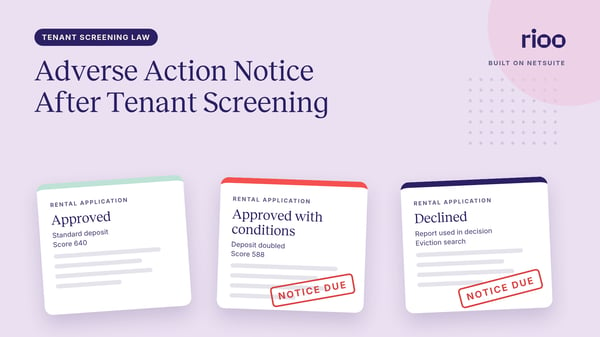
"Adverse action" is defined broadly, § 42-3505.10(j)(1). It means denial of an application, or approval subject to terms or conditions different and less favourable to the prospective tenant than those included in any written notice, statement or advertisement for the unit, including written communication sent directly to the applicant.
That second limb catches a great deal: approving an applicant at a higher rent, with a larger deposit, with a guarantor requirement, or on a shorter term than advertised is an adverse action carrying notice obligations.
The notice, (f). Written, no later than the response date provided under subsection (a)(7), including:
-
The specific grounds for the adverse action;
-
A copy or summary, free of charge, of any information obtained from a third party that formed a basis for it; and
-
A statement informing the applicant of the right to dispute the accuracy and the permissibility of the provider's use of any information relied upon.
Paragraph (f)(4), on the right to file an Office of Human Rights complaint, appears in the statute but is covered by the applicability note discussed in Step 9. Note that § 42-3541.02(f)(1) separately requires an OHR advisory in a criminal-history withdrawal notice, and that requirement is not subject to the same note.
The dispute process, (g). After receiving the notice, the applicant may provide evidence that information relied upon is inaccurate or incorrectly attributed, or based on prohibited criteria under subsection (d). The provider shall provide a written response, by mail, email or in person, within 10 days after receipt.
And a preservation clause, (g)(3). Nothing in the subsection prohibits a provider from considering debts owed to a housing authority, from applying other criteria established in federal law, or from leasing the unit to other prospective tenants in the meantime.
Because the notice must be issued by a date you set yourself and the dispute reply runs on a ten-day clock, the decision file has to be assembled at the time of the decision. Keeping the disclosure, the report, the criteria applied, the decision rationale and the notice on a single applicant record, as a Tenant 360 View approach supports, is what makes that answerable.
Step 9: Enforcement, Private Remedies, and the Applicability Question
Section 42-3505.10 provides for an Office of Human Rights complaint process and a civil action in Superior Court. The applicability position needs care.
The applicability note. The D.C. Law Library records that § 7 of D.C. Law 24-115 provided that the creation of subsections (a)(10), (f)(4) and (h) of this section is subject to the inclusion of the law's fiscal effect in an approved budget and financial plan, and states that "that amendment has not been implemented." A separate note records that § 7138 of D.C. Law 24-167 amended § 7 of D.C. Law 24-115 to remove the applicability provision impacting the section, so that the creation of the section itself has been implemented.
Subsection (h) is the provision containing the unit-count penalty schedule. Because of the applicability note, this article does not present that schedule as a currently operative enforcement mechanism. Confirm the status of subsections (a)(10), (f)(4) and (h) with D.C. counsel before relying on or disregarding any of them.
The private action, (i), is not covered by that note. A prospective tenant may bring a civil action in Superior Court against a housing provider who violates this section within one year after the alleged violation, except that they may not do so if they have filed an OHR complaint under subsection (h). Where the applicant prevails, they are entitled to reasonable attorney's fees and costs, incidental damages, and equitable relief as may be appropriate.
That is the exposure a manager should plan around: a one-year limitations period and one-way fee shifting in the applicant's favour.
One further applicability note. The amendment to this section by D.C. Law 25-308, the Pets in Housing Amendment Act of 2024, is likewise subject to fiscal-effect inclusion and has not been implemented.
Step 10: The Separate Application-Stage Property Disclosures
Section 42-3502.22 creates a separate application-stage disclosure package. At the time a prospective tenant files an application, the housing provider must provide specified information and corresponding documents concerning the rental unit.
This article summarises selected requirements rather than reproducing the full list. They include the rent-controlled or exempt status of the accommodation, its business licence, and a copy of the registration or claim of exemption with the most recent notice filed under § 42-3502.05(g)(1)(C); all copies of housing code and property maintenance code violation reports issued by the Department of Buildings for the accommodation or unit within the last 12 months, or previously issued reports for violations which have not been abated; a pamphlet published by the Rent Administrator on rent increases and petitions; the amount of any nonrefundable application fee; whether the accommodation is registered as, or converting to, a condominium or cooperative; the ownership information in the registration form; information known or that should have been known about indoor mould contamination as defined in § 8-241.01(5) in the previous 3 years, unless remediated by a certified and licensed professional; a Tenant Bill of Rights published by the Office of the Tenant Advocate under § 42-3531.07(8); and a D.C. Board of Elections voter registration packet.
The violation-report disclosure is particularly important for property managers, because it requires the provider to address both recent reports and previously issued reports for violations that remain unabated. The registration and exemption documents tie this duty to the obligations covered in our guide to D.C. rental housing registration.
Read § 42-3502.22 directly before building a disclosure pack, since it contains further items and its own timing and applicability provisions.
Step 11: Fair Housing and Source of Income
D.C.'s Human Rights Act, at § 2-1402.21, extends protection beyond the federal categories, adding traits including source of income and homeless status.
D.C. prohibits housing discrimination based on source of income. Screening policies should therefore be structured so that lawful housing assistance and other protected sources of income are not improperly excluded. A minimum-income multiple applied to earned income alone, without counting subsidy, is the classic way a facially neutral policy runs into this. Confirm the current list of protected traits and applicable standards in § 2-1402.21 and with the Office of Human Rights before setting thresholds.
Federal fair housing law applies independently, and the federal Fair Credit Reporting Act governs consumer reports and adverse action separately from anything in D.C. law.
Common D.C. Screening Mistakes Property Managers Make
1. Taking information or fees before the § 42-3505.10(a) notice
It is due before requesting any information or fees.
2. Omitting the inventory disclosure
Item (a)(6) requires available units by bedroom size and monthly rent, or prior fiscal year monthly availability.
3. Not publishing automatic denial criteria
Item (a)(3) requires them in advance.
4. Missing your own response deadline
The date you disclose under (a)(7) is the deadline for the (f) adverse action notice.
5. Putting a criminal history question on the application
It can constitute the prohibited inquiry under § 42-3541.02(b)(1).
6. Skipping the § 42-3541.02(c)(1) pre-fee disclosure
Including the rehabilitation and inaccuracy statement.
7. Charging any other fee before lease signing
Barred by § 42-3505.10(b)(3).
8. Charging utility administration, trash, lock or third-party billing fees
Named in the expanded (b-2)(1)(A) bar as amended in 2026.
9. Requiring a holding deposit from a voucher holder
Barred by (b)(5).
10. Charging a second application fee within 30 days
Barred by (b-1) unless more than one screening is required.
11. Not refunding when no screening occurs
Within a reasonable time, not to exceed 14 days.
12. Screening on an eviction filing without a judgment
Barred by (d)(1)(A), permanently.
13. Screening on a filing 3 or more years old
Barred by (d)(1)(B).
14. Using a lease-breach allegation tied to domestic violence, victimisation or disability
Barred by (d)(2)(A) to (C).
15. Applying a minimum credit score cutoff on its own
Barred by (e)(1); report contents directly relevant to fitness remain usable.
16. Treating a less-favourable approval as not an adverse action
It is, under (j)(1)(B).
17. Sending a generic denial
Subsection (f) and § 42-3541.02(f)(1) both require specificity.
18. Missing the 10-day dispute response
Required by (g)(2).
19. Considering an arrest without conviction, or an under-18 occupant's record
Barred by § 42-3541.02(a) and (g).
20. Considering a conviction off the list or older than 7 years
Section 42-3541.02(d) is exhaustive.
21. Assuming Chapter 35B applies to every property
Section 42-3541.03 sets out exclusions.
Conclusion
D.C. screening compliance is a matter of sequence, and it is governed by two statutes that attach at different moments.
-
Section 42-3505.10 governs the workflow. Pre-screening disclosures before requesting any information or fees, an application fee capped at $54 for 2026, no other pre-lease fee, one fee per 30 days across a provider's units, a 14-day refund where no screening occurs, an expanded bar on habitability-related fees now naming utilities, trash, locks and third-party billing administration, and hard limits on screening for prior possession actions and lease-breach allegations, plus a bar on adverse action based solely on a credit score.
-
Chapter 35B governs criminal history. No inquiry before a conditional offer, arrests without conviction and under-18 occupants excluded entirely, then a 7-year window over 48 listed crimes, and withdrawal only on an on-balance determination weighed against six factors.
-
Both end in notice obligations. A § 42-3505.10(f) adverse action notice by the date you set yourself, a § 42-3541.02(f)(1) withdrawal notice, and two response clocks: 10 days to answer a dispute, and 10 days to supply information requested within 20 days.
-
And the live exposure is the private action. Under § 42-3505.10(i), a prospective tenant may sue in Superior Court within one year, recovering reasonable attorney's fees and costs, incidental damages and equitable relief. The unit-count penalty schedule in subsection (h) is subject to an applicability note stating it has not been implemented, and its status should be confirmed with counsel.
For teams managing District portfolios, the fix is upstream. Rebuild the application so the § 42-3505.10(a) notice precedes any request for information or money, the criminal question does not appear at all, and a conditional-offer stage sits in front of any criminal check. Everything after that is documentation.
This blog is for informational purposes only and does not constitute legal advice. D.C. tenant screening is governed by D.C. Official Code § 42-3505.10, "Tenant screening," and by Chapter 35B of Title 42, the Fair Criminal Record Screening for Housing Act of 2016, D.C. Law 21-259, effective 7 April 2017. Section 42-3505.10 was added by D.C. Law 24-115 and amended by D.C. Law 25-65 (November 2023), D.C. Law 25-308 (March 2025) and D.C. Law 26-156 (14 August 2026). The D.C. Law Library's applicability notes state that the creation of subsections (a)(10), (f)(4) and (h) by § 3(b) of D.C. Law 24-115 was subject to inclusion of the law's fiscal effect in an approved budget and financial plan and has not been implemented, and that the amendment made by D.C. Law 25-308 has likewise not been implemented; subsections (b-3) and (b-4) are marked "Not Funded." Confirm the current status of those provisions with D.C. counsel. Section 42-3541.03 sets out exclusions from Chapter 35B and should be read first to determine coverage; §§ 42-3541.04 through 42-3541.10 are not set out here. The Rental Housing Commission determined the maximum rental housing application fee for 2026 to be $54, adjusted from the $50 statutory base under § 42-3505.10(b)(2); the figure is adjusted annually. Application-stage disclosure duties sit at § 42-3502.22, summarised only in part here. Protected traits under the D.C. Human Rights Act are at § 2-1402.21. Federal fair housing law and the federal Fair Credit Reporting Act apply independently. Registration sits at § 42-3502.05, rent adjustments at §§ 42-3502.06 and 42-3502.08, security deposits at 14 DCMR 308 to 311 and § 42-3502.17, and eviction at § 42-3505.01, each addressed separately. Verify the current text with the Council of the District of Columbia, including §§ 42-3541.02, 42-3541.03 and 42-3502.22, confirm the current fee cap with the Office of the Tenant Advocate, and consult a licensed D.C. attorney.
Frequently Asked Questions
Q1. What must a D.C. landlord disclose before screening a tenant?
Under § 42-3505.10(a), before requesting any information or fees: each fee or deposit and its purpose and refundability; the types of information accessed; automatic denial criteria; additional denial criteria; consumer reporting agency details and free-report rights; approximate available inventory by bedroom size and rent; the response timeline; the right to dispute; and the right to a refund of an unused fee. Item (a)(10) appears in the statute but is subject to an applicability note.
Q2. What is the D.C. application fee cap?
The statutory base is $50, adjustable annually by CPI-U from 1 January 2024. The Rental Housing Commission determined the maximum is $54 for 2026.
Q3. When must an application fee be refunded?
If the provider fails to conduct a screening for any reason, within a reasonable time not exceeding 14 days, under § 42-3505.10(c).
Q4. Can a D.C. rental application ask about criminal convictions?
A criminal-history question before a conditional offer can constitute the prohibited inquiry under § 42-3541.02(b)(1). After a conditional offer, only pending accusations or convictions within the past 7 years for one of 48 listed crimes may be considered.
Q5. Can eviction records be used in D.C. screening?
Not where the action did not result in a judgment for possession in favour of the provider, or was filed 3 or more years ago, under § 42-3505.10(d)(1).
Q6. Can an application be denied on credit score?
Not solely on the score or lack of one, under § 42-3505.10(e)(1). Information within the report directly relevant to fitness as a tenant may be relied upon.
Q7. What counts as an adverse action?
Under § 42-3505.10(j)(1), denial of an application, or approval on terms or conditions different and less favourable than those in any written notice, statement or advertisement for the unit.
Q8. What can an applicant recover for a violation?
Under § 42-3505.10(i), a prospective tenant may bring a civil action in Superior Court within one year, recovering reasonable attorney's fees and costs, incidental damages and equitable relief. The penalty schedule in subsection (h) is subject to an applicability note stating it has not been implemented; confirm its status with counsel.