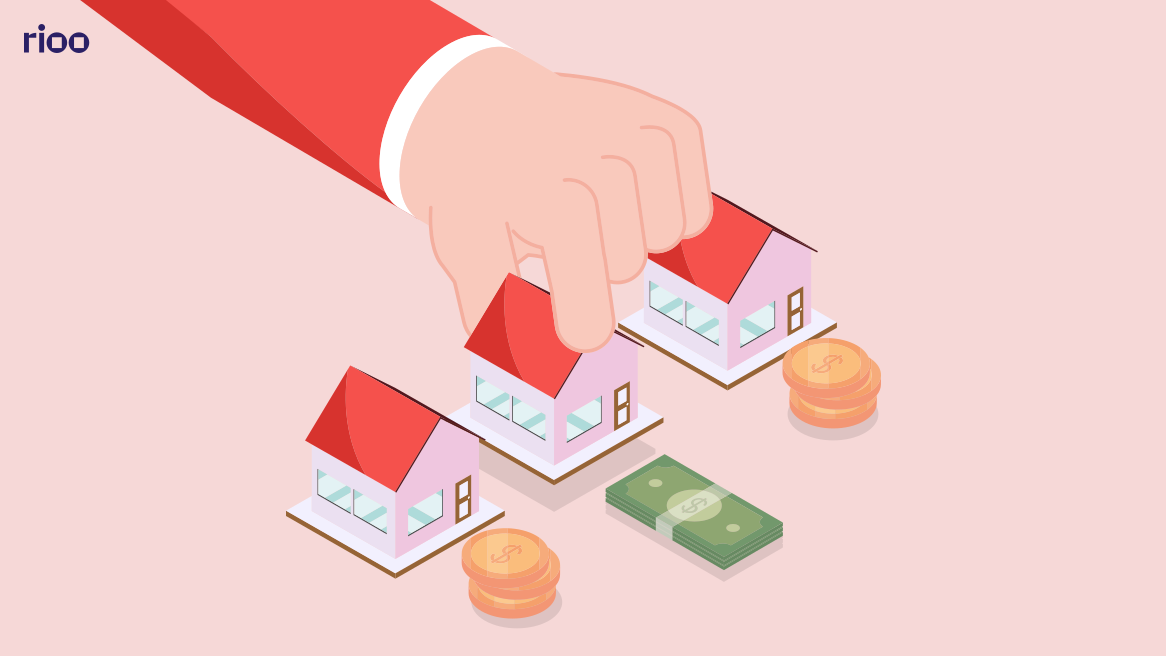
For most of its history, property management was treated as a service you hired: someone to collect the rent, answer the resident, and keep the building standing. That definition is quietly being replaced. Property management is becoming the operating system of real estate, the coordinating layer that runs the asset, allocates its resources, schedules its work, and ultimately decides whether ownership performs. The building is no longer the product. The system that runs the building is. Owners are learning that the return on a property depends less on the concrete and more on the quality of the operating layer sitting on top of it.
This is not a metaphor stretched for effect. It is a precise description of a role that has changed, and the clearest way to see the change is to borrow the definition of an operating system from the field that invented the term.
What an Operating System Actually Does
In computing, an operating system is not an app. It is the layer beneath the apps. An operating system is the software that manages a computer's hardware and resources and acts as the intermediary between applications and the hardware, providing common services for every program. It is often called the resource manager, because its central job is to allocate the machine's scarce resources, the processor, the memory, the storage, among everything competing for them.
Two properties of an operating system matter most here. First, it manages complexity downward and exposes simplicity upward, abstracting complex hardware operations into simple, standardized interfaces: the application does not need to know how the storage works, because the operating system handles that and presents something clean. Second, it is invisible when it works and catastrophic when it fails. Nobody thinks about their operating system on a good day. On a bad one, they think about nothing else. Hold those two properties in mind, because property management now has both.
The Building Is the Hardware. Property Management Is the OS.
Map the layers onto a piece of real estate and the analogy stops being loose. The building is the hardware: concrete, systems, and space. On its own it does nothing. It is capital sitting in a physical form, waiting to be run. On top of that hardware sit the applications, the things that actually produce value: leasing, resident services, vendor work, compliance, owner and investor reporting. Each of those wants something from the asset, and none of them can talk to the raw building directly.
Between the two sits property management. It is the operating system: the layer that takes a lifeless physical asset and everyone's competing demands on it, and turns that into a functioning, performing property. Without that layer, the building is just expensive hardware with no way to run anything on it. This is the shift in a sentence. Property management stopped being one of the applications and became the operating system the applications depend on.
The Four Jobs of an Operating System, Applied to Property
An operating system does four things. A modern property operation does the same four, which is why the comparison holds.
-
Resource Management.
An operating system allocates scarce resources among everything that needs them. A property operation does exactly this with capital, labor, space, and time: which vacancy gets marketed first, which repair gets funded this quarter, where the maintenance crew goes today, which lease renewal gets attention before it lapses. Every one of these is a resource-allocation decision, and the quality of those decisions is most of what separates a property that performs from one that merely functions. -
Scheduling.
An operating system decides what runs when. A property runs on a relentless schedule of rent cycles, renewals, inspections, capital projects, and reporting deadlines, and a missed beat is not a small thing. A lapsed renewal or a late reconciliation is a scheduling failure with a direct cost. The lease sits at the center of this schedule, which is why disciplined lease management is less an administrative task than the clock the whole operation runs on. -
Shared services.
An operating system provides common services so no application has to reinvent them. A property operation needs one shared layer of truth that leasing, finance, and maintenance all draw on, rather than each function maintaining its own version and reconciling the differences by hand. When the shared layer is missing, every function spends part of its day rebuilding what another function already knew. -
Abstraction.
An operating system hides complexity and presents something clean. This is the job owners feel most directly. An owner should see occupancy, net operating income, and portfolio health, not the machinery that produced them. The same is true one layer out: the resident should experience one smooth interaction, not the departments behind it. Good abstraction is why a well-run property feels effortless from the outside and is anything but on the inside.
Why This Is a Status Change, Not a Tooling Change
The temptation is to read all of this as "property managers got better software." That misses the point. The important shift is not in the tools. It is in the position of the function within the value chain.
Property management used to sit near the bottom of that chain, a cost to be minimized, judged mostly on responsiveness. As the operating system, it sits at the center, and it is judged on performance, because performance now runs through it. An operating system is not overhead. It is the thing everything else depends on. The same two properties from earlier apply directly: a property operating system is invisible when it works, which is why good management has always been easy to undervalue, and catastrophic when it fails, which is why owners are starting to pay attention to the layer they used to ignore.
What Owners Are Actually Buying Now
This reframes the purchase. An owner or investor selecting a property management capability is no longer buying a service. They are choosing an operating system, and the criteria change accordingly.
| Property Management as a Service | Property Management as an Operating System |
|---|---|
| Hired to handle tasks | Runs the asset |
| Judged on responsiveness | Judged on performance |
| A cost to minimize | The layer returns depend on |
| Sits below the asset in value | Sits at the center of it |
| Success is "nothing went wrong" | Success is the asset performing to its potential |
| Interchangeable vendor | Foundational choice |
The right column is where the market is heading, and it explains why the evaluation of a property management platform now looks less like hiring a contractor and more like choosing infrastructure.
What This Means if You Run a Property Company
If your company provides property management, the operating-system framing is not flattery. It is a standard to be held to.
-
Think in resources, not tasks. The job is not to complete a list of activities. It is to allocate capital, labor, space, and time to produce the best outcome the asset is capable of.
-
Treat reliability as the product. An operating system that is occasionally down is not a good operating system. Consistency, accuracy, and uptime are the deliverable, not extras on top of it.
-
Abstract deliberately for owners. Give owners clean performance and confidence, not raw operational noise. The quality of that abstraction is much of what they are paying for.
-
Accept that you cannot be an operating system on a pile of disconnected tools. An operating system is, by definition, an integrated layer. A property operation stitched together from separate systems is not running an operating system. It is running several, badly. That single operating layer means leasing, finance, maintenance, and resident interactions running on one shared record, so the operation behaves as one system rather than several.
The Takeaway
The building was never really the asset. It was always the hardware. The asset is the performance, and performance is produced by the layer that runs the building. That layer is property management, and calling it an operating system is not inflation of its importance. It is finally an accurate description of it.
The companies that internalize this stop selling a service and start operating infrastructure. They are judged, correctly, on whether the asset performs, and they earn a place at the center of the value chain that property management was always quietly holding. The hardware sits there either way. What decides the return is the system running on top of it.
FAQ
1. What does it mean that property management is becoming an operating system?
It means the function is shifting from a hired service that handles tasks to the coordinating layer that runs the asset. Like a computer's operating system, it allocates resources, schedules work, provides shared services, and hides complexity, and the asset's performance depends on how well it does those jobs.
2. How is this different from just having good property management software?
Software is part of it, but the real change is in the role, not the tools. Property management has moved from the bottom of the real estate value chain, treated as a cost, to the center of it, treated as the layer returns depend on. Better software is a consequence of that shift, not the shift itself.
3. What are the core jobs of a property operating system?
Four: resource management (allocating capital, labor, space, and time), scheduling (coordinating rent cycles, renewals, inspections, and reporting), shared services (one common layer of truth every function draws on), and abstraction (presenting clean performance to owners and a smooth experience to residents).
4. Why does this matter to property owners and investors?
Because it changes what they are buying. Selecting a property management capability is no longer hiring an interchangeable vendor; it is choosing the operating system their asset runs on. That choice increasingly determines occupancy, net operating income, and overall performance.
5. Can a property company be an operating system while using several disconnected tools?
Not really. An operating system is an integrated layer by definition. An operation running on separate, disconnected systems is effectively running several operating systems at once, with the gaps between them absorbed by manual work. Being the operating system for an asset requires a single, unified operating layer.


.svg)
.svg)


.svg)