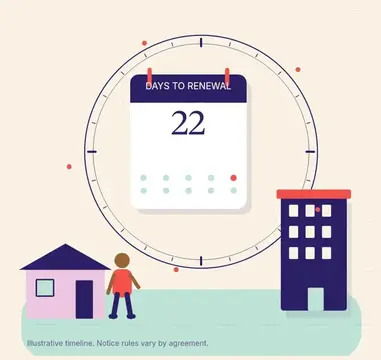

















Assured shorthold tenancies and fixed terms are replaced by assured periodic tenancies, and existing tenancies convert.
Markets · United Kingdom
Renters' Rights Act readiness: what your property system must do
The Renters' Rights Act changes how private tenancies in England are created, priced and ended. For landlords and operators running portfolios on software, it means periodic tenancies by default, a controlled annual rent-increase process, evidence-led possession, and new registration duties. RIOO is configured to support these changes on NetSuite records.
United Kingdom · Renters' Rights Act readinessUnited Kingdom
GBP · VAT- TenanciesPeriodic by default
- Section 21Abolished
- Rent increasesOnce a year, s.13
- PRS databaseRegistration
Capabilities
What does the Renters' Rights Act change?
The Renters' Rights Act replaces fixed-term tenancies with periodic ones, abolishes section 21 possession, limits rent increases to once a year and gives tenants more rights. It received Royal Assent in October 2025, with the main tenancy reforms in England commencing in 2026 and further measures phased in afterwards. Confirmcommencement dates at publication The headline changes for landlords are:
This summary is not legal advice. Read our guide to tenancy agreements after the Renters' Rights Act and section 8 grounds for possession.
Section 21 "no-fault" possession is abolished; landlords must use grounds under section 8, several of which are new or amended, with set notice periods and evidence.
Rent increases are limited to once a year through the section 13 process, with at least two months' notice, and tenants can challenge them at the First-tier Tribunal.
Rental bidding is banned and rent in advance is limited.
Tenants can request to keep a pet, and landlords must not unreasonably refuse.
A private rented sector database and a landlord ombudsman are introduced, and the Decent Homes Standard and Awaab's Law are extended to the private rented sector in later phases.
Discrimination against tenants with children or in receipt of benefits is prohibited.
Use cases
Which grounds for possession matter most now?
The grounds for possession that matter most now are selling the property and moving in, both with a protected period, rent arrears with revised thresholds, antisocial behaviour, breach of tenancy decided by the court, and redevelopment needing vacant possession. Each needs evidence on the tenancy record.
Selling the property
Landlord intends to sell, subject to a protected period at the start of the tenancy.
Moving in
Landlord or close family intends to live in the property, also with a protected period.
Rent arrears
Revised thresholds and notice periods for serious arrears.
Antisocial behaviour
Faster routes where behaviour is serious.
Breach of tenancy
Discretionary grounds decided by the court.
Redevelopment
Where substantial works require vacant possession.
Why does the Act matter for portfolio systems?
The Act changes data that most systems treat as fixed: tenancy type, end dates, rent review timing and possession routes. Systems that rely on fixed-term end dates for renewals or on section 21 for possession need new fields, templates and workflows. Getting this right across a portfolio is a systems project as much as a legal one.
Compare
What does each change mean for your system?
Each change means a system task: periodic tenancies need records without end dates, section 13 increases need annual review tracking, the end of section 21 needs evidence on each tenancy, and rent in advance limits need move-in charge rules. The table shows how RIOO supports each.
| Change | What your system must do | How RIOO supports it |
|---|---|---|
| Periodic tenancies | Tenancies with no end date; convert existing ASTs | Tenancy records without fixed end dates, conversion during migration |
| Section 13 rent increases | One increase per year, correct notice, track challenges | Renewal and rent-change workflow with dates and history Confirm |
| No section 21 | Possession only on grounds with evidence | Notes, documents and arrears history on the tenancy record |
| Rent in advance limits | Control upfront charges | Charge rules at move-in |
| No rental bidding | Advertised rent is the rent | Pricing approvals and audit trail |
| Pet requests | Record requests and decisions within deadlines | Request records and tasks Confirm |
| Landlord database | Register landlords and properties | Registration references on property records |
| Decent Homes and Awaab's Law | Respond to hazards within set timescales | Work-order priorities and service targets tracking |
How it works
How should you prepare your portfolio?
Prepare your portfolio by inventorying every tenancy, reviewing templates with your advisers, setting annual rent review rules, cleaning arrears and evidence records, configuring repair priorities for damp and mould, and preparing landlord and property details for the database and ombudsman.
- 01
Inventory tenancies
List every tenancy, its type, start date and current rent; identify fixed terms that will convert.
- 02
Review templates
Update tenancy agreements, notices and letters with your advisers.
- 03
Set rent-review rules
Configure annual review dates and notice periods per tenancy.
- 04
Clean arrears and evidence
Make sure arrears, correspondence and inspection records are on the tenancy, because possession now depends on evidence.
- 05
Set repair priorities
Configure priorities for damp, mould and other hazards ahead of Awaab's Law and Decent Homes duties.
- 06
Prepare registrations
Hold landlord and property details ready for the database and ombudsman membership.
- 07
Train teams
Leasing and property managers should understand what they can no longer say or do.
Compare
What is the Renters' Rights Act?
The Renters' Rights Act is legislation reforming private renting in England. It ends fixed-term assured shorthold tenancies in favour of periodic tenancies, abolishes section 21 no-fault evictions, limits rent increases to once a year through a formal process and adds new duties such as a landlord database and an ombudsman. Main tenancy changes began in 2026, with other measures phased. Confirmcommencement dates
| Change | Before | After |
|---|---|---|
| Tenancy type | Fixed-term or periodic ASTs | Periodic assured tenancies |
| No-fault eviction | Section 21 available | Abolished; possession on specified grounds |
| Rent increases | Per contract or section 13 | Once a year by section 13 notice |
| Rental bidding | Common in hot markets | Banned; advertised rent applies |
| Pets | Landlord discretion | Tenant may request; landlord cannot unreasonably refuse |
| Database and ombudsman | None | Landlord registration and redress scheme (phased) |
How it works
How should landlords change their processes?
Landlords should convert tenancy templates to periodic terms, remove section 21 from possession workflows, schedule annual section 13 rent reviews, advertise the rent actually charged, add a pet request process with a decision deadline, and prepare for database registration and ombudsman membership.
- 01
Review tenancy templates and convert to periodic terms.
- 02
Remove section 21 from possession workflows and document the grounds you would rely on.
- 03
Move rent reviews to an annual section 13 notice schedule.
- 04
Update advertising so the listed rent is the rent charged.
- 05
Add a process for pet requests with a decision deadline.
- 06
Prepare for landlord database registration and ombudsman membership when they apply.
How does RIOO support the changes?
RIOO tracks tenancy type and start dates, schedules annual rent reviews with notice dates, records possession grounds and notices served on the lease and stores pet requests and decisions. Because rent changes update the billing schedule directly in NetSuite, increases take effect on the right date without manual edits. Confirmsection 13 template support
How should you communicate the changes to tenants?
Communicate the changes early and plainly: tell tenants what is changing and when, explain that their tenancy continues on periodic terms, describe how annual rent reviews will work and how to request a pet. Clear, early communication reduces queries and disputes.
Why does NetSuite-native matter here?
The Act makes records matter. Arrears that justify a possession ground, the date a rent-increase notice was served, and how fast a damp report was fixed all need to be provable. With tenancies, ledgers, notices and work orders on NetSuite records with system notes, the evidence trail exists by default.
Explore by topic
Who is most affected?
The landlords most affected are build-to-rent and institutional landlords with high tenancy volumes, student accommodation providers whose tenancies may be classified differently, and portfolio landlords and housing providers who must update templates, rent reviews and possession processes across many homes.
Build-to-rent and institutional landlords
High tenancy volumes make process discipline essential, especially rent reviews across thousands of homes. See build-to-rent.
Student accommodation providers
Purpose-built student accommodation may fall outside or under specific provisions; check how your tenancies are classified. See student housing. Confirm
Portfolio landlords and housing providers
Possession evidence, arrears records and repair speed of response become central to risk management.
Who is affected least?
Commercial leases are unaffected, purpose-built student accommodation and some other specified tenancies are treated differently, and Scotland, Wales and Northern Ireland have their own laws. Check whether each property and tenancy falls within scope before changing its templates and processes.
What should finance teams plan for?
Periodic tenancies make income less tied to fixed terms, so forecast occupancy and turnover from history rather than lease end dates. Annual rent reviews should be scheduled across the year to spread workload. Possession timelines on arrears may change, which affects bad debt provisions.
Checklist
Readiness checklist
- Tenancy agreements updated to periodic terms.
- Rent review calendar set for annual increases.
- Possession procedures rewritten without section 21.
- Advertising and offer process free of rental bidding.
- Pet request process documented.
- Property data ready for database registration.
Talk to a specialist
See renters' Rights Act readiness on your own portfolio.
RIOO is configured to support these changes on NetSuite records.
When does the Renters' Rights Act take effect?
The Act received Royal Assent in October 2025. The main tenancy reforms for England commence in 2026, with the landlord database, ombudsman and housing standards measures phased in later. Check the latest government guidance for exact commencement dates before changing tenancy templates, notices or processes. Confirm
Does the Renters' Rights Act apply in Wales, Scotland or Northern Ireland?
The tenancy reforms apply mainly to England. Wales, Scotland and Northern Ireland have their own tenancy laws, such as occupation contracts under the Renting Homes (Wales) Act and private residential tenancies in Scotland, so portfolios across the UK need rules configured per nation for each property.
What happens to existing fixed-term tenancies?
Existing assured shorthold tenancies convert to assured periodic tenancies when the reforms commence, so fixed end dates stop applying. Your system should update tenancy records so end dates no longer drive renewals, expiry reminders or notices, and rent reviews move to the section 13 process instead.
How often can rent be increased under the Act?
Rent can be increased once a year, using the section 13 process with at least two months' notice. Tenants can challenge increases at the First-tier Tribunal. RIOO records rent review dates, notices served and outcomes on each tenancy, so annual limits and notice periods are visible to staff.
Can RIOO generate section 8 notices?
RIOO stores notice templates and the evidence behind them, such as arrears history, correspondence and inspection records, on the tenancy. Notice wording and the grounds relied on should be checked by your advisers before service, because the Act changes several grounds and notice periods. Confirmtemplate library
Do existing fixed-term tenancies change automatically?
Yes. Existing assured shorthold tenancies convert to assured periodic tenancies on commencement under the transition rules, so fixed terms end without any action by the tenant. Update tenancy records, templates and renewal workflows so they reflect periodic terms from that date. Confirmtransition wording
Can rent still be increased?
Yes. Rent can still be increased once a year through a section 13 notice with at least two months' notice, and tenants can challenge increases at the First-tier Tribunal. RIOO records review dates and notices on each tenancy, so increases follow the annual schedule consistently.
Does the Act apply in Scotland or Wales?
No. The Renters' Rights Act's tenancy reforms apply to England. Scotland and Wales have their own tenancy laws, such as private residential tenancies in Scotland and occupation contracts in Wales, so properties there follow those rules, configured per property in RIOO.
Can tenants still give notice?
Yes. Tenants can end a periodic tenancy by giving two months' notice, and fixed terms no longer lock them in once tenancies convert. Record the notice date and calculated end date on the tenancy so move-out inspections, deposit returns and re-letting can be planned. Confirmnotice period
Related
Related to renters' Rights Act readiness