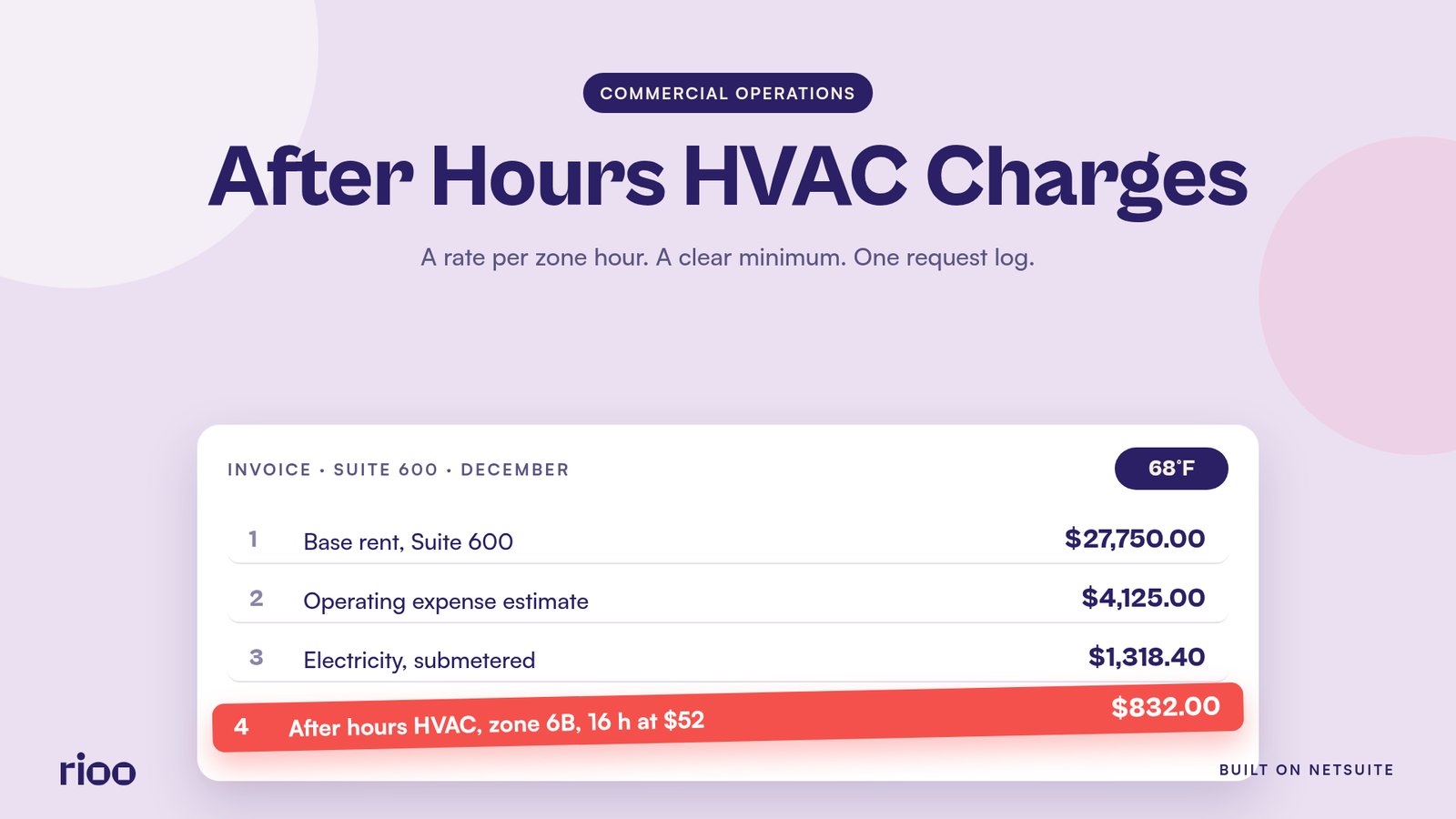
Last December, line 4 on Suite 600's invoice read: "After hours HVAC, zone 6B, four requests, $832." Two days later the tenant's office manager emailed the property team. "We asked for heat three or four times, maybe 12 hours in all. How is that $832?"
After hours HVAC charges are what a commercial tenant pays when it asks the landlord to run heating or cooling outside the building hours written in its lease. The usual method is a set hourly rate per zone or floor, times the hours run, with a one or two hour minimum per request. The rate should rest on the landlord's real cost to run the equipment: energy, wear on the plant, any engineer time and a small admin allowance. Bill it as a direct charge to the tenant who asked for it, kept outside the CAM pool so other tenants do not pay for it twice.
The $832 was correct, and the office manager still asked a fair question. Work through the five steps below and your team can answer it in one reply, with the log attached.
Step 1: Pin down the building hours in each lease
Everything starts with the definition of building hours. A common pattern is 8 AM to 6 PM on weekdays and 9 AM to 1 PM on Saturdays, with Sundays and listed holidays excluded. Some older leases say "normal business hours" and stop there. That phrase invites an argument every time a tenant works late.
Pull three facts from every lease in the building and put them in one table:
- The weekday and Saturday hours that HVAC is included.
- The holidays the lease lists. Check whether the day after Thanksgiving and 26 December are on it.
- The after hours rate, the minimum, and whether the rate can change each year.
You will often find two or three versions of the clause in one building. Leases signed in different years carry different holiday lists. Your engineers need to know which tenant is on which version before the first cold Saturday.
Step 2: Build the hourly rate from your own costs
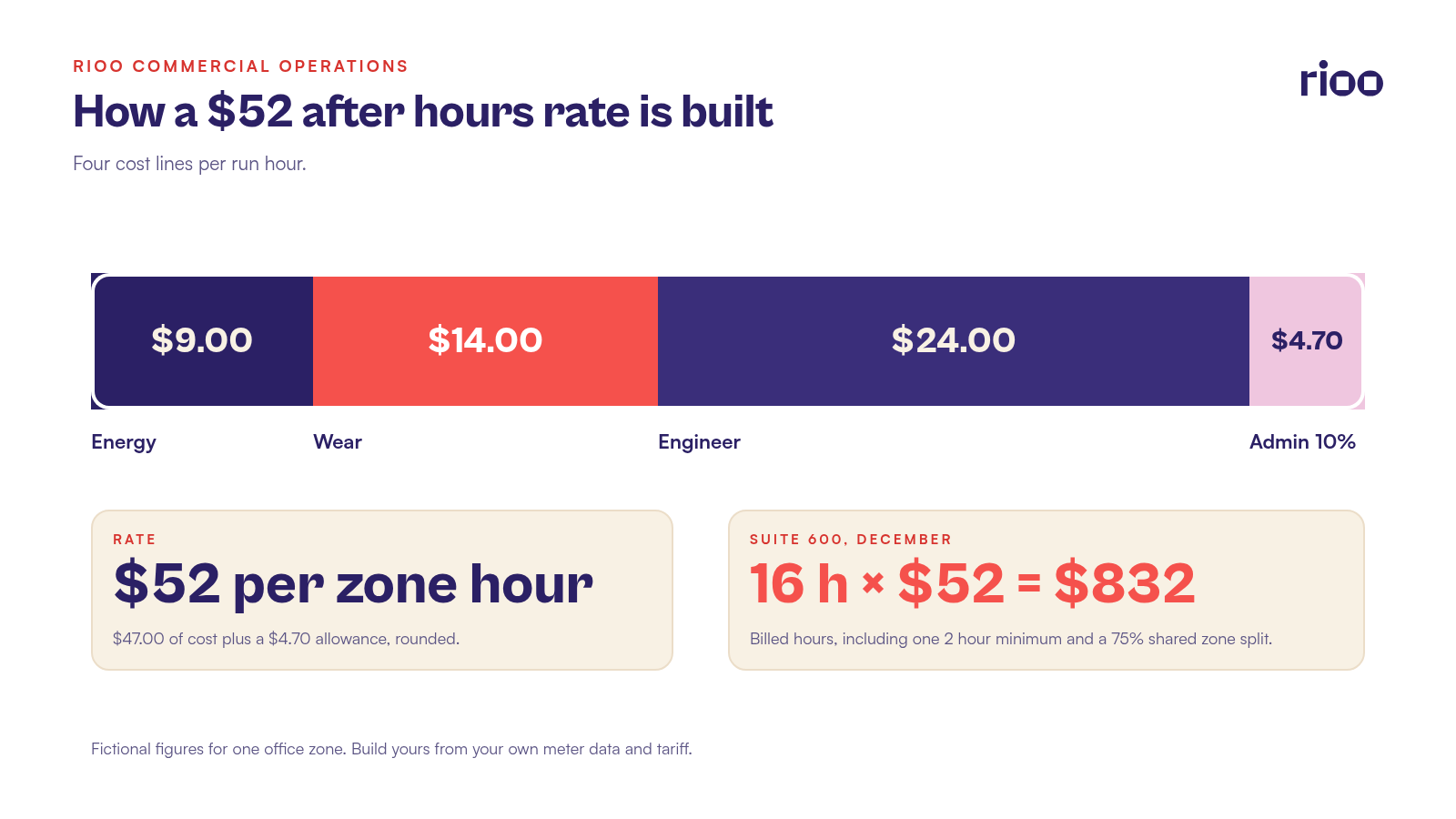
A rate copied from the last building you managed will not hold up when a tenant audits it. Build it from the plant that serves the zone. Here is one fictional build for zone 6B, a floor served by its own air handler with a share of the central boiler and chiller.
| Cost line | How it was measured | Per run hour |
|---|---|---|
| Energy | Fans and pumps, 30 kWh at $0.17 ($5.10), plus the zone's share of boiler gas, 3.25 therms at $1.20 ($3.90), from the building controls trend | $9.00 |
| Equipment wear | Planned overhaul cost for the air handler and plant share, spread over expected run hours | $14.00 |
| Engineer time | Share of the engineer on duty who starts, checks and shuts down the system | $24.00 |
| Subtotal | $47.00 | |
| Admin allowance | 10% for scheduling and billing, if the lease allows it | $4.70 |
| Rate | Rounded | $52.00 |
Energy is the line tenants test first
Use metered or trended data where you have it. If the zone has no meter, use the equipment's rated load and a realistic run factor, and write down how you got there. Use your actual tariff. Evening use can land in a higher price window, so check the time of use rates on the utility bill.
Wear is real, but keep it modest
Extra run hours bring the next overhaul closer. Spread the expected overhaul cost over the hours the equipment will run before it. If you cannot support the figure with a plan or a quote, leave it out. Our guide to repair or replace decisions for HVAC shows how to estimate remaining life.
Check what the lease lets you add
Some leases allow "landlord's cost plus a reasonable administrative fee." Others limit the charge to actual cost with no markup. Read the clause before you add the allowance line.
Step 3: Choose the unit you bill
A rate means nothing until you say "per what." Per zone, per floor and per air handler give very different bills for the same evening.
Bill per zone where the controls allow it. Say one plant serves three floors and a tenant on all three runs late. The true extra cost of the second and third floors is far below the first. Charging the full floor rate three times is the kind of thing a tenant's lease auditor finds.
Shared zones
When two tenants share a zone and both ask for the same hours, split the charge. Rentable square feet is the simplest basis. If one tenant asked alone, that tenant pays, even if the neighbor also got warm air. Write the rule down so staff do not decide it case by case.
Step 4: Take every request in one place
Requests that arrive by phone, hallway chat and text start a lot of disputes. Pick one channel, usually the tenant portal or a service request form, and refuse to start equipment without a logged request.
Each request should capture:
- The suite, the zone and who asked.
- Start and stop times requested.
- Actual start and stop times from the building controls.
- Whether the day is a lease holiday.
Set a cutoff. "Requests for Saturday by 2 PM Friday" gives the engineer time to schedule. In late November, send each tenant the holiday dates when HVAC is off, and ask for requests early. This fits neatly into a holiday staffing plan for the building team.
Step 5: Bill it as a direct charge
After hours HVAC belongs on the requesting tenant's invoice as its own line, with the hours and the rate. It should not sit in the operating expense pool. If it did, every tenant would share a cost that one tenant created.
There is a second check. The energy for after hours runs still shows up on the building's utility bill, which flows into operating expenses. Many leases handle this by crediting after hours HVAC income against the energy line, so the cost is not recovered twice. Check what your leases say and treat it the same way at year end. Our guide to NNN recoveries and pass throughs and the annual CAM reconciliation timeline cover where that credit lands.
Suite 600's December, line by line
Back to the email. Here is how the $832 was built, using the fictional $52 rate and a two hour minimum. Suite 600's lease allows cost plus a 10% administrative fee, so the allowance line applies. Suite 600 has 9,000 rentable square feet on zone 6B. Suite 610 has 3,000 square feet on the same zone.
| Date | Request | Hours run | Hours billed | Charge to Suite 600 |
|---|---|---|---|---|
| Sat 6 Dec | 1 PM to 5 PM, requested by both suites | 4 | 3 (75% of 4) | $156 |
| Tue 9 Dec | 6 PM to 9 PM | 3 | 3 | $156 |
| Thu 11 Dec | 6:00 PM to 6:40 PM | 0.67 | 2 (minimum) | $104 |
| Fri 26 Dec | 8 AM to 4 PM, a lease holiday | 8 | 8 | $416 |
| Total | 15.67 | 16 | $832 |
The Saturday run cost $208 in total. Suite 600 pays 75% of it, $156, and Suite 610 pays $52. The short Thursday run cost Suite 600 the two hour minimum. The holiday was the biggest line. Suite 600's lease is one of the older ones that lists 26 December as a holiday. Its staff forgot, so the whole day ran at the after hours rate.
The office manager remembered about 12 hours. The log shows 15.67 hours of run time on the zone and 16 hours billed to Suite 600 at $52. The reply the property manager sent was short:
"Thanks for checking. Zone 6B ran four times in December. You are billed 16 hours at $52: 3 hours as your 75% share of the Saturday you shared with Suite 610, 3 hours on 9 December, the 2 hour minimum on 11 December, and 8 hours on 26 December, which is a lease holiday. The request log with start and stop times is attached."
That email worked because every number in it came from a log. Keep run hours and billed hours in separate columns on every report. Tenants compare the bill with what they remember, and the minimum and the shared zone split are where memory and invoice drift apart.
The rate letter at lease renewal
If your leases allow annual changes, review the rate once a year, after the new utility tariff is known. Send tenants a short letter with the new rate, the date it starts and one line on how it was set. Keep the build table on file.
At renewal, tenants with long working hours sometimes ask for a bank of free after hours time, such as 100 hours a year. That is a commercial concession like any other. Price it into the deal and track the balance, or it quietly turns into free heat with no ceiling.
Look at who requests after hours time and how often. A tenant running 40 evenings a quarter may want different building hours written into the next lease. That conversation is easier with a year of logged requests in front of you.
Running after hours requests in RIOO
RIOO is property management software built on NetSuite. Tenants can raise an after hours HVAC request through the tenant portal as a service request, which your engineers schedule and close with actual times. The resulting charge can go to the tenant's invoice as its own line, and it posts to the tenant ledger in the same NetSuite account your accountants close. When a tenant questions a bill, the request, the times and the invoice line sit on one record. See commercial lease administration in RIOO for how lease terms are abstracted into structured records that drive billing.
Questions tenants ask about after hours HVAC
Are after hours HVAC charges part of CAM?
Usually not. They are billed directly to the tenant who asked. Many leases then credit that income against the building's energy costs so the cost is not recovered twice through operating expenses.
Can a landlord make a profit on after hours HVAC?
It depends on the lease. Some allow cost plus an admin fee. Others say actual cost with no markup. Tenants with strong negotiating positions often push for the second.
Why is there a minimum charge?
Equipment needs time to bring a space to temperature, and a call out has a fixed cost. One or two hours per request is common. Tell tenants about the minimum before the first request, not on the first invoice.
Do holidays count as after hours?
If the lease lists the day as a holiday, yes. Send tenants the list in November so the day after Thanksgiving and late December do not surprise anyone.
Should tenants pay per floor or per zone?
Per zone is usually fairer when the controls allow it. A per floor rate applied to several floors on one plant overstates the real cost.