Seven days. Several states follow the Uniform Residential Landlord and Tenant Act. There, a tenant away for longer than a week is on an "extended absence," and the lease can require them to tell you before they go. Florida counts it differently: half the rent period, so 15 days for monthly rent. Those numbers matter in December and January, when residents travel for the holidays and snowbirds head south for the season.
If a resident leaves the unit empty for weeks but keeps the tenancy and keeps paying rent, that is an extended absence. A lease clause can ask the tenant to give notice of any absence longer than seven days. In Nebraska and Oregon, a tenant who willfully skips that required notice can owe actual damages. Virginia allows actual damages for any failure to give it. In those states the landlord may also enter at times reasonably necessary during an absence over seven days. An absence is a different thing from abandonment. If rent is current and the tenant has told you they are away, treat the unit as theirs and limit entry to the reasons your state allows.
This is general information as of November 2026, not legal advice. Rules vary by state and city, so read your statute and confirm with counsel.
What counts as an extended absence?
There is no single national rule. Where a state has adopted the uniform act's language, the line is "in excess of seven days." Florida ties it to the rent cycle instead. Other states say nothing, and the lease sets the rule.
For a property manager, three questions sort out what you are dealing with:
- Is rent current?
- Did the tenant tell you they would be away, and until when?
- Are their belongings still in the unit?
Rent current, notice given and belongings in place means a normal absence. Rent unpaid, no word from the tenant and a unit that looks emptied is a different situation, covered further down.
Can a lease require tenants to report an absence?
Yes, in many states, and a few go further. Alaska's statute says the rental agreement shall require the tenant to notify the landlord of an anticipated absence over seven days, as soon as reasonably possible. Oregon lets the lease require actual notice no later than the first day of the absence.
Even where the statute is silent, a reporting clause is usually allowed as an ordinary lease term. Keep it practical. You want dates, a way to reach the tenant, and permission to check the unit if something goes wrong. You do not need a reason for the trip.
How do the state rules compare?
Here are six states with written absence rules, checked against the official statute pages in November 2026. Always read the current text before relying on it.
| State | Statute | Absence trigger | What it allows |
|---|---|---|---|
| Alaska | AS 34.03.150 and 34.03.230 | Over 7 days | Lease must require notice. Willful failure: up to 1.5 times actual damages. Entry at reasonably necessary times. |
| Florida | Fla. Stat. 83.53 | Half the rent period | Entry for inspection, repairs or showings during the absence. If rent is current and the tenant gave notice, entry needs consent or must be to protect or preserve the premises. |
| Kansas | K.S.A. 58-2565 | Notice: over 7 days. Entry: over 30 days | Actual damages for willful failure to give required notice. Entry at reasonably necessary times once the absence passes 30 days. |
| Nebraska | Neb. Rev. Stat. 76-1432 | Over 7 days | Actual damages for willful failure to give required notice. Entry at reasonably necessary times. |
| Oregon | ORS 90.340 and 90.410 | Over 7 days | Lease may require actual notice by the first day away. Actual damages for willful failure. Entry at reasonably necessary times. |
| Virginia | Va. Code 55.1-1249 | Over 7 days | Actual damages if the tenant fails to give required notice. Entry at times reasonably necessary to protect the landlord's property. |
"Actual damages" means real, provable loss. A typical example is a burst pipe that ran for days because nobody knew the unit was empty. It is not a flat penalty you can write into the lease.
When can you enter while the tenant is away?
To protect the property
This is the common ground. Under the uniform act statutes in the table, the landlord may enter at times reasonably necessary once an absence passes seven days, or 30 days in Kansas. Florida allows entry at any time to protect or preserve the premises. A heating failure in a freeze, a water alarm or a smell of gas all qualify.
For routine work
Repairs, inspections and showings are where care is needed. Florida shows why. Its absence rule lets a landlord enter for inspections, repairs or showings once the tenant has been gone for half the rent period. That route closes if rent is current and the tenant told you about the trip. Entry on the absence ground then needs the tenant's consent, or must be to protect or preserve the premises. The same section has a separate rule for repairs on 24 hours' notice between 7:30 AM and 8 PM. Ask counsel how it applies while the tenant is away. Elsewhere, treat routine work the same way you would if the tenant were home, with your normal notice. Our notice of entry guide covers what to send.
What to do every time
Write down why you entered, who went in, when, and what you did. Take photos. Leave a note in the unit and send the tenant a message the same day. Entry during an absence can be lawful under these statutes. Entry without a record is hard to defend later.
What should an absence clause say?
Here is a plain clause you can adapt with your attorney:
"If Tenant expects to be away from the unit for more than seven days in a row, Tenant will tell Landlord in writing before leaving. The notice will give the dates away, a phone number or email where Tenant can be reached, and the name of anyone with a key. During the absence, Landlord may enter at reasonable times to protect the unit and building, including to check heat, water and alarms. Landlord will tell Tenant about any entry the same day."
Pair it with a winter section in your welcome pack. Ask residents to leave the heat on at a set minimum while away, and to say who will collect mail and packages. The frozen pipes guide has a freeze warning message you can send before a cold snap.
What does a three week holiday trip look like in practice?
Here is a fictional example from a 48 unit building in Virginia.
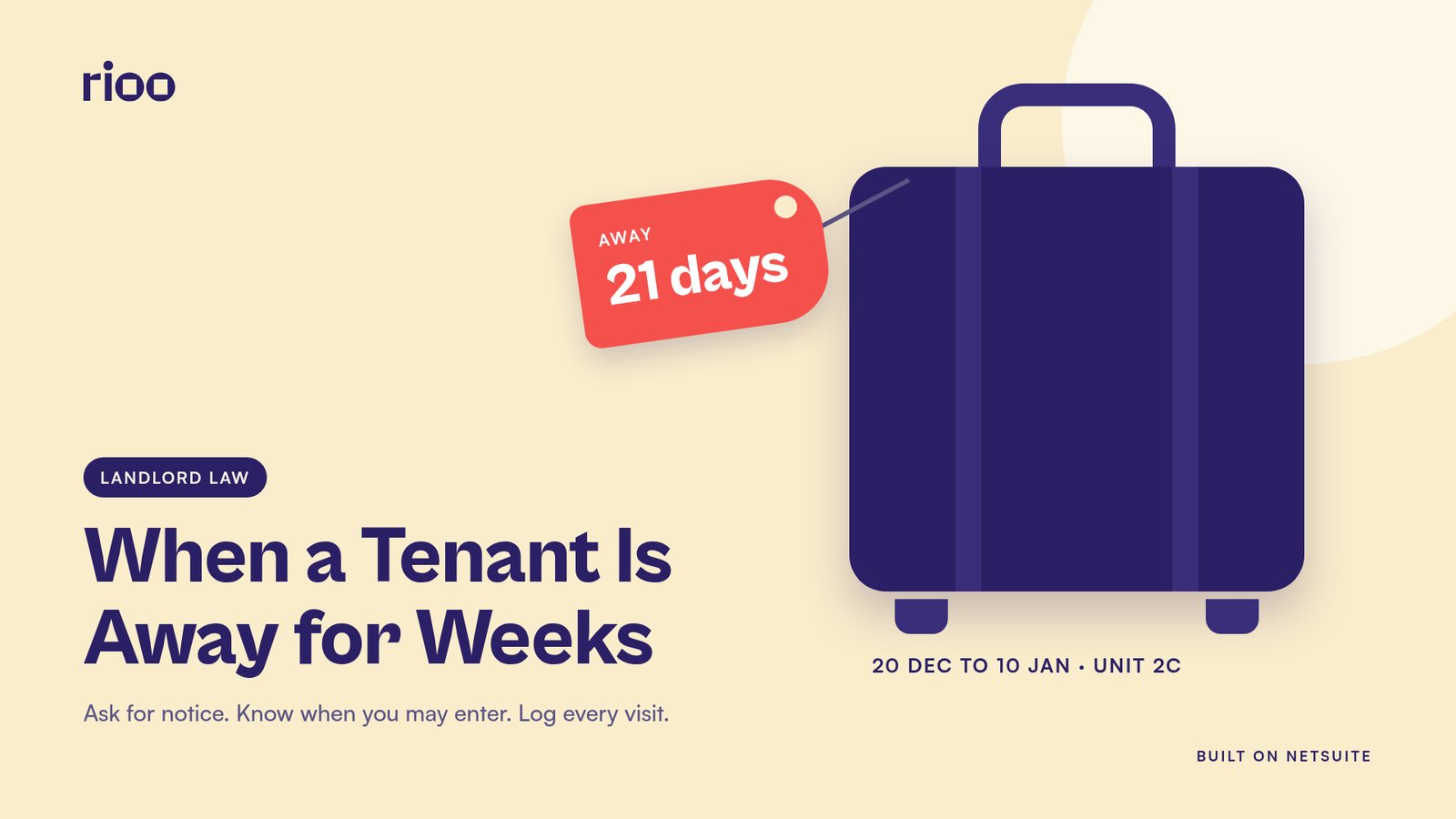
On 15 December the tenant in 2C emails the office: "We are visiting family from 20 December to 10 January. My brother Sam has a key and his number is on file." The coordinator logs the dates and adds Sam as a contact. Then she replies with a short checklist. Thermostat no lower than 55°F. Washer supply valves off. Cabinet doors under the sinks left open on the outside wall.
On 3 January the forecast drops to 9°F overnight. At 4:30 PM the building's monitoring shows the hallway outside 2C at 51°F. The maintenance lead calls the tenant and gets voicemail. He calls Sam, who is two hours away at work. Then he texts the tenant:
"Hi, this is Marco from building maintenance. Hallway outside 2C is cold and tonight is 9°F. We will check your unit at 5:15 PM to make sure the heat is running. We will photograph the thermostat and leave a note."
At 5:15 PM Marco and a second staff member enter. The thermostat reads 49°F with a dead battery. They replace the battery, the heat comes on, and by 6:00 PM the unit is at 58°F. They photograph the thermostat, leave a note on the counter, and log the entry with times and names.
A burst supply line in an outside wall can run to thousands of dollars in water damage across two floors. This visit cost one battery and 45 minutes of two people's time. Because the tenant gave notice, the team knew the unit was empty and had a contact number. Under Va. Code 55.1-1249, the entry was to protect the landlord's property during an absence over seven days.
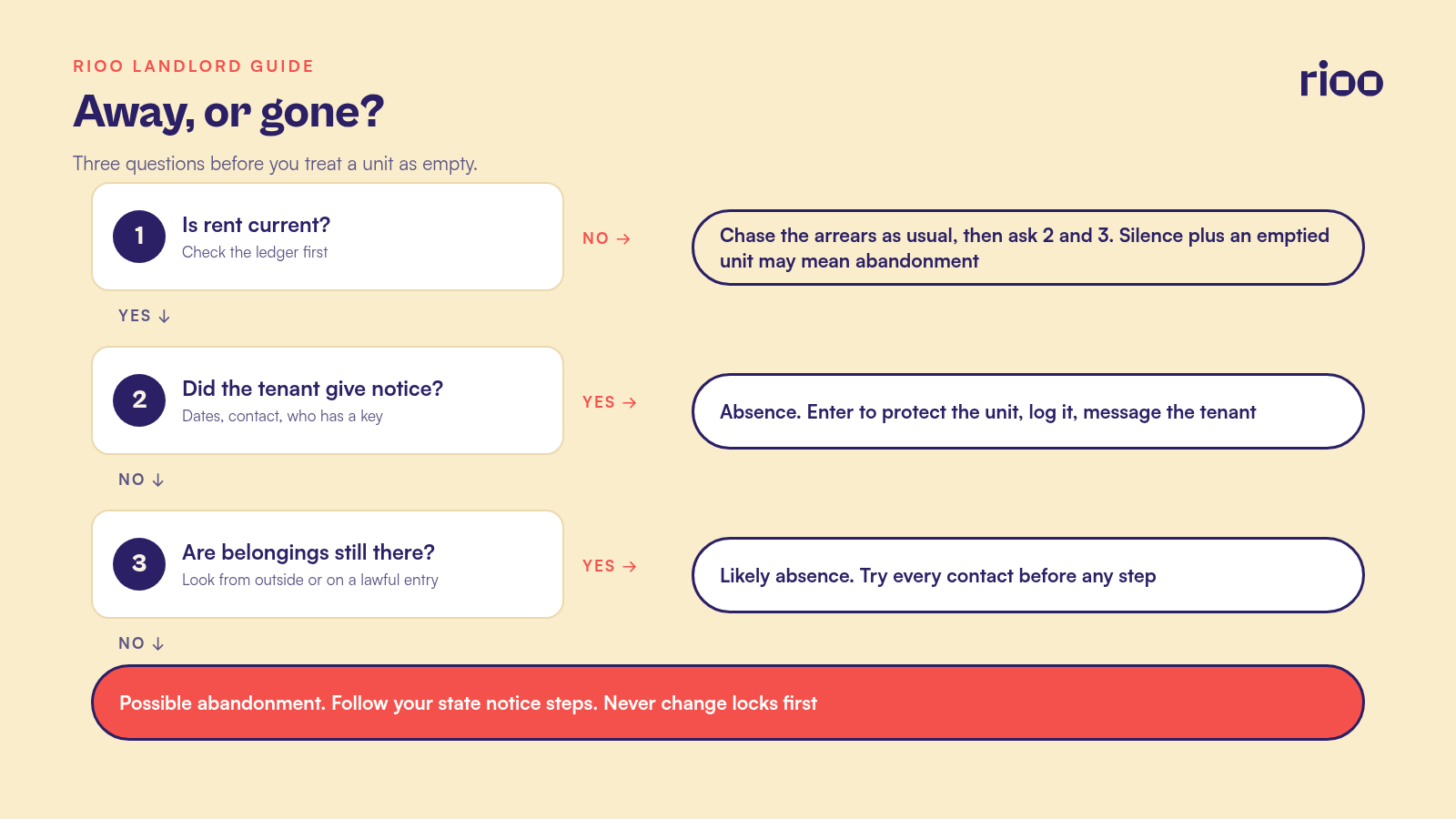
Is the tenant away, or gone?
This is where mistakes get expensive. Treating an absence as abandonment and changing the locks can be an unlawful lockout. Treating real abandonment as an absence leaves a unit empty for months.
States define abandonment in their own way. Arizona's A.R.S. 33-1370 defines abandonment two ways. One is an absence of at least seven days without notice, with rent ten days unpaid and nothing but the tenant's belongings to suggest anyone lives there. The landlord must then post and mail a notice of abandonment and wait five days before retaking the unit. Virginia lets a landlord who cannot tell send a written notice asking the tenant to confirm, within seven days, that they intend to stay. Kansas lets a landlord assume abandonment after a ten day rent default if the tenant has removed a substantial part of their belongings and has not said otherwise.
The common thread: unpaid rent plus silence plus an emptied unit points to abandonment. Paid rent plus a holiday email is an absence, however long it runs.
Answers to common absence questions
How long can a tenant be away from a rental?
As long as they keep paying rent and follow the lease. A tenant does not lose the tenancy by traveling. The lease may require notice of a long absence and may require the unit to stay heated.
Can I charge a fee if a tenant does not tell me they are away?
In Alaska, Kansas, Nebraska, Oregon and Virginia you can recover actual damages when a tenant fails to give notice the lease requires. Alaska, Kansas, Nebraska and Oregon require the failure to be willful. Alaska allows up to one and a half times actual damages. A flat fee in the lease may not hold up. Ask your attorney before adding one.
Can I enter just to check that everything is fine?
For a quick check during a freeze or after an alarm, the statutes above allow entry when reasonably necessary or to protect the premises. Kansas waits until day 30 for absence entry, so rely on its emergency rules before then. For routine visits, follow your normal entry notice rules.
Does renters insurance cover damage while a tenant is away?
It depends on the policy. Some policies limit cover for freeze damage when a unit is left unheated or unoccupied for a set period. Ask residents to check before a long trip, and see our guide on renters insurance requirements.
Does the heat have to stay on while the unit is empty?
Your lease can require a minimum setting. Local heat rules for occupied units vary by city, as set out in our guide to landlord heat requirements.
Keeping absence notices on the tenant record in RIOO
RIOO is property management software built on NetSuite. Residents can tell the office about a trip through the tenant portal, and that message stays on the tenant record with their contact details. When a freeze warning comes in, staff can check those records to see which units are empty that week. Entry visits can be logged as service requests with times and photos, which gives you a dated record if a tenant or owner asks later. RIOO tenant communication tools handle the same day message after an entry.