In the US cities that set a number, the usual legal floor for rental heat is 68°F during the day. The night figure, the season dates and the way a reading is taken change from place to place.
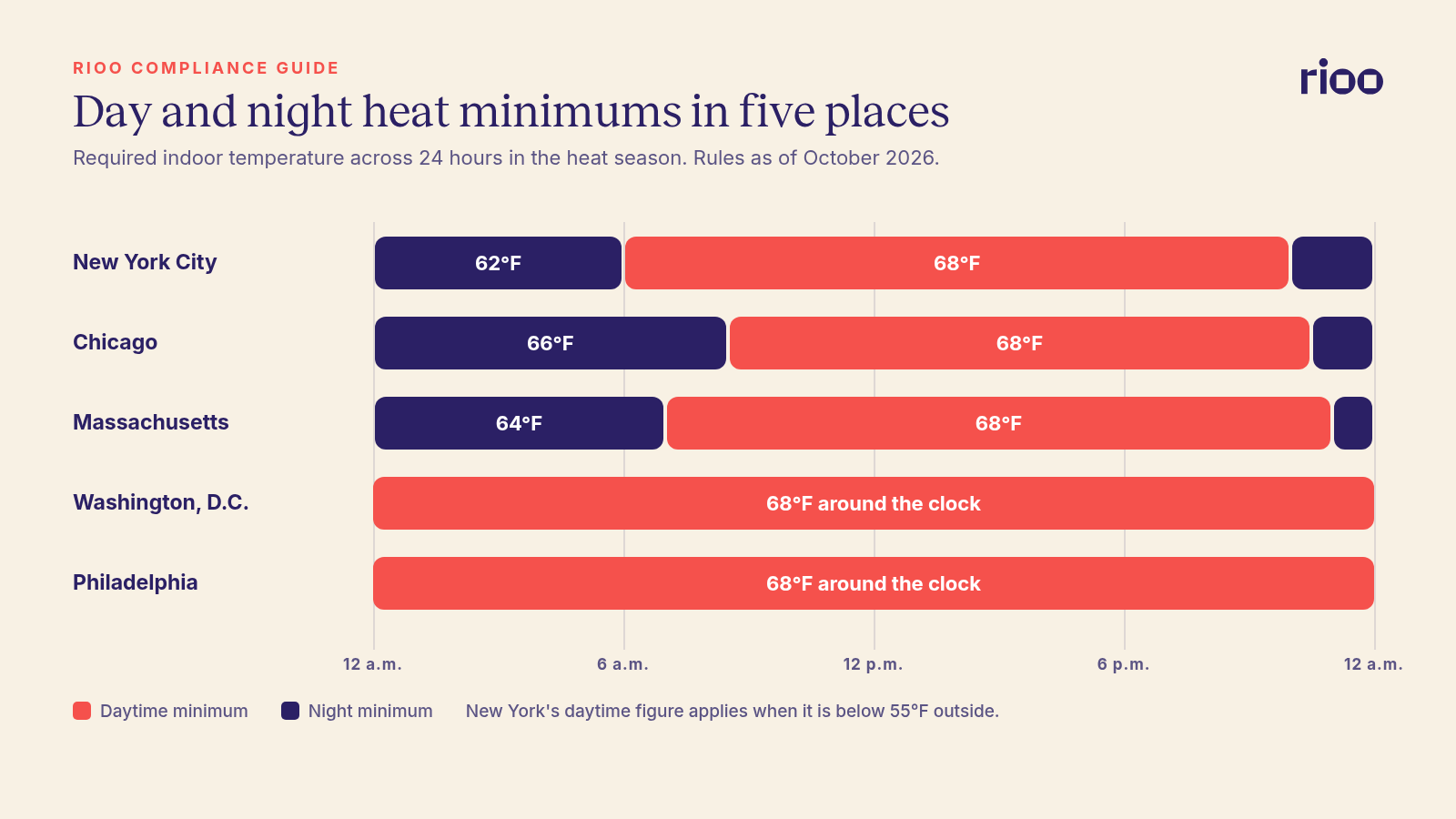
Landlord heat requirements apply when the landlord controls the heat, usually through a central boiler or furnace. They also apply to the equipment itself: every rental needs a permanent heating system that can reach the required temperature. New York City asks for 68°F by day when it is below 55°F outside and 62°F at night from 1 October to 31 May. Chicago asks for 68°F by day and 66°F at night from 15 September to 1 June. Rules are current as of October 2026. Check your local code before you rely on any figure here, because cities amend these rules and some counties add their own.
Heat rules in seven places
Each row comes from the city or state source linked under the table. Five set a night figure or a single all day figure. California sets a capability standard instead.
| Place | Heat season | Day minimum | Night minimum | Worth knowing |
|---|---|---|---|---|
| New York City | 1 Oct to 31 May | 68°F, 6 a.m. to 10 p.m., when outside is below 55°F | 62°F, 10 p.m. to 6 a.m., whatever the outside temperature | Hot water at 120°F all year. Heat violations are class C, the top tier. |
| Chicago | 15 Sep to 1 Jun | 68°F, 8:30 a.m. to 10:30 p.m. | 66°F, 10:30 p.m. to 8:30 a.m. | Two pipe buildings may hold 64°F early and late in the season. Fines run $500 to $1,000 per day, per violation. |
| Massachusetts | 15 Sep to 31 May | 68°F, 7 a.m. to 11 p.m. | 64°F, 11:01 p.m. to 6:59 a.m. | No room may go above 78°F. A local board of health can shorten the season. |
| Washington, D.C. | 1 Oct to 1 May | 68°F | 68°F | Two pipe systems that need time to switch over must start by 15 Oct. The older 65°F night figure is no longer the one enforced. |
| Philadelphia | 1 Oct to 30 Apr | 68°F | 68°F | Also on May and September days below 60°F outside. Covers two family and larger buildings, unless each unit has its own heating under the tenant's sole control. |
| Minnesota (statewide) | 1 Oct to 30 Apr | 68°F | 68°F | Written into every residential lease. Kitchens and bathrooms count. |
| California (statewide) | All year | 70°F capability | 70°F, around the clock, if the landlord controls the heat | Measured three feet above the floor. Older buildings may qualify for an exemption. |
Sources: New York City HPD, Chicago Department of Buildings, Mass.gov, D.C. Department of Buildings, City of Philadelphia, Minnesota Statutes 504B.161 and California Civil Code 1941.1. The California figure comes from Title 25, section 34 of the state's housing regulations. For D.C., the Department of Buildings said in a September 2025 administrative bulletin that it enforces the property maintenance code figure of 68°F. The older housing code still prints 68°F by day and 65°F at night, so you will see both numbers online.
Places without a number
Many states never name a temperature. Their landlord tenant law says heat must be adequate, or that heating facilities must be in good working order. Cities in those states often adopt a property maintenance code that sets 68°F in habitable rooms. So the number you must hit can come from the city, even when the state law reads vaguely. Ask the local code office which edition it enforces.
When the tenant pays for the fuel
These rules bite hardest when the landlord supplies the heat. If each unit has its own furnace or electric heaters on the tenant's meter, the duty usually shifts. The landlord must still provide equipment that can reach the minimum and keep it repaired. The tenant runs it and pays the bill. Chicago spells this out: the owner keeps the equipment, windows and walls in order, and the occupant may pay the utility.
How an inspector takes the reading
A complaint becomes a violation when a reading in the unit falls below the line at the wrong hour. Knowing where the thermometer goes stops arguments later.
- Massachusetts: five feet above the floor, on a wall at least five feet from an exterior wall.
- Philadelphia: three feet above the floor, near the centre of the room and two feet in from the centre of each exterior wall.
- Chicago: three feet above the floor, at least three feet from any exterior wall, with windows and exterior doors shut and any space heater off.
- California: three feet above the floor in every habitable room.
- New York City: the inspector also records the outdoor temperature. A daytime violation needs it to be below 55°F outside.
Use the same method for your own checks. A reading taken at the radiator tells you nothing a judge will accept. Note the time, the room, the height and who took it.
The night the boiler locked out
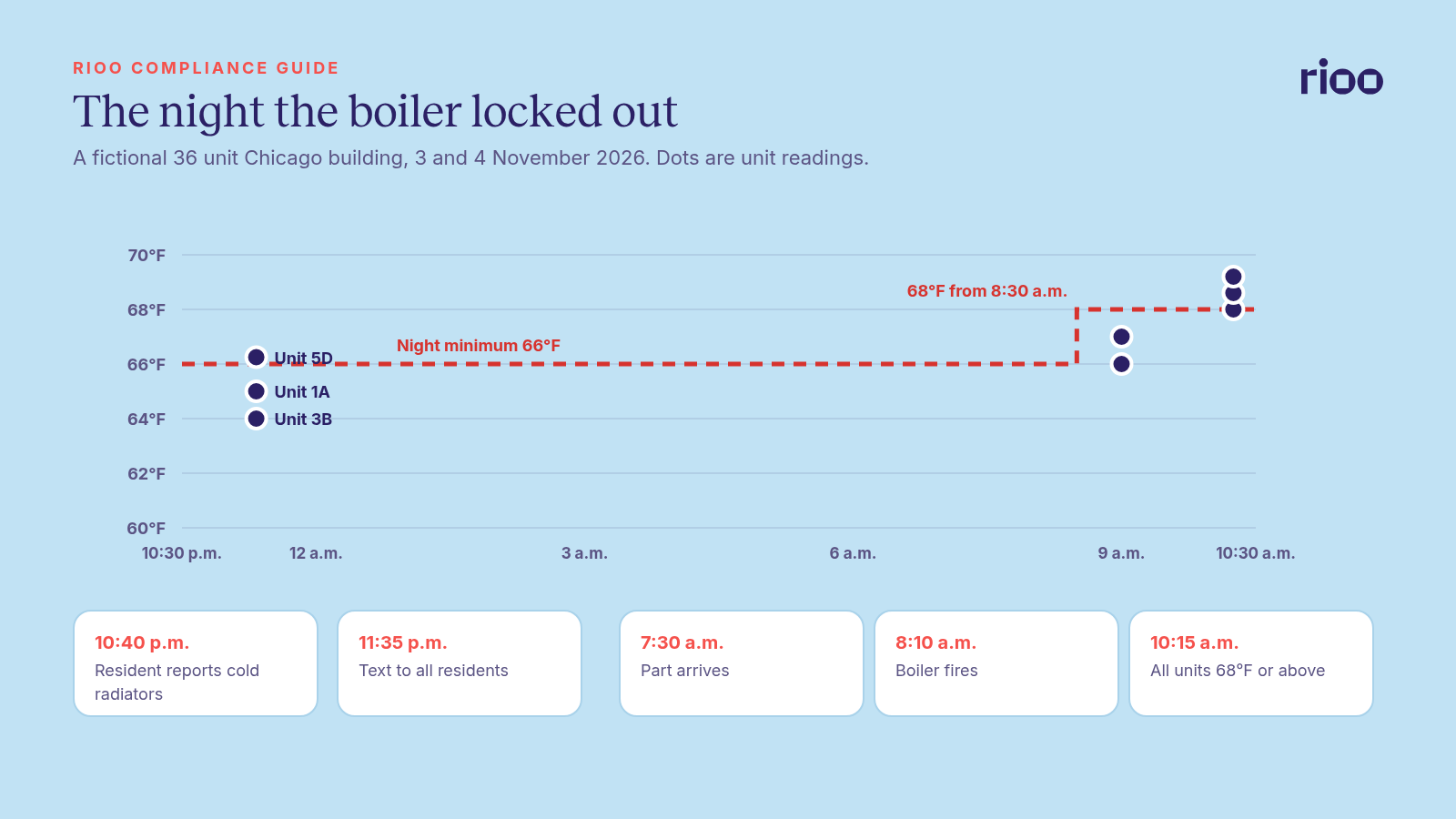
This is a fictional example. A 36 unit building in Chicago runs on one gas boiler. The dates fall in the first cold week of November 2026. Chicago treats a failed boiler during heat season as an immediate violation, whatever the cause, so the clock starts with the first cold radiator.
Tuesday 3 November, 10:40 p.m.
The resident in 3B sends a portal message. "Radiators are cold and it is getting chilly." The outdoor temperature is 31°F. The night minimum of 66°F started at 10:30 p.m.
11:05 p.m.
The on call technician reaches the boiler room. The boiler has locked out on an ignition fault. He resets it and it fires, then locks out again after twenty minutes. The flame sensor needs replacing and there is no spare on the van.
11:20 p.m.
He takes readings in three units the way the city does, three feet up and away from the outside walls. 3B reads 64°F. 1A reads 65°F. 5D, on the top floor, reads 66°F. The building is now below the night minimum in at least two units.
11:35 p.m.
The property manager sends a text to every resident. It says the boiler failed, a part is coming at 7 a.m., and staff will check on anyone who needs help tonight. Two residents with infants ask for help. The manager delivers two electric heaters as a stopgap. The log notes that space heaters do not count toward compliance.
Wednesday 4 November, 7:30 a.m.
The part arrives from the supply house. The boiler fires at 8:10 a.m. Readings at 9 a.m. show 66°F to 67°F, still under the 68°F daytime line that started at 8:30. By 10:15 a.m., all three units read 68°F or above.
10:40 a.m.
The manager closes the work order with the readings, times and part details attached. A 311 complaint arrives later that morning. The file shows when the failure started, every reading, what residents were told and when heat came back. Chicago says a hearing officer can weigh that kind of communication and mitigation when setting a fine.
Two things in that night were cheap and made the difference. A spare flame sensor would have cut the outage to under an hour. And the log turned a complaint into a short conversation.
Space heaters and other shortcuts
A portable heater handed to a resident keeps them warm. It does not satisfy the rule. Massachusetts says so directly in its sanitary code. Chicago's ordinance rules out portable space heaters, cooking appliances, water heaters and fireplaces as ways to meet the minimum. Philadelphia bars cooking appliances too.
Other shortcuts that end in a violation:
- Turning the system on late in the season to save fuel. Season dates are fixed, and in New York the night minimum applies whatever the weather.
- Setting a thermostat in the hallway and assuming the units match. Top floors and end units run colder.
- Ignoring drafts. A system can run flat out and still lose to failed weatherstripping or a broken window. Inspectors treat the unit temperature as the test, whatever the cause.
Building a heat season routine
Heat complaints tend to come from a few predictable failures. A routine catches them before the first cold night.
- September: service the boiler or furnaces, bleed radiators, test thermostats and check spare parts on hand. Our winterization checklist by climate zone covers the wider building.
- First week of the season: take readings in a sample of units, including top floor and corner units. Save them.
- Every no heat call: treat it as an emergency, with readings at arrival and at closeout.
- Every cold snap: check that residents know how to reach staff after hours.
Managing in Massachusetts? Heat is one part of a longer list in our guide to the Massachusetts sanitary code. Heat also sits inside every state's habitability duty. Our Minnesota habitability and rent escrow guide shows what tenants can do when repairs stall.
Logging heat calls in RIOO
RIOO sorts maintenance requests by priority. No heat in winter is in the emergency tier, attended first on any day. See service requests and tasks for how priorities and targets are set. An emergency request can go straight to the on call technician as a high priority work order, with the boiler's service history on their phone.
Each work order keeps its notes, photos and status history on the unit record. Readings and times can go in the closeout notes, which gives you the file from the Chicago example. RIOO does not control the boiler. Live heating control stays with your building systems, and RIOO holds the request, the work and the record. The RIOO maintenance platform page explains what is in scope.
Heat complaints: short answers
What temperature must a landlord keep an apartment at?
Where a number is set, 68°F during the day is the common floor. Night minimums run from 62°F in New York City to 68°F in Washington, D.C., Philadelphia and Minnesota. California uses 70°F. Check your city code, because local rules can be stricter than the state.
When does heat season start?
It depends on the place. Chicago and Massachusetts start on 15 September. New York City, Washington, D.C., Philadelphia and Minnesota start on 1 October. California has no season; the standard applies all year.
How fast must a landlord restore heat?
Housing codes generally treat loss of heat as an emergency. In Massachusetts, once a board of health finds a violation, the owner must make a good faith effort to correct it within 24 hours. New York City treats heat violations as immediately hazardous. Restore heat as fast as parts allow and record each step.
Does a landlord have to provide heat if the tenant pays for gas?
The landlord still has to provide working equipment that can reach the minimum and keep it repaired. The tenant may pay to run it, if the lease says so. A broken furnace is still the landlord's problem.
Can a tenant withhold rent for no heat?
Some states allow rent escrow or repair and deduct remedies when a landlord fails to fix a serious condition. The steps and notice rules are strict and differ by state. Talk to local counsel before you respond to a withholding notice.
This article is general information, not legal advice. Heat rules change, and a city or county may set stricter limits than the state.