Since 1 April 2025, many California landlords have had to offer every new tenant a choice at lease signing. Should their on time rent be reported to a credit bureau, or not? Tenants already in place on 1 January 2025 were due the same offer by 1 April 2025. Either way, the offer has to come back at least once a year.
Positive rent reporting means sending a record of complete, on time rent payments to a consumer reporting agency, so they can count toward the tenant's credit file. Late or missed payments are not part of it. In California, Civil Code section 1954.07 (passed as AB 2747) makes the offer mandatory for covered landlords. The tenant can say yes, no, or yes later. The landlord may charge a fee of up to $10 a month, or the actual cost if lower. Outside California the offer is usually voluntary, but the same mechanics apply if you choose to run it. This guide is written from the leasing office side: who has to offer it, what the paperwork must say, and how one lease plays out over a year. Rules are stated as of October 2026.
Does your building have to offer it?
Every building with more than 15 units is covered. Smaller buildings are exempt unless the owner fits two tests, and those tests are about who owns the building, not its size. Work through three questions.
Question 1: Does the building have more than 15 units?
If yes, you must offer reporting. Stop here. If the building has 15 or fewer units, go to question 2.
Question 2: Does the same landlord own more than one residential rental building?
If no, the building is exempt. If yes, go to question 3. The size of the other buildings does not matter.
Question 3: Is the landlord a REIT, a corporation, or an LLC with at least one corporate member?
If yes, the small building is covered after all. If the owner is an individual, a partnership or an LLC owned only by people, it stays exempt.
Assisted housing developments, as the Government Code defines them, are outside the rule entirely. Read the statute at California Civil Code 1954.07 for the exact wording. If you manage for many owners, record each owner's answer to these questions when you onboard the property. Ownership structure is easy to forget by the time a renewal comes round.
What the written offer must include
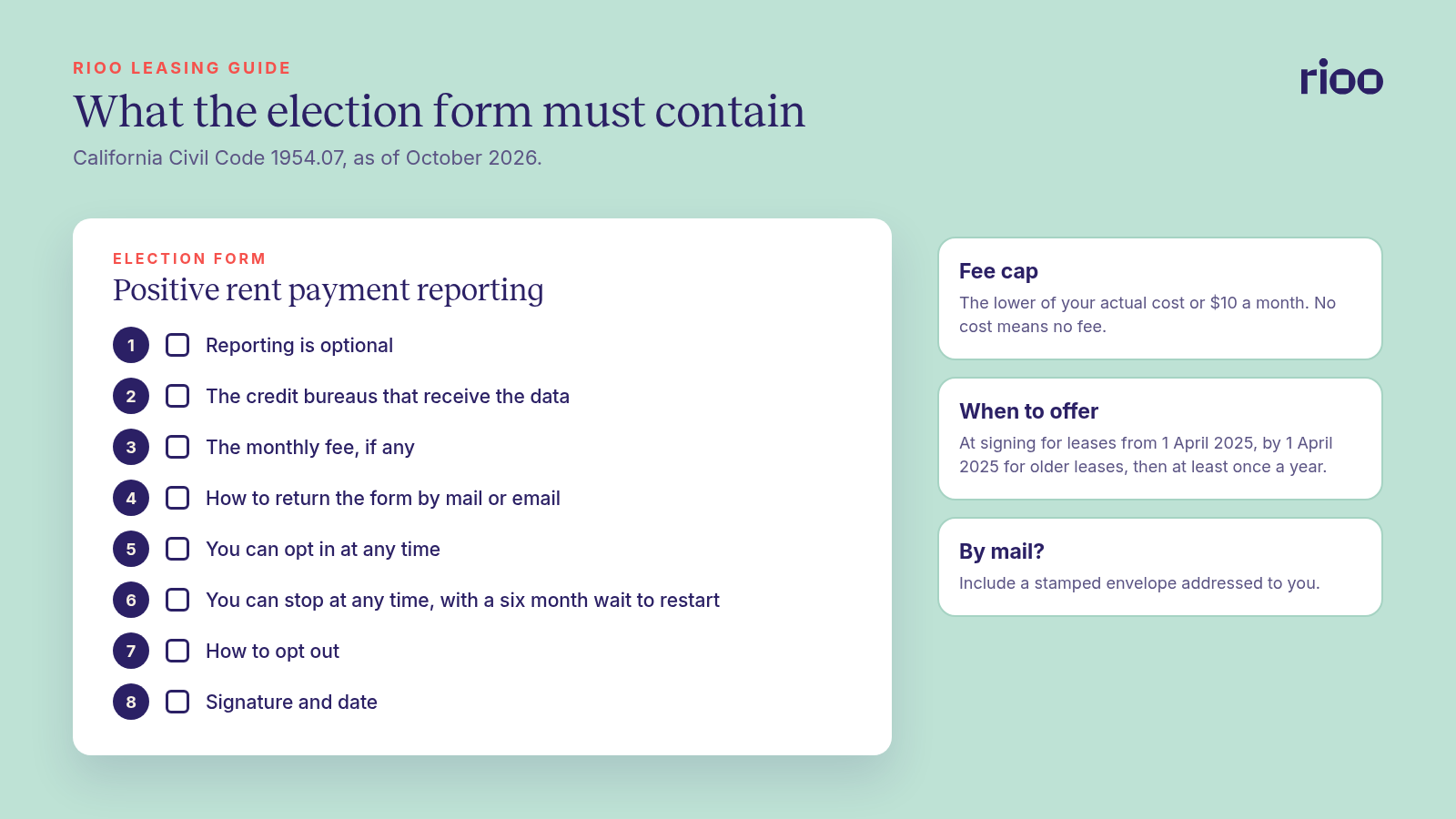
The offer goes by first class mail or email. It must come with a written election form, and the statute lists what that form contains.
- A statement that reporting is optional.
- The name of each consumer reporting agency that will receive the data.
- The amount of any monthly fee.
- How to return the election by mail or email.
- A statement that the tenant can opt in at any time after the first offer.
- A statement that the tenant can stop at any time, but cannot restart for at least six months.
- How to opt out.
- A signature block for the tenant to date and sign.
If you send the offer by mail, include a stamped envelope addressed to you. Tenants can ask for extra copies of the form whenever they like, and you must send them.
The reporting agency has to be one of the nationwide credit bureaus, or a service that passes the data on to one. Many landlords use a rent reporting service rather than reporting directly. Ask the service which bureaus it reports to, and put those names on the form.
The fee, and what happens when it goes unpaid
You may charge a tenant who opts in. The cap is the lower of your actual cost or $10 a month. If reporting costs you nothing, you can charge nothing.
The fee comes with protections that change how your ledger works:
- Rent payments cannot be applied to the fee. A payment is rent first, whatever the memo line says.
- An unpaid fee is never grounds to end the tenancy.
- You cannot take an unpaid fee out of the security deposit.
- Paying or not paying the fee is never reported to a bureau.
- After 30 days unpaid, you may stop reporting. The tenant then waits six months from the date the fee first fell due before opting in again.
One more protection matters for maintenance. If a tenant lawfully withholds rent or uses repair and deduct, and tells you before rent is due, that payment does not count as late.
Set the fee up as its own charge code, separate from rent. If your rent allocation rules put payments against the oldest charge first, check that they never touch the reporting fee.
What residents ask at lease signing
Will this raise my credit score?
It can help, especially for someone with a thin file. Each bureau and scoring model treats rent data in its own way, so make no promises. Say what the law says: on time payments get reported, missed ones do not.
What if I pay late one month?
Under the California rule, only complete and timely payments are reported. A late month is simply not sent.
Can I sign up later?
Yes. A tenant can return the election at any time after the first offer. They will also see the offer again at least once a year.
Can I stop?
Yes, with a written request. After stopping, they cannot restart for at least six months.
Does it cost anything?
Only what your form says, and never more than $10 a month.
Dana's first year on the lease
This is a fictional example that shows how the pieces fit. A 12 unit building in Sacramento is owned by an LLC. The LLC's sole member is a corporation that also owns a 20 unit building nearby. Under question 3, the small building is covered.
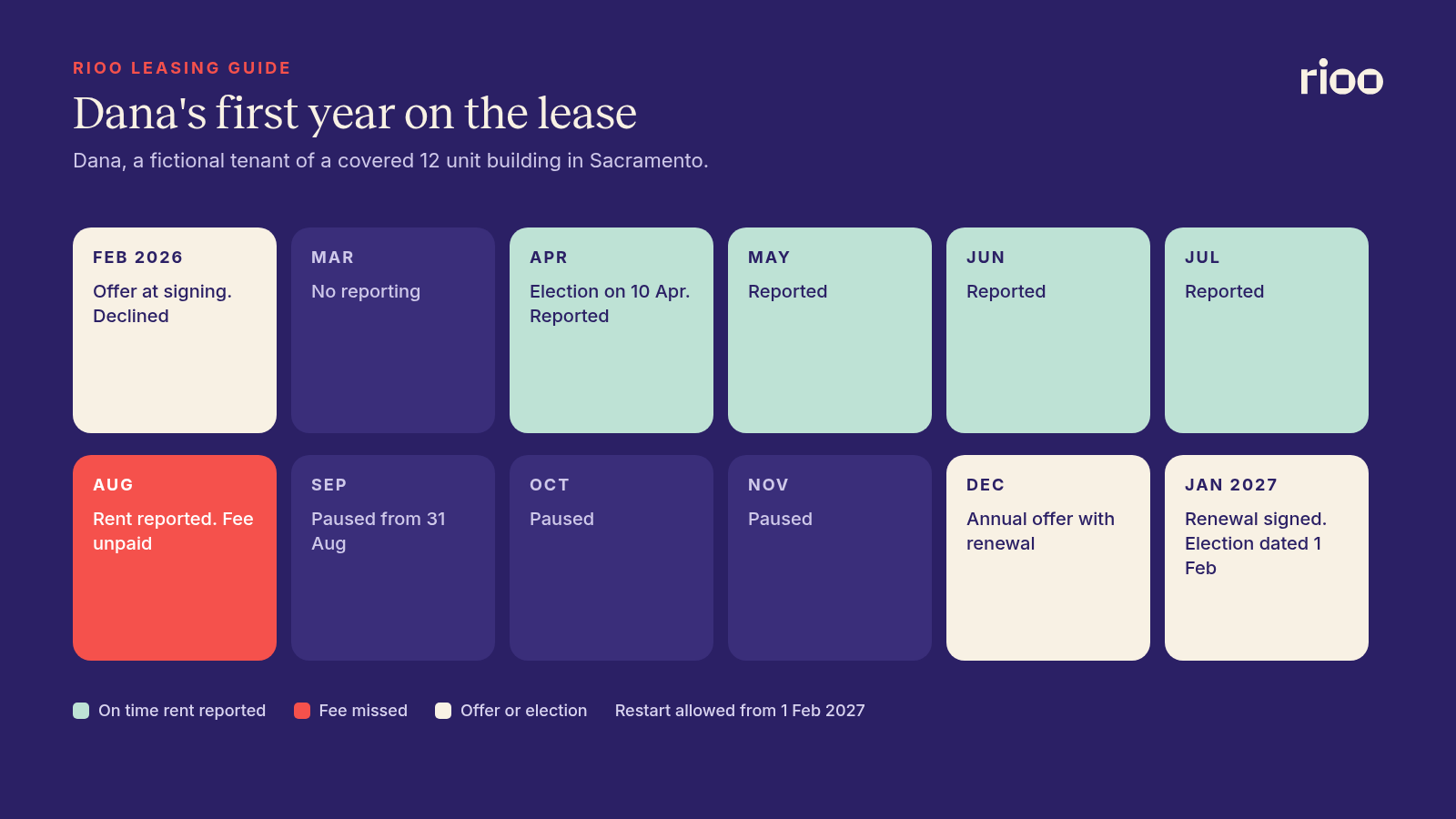
1 February 2026. Dana signs a 12 month lease for unit 7 at $1,950 a month. The lease packet includes the rent reporting offer and election form by email. The landlord's reporting service charges $4.50 per tenant each month, so the form shows a $4.50 fee. Dana declines at signing.
10 April. Dana is planning to finance a car and emails back a signed election. The leasing agent sets up the $4.50 monthly charge and enrols her with the service. April's rent, paid on the 1st, is the first payment reported.
May to July. Rent and fee are paid on time. Three more months go to the bureau.
1 August. Dana pays $1,950 but not the $4.50 fee. The payment goes to rent, as the law requires. August rent is reported as paid on time.
31 August. The fee is 30 days unpaid. The landlord may stop reporting and does. The leasing office emails Dana to say so. It also explains that she can opt in again from 1 February 2027, six months after the fee first fell due. Her deposit is untouched and her tenancy is unaffected.
December. The renewal offer goes out for a 1 February 2027 start. The annual rent reporting offer travels with it, with a fresh election form. Dana signs the renewal in January. The leasing agent reminds her that the election only counts from 1 February, so she returns it that day and February rent is reported.
Two habits kept this clean. The fee had its own charge code, so it never ate into rent. And every message about the election was saved on Dana's tenant record, which is where an auditor or a court would look first.
Offering rent reporting outside California
In other states, rent reporting is generally a choice. Some operators offer it as a resident benefit. Others use it as a renewal incentive. Either way, run it as an opt in with clear consent.
If you report directly to a bureau, you become a furnisher under the federal Fair Credit Reporting Act. Furnishers must send accurate data, fix errors and investigate disputes, usually within 30 days. The FTC explains these duties in Consumer Reports: What Information Furnishers Need to Know. Using a reporting service moves much of this work off your desk, but you still need to send it correct payment data.
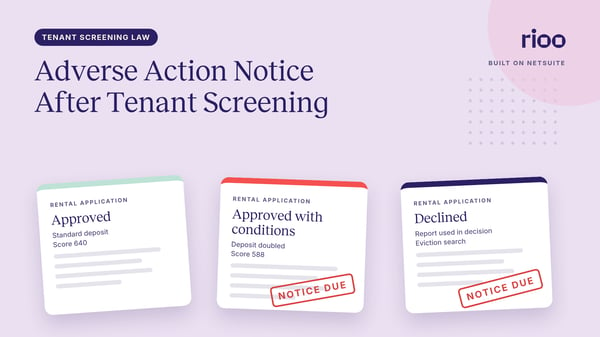
Keep rent reporting and screening separate in your process. Screening uses reports about applicants. Reporting sends data about residents. When a screening report affects an approval, a different duty applies. Our guide to the adverse action notice after tenant screening covers that step.
Managing in California? The rent reporting offer sits alongside the other items in our California lease disclosures checklist. The annual offer pairs well with your lease renewal offer letter, so residents see both together.
Keeping the annual offer on schedule in RIOO
RIOO keeps leases, renewals and tenant messages on one record in NetSuite. That makes the annual offer a scheduled task rather than something a leasing agent has to remember.
With contracts and renewals, lease packets are built from your templates. The rent reporting offer and election form can go in as a standard document for covered properties. Tenant communication tools handle scheduled reminders, templates and email, with delivery tracking and a full history on each tenant and lease record. A signed election can be stored with the lease. The reporting fee can be a separate recurring charge on the tenant ledger, so rent allocation never touches it.
The reporting to the bureaus is done by the service you choose. RIOO holds what that service relies on: the offer, the election, the charges and the payment record.
This article is general information, not legal advice. Confirm how the rule applies to your buildings with California counsel.