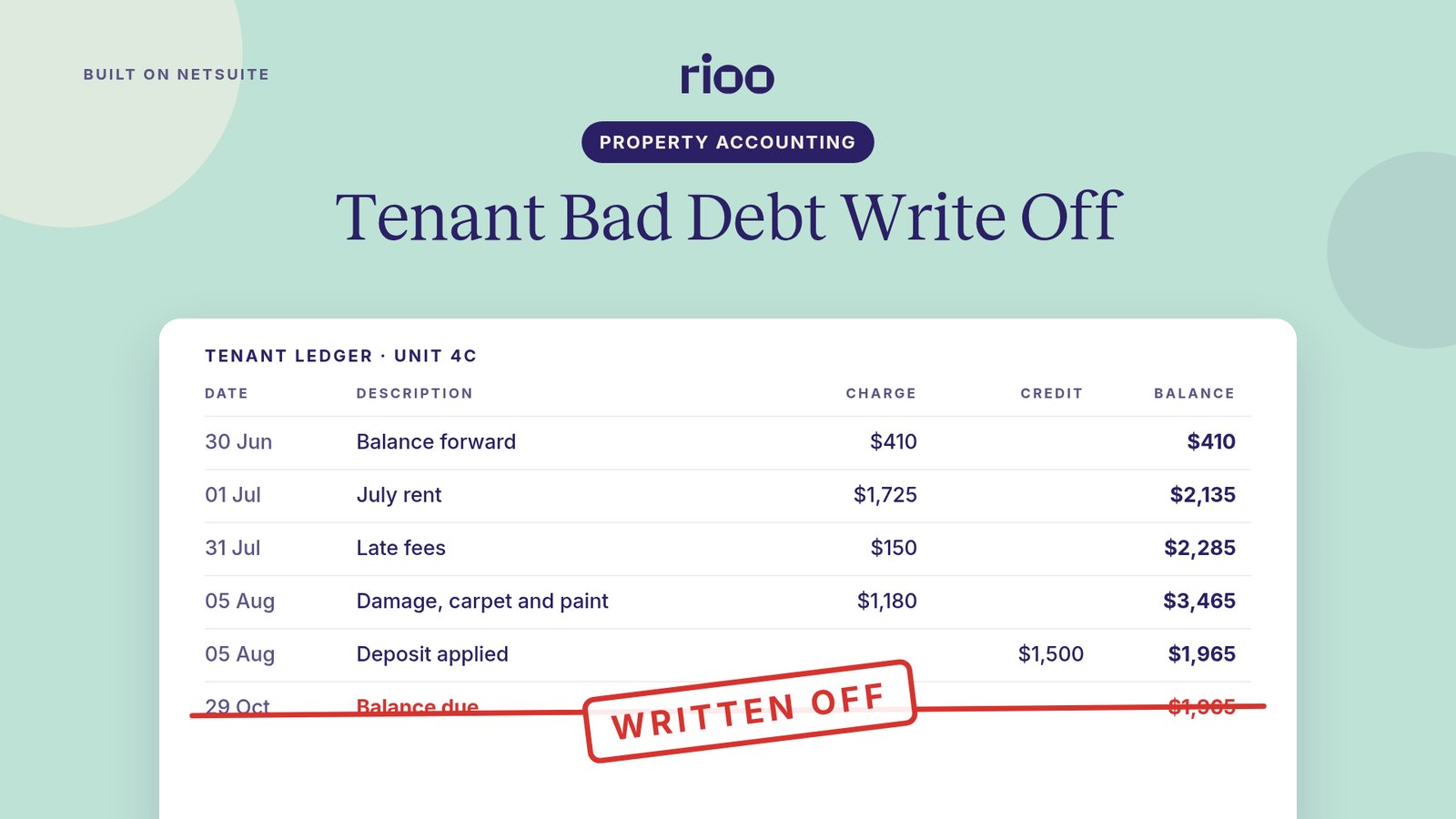
Unit 4C. Moved out 31 July 2026. Balance after the deposit: $1,965. Last payment: 3 June. Demand letter sent 14 August, no reply.
A tenant bad debt write off is the entry that takes a balance like that off your receivables once you no longer expect to collect it. You apply the deposit first, wait for the date your policy sets, then post the write off against your allowance or as bad debt expense. The receivable leaves your books but the debt still exists, so collections can continue. Any later recovery is booked as a new entry. The sections below follow the 4C balance from move out to a partial recovery the next year. The figures are fictional and the treatment is general. Confirm the details with your accountant, because policies and frameworks differ.
The deposit comes off first
The deposit is a liability you hold for the tenant. At move out it settles what the lease allows, and only the rest becomes a possible write off.
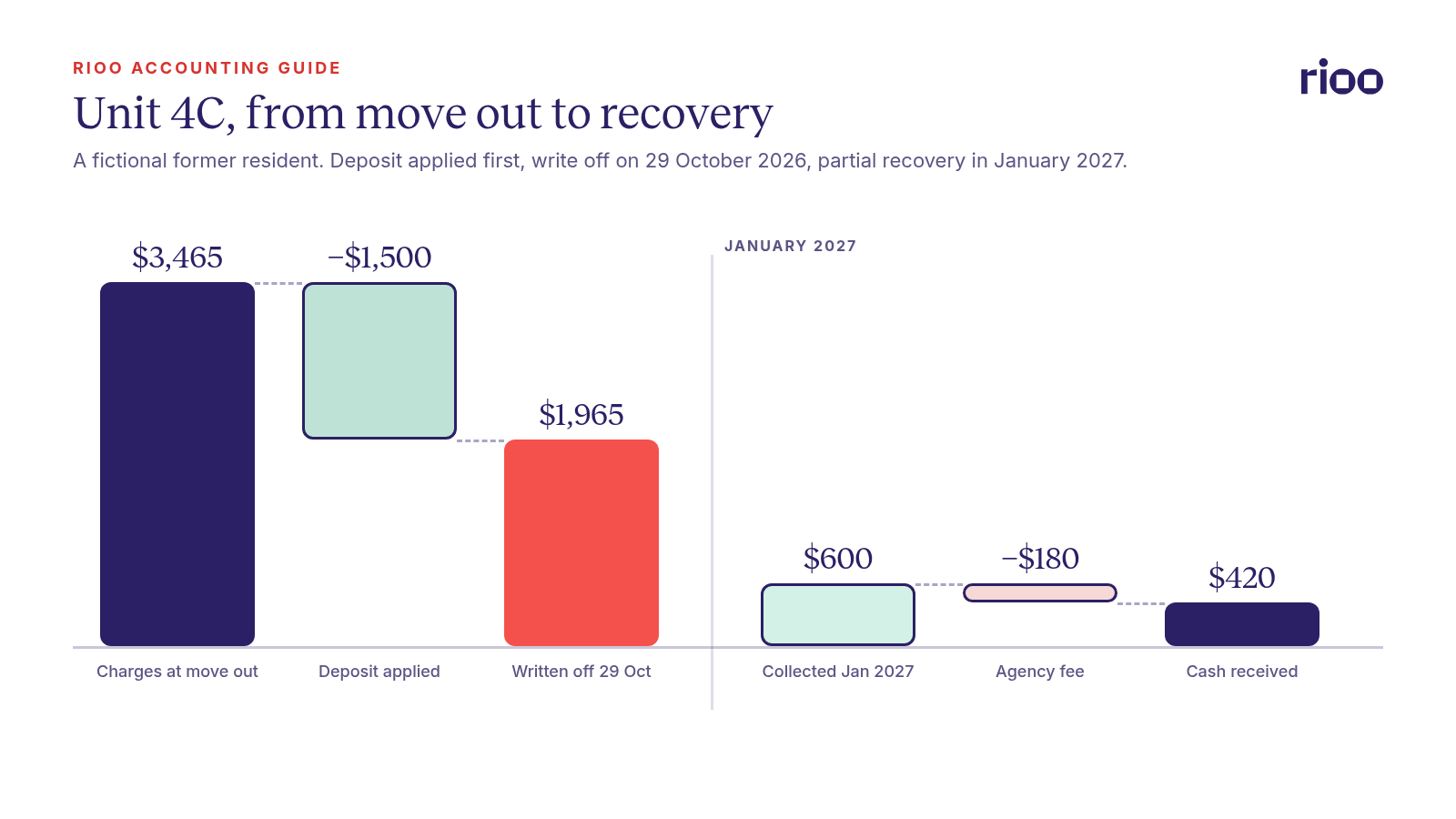
In our example the resident left owing four things. July rent of $1,725 was unpaid. $410 was still open from June. Late fees came to $150. The move out inspection found $1,180 of damage beyond normal wear, mostly carpet and paint. That is $3,465 in total.
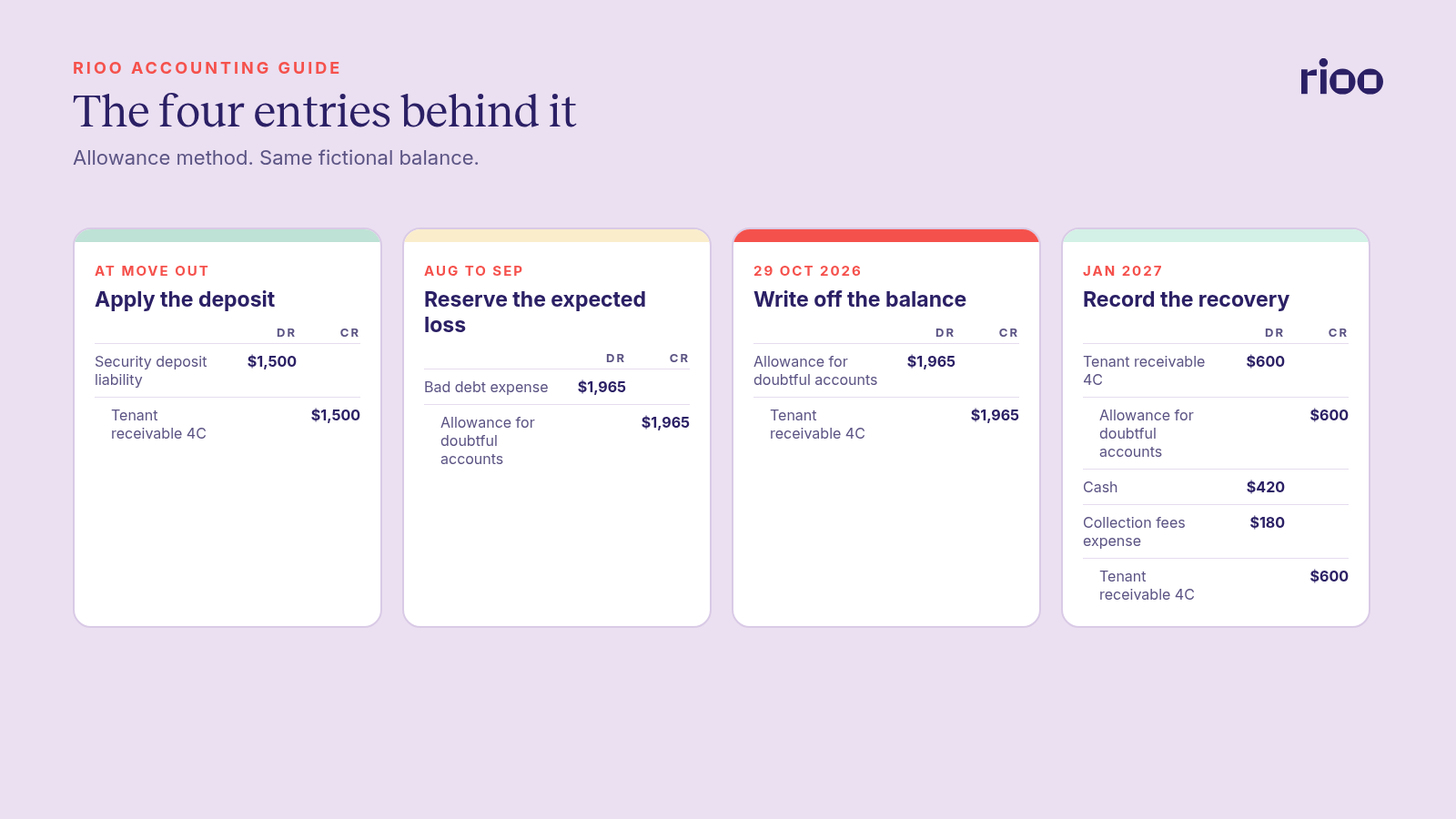
The deposit was $1,500. The entry applies it against the receivable:
| Entry | Debit | Credit |
|---|---|---|
| Security deposit liability | $1,500 | |
| Tenant receivable, unit 4C | $1,500 |
That leaves $1,965. Send the itemized statement within your state's deadline, or the deduction itself can be challenged. Our guide to security deposit accounting from intake to reconciliation covers the liability side in more detail.
A written policy sets the date
Write offs drift when nobody owns the date. A written policy fixes it, and the policy should be the same for every property.
Common triggers, often used together:
- A set number of days after move out with no payment, often 60 or 90.
- A returned demand letter or no valid contact details.
- A bankruptcy filing, which stops collection on that debt.
The 4C balance falls under a 90 day rule. The resident moved out on 31 July, so the write off date is 29 October 2026. Our post on who owns an unpaid balance after move out sets out the handoff calendar that leads up to this date.
Who approves it
A write off removes money from the books, so it needs a second person. Set thresholds by amount. For example, a property manager approves up to $500, the controller approves up to $5,000, and the owner signs anything larger. The person who applies tenant receipts should never be the one who writes off balances.
Allowance or direct write off
There are two ways to recognize the loss. Pick one and use it consistently across properties.
The allowance method. Each month you estimate how much of the open receivable you will not collect and hold a reserve for it. When you write off a balance, it comes out of the reserve. The expense lands in the month the risk appears, which matches it to the rent it relates to. Owners who report under GAAP generally need this or the lease income rule below, not the direct method.
The direct write off method. You record nothing until a balance is written off, then take the whole amount as expense that month. It is simpler. It can also make one month look much worse than it was, and auditors may not accept it for material balances.
Residential operators often show bad debt as a reduction of revenue in the operating statement rather than as an operating expense. Either way, report it on its own line. Owners compare it with gross potential rent, and our post on multifamily rent collection KPIs shows the ratios they watch.
Operating leases under ASC 842
Residential and commercial leases are usually operating leases for the landlord, and ASC 842 adds a lessor rule on top. If collecting the remaining lease payments is no longer probable, lease income is limited to cash received. Any straight line rent receivable is reversed against lease income in that period. The hit lands in revenue, which is one reason many operators show bad debt there. Ask your auditor how your firm applies it alongside any general reserve.
The entry on 29 October
On 29 October the controller approves the $1,965 write off for 4C. Under the allowance method the entry uses the reserve that was built in August and September.
| Entry on 29 October 2026 | Debit | Credit |
|---|---|---|
| Allowance for doubtful accounts | $1,965 | |
| Tenant receivable, unit 4C | $1,965 |
Under the direct method you would debit bad debt expense instead of the allowance.
Check one detail before you post. Did the $150 of late fees ever go to income? Some owners only record late fees when they are paid. If yours were never booked as income, they are not part of the write off. In that case the receivable would show $1,815, and the write off follows it.
Write offs inside RIOO and NetSuite
In RIOO, an unpaid balance after move out stays an open receivable on the tenant's NetSuite customer record. From there it can go to collections or be written off, and bad debt is visible by property. The move in and move out page shows how each step maps to the ledger.
Approval chains can be set for write offs at property or community level, with amount thresholds, backup approvers and an audit trail. The same NetSuite roles keep cash application and write off authority apart. Our page on audit trail and controls lists the separations finance teams usually set.
The debt outlives the entry
Writing off a balance is an accounting decision. The former tenant still owes the money unless you settle or forgive it.
Keep a memo record of every written off balance. Note the amount, the date, the collection agency if one is used and any payment plan. In our example the balance went to an agency on 15 September on a 30% contingency fee. Agencies report to you monthly. Reconcile their report to your memo list, not to your live receivables.
Check the law before you hand anything over. Collection agencies follow federal and state debt collection rules. Some states also limit what a landlord can charge, such as late fees. Charging only what the lease and law allow keeps the balance defensible.
When money comes back in January
In January 2027 the agency collects $600 from the former resident. It keeps its $180 fee and sends you $420.
First, reinstate the part that was recovered. Then record the cash and the fee:
| Entry in January 2027 | Debit | Credit |
|---|---|---|
| Tenant receivable, unit 4C | $600 | |
| Allowance for doubtful accounts | $600 | |
| Cash | $420 | |
| Collection fees expense | $180 | |
| Tenant receivable, unit 4C | $600 |
Reinstating first keeps the tenant's history complete. If the same person applies again, the record shows the debt, the write off and the payment. Some teams credit a bad debt recovery line instead of the allowance. That works too if it is applied the same way every time.
Owner statements and the tax return
If you manage for third party owners, the bad debt belongs to the owner. Post it in the owner's books, show it on the owner statement and follow the approval terms in the management agreement. An owner should never find a write off for the first time in a year end pack.
Tax treatment depends on the owner's accounting method. The IRS says a cash basis landlord cannot deduct uncollected rent, because it was never reported as income. An accrual basis landlord who already reported the rent as income may be able to deduct it as a business bad debt. See IRS Publication 527 and confirm the treatment with a tax adviser. Note the date and reason for each write off in the file. That support matters if the deduction is questioned.
At year end, review the reserve against what was actually written off and recovered during the year. If you reserved far more than you lost, your estimate needs adjusting. Our guide to year end close adjustments covers that review alongside the other once a year entries.
Tenant bad debt, answered
When should you write off a tenant balance?
When your policy trigger is met and you no longer expect to collect through normal efforts. Common triggers are 60 or 90 days after move out with no payment, a bankruptcy filing, or no way to reach the former tenant.
Is bad debt an expense or a reduction of revenue?
Both are used. Many residential owners show it as a deduction from rental revenue in the operating statement. Others report it as an operating expense. Under ASC 842, uncollectible operating lease payments reduce lease income. Use one approach and disclose it.
Does writing off a balance stop collection?
No. It changes your books, not the tenant's obligation. You can keep collecting directly or through an agency, within debt collection rules.
What happens if a written off tenant pays later?
Reinstate the recovered amount on the receivable, then record the cash against it. Any agency fee goes to expense. The tenant's ledger then shows the full history.
Can you write off a balance while the tenant still lives in the unit?
Policies differ. Many teams reserve for a current resident's arrears but write off only after move out or a judgment. A write off on a live lease can confuse later notices and court filings.