You owe a rental applicant an adverse action notice whenever a screening report plays any part in a decision that leaves them worse off. That covers a denial. It also covers an approval that comes with a cosigner, a bigger deposit or higher rent than you would ask of someone else. The rule comes from the Fair Credit Reporting Act, section 615(a), and it applies even when the report was a small factor.
The notice itself is short. It names the screening company and says that company did not make the decision. It also tells the applicant they can get a free copy of the report within 60 days and dispute anything wrong in it. If you used a credit score, you add the score and the factors that pulled it down. This guide shows which decisions need a notice, works through one conditional approval, and ends with a sample you can adapt.
Decisions that trigger a notice
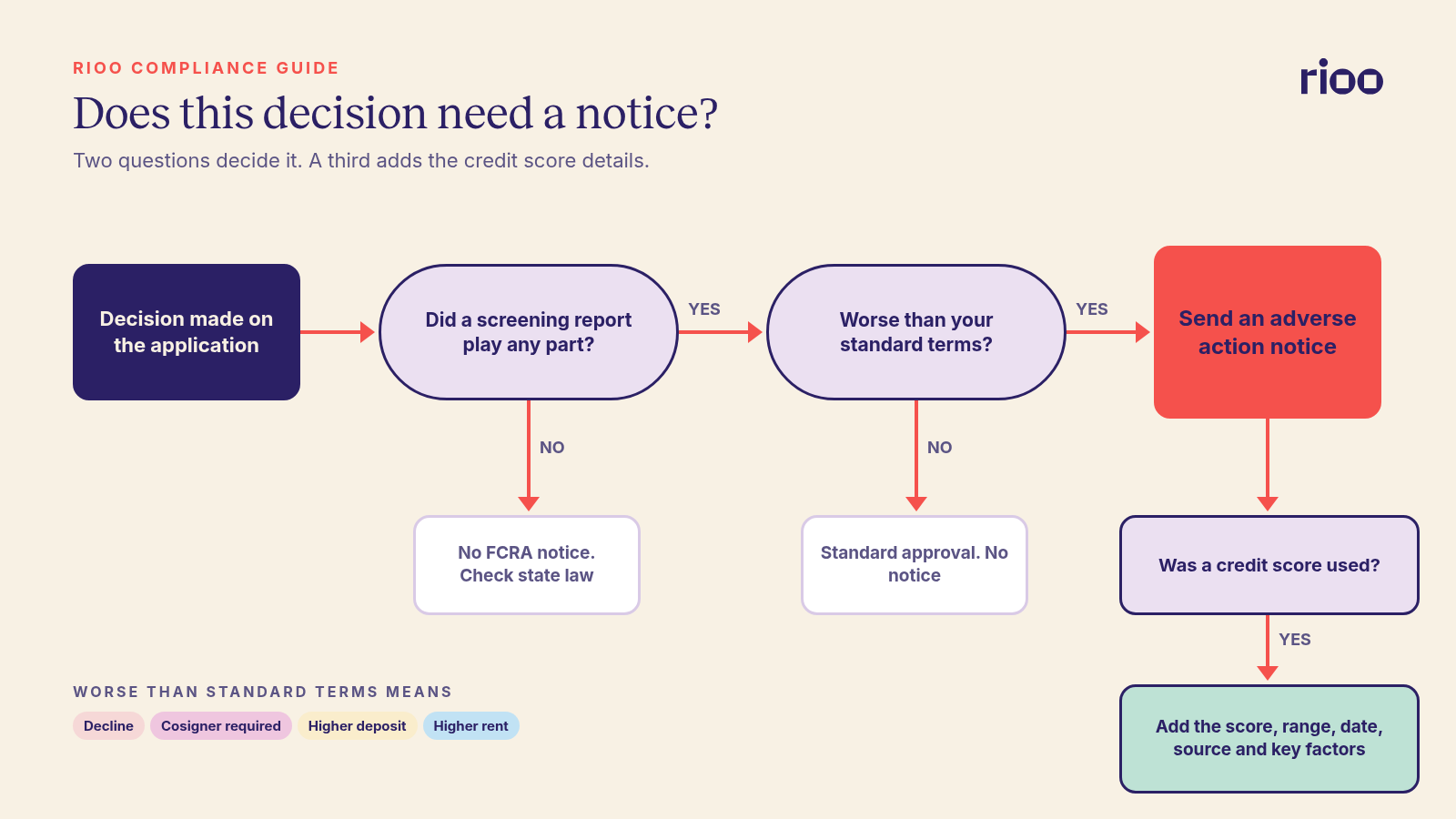
Ask two questions about every decision. Did a consumer report play any part? Is the result less favourable than your standard terms? If both answers are yes, send the notice. A consumer report here means anything a screening company sends you. That covers credit reports, eviction and criminal record searches, risk scores, and reference checks run by an outside service.
| Your decision | Report played a part? | Notice needed? |
|---|---|---|
| Decline the application | Yes | Yes |
| Approve, but only with a cosigner or guarantor | Yes | Yes |
| Approve with a deposit other applicants would not pay | Yes | Yes |
| Approve at a higher rent than the listed rent | Yes | Yes |
| Decline for low income and a weak credit report together | Yes, in part | Yes |
| Raise rent at renewal after pulling a fresh report on the tenant | Yes | Yes |
| Approve on your standard terms | Yes | No |
| Decline because pay stubs you checked yourself fall short, with no report ordered | No | Not under the FCRA. Check state law. |
The fifth row catches people out. Your written criteria might say an applicant needs income of three times the rent and a clean credit report. If both fail, income alone could have sunk the application. The FTC still treats the report as part of the decision, so the notice is still due.
One applicant, one doubled deposit
Here is how a routine conditional approval plays out. The applicant and the building are fictional.
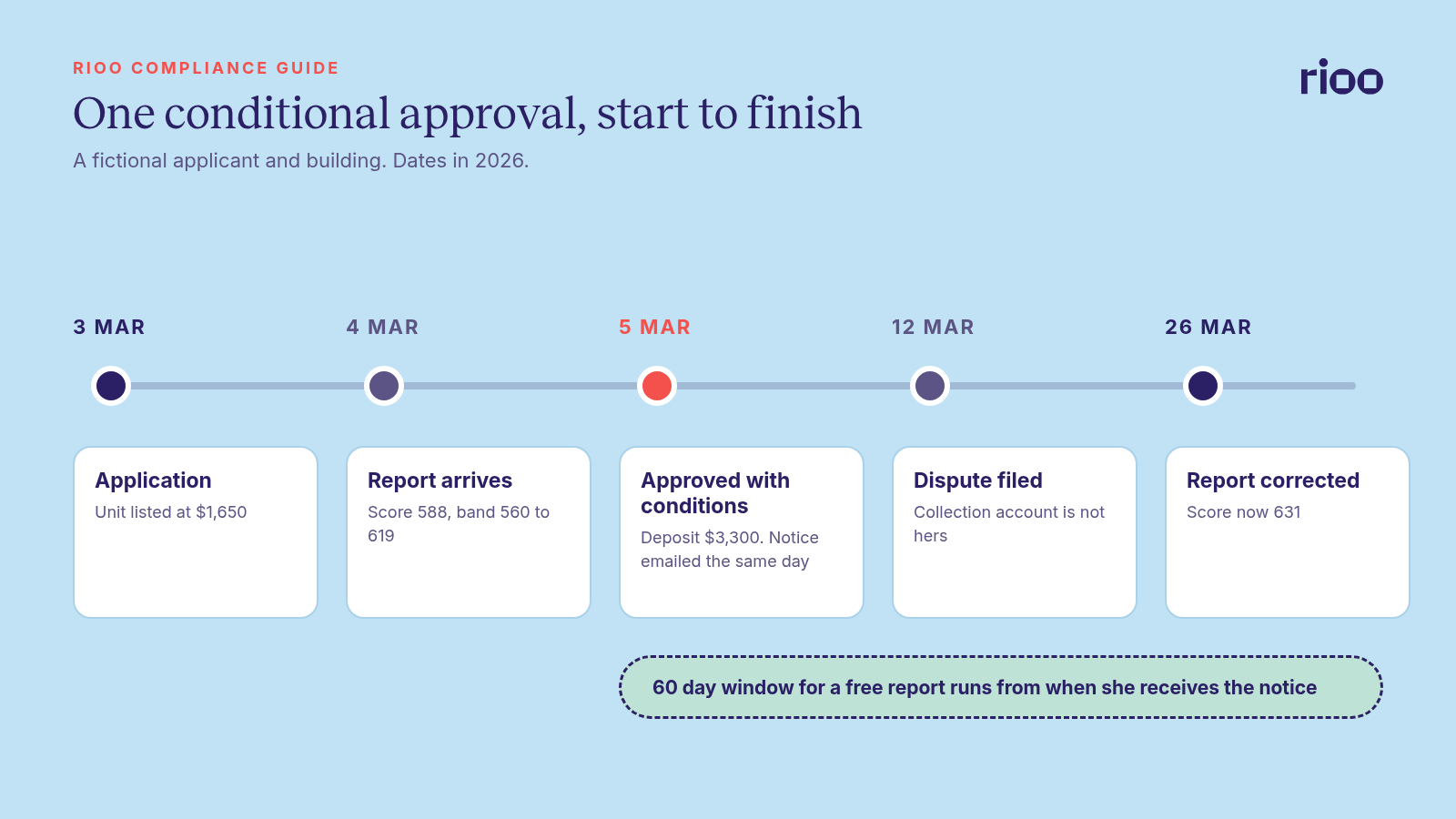
Maya applies on Tuesday 3 March 2026 for a two bedroom unit listed at $1,650 a month. The building sits in a state with no cap on security deposits. The written criteria say applicants with a credit score of 620 or higher pay a deposit of one month's rent. Applicants between 560 and 619 can be approved with a deposit of two months' rent.
The screening report arrives on Wednesday 4 March. Maya's score is 588. Her rental history is clean and her income clears the bar. The leasing agent, Tom, calls her on Thursday 5 March.
"Good news, Maya. You're approved. Because of your screening result, the deposit is $3,300 instead of $1,650."
"Why? Did the screening company turn me down?"
"No. The decision was ours, based on our written criteria. The screening company only supplied the report. I'm emailing you a notice right now with their contact details and your rights."
Tom gave the right answer, and the email matters as much as the call. Maya was approved, but on worse terms than an applicant with a 620 score. The report drove that difference. The FTC uses almost this exact case, a doubled deposit after a credit report, as an example of a decision that needs a notice.
Because a credit score was part of the decision, Maya's notice also lists her score of 588 and the range the model uses. It adds the date the score was created, who supplied it, and up to four key factors that lowered it. She now has 60 days from receiving the notice to ask the screening company for a free copy of her report.
Say Maya finds a collection account that belongs to someone else and disputes it on 12 March. The screening company corrects the file on 26 March and her score rises to 631. The law does not make you reverse the deposit. Your written policy can say what you do when a corrected report comes back, and a fair policy applies that rule to every applicant the same way.
What the notice has to say
Section 615(a) of the FCRA, at 15 U.S.C. 1681m, lists the contents. The FTC sums them up in its guide for landlords, Using Consumer Reports: What Landlords Need to Know.
The screening company's details
Give the name, address and phone number of the company that supplied the report. If you used a nationwide bureau, include its toll free number. If two companies supplied reports and both played a part, name both.
A statement that the company did not decide
Say plainly that the screening company did not make the decision and cannot explain why it was made. Applicants often call the bureau first. This line sends them back to you for the reasons.
The applicant's rights
Tell the applicant they can get a free copy of their report from that company if they ask within 60 days. Tell them they can dispute the accuracy or completeness of anything in it with that company.
Credit score details, when a score was used
If a numerical credit score fed the decision, the notice must be written or electronic and must include the score itself. Add the range of possible scores under that model and the key factors that hurt the score, up to four of them, in order of importance. List a fifth when the number of inquiries was a key factor. Finish with the date the score was created and the name of whoever provided it. Your screening company can usually supply these fields with the report.
A sample notice to adapt
Keep the notice on one page. Plain words work better than legal phrasing, because the applicant needs to act on it. Fill the brackets from your own file.
Notice of action taken on your rental application
Date: [5 March 2026]
Applicant: [Maya, name in full]
Property and unit: [Building name, unit 4B]We approved your application on these conditions: [a security deposit of $3,300, which is two months' rent]. Our decision was based in whole or in part on information in a consumer report from:
[Screening company name]
[Street address, city, state, ZIP]
[Phone number, and toll free number if a nationwide bureau]The company named above did not make this decision and cannot tell you why it was made.
You have the right to a free copy of your report from that company if you ask for it within 60 days of receiving this notice. You also have the right to dispute with that company the accuracy or completeness of any information in the report.
We used a credit score in this decision. Your score: [588]. Possible scores range from [300] to [850]. Date the score was created: [4 March 2026]. Score provided by: [name]. Key factors that lowered your score: [factor 1], [factor 2], [factor 3], [factor 4].
Questions about this decision: [leasing office name, phone, email]
Delete the credit score paragraph if no score was used. For a denial, change the first line to say you could not approve the application.
Timing, from the decision onward
The statute does not set a deadline in days for sending the notice. Treat it as part of the decision itself. Send it the same day you tell the applicant, in the same channel or by email straight after a call.
| When | What happens | Who acts |
|---|---|---|
| Day 0 | You decide on the application and tell the applicant | Leasing team |
| Day 0 | The written or emailed notice goes out with every required item | Leasing team |
| Within 60 days of receiving it | The applicant may ask the screening company for a free report | Applicant |
| Any time | The applicant may dispute errors with the screening company | Applicant and screening company |
| When you finish with the file | Dispose of the report securely under the FTC disposal rule, after your retention period ends | Office manager |
Oral notice is allowed under federal law, but a phone call leaves no proof. The FTC calls written notice the better practice. Keep a copy of every notice, with the date and how it was sent, in the application file.
State and city rules on top
The FCRA sets a federal floor. Some states and cities add steps. Washington, for example, requires a written adverse action notice that states the reasons, in a format substantially similar to the one set out in RCW 59.18.257. The form in that statute has boxes for an increased deposit, a guarantor, last month's rent and higher rent.
Washington, D.C. has its own rules on screening fees, disclosures and criminal records, covered in our guide to D.C. tenant screening laws. Other cities limit when you can look at criminal history at all. Check the rules for each property before you set one notice template for the whole portfolio, and confirm with counsel where the rules differ.
Where notices go wrong
The conditional approval feels like a yes
Staff treat an approval with a bigger deposit as good news and skip the notice. It is the easiest gap to miss. Any condition that came from the report needs the notice.
The score goes missing
Teams send a standard notice and forget the score block. If the criteria use a score band, the score fields belong in every notice that band triggers.
The reason changes later
A file records one reason and a later email gives another. Record the criterion that failed at the moment of decision. Our guide to screening criteria that survive a complaint covers how to write criteria you can point to.
The notice goes to the wrong person
With joint applicants, each person whose report affected the result should get a notice about their own report. A notice addressed only to the first name on the application leaves the second applicant without their rights.
How RIOO records the decision
In RIOO, the screening result comes back onto the application, and the decision is recorded as approve, conditional or decline, with reasons. A conditional approval notes the extra deposit or guarantor. Your criteria are set up front and applied the same way to every applicant at a property.
That record makes the notice trigger easy to see. Any conditional or decline with a report attached is a notice case. A leasing manager can check each one against its saved notice before the lease goes out. The RIOO tenant screening and application page shows how the application flows into the lease and the deposit posts to NetSuite. For the earlier stages, see our tenant screening process guide.
Adverse action notice FAQ
Is a conditional approval an adverse action?
Yes, when a screening report played a part. Requiring a cosigner, a larger deposit or higher rent than other applicants pay are all adverse actions in the FTC's guidance for landlords.
Can I give the notice by phone?
Federal law allows oral notice for the basic contents. If you used a credit score, the score details must be written or electronic. A written notice also gives you proof, so send one either way.
Do I have to tell the applicant why I declined?
The FCRA notice does not require you to list your reasons. It requires the screening company's details and the applicant's rights. Some states, such as Washington, do require reasons. Stating the failed criterion anyway can cut down on disputes.
Does the notice apply if I call a previous landlord myself?
A call you make yourself is not a consumer report, so the FCRA notice for reports does not apply to it. If an outside reference checking service makes the call, its report is a consumer report and the notice applies.
What happens if I skip the notice?
Under the FCRA, a willful failure can lead to actual damages or statutory damages of $100 to $1,000 per applicant, plus punitive damages and attorney's fees. The law also protects users who can show reasonable procedures to comply, which is one more reason to build the notice into your process.
How is this different from choosing a screening service?
Choosing a service decides what reports you get. The notice is about what you do after you act on one. Our tenant background check services guide covers the choice itself.
This guide gives general information as of October 2026 and is not legal advice. Federal, state and local screening rules change. Confirm your notice template with counsel for each state where you rent.