"We opened fourteen months ago. We are 81% leased, and your fee has gone up every month. Why?" An owner could fairly ask that at a quarterly review of a new building. The honest answer is that the fee did what the contract said. It paid a share of collected rent, and rent rose as units filled, however slowly.
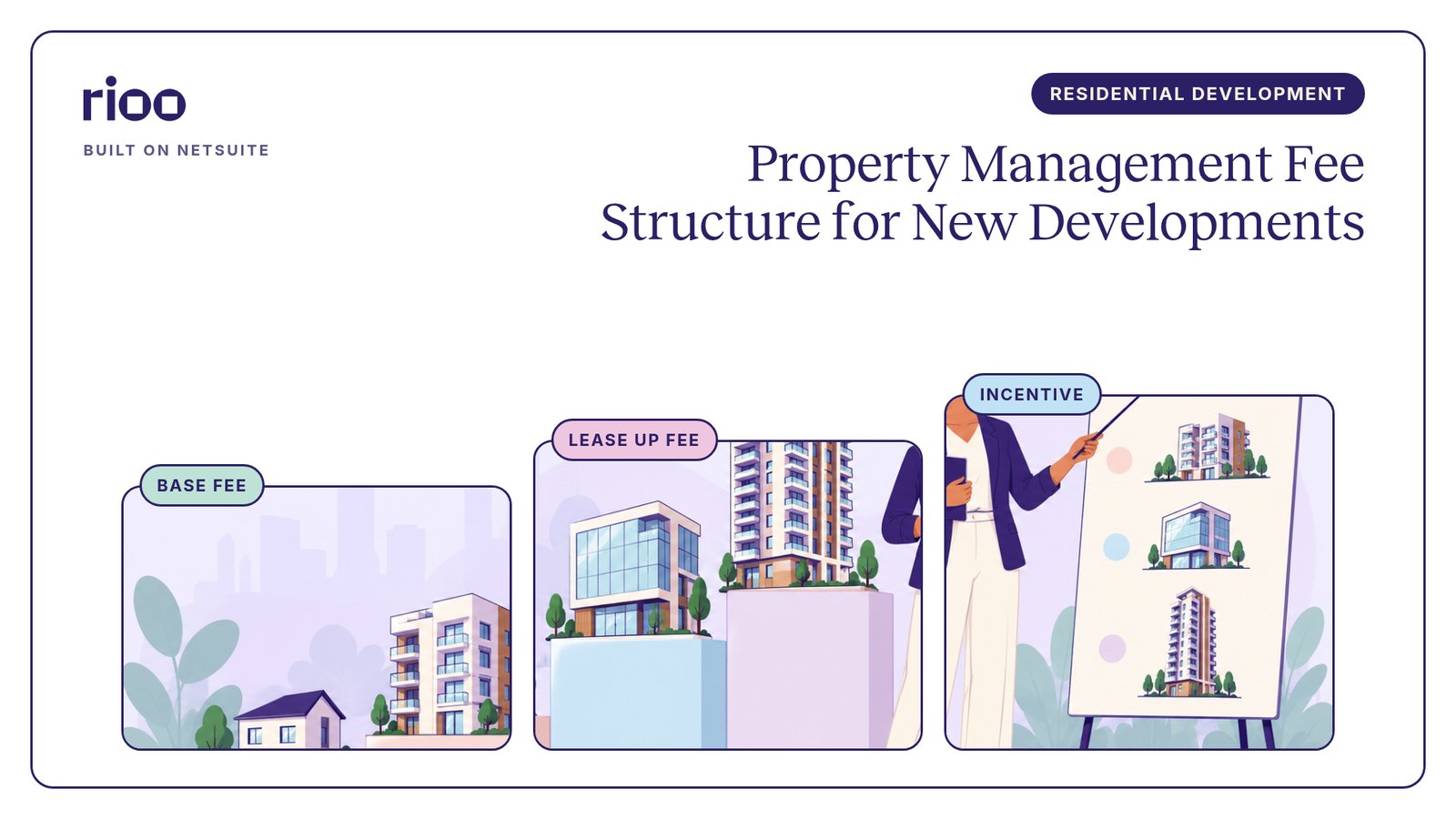
A property management fee structure for a new residential development usually pairs a base fee on collected revenue with fees for the opening work. Those include a lease up fee for each new lease and sometimes a setup fee. Some owners add an incentive tied to occupancy or NOI targets, and a success fee at sale or refinance. I would go further. A new building needs more of its fee tied to results than a stabilised one does.
This piece makes that case with numbers. It is written for owners and developers who hire a third party manager, and for managers who want to price a lease up honestly.
The parts of a fee structure
Each fee pays for a different kind of work. Mixing them up is where disputes start. The table sets out the common parts and the way each one goes wrong.
| Fee | Usual basis | What it pays for | Where it goes wrong |
|---|---|---|---|
| Base fee | A percentage of collected revenue, often with a monthly minimum | Running the building day to day | "Collected revenue" is left undefined |
| Lease up fee | A flat amount per new lease signed during the initial lease up | Marketing, tours, screening and move ins | No end date, so it keeps paying after stabilisation |
| Setup fee | A flat amount at takeover or opening | Hiring, systems, vendor contracts and policies | Charged again for work the base fee already covers |
| Incentive fee | A share of NOI above budget, or a bonus for hitting an occupancy date | Results the owner underwrote | Targets set after the fact, or no cap |
| Success fee | A flat amount or small share of value at sale or refinance | Getting the asset ready for exit | Rewards a sale the owner did not want |
For the basics of percentage, flat and hybrid fees on smaller portfolios, see our guide to property management fees explained. This piece is about what changes when the building is brand new.
Why a base fee alone misfires during lease up
A base fee on collected revenue works well once a building is full. Revenue is steady, the work is steady and the fee tracks both. A new building breaks that link.
The work comes before the revenue
The hardest months for a manager are the first ones. Every unit needs marketing, a tour, an application and a move in. Revenue in those months is at its lowest. A pure percentage fee pays least when the team works hardest.
The fee rewards the calendar
Under a pure percentage, the fee climbs as units fill, whatever the pace. A building that reaches 93% in month twelve and one that gets there in month twenty both end up paying the full fee. The owner of the slow building pays for months of missed rent and a fee that kept rising anyway.
Concessions blur the picture
Lease ups often use free rent to sign tenants faster. If the base fee is on collected revenue, free rent cuts the fee. If it is on scheduled rent, the manager earns a fee on money that never arrived. Owners and managers often assume different answers until the first statement.
Two fee models on one 200 unit building
Here is a worked example. The building, rents and results are fictional. The fee rates are illustrations, not market benchmarks.
The building has 200 units at an average rent of $1,800 a month. Full potential rent is $4.32 million a year. We compare two fee models across the first two years, under a fast lease up and a slow one.
- Model A: a base fee of 3.5% of collected revenue, plus $200 for each new lease signed in the first twelve months.
- Model B: a base fee of 2.75%, plus $150 per new lease in the first twelve months, plus a $50,000 bonus for reaching 90% occupancy by month twelve. In year two, the manager also earns 15% of NOI above budget, capped at 1.5% of revenue.
In the fast case, the building signs 190 leases in year one and collects $2.376 million. In year two it collects $4.05 million, and NOI beats budget by $130,000. In the slow case, it signs 150 leases in year one and collects $1.9 million. Year two brings $3.6 million, and NOI misses budget.
| Two year fee to the manager | Fast lease up | Slow lease up | Difference |
|---|---|---|---|
| Model A | $262,910 | $222,500 | $40,410 |
| Model B | $274,715 | $173,750 | $100,965 |
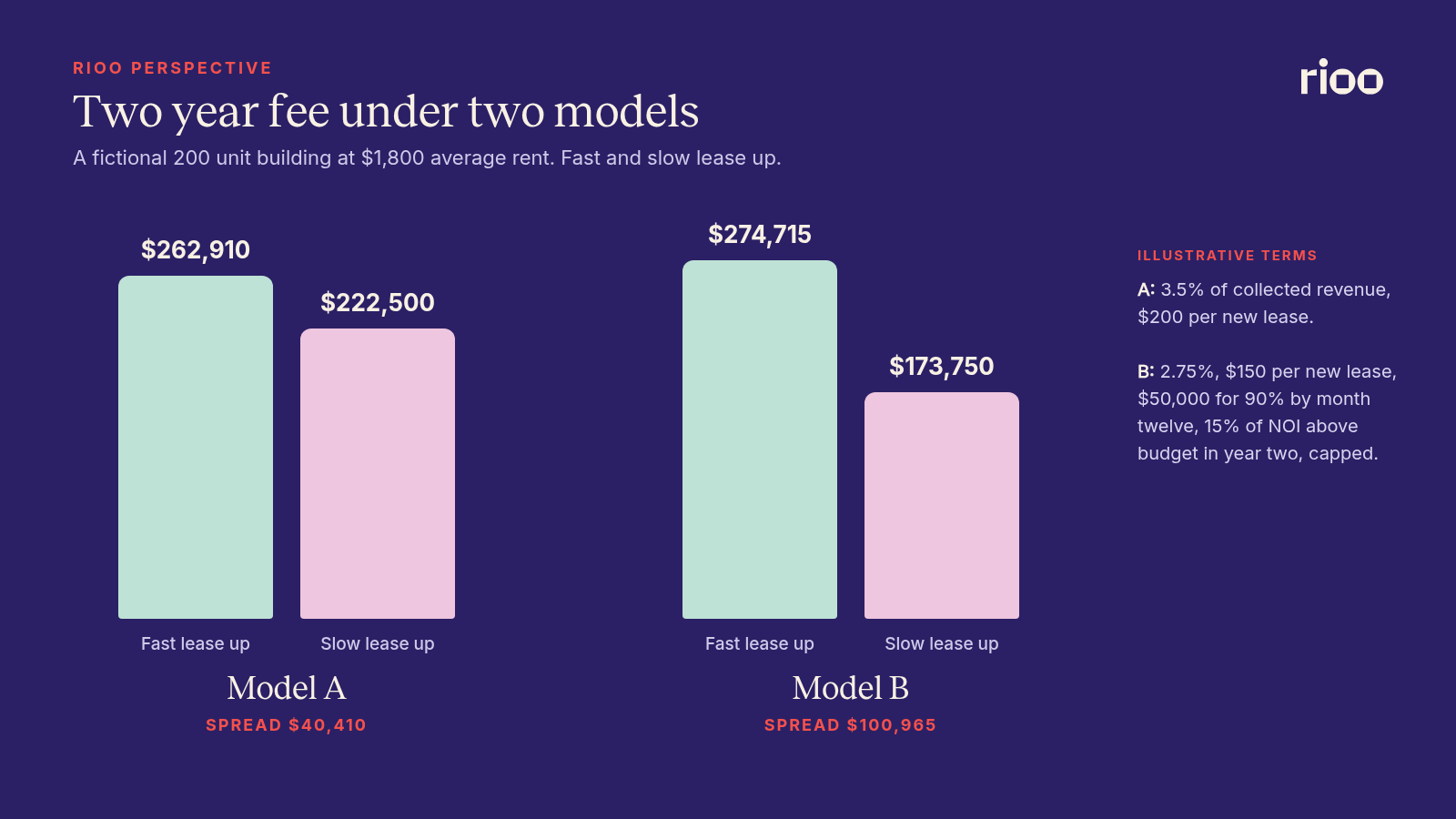
Look at the last column. Under Model A, a fast lease up is worth about $40,000 more to the manager than a slow one. Under Model B, it is worth about $101,000 more. The owner pays more under Model B in the fast case and far less in the slow case.
That is the trade I would want as an owner. I pay a little more when the building hits the plan. I pay a lot less when it misses. The manager gets a real reason to push for the faster result.
Writing an incentive that holds up
Incentives cause more arguments than base fees, because they depend on definitions. Four choices decide whether one works.
Set the target before opening
Write the occupancy date or NOI budget into the agreement before the first lease is signed. A target agreed in month nine, once both sides can see the trend, is a negotiation over a result.
Pick one measure and define it
Occupancy is easy to count but can be bought with concessions. NOI is harder to game but depends on costs the owner may control. If you use occupancy, use economic occupancy, which counts the rent actually collected. If you use NOI, list which costs are in and which are out.
Cap it and set the payment date
Put a ceiling on the incentive, as Model B does with its 1.5% cap. Say when it is measured and when it is paid. A year end true up is cleaner than a monthly estimate that later reverses.
Say what happens when the plan changes
Owners sometimes delay amenities, change rents or pause marketing. Each of those moves the result. The agreement should say whether targets adjust when the owner changes the plan.
Success fees at sale or refinance
Some developers sell a new building once it stabilises, or refinance out of the construction loan. A success fee pays the manager for getting the asset ready. That work covers clean books, a full rent roll, signed renewals and a tidy file for buyers and lenders.
Keep the trigger clear. Tie the fee to a closing the owner chooses, not to a listing or an offer. If the fee is a share of value, define value and the starting point. A flat amount is easier to agree and harder to dispute.
Adding up the whole fee load
Owners should judge the total of all fees, not each line alone. Add the base, lease up, setup and incentive fees for a year. Then divide by collected revenue.
In our fast case, Model B costs $143,840 in year one on $2.376 million collected. That is about 6% of revenue, more than double the 2.75% base rate. In year two it falls to about 3.2%. That jump is fine if the owner expected it. It turns into a dispute when nobody did the sum before signing.
Watch for charges that inflate the load quietly:
- A lease up fee paid on top of a commission to an outside broker for the same lease
- Fees charged on money that passes straight through, such as utility recharges or deposits
- Payroll or software billed to the property when the base fee is meant to cover them
- A supervision fee on capital work that a contractor is already paid to oversee
Making every fee calculable each month
Each fee in the table needs a number someone can check. That means collected revenue by property, new leases by date, occupancy that counts collected rent and NOI against budget.
In RIOO, property accounting handles that calculation. Management fees can be set from each management agreement, such as a percentage of rent received. They post for each owner at period close and appear on the owner statement. RIOO is built natively on Oracle NetSuite, so the fee, the rent behind it and the ledger come from the same records. For developers moving from construction to leasing, RIOO for build to rent keeps the lease up and the books in one place.
The handover from developer to manager matters too. Our mobilization plan for a new management contract covers the first weeks.
Quick answers on fee structures
Should the base fee be on scheduled rent or collected rent?
Collected rent is the safer choice for owners. It means the manager shares the cost of arrears and free rent. Define it in writing, including whether parking, utility recharges and late fees count.
When should a lease up fee stop?
Set an end point, such as a stated occupancy level or a date. After that, new leases come under the base fee or a separate renewal and turnover fee.
Is a setup fee fair?
It can be. Opening a building takes real work before any rent arrives. List what the fee covers so it does not overlap with the base fee.
Where do these terms go?
In the management agreement, with worked examples attached. Our checklist of what to include in a property management agreement lists the clauses.