Rent roll analysis is the work of testing a seller's rent roll before you price a deal or approve a loan. You check that the units add up and that the rent on paper reaches the bank. You also check what new leases really sign at, when leases end and who stands behind the rent. A rent roll is a claim. Your job is to find out how much of it is true.
The quickest way to learn the method is on one rent roll. The building below is fictional, and so are its numbers. The issues in it are the kind that turn up in real files, and each one moves the price.
The rent roll on the table
Picture a 48 unit garden apartment building. The seller sends a rent roll dated the first of the month, a trailing three months of bank statements and an offering memo. The memo prices the deal at a 6% cap rate on the rent roll income.
| Line on the rent roll | Figure |
|---|---|
| Units | 48 |
| Occupied units | 46 |
| Contract rent on occupied units | $62,100 a month |
| Average contract rent | $1,350 |
| Security deposits held | $52,600 |
| Leases signed in the last 90 days | 5 |
On its face, that is $745,200 of rent a year. Before you accept it, run the checks below in order. If you need a refresher on the columns themselves, start with what a rent roll is and what it tells you.
Do the units add up?
Count the units on the rent roll and compare them to the memo, the property tax record and the site plan. Then compare the unit mix. In our building, the memo says 24 one bedroom and 24 two bedroom units. The rent roll lists 26 one bedrooms and 22 two bedrooms.
That gap has a story. Two units were split or relabeled at some point, or the memo is wrong. Either way, you now know to walk those units on the site visit. You also know the comparable rents in the memo may not fit the real mix.
Then look at the two vacant units. Ask how long each has been empty and whether it is ready to rent. A unit that has sat empty for five months often needs work first. Budget for that work before you count the unit at market rent.
Check for duplicates and gaps in unit numbers too. A unit that appears twice inflates rent. A unit that is missing may be down, used as an office or rented off the books.
Does the rent reach the bank?
This check moves value more than any other. Take the average monthly deposits from the bank statements and compare them to contract rent. In our building, deposits average $58,400 a month. The rent roll says $62,100. The rent roll looks 6% richer than the cash.
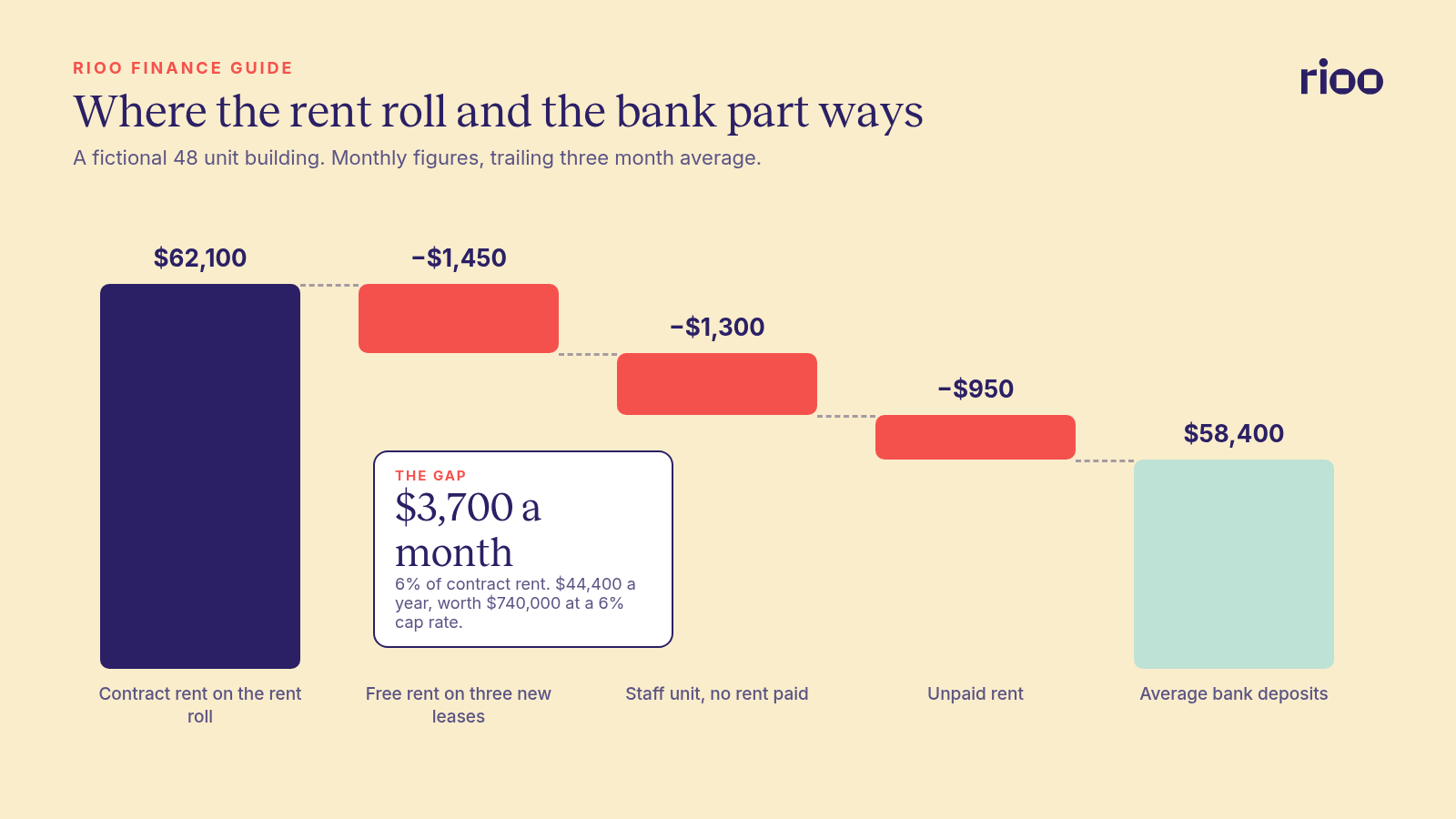
The gap of $3,700 a month breaks into three pieces once you ask the seller for a ledger by unit.
The free rent
Three of the five new leases came with one month free at $1,450. Over the three month sample, that is $4,350 of rent that never arrived, or $1,450 a month. The rent roll shows the full contract rent with no flag.
The staff unit
One unit is marked occupied at $1,300. It houses the maintenance technician, who pays nothing. That is a fair business choice. It is also $1,300 a month that will never be collected while the arrangement lasts.
Arrears
The remaining $950 a month is unpaid rent, mostly from two units with balances over 60 days. Ask for an aged receivables report. Then ask whether any of that balance is in a payment plan or headed to court.
Now put a price on it. The $3,700 monthly gap is $44,400 a year. None of that income has an expense against it, so it comes straight off NOI. At the memo's 6% cap rate, $44,400 of NOI is worth $740,000. That is the size of the mistake if you price off the rent roll alone. Lenders run the same test, which is why a lender reporting package pairs the rent roll with a trailing twelve month statement.
What are new leases really signing at?
Recent leases tell you where rents are heading. In our building, the five newest leases show an average rent of $1,450. That looks like $100 above the in place average of $1,350.
Three of those five carry a month free. Spread over twelve months, a $1,450 lease with one month free is worth about $1,329 a month. So the effective rent on new deals sits below the in place average. The upside in the memo may not exist.
Compare in place rents to effective market rents unit by unit. The difference is loss to lease, or gain to lease when in place rents are higher than the market. Our guide to loss to lease shows how to measure it. If in place rents are above effective market rents, expect pressure at renewal.
When do the leases end?
Sort the leases by end date and group them by month. In our building, 19 of the 46 leases end in the first 90 days after the planned closing. Four more are already month to month.
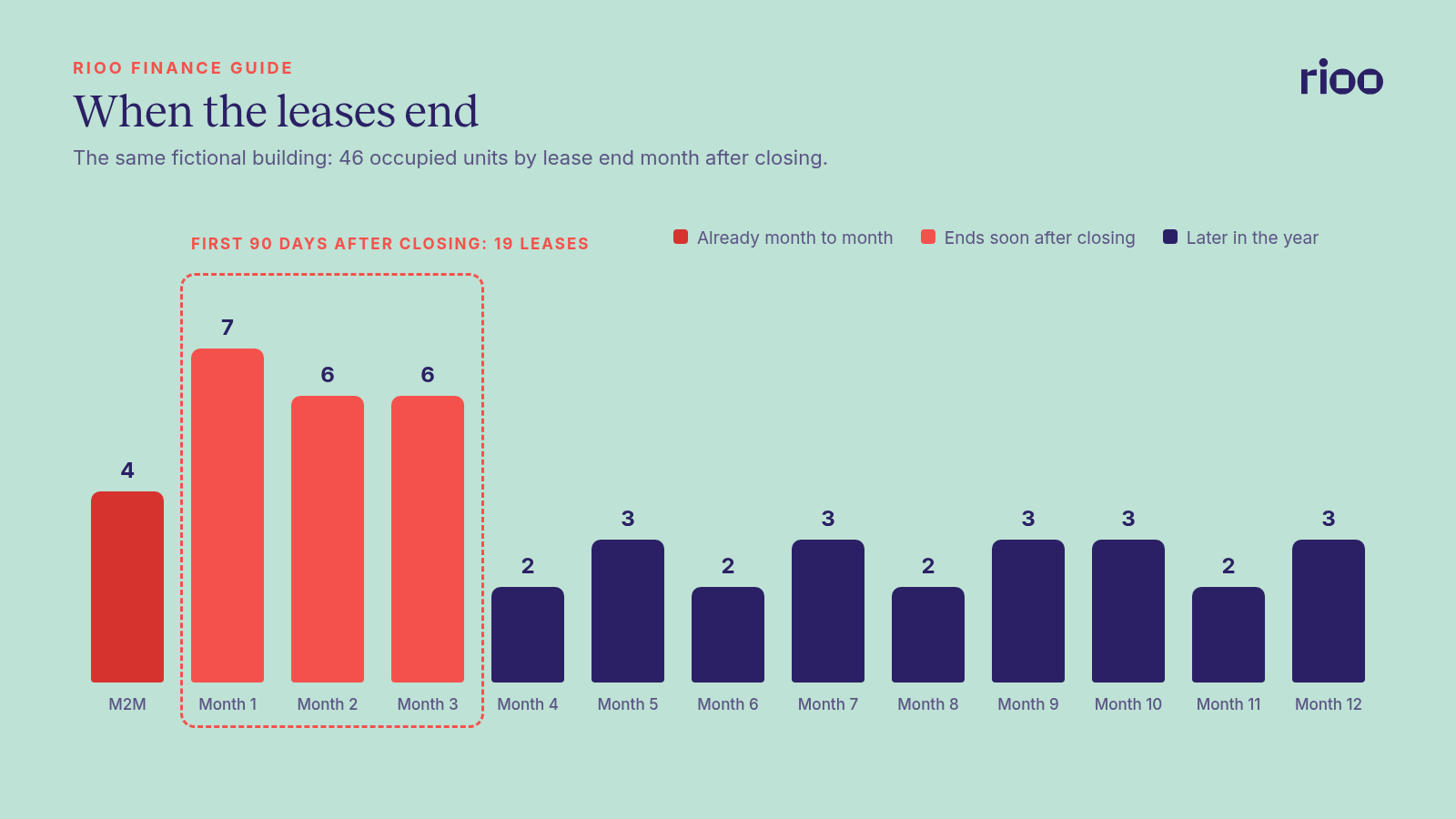
Add the four month to month leases and 23 of the 46 occupied units, exactly half, could turn over while you are still learning the building. Turnover costs money in vacancy, cleaning, paint and leasing time. It also hands you an early test of whether market rents hold.
Stacked expiries are not always bad news. If in place rents are below market, they give you a quick route to raise them. The point is to know before you sign, and to budget for it.
Who stands behind the rent?
Look at who the tenants are as well as what they pay. Start with these questions.
Is one tenant a large share of the rent? In our building, a local employer leases six units for visiting staff. That is 12.5% of units on one contract. If that contract ends, six units go dark in the same month.
Are any tenants related to the seller? Family members, staff and affiliated companies can sit on a rent roll at rents that a stranger would never pay. They can also leave at closing.
Are any leases unusual? Look for rent that never escalates, early termination rights and side letters. Ask for copies of any lease that looks out of pattern, then compare it to the rent roll line.
Do the deposits match the money held?
The rent roll says $52,600 of security deposits. The seller's deposit account holds $49,800. The $2,800 difference is a liability you would inherit, because tenants will expect their full deposits back.
Ask for a deposit ledger by unit and the matching bank statement. Agree on how any shortfall is credited at closing. Some states also set rules on where deposits are held and how they transfer on a sale, so check the state where the building sits.
Running these checks on buildings you already own
The same tests work after closing. A rent roll that stays honest each month makes the next sale, refinance or lender report easier.
In RIOO, the rent roll comes from the same records that bill rent and post receipts. Leases, charges, concessions and deposits sit on the unit. Because RIOO is built natively on Oracle NetSuite, those transactions post to the ledger finance closes. Your team can compare billed rent to cash by property and unit without rebuilding a spreadsheet. RIOO dashboards and reports show occupancy, expiries and arrears from that same data.
A monthly tie out is the habit that keeps it clean. Our rent roll reconciliation process for month end walks through it.
The questions to send the seller
Here is the list we would send for our fictional building. Adapt it to your deal.
- Explain the unit mix difference between the memo and the rent roll.
- Send a ledger by unit for the last twelve months, with every concession shown.
- List every unit occupied by staff, family or affiliates, and what each pays.
- Send an aged receivables report and the status of each balance over 30 days.
- Send copies of the corporate lease and any lease with special terms.
- Send the deposit ledger and the bank statement for the deposit account.
- Confirm the rent roll date matches the bank statement period.
Rent roll analysis is one part of a wider review of operations. Our guide to operational due diligence for a property acquisition covers the rest.
Rent roll analysis FAQ
How is rent roll analysis different from reading a rent roll?
Reading tells you what the seller claims. Analysis tests the claim against cash, leases and the market, then turns the gaps into a price.
How many months of bank statements should I ask for?
Three months shows recent collections. Twelve months shows seasonality and lets you tie the rent roll to a trailing twelve month income statement. Ask for twelve when the seller will give them.
What is a normal gap between rent roll and deposits?
There is no single figure. Every gap should have a named cause, such as concessions, vacancy, staff units or arrears. A gap you cannot explain is the one to worry about.
Does rent roll analysis work for commercial property?
Yes. The checks are the same, with more weight on tenant credit, lease expiries and recoveries. One tenant can be a large share of the income, so concentration matters more.