Short answer: a written notice to move out is a dated letter that tells the other party a tenancy will end on a set date. For a fixed term lease, the notice clause in the lease decides how much notice is due. For a month to month tenancy, state law sets the minimum. Many states use 30 days, but the rules differ. Florida asks for 30 days before the end of a monthly period, Texas asks for one month, and North Carolina asks for seven days. A good notice names everyone on the lease, gives the address and the exact end date, and is delivered in a way you can prove.
Notices to move out look simple. One paragraph, one date, one signature. Yet a vague date or the wrong delivery method can add a month of rent, delay a turn or start a deposit dispute. This guide covers both directions: the notice a resident gives you, and the notice a landlord gives a resident. It explains how much notice the law asks for, how to count the days and what to do the moment a notice lands on your desk.
Laws change, and cities can add their own rules. Treat the figures below as a starting point, confirm the current law for each property, and ask counsel when a case is unusual.
What a written notice to move out is
A written notice to move out ends a tenancy on a date that the lease or the law allows. It can come from either side.
- A resident's notice to vacate. The resident tells the landlord they will leave on a set date.
- A landlord's notice of non renewal or termination. The landlord tells the resident a fixed term will not renew, or that a month to month tenancy will end.
Keep this separate from an eviction notice. A pay or quit notice or a lease violation notice starts a legal process for cause. It has its own wording, timing and delivery rules. If that is the situation, follow the state's eviction rules. Our Texas notice to vacate guide shows how one state handles both kinds.
How much notice is required
The answer depends on two things: the type of tenancy and the state. Start with the lease, then check the law.
Fixed term leases
A fixed term lease ends on its end date. Many leases still ask for notice before that date. A common clause asks for 30 or 60 days of written notice if the resident does not plan to renew. Without it, the lease may roll into a month to month tenancy or renew for another term. Read the renewal clause closely, because it decides what a late notice costs.
A resident who wants to leave before the end date is asking to break the lease. That is a different conversation. It depends on the lease terms, any early termination clause and state rules on reletting.
Month to month tenancies
For month to month tenancies, state law sets a minimum. Here are four examples, checked against the official statutes as of October 2026.
| State | Who gives notice | Minimum notice | Source |
|---|---|---|---|
| Florida | Either party | At least 30 days before the end of any monthly period | Florida Statutes section 83.57 |
| Texas | Either party | One month, unless both parties signed a different notice period | Texas Property Code section 91.001 |
| California | Resident | At least as long as the rental period, so 30 days for monthly rent | California Civil Code section 1946.1 |
| California | Landlord | 60 days, or 30 days if a tenant or resident has lived there less than one year | Same section |
| North Carolina | Either party | Seven days before the end of the current month of the tenancy | North Carolina notice to quit statute |
Two of these rules surprise people. Florida moved its month to month notice from 15 days to 30 days in 2023, so older templates may still say 15. North Carolina's seven days, counted back from the end of the monthly period, is far shorter than many residents expect. In California, when residents in one home have lived there for different lengths of time, ask counsel which landlord notice period applies. Giving 60 days is the cautious choice. Our guide to North Carolina landlord tenant law covers the rest of that chapter.
When the landlord gives notice
Landlord notices carry more rules than resident notices. Some states and cities require a just cause to end a tenancy at all. California is one example, where the state Tenant Protection Act applies to many units. Some places also require longer notice for long tenancies, or relocation payments. Before a landlord sends a notice of non renewal, check whether the unit is covered by a just cause or rent stabilization rule. If it is, the notice must state a lawful reason in the required form.
How to count the notice period
Counting errors are a common reason a notice fails. Each state counts in its own way, so use the statute's wording. Here are two illustrative examples, both with rent due on the first of the month.
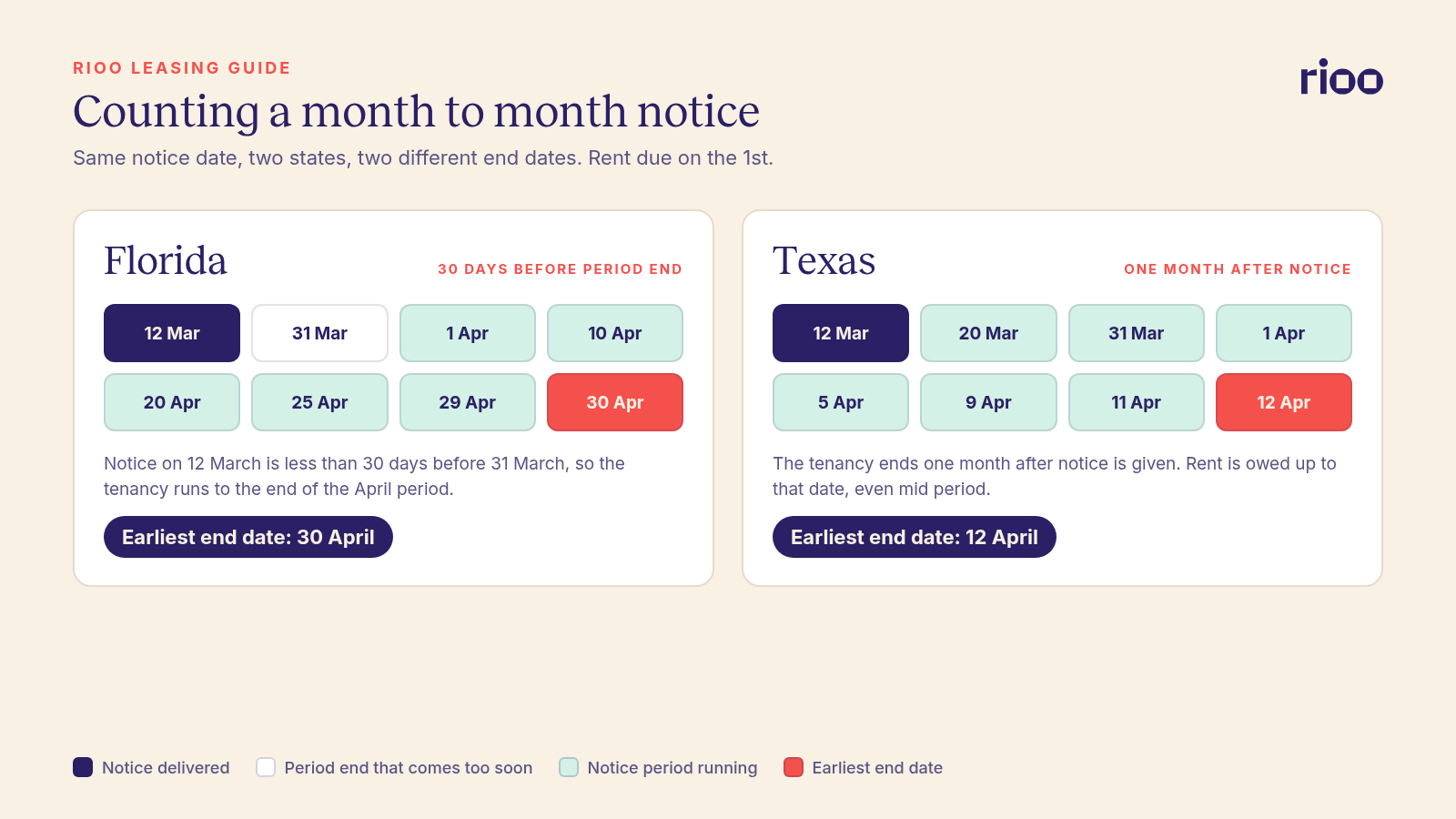
- Florida. A resident on a month to month tenancy delivers notice on 12 March. The notice must come at least 30 days before the end of a monthly period. The March period ends on 31 March, which is too soon. So the earliest end date is 30 April.
- Texas. The same resident in Texas delivers notice on 12 March. Under the statute, the tenancy ends on the later of the date in the notice or one month after notice is given. That makes the earliest end date 12 April. Texas law also says that when the end date falls mid period, rent is owed up to the termination date and no further.
Two habits prevent many disputes. Write the exact end date in the notice instead of "30 days from today". And record the date you received it, because the date on the letter can differ.
What to include in the notice
A clear notice to move out answers every question the other side might ask later.
- The date the notice is written.
- The full names of every resident on the lease.
- The property address and unit number.
- The exact date the tenancy ends and the keys come back.
- A reference to the lease or the notice period it follows.
- A forwarding address for the deposit return.
- Contact details for arranging the move out inspection.
- Signatures from every resident, or from the landlord or agent.
For copy ready wording, use our notice to vacate templates. They include a resident notice and a landlord notice of non renewal.
How to deliver it and keep proof
A notice that cannot be proved may as well not exist. Use the method the lease and the state allow, then keep the evidence.
- Hand delivery. Ask for a signed and dated copy, or note who delivered it and when.
- Mail. Certified mail gives a receipt. If the period counts from receipt, allow extra days.
- Email or portal. Check the rules first. Florida, for example, allows email notices when both sides have signed an email delivery addendum to the lease. Without that addendum, use another method. A time stamped portal record is strong evidence where electronic notice is allowed.
Store the notice and the proof on the resident's record, where anyone on the team can find it.
What to do when a resident's notice arrives
For a property team, the notice is the start of a move out process. Handle it the same way every time.
- Log it on the day it arrives. Record the received date and the delivery method.
- Check it against the lease. Confirm the notice period, every signature and whether the date works. If the date is too early, tell the resident in writing what the earliest valid date is.
- Confirm in writing. Send a short reply that accepts the notice and repeats the agreed end date.
- Send move out instructions. Explain cleaning standards, key return and the inspection. Our guide to the move out instructions letter covers what to send.
- Start the turn plan. Book the inspection, plan the work and open the unit for leasing where the lease allows showings.
- Set the deposit clock. Note the state deadline for returning the deposit after move out.
Treat a mid lease notice as a request until you have checked the lease. In Florida, the month to month rules sit inside wider termination rules, covered in our Florida lease termination guide.
Common mistakes
- A vague end date. "Thirty days from now" invites a dispute. Write the date.
- A verbal notice. A phone call is a heads up. Ask for it in writing.
- Missing residents. A notice signed by one co tenant may not end the tenancy for the others. Check the lease and state law.
- Old templates. A form with last decade's notice period can make the whole notice invalid.
- Silence after receipt. If the date is wrong and nobody says so, the resident plans around it anyway.
Where RIOO fits
In RIOO, a move out runs as a tracked process. The checklist runs from notice recorded, through the inspection, key return and final charges, to the deposit statement and the unit's release for turn. Tasks are generated automatically when notice is recorded, and assigned to the right team. Move out guidance, including cleaning standards, can go to the resident when notice is received, and deposit refunds are coordinated through finance. See how RIOO move ins and move outs work, from inspection to final statement.
Frequently asked questions
Does a notice to move out have to be in writing?
In practice, yes. Many state statutes and leases require written notice, and a written notice is the clear proof of the date. Ask for written notice even when a resident tells you in person.
Can a resident give notice by email?
It depends on the lease and the state. Some states, such as Florida, allow email notices when both parties have signed an addendum agreeing to it. Where email is allowed, keep the sent message and any reply on file.
How much notice does a landlord need to give a month to month resident?
It varies by state and sometimes by city. Florida and Texas apply the same notice period to both sides. California asks landlords for 60 days, or 30 days if a tenant or resident has lived there less than one year. Some places also require a just cause.
What happens if a resident leaves before the notice period ends?
The resident usually owes rent through the end of the notice period. Many states expect the landlord to make a reasonable effort to relet, which can reduce what is owed. Check the lease and the state rules before charging the full amount.
Can a resident cancel a notice to move out?
Not without the landlord's agreement. Once a valid notice is given, the landlord may already have signed a new lease for the unit. Put any agreement to withdraw a notice in writing.