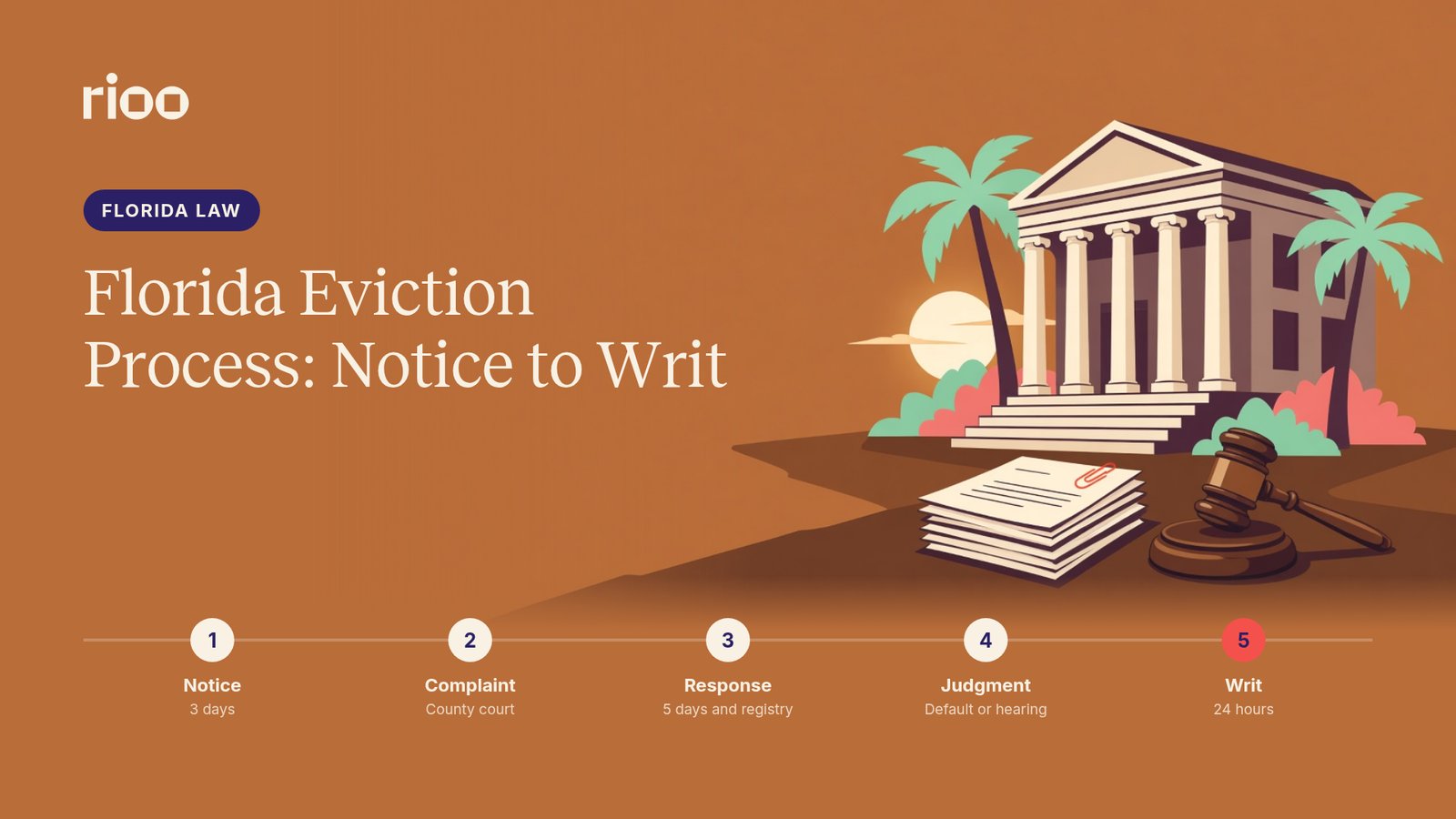
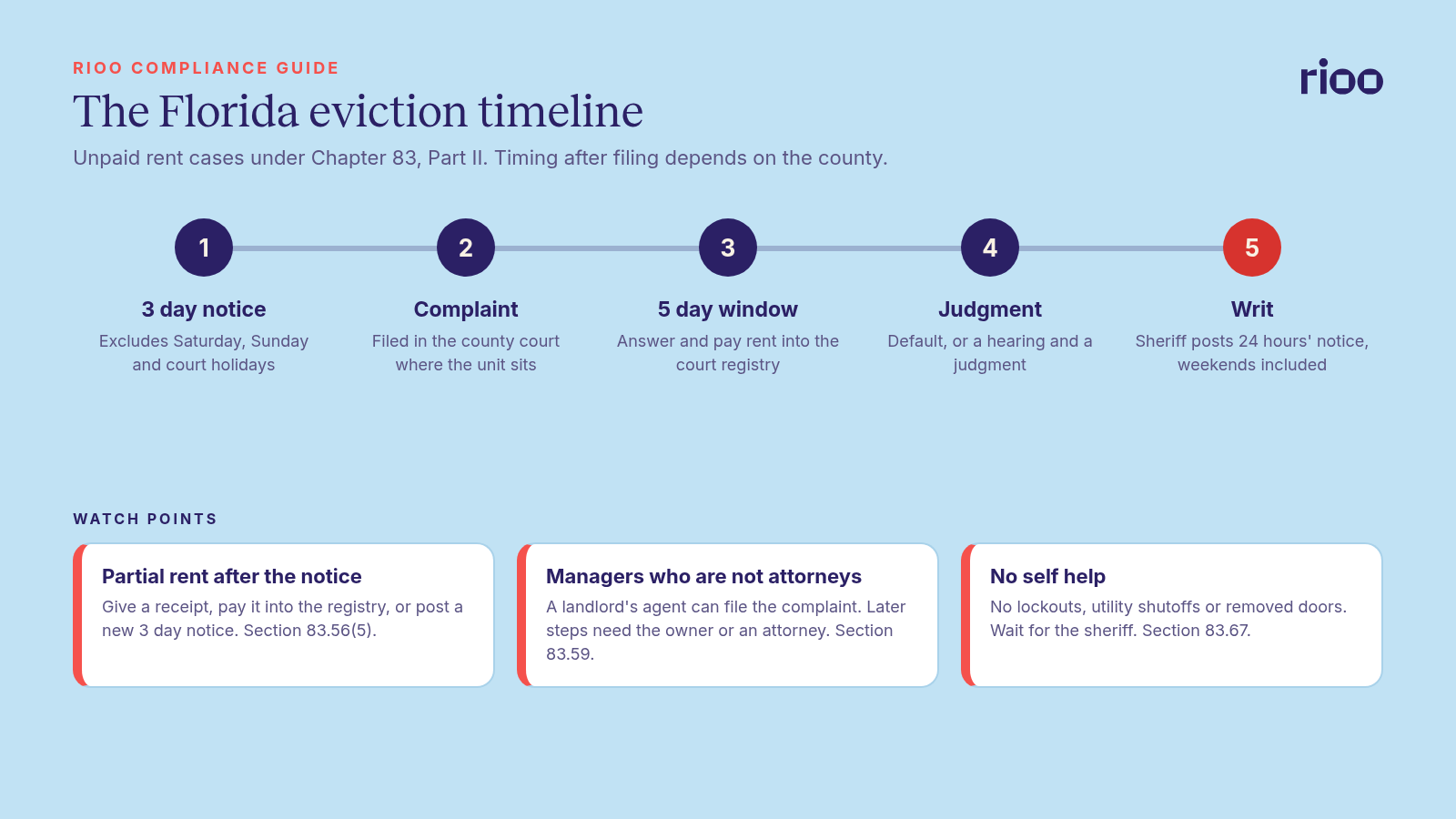
Short answer: the Florida eviction process for unpaid rent has five stages. First, a 3 day notice that excludes weekends and court holidays. Second, a complaint filed in the county court where the property sits. Third, a window of 5 days, excluding weekends and legal holidays, for the tenant to respond and pay the rent into the court registry. Fourth, a default or a hearing that ends in a judgment for possession. Fifth, a writ of possession that the sheriff posts with 24 hours' notice. An uncontested case can finish in a few weeks. A contested case takes longer, and timing varies by county.
Florida's process moves quickly, and it is strict. Each stage has a clock, and a mistake at one stage can send the landlord back to the start. This guide walks through what happens after the notice expires, stage by stage, with the statute behind each step. For the notice itself, see our Florida eviction notice guide.
The rules below come from Part II of Chapter 83 of the Florida Statutes, which covers residential tenancies, checked as of October 2026. Commercial evictions follow a separate part. Laws change, so confirm the current text and use a Florida attorney for contested cases. For other states, start with our US landlord tenant law library.
The Florida eviction timeline at a glance
| Stage | What happens | Clock | Statute |
|---|---|---|---|
| 1. Notice | Landlord delivers a written demand for rent or possession | 3 days, excluding Saturday, Sunday and court holidays | 83.56(3) |
| 2. Complaint | Landlord files for possession in county court | After the notice period ends | 83.59 |
| 3. Response | Tenant answers and pays rent into the court registry | 5 days after service, excluding weekends and legal holidays | 83.60(2) |
| 4. Judgment | Default judgment, or a hearing and a judgment | Set by the court | 83.60, 83.625 |
| 5. Writ | Clerk issues the writ and the sheriff posts it | 24 hours after posting; weekends do not pause it | 83.62 |
Stage 1: the notice ends the tenancy
A Florida eviction starts with a notice that terminates the rental agreement. The notice type depends on the reason.
- Unpaid rent. A 3 day notice demanding the rent or possession. The 3 days exclude Saturday, Sunday and court observed holidays.
- A lease violation the tenant can fix. A 7 day notice to cure, such as an unauthorized pet.
- A serious or repeated violation. A 7 day notice with no chance to cure, such as intentional damage.
- The end of a month to month tenancy. At least 30 days' written notice before the end of a monthly period, under section 83.57.
The statute sets out the wording for the 3 day and 7 day notices, and the lease cannot waive those notice rules. If a tenant stays after the lease ends without permission, section 83.58 allows the landlord to seek possession and up to double rent for the holdover period. Our Florida landlord tenant law guide covers the notice rules alongside the rest of the chapter.
Federal rules can add a step. Properties with certain federally backed mortgages or in federal housing programs may need a longer notice before a nonpayment case. Ask counsel whether a property is covered.
Stage 2: filing the complaint in county court
If the tenant neither pays nor leaves by the deadline, the landlord can file a complaint for possession. Section 83.59 sets the rules:
- File in the county court for the county where the property sits.
- Describe the unit and state the facts that support recovering it.
- The landlord gets the summary procedure in section 51.011, and the court must move the case up its calendar.
One rule matters a lot for property management companies. A landlord's agent can file the initial complaint. After that, an agent who is not an attorney cannot take any further action in the case. So a manager can start the case, but a motion for default or an appearance at a hearing needs the owner or an attorney.
Many landlords file two counts together: one for possession and one for unpaid rent. The possession count moves on the fast summary track. A money judgment has its own service rules, covered in Stage 4.
Stage 3: service and the 5 day window
The tenant is served with a summons. From that day, the tenant has 5 days, excluding Saturday, Sunday and legal holidays, to act. The clerk tells the tenant about the rent deposit rule in the summons.
This is the stage that decides many Florida cases. Under section 83.60(2) of the Florida Statutes, a tenant who raises any defense other than payment must also pay into the court registry:
- the rent alleged in the complaint, or the amount the court decides, and
- the rent that comes due while the case is open.
A tenant who disputes the amount can file a motion to determine rent, with documents to support it. If the tenant does neither within the 5 days, the statute calls that an absolute waiver of defenses other than payment. The landlord is then entitled to an immediate default judgment, with a writ of possession to issue without further notice or hearing.
Section 83.56(5)(b) adds that the court cannot set mediation or a trial until the deposit rule is met.
Stage 4: default or hearing, then judgment
There are two paths from here.
The tenant does not respond or deposit
The landlord asks the court for a default and a final judgment for possession. On this path, a case can move from filing to judgment quickly. How quickly depends on the county and the judge's calendar.
The tenant responds and deposits the rent
The court sets a hearing, and sometimes mediation first. Common defenses include:
- A defective notice. The statute gives the landlord a chance to cure a deficiency in a notice or the pleadings before the case is dismissed.
- Failure to maintain the unit. This needs a written notice from the tenant at least 7 days earlier, under section 83.60(1)(b).
- Retaliation. Section 83.64 bars evictions brought mainly to retaliate, such as after a code complaint. Good cause, such as a good faith action for nonpayment, defeats that defense.
If the court rules for the landlord on a nonpayment case, section 83.625 directs a money judgment for the unpaid rent as well. There is a catch: the tenant must have been served by personal service or another method the law allows for money claims. Posting alone supports possession, but not a money judgment.
Stage 5: the writ of possession
After judgment, the clerk issues a writ of possession to the sheriff. Under section 83.62:
- The sheriff puts the landlord in possession after 24 hours' notice posted on the property.
- Saturdays, Sundays and legal holidays do not pause the 24 hours.
- When the writ is carried out, or after, the landlord may move the tenant's belongings to or near the property line.
- The landlord can ask the sheriff to stand by while locks are changed, at a reasonable hourly rate set by the sheriff.
Plan the turn for this day. Have a locksmith booked, photos ready to take and the unit's inspection form on hand.
Accepting partial rent during the process
Many managers get this part wrong. Accepting partial rent after posting a 3 day notice does not waive the right to evict. Section 83.56(5)(a) requires the landlord to do one of three things:
- Give the tenant a receipt with the date, the amount received, the agreed date and the balance due, before filing.
- Pay the partial rent into the court registry when filing.
- Post a new 3 day notice for the new amount due.
Pick one and record it. Accepting rent with actual knowledge of a lease violation is different. It can waive the right to evict for that violation. Our post on how a partial payment can waive the right to evict covers that risk in more depth.
What landlords and managers must not do
Self help evictions are illegal in Florida. Under section 83.67, a landlord cannot:
- cut off utilities, such as water, power or gas,
- change the locks or use a boot lock to keep the tenant out, or
- remove outside doors, locks, the roof, walls or windows, except for maintenance, repair or replacement, or remove the tenant's belongings before a lawful eviction, surrender or abandonment.
The writ, carried out by the sheriff, is the lawful way to recover the unit.
A worked example
This illustrative case assumes no court holidays fall in the period and the tenant does not respond.
- Monday 1 March: the 3 day notice is hand delivered.
- Thursday 4 March: the deadline to pay passes. The day of delivery and weekends do not count.
- Friday 5 March: the complaint is filed in county court.
- Tuesday 9 March: the tenant is served.
- Tuesday 16 March: the 5 day window ends with no answer and no deposit.
- Later that week or the next: the court enters a default judgment, and the clerk issues the writ.
- 24 hours after posting: the sheriff returns possession.
Real timing depends on the county, service and the court's calendar. If the notice is mailed, ask counsel how many days to add.
Keep the record clean
A Florida eviction is won or lost on paperwork. Keep these together for each case:
- The signed lease and any addenda, including an email notice addendum if used.
- The notice, with proof of the date and method of delivery.
- A tenant ledger that shows every charge, payment and partial payment.
- Copies of every filing, the summons and the proof of service.
- Any messages about payment plans or promises to pay.
Balances left after the tenant leaves need their own process. Our post on unpaid balances after move out explains who owns them and when.
Where RIOO fits
RIOO does not give legal advice or file court papers. It keeps the record an eviction depends on. RIOO gives property teams a structured collections operation: delinquency queues by property, reminder cadences, late fees and grace periods applied consistently, payment plans and escalation rules. Every step is recorded on the tenant ledger in NetSuite, so collections, finance and property managers work from the same balance. See how RIOO rent collection services set up a delinquency workflow that follows your lease and local law.
Frequently asked questions
How long does an eviction take in Florida?
An uncontested nonpayment case can finish in a few weeks from the notice. Contested cases take longer because of hearings or mediation. The county, the sheriff's schedule and how fast the tenant is served all affect the timing.
Can a property manager file an eviction in Florida?
A landlord's agent can file the initial complaint. Under section 83.59, an agent who is not an attorney cannot take any further action in the case. Many owners use an attorney from that point.
What is the court registry in a Florida eviction?
It is an account held by the clerk of court. A tenant who wants to raise a defense other than payment must deposit the rent claimed, plus rent that comes due during the case. Missing the deadline lets the landlord seek a default judgment.
Does the 24 hour writ notice pause for weekends?
No. Section 83.62 says Saturdays, Sundays and legal holidays do not stay the 24 hour notice period.
Can a Florida landlord change the locks after the notice expires?
No. Changing the locks or cutting utilities to force a tenant out is a prohibited practice under section 83.67. Wait for the sheriff to carry out the writ of possession.