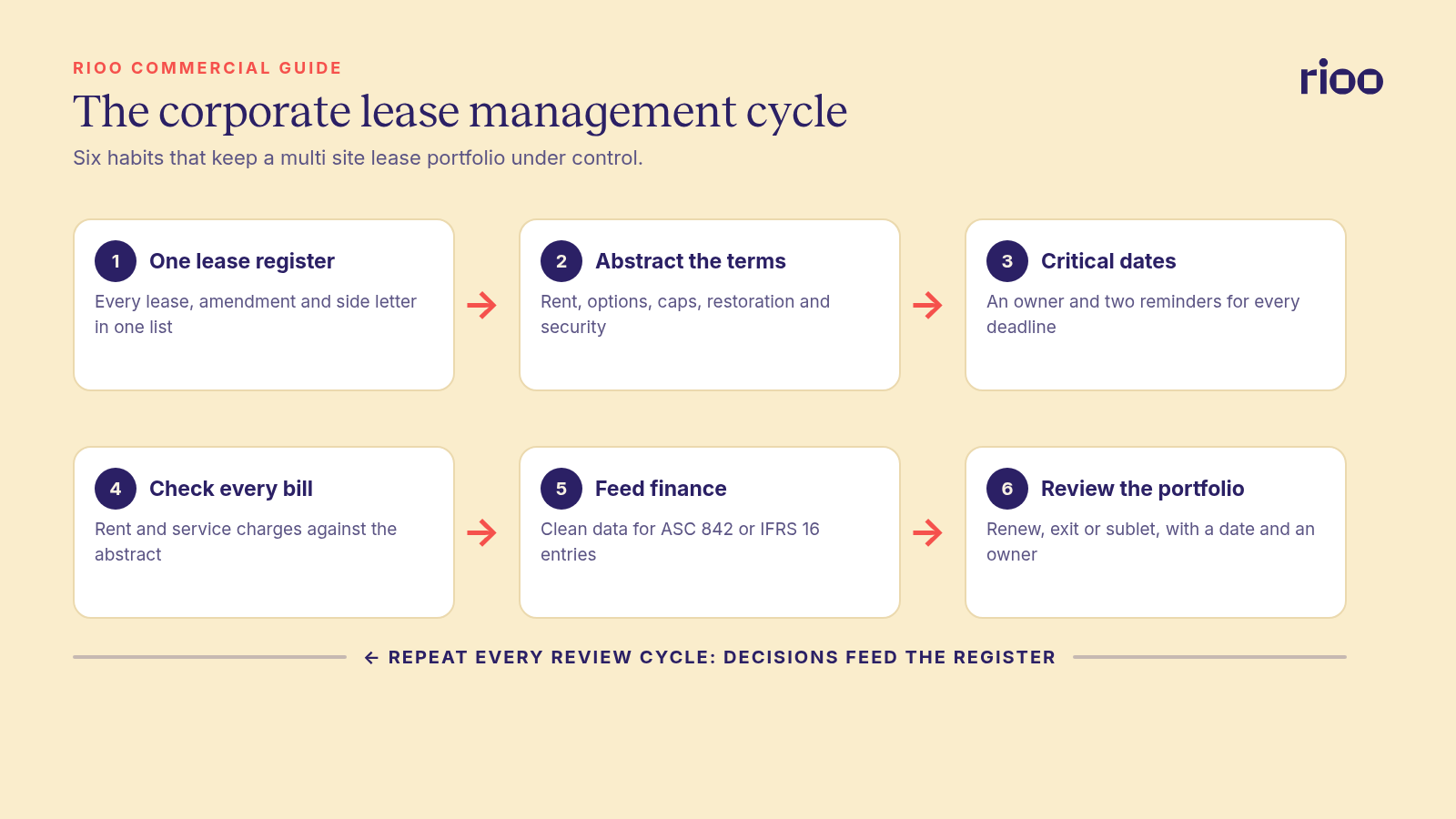
Short answer: corporate lease management is the work a company does, as a tenant, to control every lease it holds for offices, stores, warehouses and branches. It rests on six habits. Keep one lease register. Abstract the terms that cost money. Run a critical date calendar with named owners. Check every rent and service charge bill against the lease. Give finance clean lease data for ASC 842 or IFRS 16. Review the portfolio to decide what to renew, exit or sublet. Done well, option windows are caught in time and real estate and finance work from the same numbers.
Ask a finance director how many leases the company holds and you may get two answers. Real estate counts one figure. The lease accounting schedule shows another. The gap is usually a few branch leases signed locally, a storage unit nobody logged and an amendment that never reached finance. Each one is small. Together they decide whether the company exits a lease on time or pays for empty space for another five years.
This guide is for corporate tenants: companies that rent the space they use. It sets out a practical model for running a lease portfolio across many sites.
How corporate tenants differ from landlords
Landlords and corporate tenants read the same lease with different goals. A landlord wants income collected and recovered in full. A corporate tenant wants the right space at a cost the lease supports, and the freedom to change course.
| Topic | Landlord side | Corporate tenant side |
|---|---|---|
| Main goal | Collect rent and recoveries | Control cost, risk and flexibility |
| Key dates | Rent reviews, tenant option deadlines | Own option and break deadlines, expiries, restoration duties |
| Bills | Issues invoices | Checks invoices before paying |
| Accounting | Lessor model, straight line income | Lessee model, right of use assets and lease liabilities |
| Big risk | Vacancy and unbilled escalations | Missed exits, overpaid service charges, surprise liabilities |
The landlord view is covered in our guide to what lease management is. The rest of this post stays on the tenant side.
Who owns what
Corporate leases cross four teams, and gaps open between them. Write the split down.
| Task | Usual owner |
|---|---|
| Lease register and abstracts | Real estate or a lease administrator |
| Critical dates and decisions | Real estate, with the business unit that uses the site |
| Bill checks and payments | Accounts payable, with real estate review |
| Lease accounting entries | Finance or the controller's team |
| Signing and amendments | Legal, with an approval matrix |
| Repairs and restoration duties | Facilities |
One rule keeps this working. No lease or amendment is signed until real estate has a copy for the register.
Step 1: build one lease register
The register is a single list of every lease the company holds, with one record per lease. Each record links the signed lease, every amendment and any side letters. Start with a hunt across the business:
- Accounts payable vendors who receive rent each month.
- Regional and country teams that sign leases locally.
- Storage units, parking, data rooms and pop up sites.
- Leases held by subsidiaries or recently acquired businesses.
Compare the rent payments in the ledger with the register. A payment with no lease behind it is a lease you have not found yet.
Step 2: abstract the terms that cost money
An abstract turns a long lease into fields that people can act on. For a corporate tenant, these are the fields that tend to cost money:
- Term, commencement and expiry.
- Base rent, escalations and rent review method.
- Service charge or operating cost share, caps and audit rights.
- Renewal options and break options, with notice periods.
- Restoration and dilapidation duties at exit.
- Assignment and subletting rights.
- Security, such as a deposit, a bank letter of credit or a parent company undertaking.
Our lease abstraction checklist lists the full set of fields. Abstract once, check the abstract against the lease, and update it with every amendment.
Step 3: run critical dates with lead time
A critical date is a deadline that changes your options if it passes. For corporate tenants, the costly ones are break notices and renewal notices. Miss a break window and the company may be locked in for years. Miss a renewal option and the landlord can let the space to someone else, or reprice it.
Give every date an owner and two reminders. The first should come early enough to make a real decision, such as 12 to 18 months before a large office expiry. The second should come before the notice deadline. Our guide to tracking critical lease dates across a portfolio covers alert design in detail.
Step 4: check every bill against the lease
Tenant companies often pay what they are billed. That habit is expensive. Before paying, check each charge against the abstract:
- Base rent. Does the amount match the schedule and the latest escalation?
- Service charges or operating costs. Is the share correct, and does any cap apply?
- Taxes and insurance. Are these passed through as the lease allows?
- Year end reconciliations. Did they arrive in time, and is there an audit window?
Here is an illustrative case. A lease caps increases in controllable operating costs at 5% a year. The year end statement shows a 9% increase. Without the abstract, accounts payable pays it. With the abstract, real estate queries the excess within the audit window.
Step 5: feed clean lease data to finance
Under ASC 842 and IFRS 16, a tenant company records a right of use asset and a lease liability on its balance sheet for its leases. Both standards allow a short term exemption for leases of 12 months or less that meet each standard's conditions on purchase options. IFRS 16 also allows an exemption for low value assets.
Finance needs the same facts real estate already holds:
- Commencement date and lease term, including options the company is reasonably certain to use.
- Fixed payments and their schedule, plus incentives and initial direct costs.
- Variable payments tied to an index or rate.
- Every modification, with its effective date.
The common failure is an amendment that reaches real estate but not finance. Agree that every signed change is sent to finance in the same week. Exiting space early has its own accounting effects, as our post on vacating space and the balance sheet explains. Accounting policy choices remain a matter for your auditors.
Step 6: review the portfolio on a cycle
A register shows what you have. A review decides what you should keep. Many companies review twice a year, with a deeper look before the annual budget. Bring four views to the table:
- Expiry ladder. How many leases end in each of the next five years?
- Cost per site. Rent and occupancy cost per seat, per store or per square foot.
- Use. How full is each site, and how is that changing?
- Flexibility. Which leases have breaks or short remaining terms?
Label every lease with a decision: renew, renegotiate, relocate, exit or sublet. Then tie each label to a critical date and an owner.
Subletting surplus space makes you a landlord
When a company sublets space it no longer needs, it takes on landlord tasks. It must get any consent the head lease requires, bill the subtenant, collect rent and pass on service charges. The head lease still binds the company. If the subtenant stops paying, the company still owes its landlord.
Run a sublease with the same discipline as an owned property. Track the subtenant's ledger, the sublease dates and the head lease dates side by side.
A worked example
This is an illustrative case. A retailer's register shows 44 leases across two countries: 40 stores, 3 warehouses and a head office. Accounts payable makes 46 rent payments each month. The two extra payments turn out to be a storage unit and a car park licence signed by a regional team.
- Both are added to the register and abstracted.
- The expiry ladder shows 9 store leases ending next year. Another 4 have break options in the same window.
- The review labels 2 stores for exit and one warehouse for partial sublet.
- Each decision gets a notice date, an owner and a finance handoff.
Where RIOO fits
RIOO focuses on the landlord side of the lease. For a company's own right of use schedules, lessee accounting tools in NetSuite cover that work. Many corporate groups hold both kinds of lease: space they rent, and buildings they own or space they sublet. For the second kind, RIOO turns commercial leases into structured records on NetSuite: abstracted terms, critical dates, options, escalations, recoveries, security and documents. The same lease drives billing, CAM and lease accounting. See how RIOO commercial lease administration connects those leases to the ledger.
Frequently asked questions
What is corporate lease management?
It is the process a company uses, as a tenant, to track and control all the leases it holds. It covers the lease register, abstracts, critical dates, bill checks, lease accounting data and portfolio decisions.
What is the difference between lease administration and lease management?
Lease administration is the day to day work: abstracting, tracking dates and checking bills. Lease management is wider. It adds the decisions about which leases to renew, exit or sublet, and how the portfolio supports the business.
Who should own critical lease dates in a company?
Real estate usually owns the calendar. The business unit that uses each site should share the decision, because it knows whether the space is still needed.
Do short leases go on the balance sheet?
Both ASC 842 and IFRS 16 allow an exemption for leases of 12 months or less, as long as the purchase option conditions in each standard are met. The company must elect it as a policy. Check the details with your auditors.
What should a corporate lease register include?
Keep one record per lease. Each record holds the site, the landlord, the legal entity, the term and the rent. Add the options and their notice dates, the restoration duties and links to every signed document.