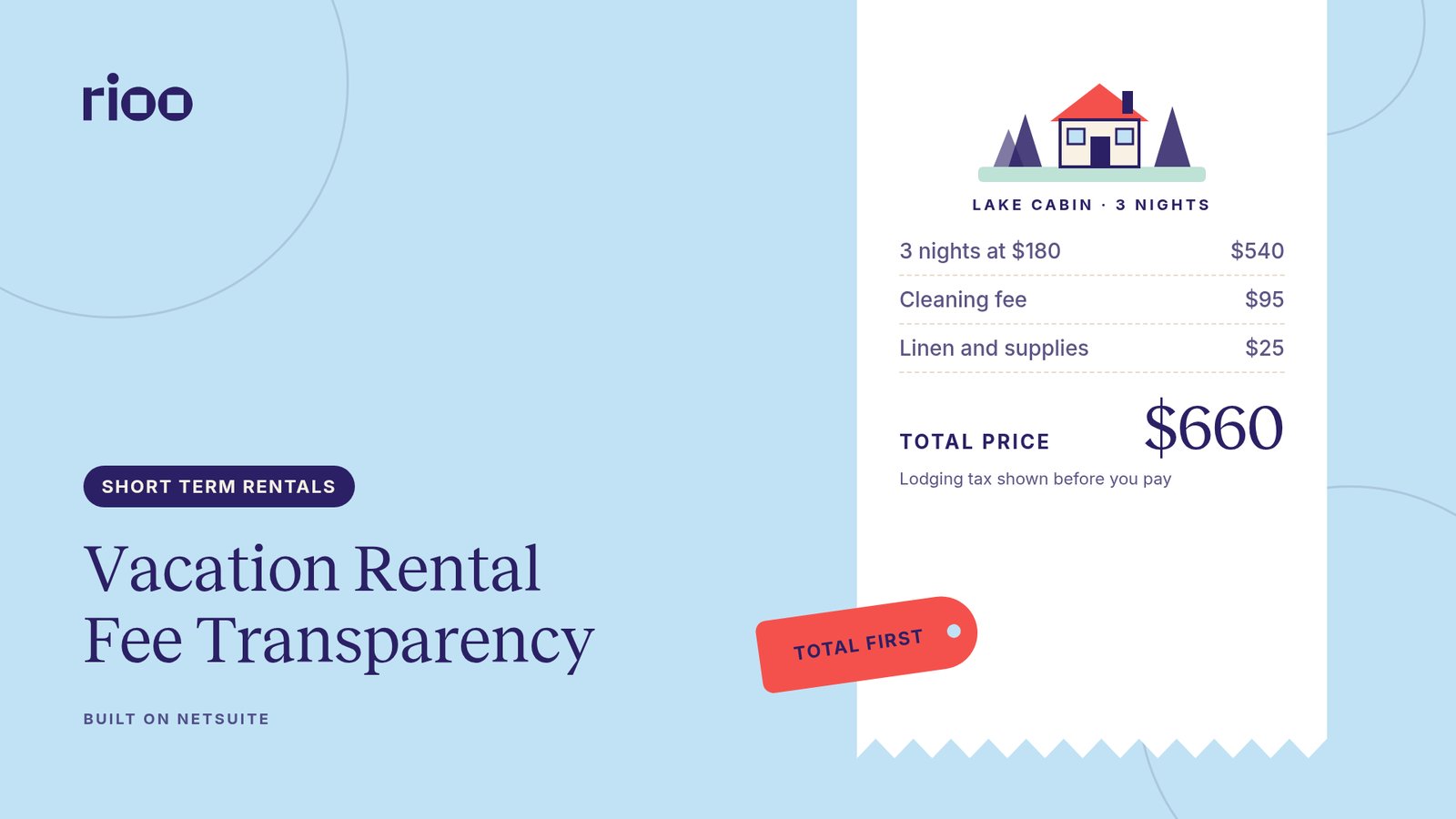
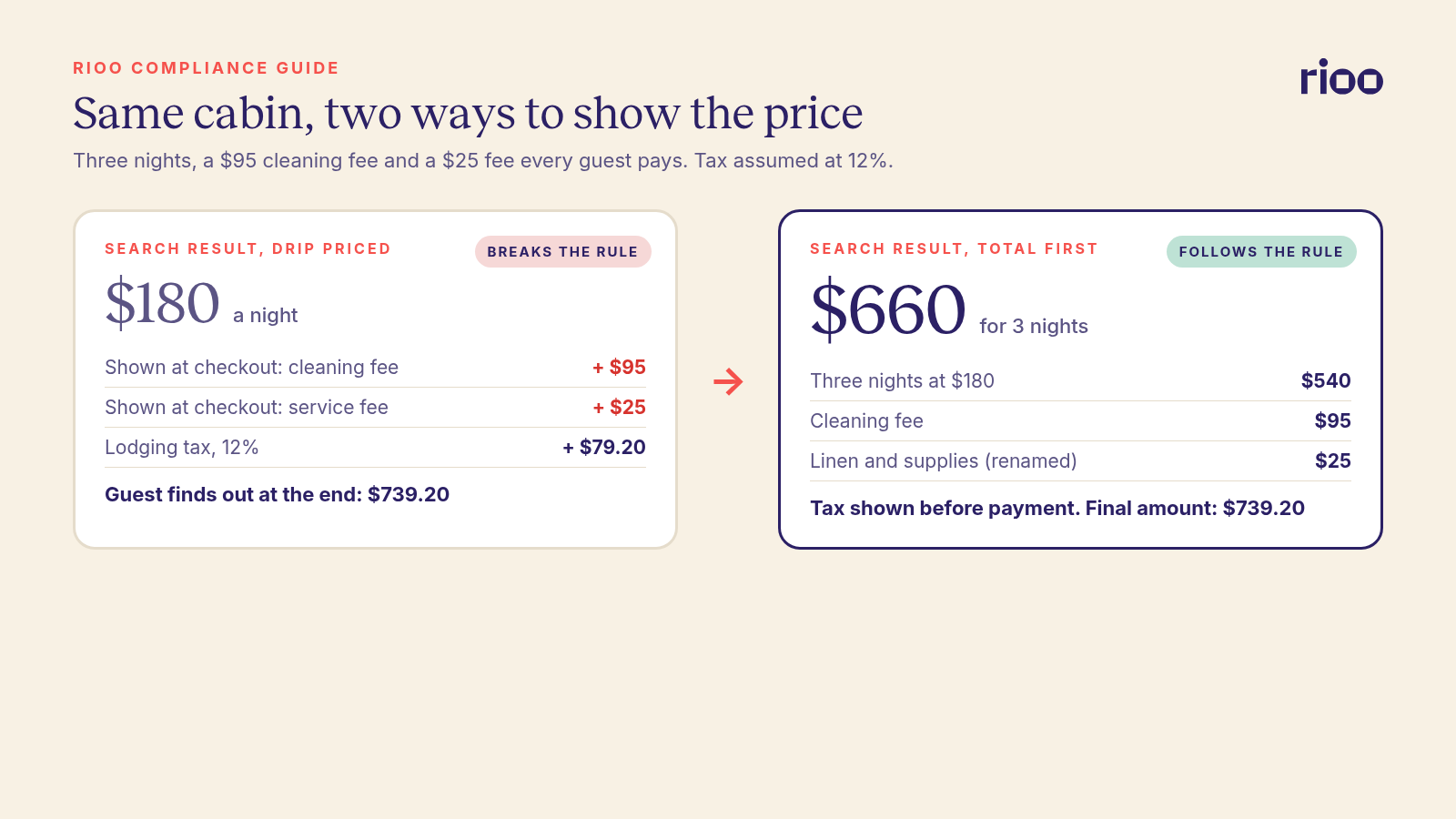
A guest searches for a lake cabin for three nights in June. Your listing says $180 a night. At checkout the guest meets a $95 cleaning fee, a $25 service fee and lodging tax. A stay that looked like $540 now costs $739.20. Since 12 May 2025, showing that $180 figure on its own breaks a federal rule.
In plain terms: The FTC Rule on Unfair or Deceptive Fees, at 16 CFR Part 464, covers short term lodging and names vacation rentals. Whenever you show a price for a stay, you must also show the total price, and the total must stand out above every other price. It includes every fee the guest has to pay. Taxes and truly optional extras can sit outside it, as long as you disclose them before payment. For the cabin, the headline number is $660 for three nights.
This guide walks through that one listing, charge by charge. Then it covers the places a price shows up, how to name fees, who is responsible on a platform, and the state rules on top.
What the fee rule asks of a vacation rental listing
The rule has two working parts. Section 464.2 bans hidden fees. Section 464.3 bans misleading fees.
Take hidden fees first. If an offer, display or ad shows any price for a stay, it must also show the total price. The total must stand out more than any other price in that offer. The rule calls this clear and conspicuous. Online, it means the guest cannot miss it.
The rule defines the total price as the maximum total of all charges the guest must pay. Two words carry the weight. "Must pay" means mandatory charges. "Maximum" means you cannot show a lower figure that a guest will never get.
Before the guest agrees to pay, you must show two more things. The first is the nature, purpose and amount of any charge you left out of the total, such as tax. The second is the final amount of payment. That final amount has to be at least as prominent as the total price.
Misleading fees come next. You cannot misstate what a fee is, what it pays for, how much it is or whether it is refundable. A label that hides the purpose of a fee can break the rule even when the amount sits inside the total.
The full text is short and readable. You can find it on the eCFR page for 16 CFR Part 464. The FTC also publishes a staff guide with frequently asked questions, which I quote below.
Does your rental count as short term lodging?
The rule covers temporary sleeping accommodations at a hotel, motel, inn, short term rental, vacation rental or other place of lodging. The FTC guide adds home shares and vacation rentals offered through platforms.
Stays the rule covers
Nightly and weekly vacation rentals are covered. So are rooms in a home that you let by the night. Discounted extended stays at a hotel are covered too. The rule sets no cutoff in nights. Whether a stay counts as short term depends on the facts of the arrangement.
Stays outside the rule
The FTC guide lists three examples that fall outside. The first is rental housing with an ongoing landlord and tenant relationship. The second is a short extension that a housing provider offers on an existing lease. The third is corporate housing that an apartment community lets on the same terms as its long leases.
If you manage both kinds of property, you need two pricing processes. Long term fees follow state law instead. Our guide to rental fee transparency laws by state covers that side.
Line by line: the cabin booking under the rule
Back to the cabin. The table shows how each charge on that booking is treated. The 12% lodging tax is an assumption for the example. Your local rate will differ.
| Charge | Amount | Inside the total price? | Reason |
|---|---|---|---|
| Nightly rate for three nights | $540 | Yes | The core price of the stay |
| Cleaning fee | $95 | Yes | Every guest pays it. The FTC guide uses this exact fee as an example. |
| Service fee | $25 | Yes | Mandatory. The name also needs work. |
| Pet fee | $40 | No, if the guest chooses it | An optional extra the guest adds |
| Lodging tax at 12% | $79.20 | Can be left out | A government charge, shown before payment |
So search results and the listing should lead with $660 for the three nights. A per night figure can appear as well, but it cannot be bigger or bolder than the total. At checkout, the guest sees $739.20 before entering card details. If they add the $40 pet fee, it joins the final amount, with any tax due on it, before they pay.
Cleaning fees
A cleaning fee charged on every stay is mandatory. It belongs in the total. You can also fold it into the nightly rate and drop the line. If the fee changes with the length of stay, the total should reflect the dates the guest entered.
Card fees and extras ticked in advance
A card surcharge is mandatory when guests have no other workable way to pay. In that case it goes in the total. If guests can pay another way without the fee, you may leave it out, but you still disclose it before payment.
Extras such as early check in or trip protection are optional when the guest chooses them. An extra that arrives already ticked is a different story. The FTC guide says boxes ticked in advance and default billing make a fee mandatory. Either include it or leave the box empty.
Taxes, deposits and charges after the stay
Government charges can sit outside the total. The rule defines them as charges a government imposes on the transaction. A fee you add to recover your own permit cost is your fee, so treat it like any other fee.
Charges that arise after the stay are different. The FTC guide says a business may leave out fees for damage to a room, because they are not part of the same transaction. A refundable damage deposit taken at booking is a harder case. The rule text does not address it directly. Show the deposit clearly, state when it comes back, and ask counsel how to present it.
Every place a price shows up
The rule applies to any offer, display or ad that shows a price. For a vacation rental manager, that list is longer than it looks.
- Search results and map pins on your own booking site
- The listing page, the calendar and the date picker
- Email campaigns and social posts that mention a rate
- Quotes your team gives by phone, chat or text
- Paid ads with a rate in the headline
Phone quotes count. The definition of clear and conspicuous covers audible disclosures, so a reservations agent should say the total first. For ads that cover several properties or a whole region, the FTC guide says to advertise the maximum total price for the area you target.
The guide also allows the lowest available total price for a room, as long as guests can actually book it at that price. Once a guest picks a feature that raises the rate, the total has to update.
Fee names guests can understand
The FTC guide tells businesses to avoid vague labels such as "convenience fee", "service fee" and "processing fee". The cabin's $25 service fee fails that test. Guests cannot tell what it buys.
There are two ways to fix it. You can roll the charge into the nightly rate and drop the line. Or you can rename it for what it pays for, such as "linen and supplies". Either route keeps the total the same. The second route only works if the money really covers linen and supplies.
The guide gives examples of labels that mislead. One is an "environmental fee" that funds nothing environmental. Another is a charge described as a government fee when no government requires it. Itemizing is allowed. Every item has to be true, and the list cannot overshadow the total.
Platforms, your own site and who is responsible
The rule covers any business that offers, displays or advertises lodging, and that includes third party platforms. Responsibility runs both ways.
If you list on a platform, you must give it accurate pricing information. That covers your cleaning fee, any extras and any mandatory charge it cannot see. If the platform shows the price, it must show the total. It must also give you the information you need to calculate a total, such as its own guest fee.
Your own direct booking site is all yours. So are your emails, your ads and your phone script. A manager with twenty listings on two platforms and one direct site has at least four places to check.
The FTC is enforcing the rule in lodging. In July 2026 it announced a $35 million settlement with a travel booking app over fees it said were hidden or added by default. The complaint included claims under this rule for lodging bookings made after 12 May 2025. The FTC lists compliance orders, refunds and civil penalties as possible outcomes.
State rules on top of the federal one
The federal rule does not replace state law. Where a state gives guests more protection, you follow both. Where the two truly conflict, the federal rule wins only to the extent of that conflict.
California is the clearest example. Its hidden fee law, Civil Code section 1770(a)(29), took effect on 1 July 2024. The Attorney General names short term rentals and hotels among the businesses it covers. The California Attorney General hidden fees page has the details.
Cities and counties also regulate vacation rentals through permits, occupancy limits and tax registration. Those rules sit beside the fee rule. Our guides to Nashville short term rental permits and New Orleans short term rental rules show how much they vary.
Questions vacation rental managers ask
Can I still show a nightly rate?
Yes. The nightly rate can appear, but the total price for the stay has to be more prominent. If no dates are entered yet, make sure any figure you show is one a guest could actually book.
Does the rule apply to a 30 night stay?
It can. The rule sets no length of stay. A 30 night vacation booking is still temporary lodging. A 30 day lease with an ongoing tenancy is not.
Do I have to include a resort or amenity fee?
Yes, if every guest pays it. The FTC guide uses a $199 nightly rate with a $39 daily resort fee as its example. The resort fee belongs in the total.
What about a fee for a second cleaning midway through?
If the guest chooses it, it is an optional extra. Disclose it and add it to the final amount once the guest selects it.
Does the rule cover my owners or only my company?
It covers any business that offers, displays or advertises the stay. If you advertise on behalf of owners, your listings and ads are in scope. Check what your management agreements say about who sets fees.
If you also manage long term rentals
Plenty of managers run a few vacation homes next to a book of annual leases. The two sides follow different fee rules, and both depend on knowing every charge that applies to a unit.
In RIOO, the long term side of that work sits in one system. Pricing and charge management in RIOO keeps rent, amenity fees and one time charges on the unit or lease that bills them. That gives your team one list to check when a state fee law changes. RIOO is built natively on Oracle NetSuite, so those charges post to the same ledger finance reports on.
For the vacation rental side, run the cabin test on each listing this week. Search with real dates, compare the first price to the final amount, and rename any fee a guest could not explain.