A resident in 3B texts the office at 11:40 PM: "The stereo upstairs has been going for an hour. Can you do something?" The leasing agent on call has no written quiet hours rule to point to, so the reply is guesswork. That is how noise becomes a revolving complaint file.
Quiet hours are the set times when noise from units, common areas and outdoor spaces must stay low enough that neighbours can sleep. A workable apartment quiet hours policy names the hours and lists what counts as noise. It tells residents how to report a problem. It sets a short enforcement path that matches your lease. Put it in the community rules and hand it out at move in, not after the third complaint.
What quiet hours cover
Quiet hours protect sleep and rest. Outside those hours, noise still has to stay reasonable. The policy should say both things in plain words.
| Topic | What to write |
|---|---|
| Weeknight hours | Example: 10:00 PM to 7:00 AM, Sunday night through Thursday night. |
| Weekend hours | Example: 11:00 PM to 8:00 AM, Friday and Saturday nights. Some buildings keep one set of hours every day. |
| Inside the unit | Music, TV, gaming, parties, loud appliances late at night, slamming doors. |
| Common areas | Hallways, courtyards, pools, gyms, parking decks, roofs. |
| Vehicles and outdoor gear | Bass from cars, idling, generators, power tools after hours. |
| Pets | Repeated barking that disturbs neighbours. Link this to your pet policy. |
Match local noise ordinances if your city publishes quiet hours. Confirm the final wording with counsel before you attach it to the lease.
How to set the hours
Pick times residents can remember. 10:00 PM to 7:00 AM is common on weeknights. Many communities push weekend start to 11:00 PM so Friday gatherings can wind down. Keep one schedule for the whole property unless a local rule forces a change.
- Write the hours in numerals and words once, then repeat the same line in every notice.
- Say that guests and delivery drivers count as the resident's responsibility.
- Say that holiday weekends follow the weekend hours, not a special looser rule.
- If you have a pool or roof deck with its own close time, put that time in the same document.
Hand the rule out with the tenant welcome packet and post it in the lobby. A rule nobody has seen is hard to enforce.
Translate the same hours into the languages your leasing office already uses for other house rules. A notice posted only in English in a bilingual building leaves half the community guessing.
How complaints should move
Staff need a path that does not turn every late call into a shouting match at a door.
- Ask the caller for the unit, the time, and a short description. Log it the same night.
- If the noise is still going, call the unit once. State the quiet hours and ask them to turn it down.
- If there is no answer or no change, a staff member or after hours vendor knocks, shows ID, and leaves a written door note.
- Send a written follow up the next business day. Keep copies of the call log, the door note and any photos.
- A second verified complaint in 30 days moves to a formal lease warning. Use the same tone as your lease violation warning letter.
Do not tell residents to bang on each other's doors. That turns a noise issue into a safety issue.
Train evening staff on the same script. A different answer from the desk and the on call phone teaches residents to shop for the softer reply.
What one Saturday night cost
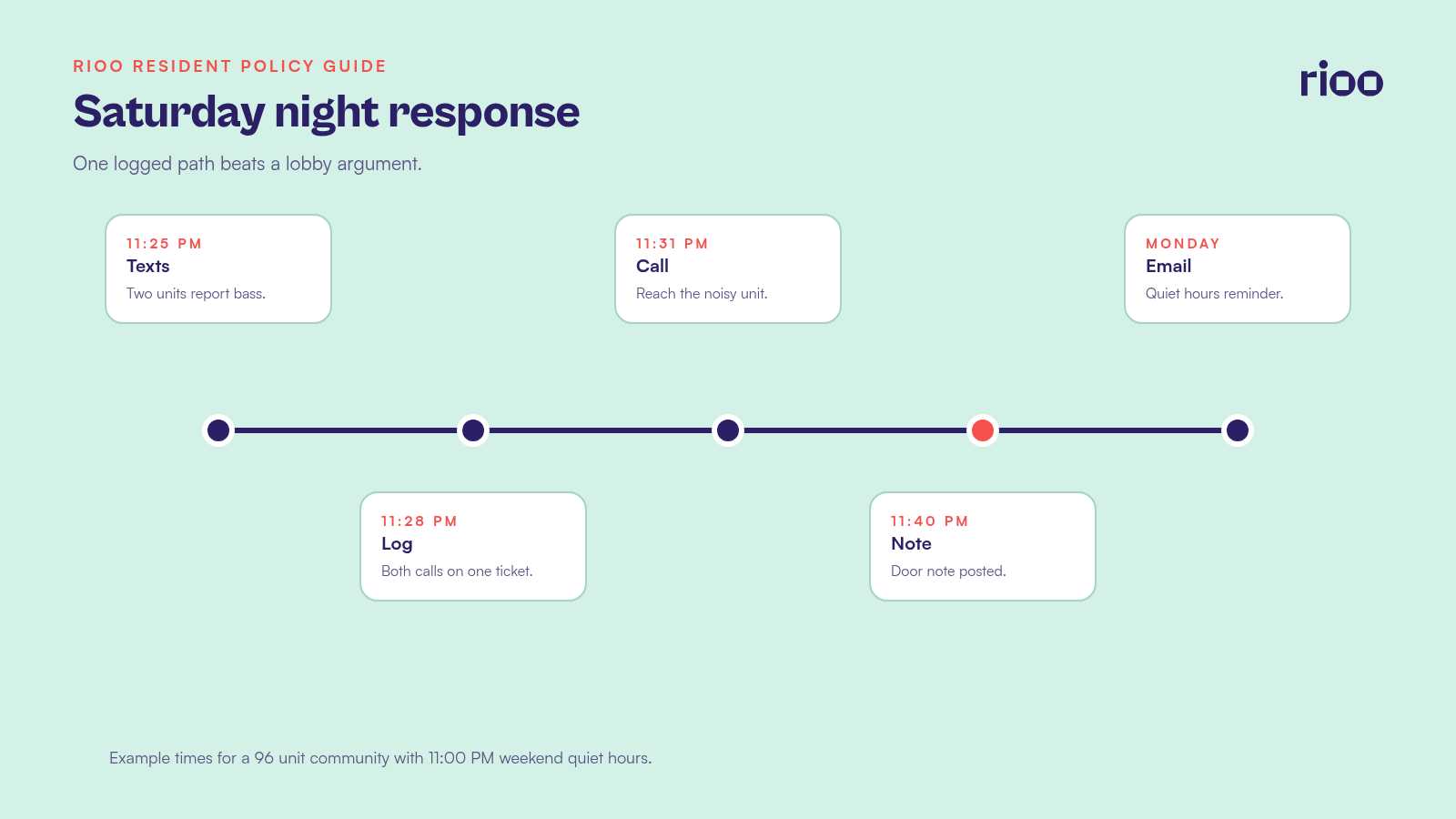
Take a fictional 96 unit garden community. Quiet hours run 10:00 PM to 7:00 AM on weeknights and 11:00 PM to 8:00 AM on weekends. On Saturday 5 December, unit 2C hosts a birthday dinner. At 11:25 PM, 2A and 2B both text the on call line about bass through the floor.
The on call agent logs both texts at 11:28 PM, calls 2C at 11:31 PM, and reaches the resident. The music drops within five minutes. The agent still posts a door note at 11:40 PM and emails a short reminder on Monday with the quiet hours line pasted in.
Cost of the response: 20 minutes of on call time at $28 an hour, about $9. Cost of doing nothing: two open complaint tickets, a Monday lobby argument, and a real chance that 2A gives notice to vacate in January. Between Thanksgiving and New Year's Day this community sees five weekends of parties and house guests. One clear rule and one logged call each time keeps the file thin.
A quiet hours policy you can copy
Paste this into your community rules and adjust for local law and counsel.
- Quiet hours: 10:00 PM to 7:00 AM Sunday night through Thursday night. 11:00 PM to 8:00 AM Friday and Saturday nights, including holiday weekends.
- Standard: During quiet hours, noise from a unit or common area must not disturb neighbours. Outside quiet hours, keep volume reasonable.
- Covered sources: music, TV, gaming, gatherings, appliances, vehicles, pets and outdoor equipment.
- Guests: Residents are responsible for guests and delivery drivers.
- Reporting: Call or text the office number listed on your lease. Do not confront neighbours directly.
- Enforcement: First verified complaint: verbal request plus written note. Second verified complaint in 30 days: formal warning under the lease. Repeated breaches may lead to further lease action.
Pair this with your smoke free apartment policy so residents get one clear house rules pack, not five loose emails.
Proof that holds up later
Noise cases fall apart when the file is thin. Build the file as you go.
- Date, time and unit of every call or text.
- What the caller heard, and for how long.
- Whether staff reached the noisy unit, and what was said.
- A photo of the door note or a copy of the email.
- Any pattern: same unit, same night of the week, same holiday.
One complaint can be a bad night. Three logged complaints in a month, with the same quiet hours line quoted each time, support a formal warning. Keep the tone factual. Skip guesses about who was visiting or how many people were inside.
If your market expects a cure period before a formal notice, put that period in the policy so staff do not invent different timelines on different nights.
Holiday visitors and short stays
November and December bring house guests, late arrivals and parking debates. Quiet hours still apply. Say so in the November resident note, next to package room hours and office holiday coverage.
Guests who stay overnight remain the leaseholder's responsibility. If a guest hosts the gathering, the warning still goes to the unit on the lease. That keeps the file clean and avoids arguments about who "really" made the noise.
For buildings with short stay pressure, keep quiet hours in the same pack as your guest and parking rules. One PDF is easier to enforce than four emails sent a week apart.
Construction, turnovers and early work
Turn crews and vendors often want to start at 7:00 AM. If quiet hours end at 7:00 AM, that is the earliest hammer time unless an emergency forces an earlier start. Put vendor start times in the work order notes and in the vendor onboarding pack so a flooring crew does not wake a wing of the building.
For planned noisy work that must start early, post a 48 hour notice on the affected floors with the date, the window and a contact number. Residents forgive work they were told about. They do not forgive a surprise at 6:30 AM.
Quiet hours records in RIOO
Quiet hours work when the rule, the call and the follow up live in one place. In RIOO, you can send the policy to every resident through the tenant portal. Log after hours noise calls as service requests with unit and time stamps. Attach a photo of the door note to the request. Managers see repeat units before the next holiday weekend. See how resident portals work in RIOO.
Quiet hours FAQ
Can a landlord set quiet hours in an apartment lease?
Usually yes. Quiet hours sit inside community rules or a lease addendum. Check local noise ordinances and fair housing limits, and have counsel review the final text.
What if a resident works nights and sleeps during the day?
Quiet hours protect night sleep for the building as a whole. Daytime noise still has to stay reasonable. Handle special cases case by case and document what you agree.
Do quiet hours apply to the gym or the courtyard?
Yes, if those spaces are on the property. State the close time for each amenity in the same policy so staff are not inventing rules at 11 PM.
Should staff call the police for loud parties?
Call emergency services when there is a safety risk, violence or a clear local noise emergency. For ordinary loud music, follow your internal path first and keep records. Write the threshold in the staff script so one agent is not calling the police while another is still dialing the unit.