










| Accrual for October | Debit | Credit | Amount |
|---|---|---|---|
| Water and sewer, bill due mid November | Utilities expense | Accrued expenses | $4,200 |
| Boiler repair, work order closed 28 October, invoice not in | Repairs and maintenance | Accrued expenses | $3,850 |
| Landscaping, October visits | Contract services | Accrued expenses | $1,600 |
| Site staff wages, 27 to 31 October, paid 7 November | Payroll expense | Accrued payroll | $2,700 |
| Total | $12,350 |
That table is a month end close for one fictional 80 unit building. Without it, October net operating income looks $12,350 better than it was. November then looks $12,350 worse. The owner sees a swing that never happened.
What month end accruals are: journal entries that record costs you incurred, or income you earned, in the month. You book them even though the bill or payment has not arrived. In property accounting, the usual ones are utilities and repairs with a late invoice. Contract services, payroll that spans the month end and property tax come next. Each one is an estimate you reverse at the start of the next month, when the real invoice posts.
I work on property accounting and close at RIOO. When an owner calls about a "lumpy" statement, the cause is often an accrual nobody booked.
Why the numbers move without accruals
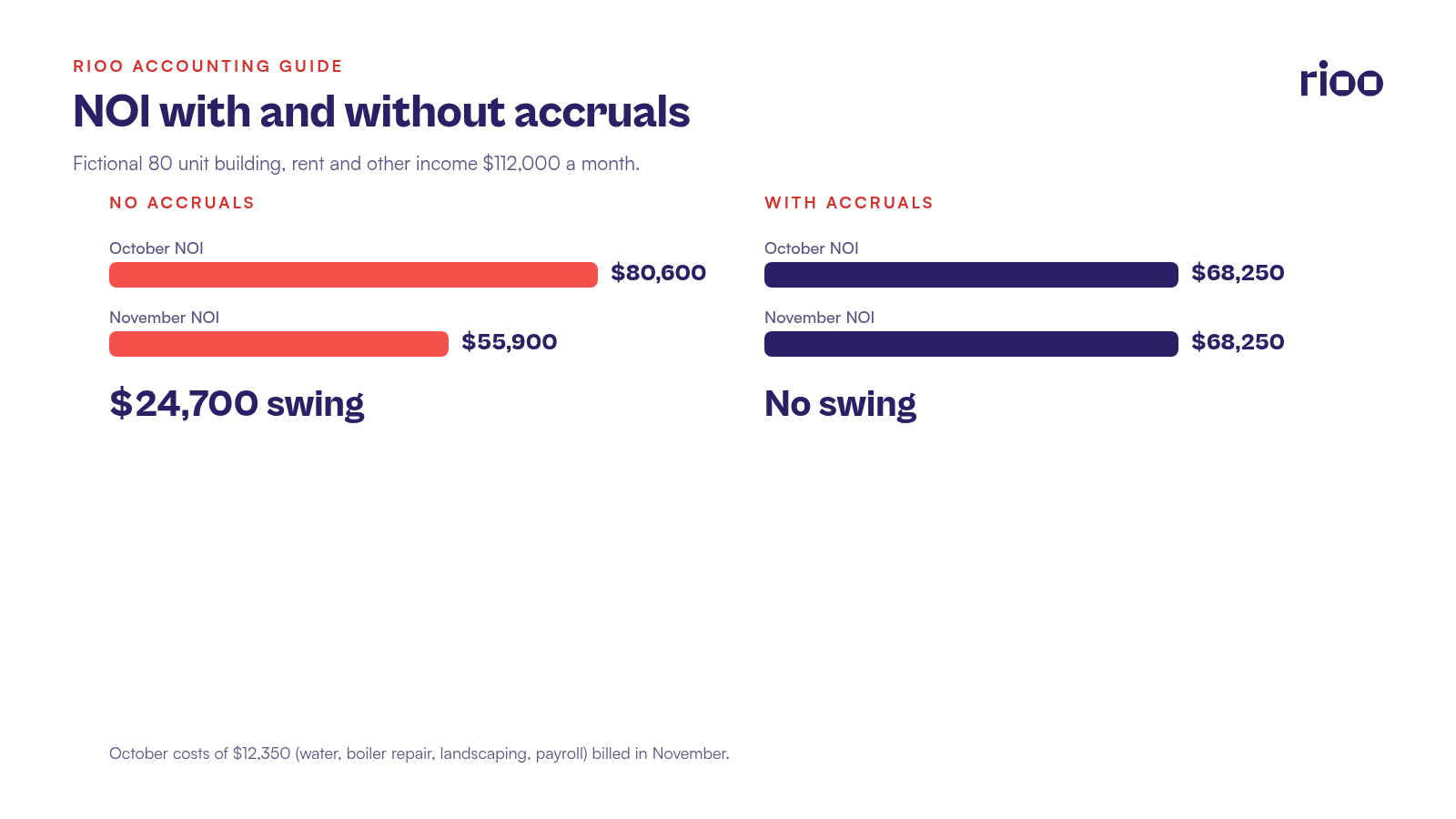
Here is the same building, with and without the four entries above.
| October, no accruals | October, with accruals | November, no accruals | |
|---|---|---|---|
| Rent and other income | $112,000 | $112,000 | $112,000 |
| Operating expenses | $31,400 | $43,750 | $56,100 |
| NOI | $80,600 | $68,250 | $55,900 |
November without accruals carries its own normal $43,750 of costs plus October's $12,350 that arrived late. That is the $56,100. With accruals, both months show about $68,250. The second number is the one the owner can plan with.
Six accruals to check every month
Utilities
Water, sewer, gas and common area electric bills often arrive two to six weeks after the service period. Accrue the month using the last bill, adjusted for days and season. If the last water bill was $4,050 for 30 days, a 31 day month is about $4,185. Round to $4,200 and move on.
Repairs done but not yet billed
This is the accrual teams miss again and again. Pull work orders closed in the month that have no vendor bill. Use the quote, the purchase order or the vendor's usual rate. The boiler repair above came from a quote of $3,850.
Contract services
Landscaping, cleaning, security and elevator contracts that bill in arrears. A fixed monthly contract is the easiest accrual you will make.
Payroll across the month end
If site staff are paid every two weeks, some days almost always fall in one month and get paid in the next. Accrue those days at the daily cost, including payroll taxes.
Property tax
Accrue one twelfth of the expected annual bill each month, then true it up when the bill arrives. We cover the reconciliation in property tax accruals.
Income accruals
Less common in residential books. In commercial ones, think percentage rent earned on reported sales, or CAM recoveries you will bill after year end. Book them when you can estimate them reliably and confirm the policy with your auditor.
A short example of the full cycle
Follow one accrual from start to finish. On 28 October, a technician closes a work order for a boiler circulator pump. The vendor quoted $3,850. On 31 October, the property accountant books a $3,850 debit to repairs and a credit to accrued expenses, with the work order and quote attached. On 1 November, the entry reverses. On 6 November, the vendor's invoice arrives for $3,935, because of a fitting that was not in the quote. Accounts payable posts it to repairs. November shows a net $85 for that job, and October carries the $3,850 that belongs there.
The owner statement for October now matches what happened in the building. The $85 variance is small enough to leave in November without comment.
Reversing entries: how to stop double counting
Set each accrual to reverse on the first day of the next month. On 1 November, the $4,200 utilities accrual reverses, which puts a $4,200 credit in November utilities. When the real $4,260 bill posts on 14 November, November shows a net $60. That small difference is the estimate error, and it lands in the month you learn about it.
Without the reversal, the bill lands on top of the accrual and the expense counts twice. After missing accruals entirely, this is the error auditors flag next.
How precise do the estimates need to be?
Close enough that a reader of the statement would make the same decision. Many firms set a threshold, for example any single accrual over $500 per property, and skip the rest. Write the threshold down so every accountant on the team applies it the same way. Your auditor will ask for it at year end, along with the support for each estimate. The audit PBC list guide shows what they usually request.
Who owns each accrual
Accruals go wrong when the accountant has to guess what happened on site. Split the work so the person closest to the cost supplies the number.
| Accrual | Source of the number | Due by |
|---|---|---|
| Unbilled repairs | Property manager or maintenance lead, from closed work orders | Business day 1 |
| Utilities | Accounts payable, from the last bill per account | Business day 2 |
| Contract services | Accounts payable, from the contract schedule | Business day 2 |
| Payroll | Payroll team, from the pay calendar | Business day 2 |
| Property tax | Property accountant, from the annual estimate | Business day 3 |
The repair list is the one that slips. Site teams close work orders on a phone and forget them. Make a five minute call to each property manager on the first business day. It catches what the system missed, such as a roofer who finished on the 30th and has not sent anything.
Mistakes that show up at audit
Accruing a full invoice for partial work
A painting contract runs from 20 October to 10 November. Accrue the October share, not the full quote. If the quote is $6,000 and the work is about half done, accrue $3,000.
Accruals with no support
An entry that says "est. utilities" with no backup will be questioned. Attach the last bill and a one line calculation.
Old accruals that never cleared
Run the accrued expenses account by vendor each month. Anything older than 90 days needs a reason or a reversal. A balance that only grows is a sign of entries that did not reverse.
Booking capital work as an expense accrual
A roof replacement or a new boiler is usually a capital item. Accrue it to construction in progress or the asset account your policy uses, not to repairs.
A month end accrual checklist
- Pull work orders completed in the month with no matching bill.
- List utility accounts and the date of the last bill for each.
- List contracts that bill in arrears.
- Count payroll days between the last pay date and month end.
- Book property tax at one twelfth of the annual estimate.
- Set every entry to auto reverse on day one of the next month.
- Keep the support (quote, last bill, contract) attached to each entry.
- After the real bills post, review any estimate that missed by more than 10 percent and adjust the method.
Accruals also feed the larger annual adjustments covered in year end close vs month end close.
Where RIOO fits
The hardest accrual to find is the repair that is done but not billed. In RIOO, work orders and purchase orders sit in NetSuite next to the general ledger. A list of closed work orders with no vendor bill becomes a saved search instead of a hunt through email. Accrual journals can be set to reverse automatically, and each property's entries roll into the owner statement for the right month. See how the month end close works in RIOO.
Accrual questions
Are accruals the same under GAAP and IFRS?
The idea is the same under both: record costs in the period they are incurred. Presentation details can differ, so follow the framework your owners report under.
Do small landlords need to accrue expenses?
If they report on a cash basis, no. Many small owners do. Once lenders, investors or audits are involved, accrual basis statements are usually expected.
What is the difference between an accrual and a prepaid expense?
An accrual records a cost you incurred but have not paid. A prepaid records a cost you paid before you used it, such as an insurance premium. They are mirror images.
Should accruals be booked by property or at the portfolio level?
By property. Owners and lenders read property statements, and a portfolio level accrual will not show up where they look.
How many days should month end accruals take?
For a single property with a clean work order list, an hour or two. For a portfolio, build it into the first three business days of the close calendar so the numbers are in before review.
What happens if an accrued invoice never arrives?
Ask the vendor. If the work was covered by warranty or the vendor will not bill, reverse the accrual and note why.