"Is it okay if I use a space heater in the bedroom? The radiator barely works at night." Every leasing office hears some version of that question in November. The answer you give at the front desk is your policy, whether it is written down or not.
The short answer: a lease can usually restrict or ban portable space heaters, subject to local fire codes and housing rules. A workable policy allows certified electric heaters with tip over and overheat shutoff. It bans fuel burning and open coil models. It also sets placement rules: three feet from anything that burns, plugged straight into a wall outlet, and off when nobody is in the room. It also says what happens when the building heat fails, because that is when every resident plugs one in at once.
I write resident policies for apartment communities at RIOO. This is the version I would put in front of a community manager before the first cold snap.
Can a landlord ban space heaters?
Usually, yes. A lease can limit which appliances residents bring in, and many lease forms already ban fuel burning heaters. Check two things before you ban electric heaters outright.
- Your local fire code and housing code. Some cities restrict certain heater types in multifamily buildings. Your fire marshal's office can tell you what applies.
- Your heat obligation. If the building does not hold the minimum temperature your city requires, a ban on space heaters will not hold up well with residents or inspectors. Fix the heat first. Our guide to minimum heat rules by city covers the numbers.
A total ban also tends to push heaters out of sight. A resident who hides a heater under a desk is more of a risk than one who follows clear placement rules. In many communities, a permitted list works better than a ban. Rules vary by place, so confirm your wording with counsel.
Which heaters to allow and which to ban
| Heater type | Policy | Why |
|---|---|---|
| Electric oil filled radiator | Allowed | No exposed element, slow surface heat, stable base. |
| Electric ceramic heater with tip over and overheat shutoff | Allowed | Shuts off if knocked over or too hot. |
| Electric heater with no safety certification mark | Banned | No independent testing. |
| Open coil or bar heaters | Banned | Exposed glowing element close to fabric. |
| Kerosene, propane or other fuel burning heaters | Banned | Carbon monoxide and fuel storage risk indoors. |
| Outdoor patio heaters used indoors or on enclosed balconies | Banned | Built for open air. |
The placement rules residents actually follow
Short rules get followed. Long ones get skimmed. These match the safety guidance from the U.S. Consumer Product Safety Commission, which estimates that portable heaters are involved in about 1,600 fires a year.
- Keep the heater three feet from beds, sofas, curtains, clothes and paper.
- Plug it straight into a wall outlet. No extension cords or power strips.
- Turn it off when you sleep or leave the room.
- Put it on a hard, level floor where it cannot be knocked over.
- Never run the cord under a rug.
- If the plug, cord or outlet feels hot, unplug it and tell the office.
How one heater can trip a breaker
Bedroom circuits in older apartments are often 15 amps at 120 volts. That is 1,800 watts at the absolute limit, and electricians plan continuous loads at 80 percent, so about 1,440 watts. A typical space heater on high draws 1,500 watts. On its own it already sits above the comfortable limit for that circuit. Add a laptop charger and a lamp and the breaker trips, or worse, the outlet runs hot for hours.
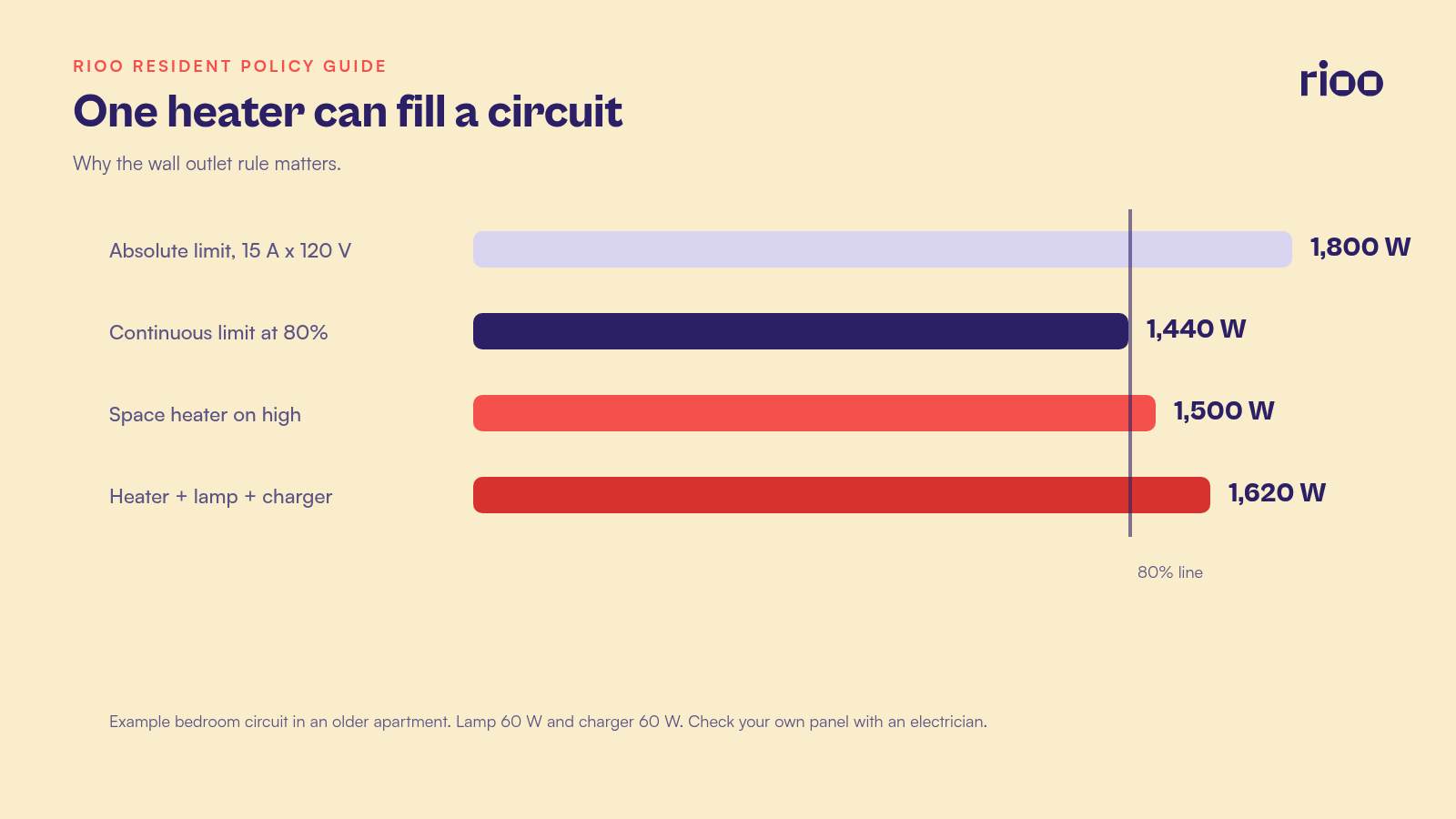
That is the real reason for the wall outlet rule. It also explains the maintenance calls about "dead outlets" every December. Tell your technicians to ask about heaters before they open the panel.
When the building heat fails
Many policies skip this part. Here is how it plays out.
An example outage
Take a 64 unit building. The boiler fails at 7 PM on a Thursday with 38°F outside. The replacement part arrives Saturday at noon, 41 hours later. By Friday morning, 22 households have asked for help.
The manager buys 24 oil filled radiators at $65 each, $1,560 in total, and lends one to each household that asked. Each comes with a one page copy of the placement rules and a sign out sheet. Two stay in the office as spares.
Residents are now paying for electricity to heat their own units. Say each loaner runs about 30 hours at 1.5 kilowatts and power costs $0.17 per kilowatt hour. That is 45 kilowatt hours, or about $7.65 per unit. The manager credits $10 to each of the 22 ledgers, $220 in total, and says so in the outage notice. It costs little and heads off the arguments before they start.
After the boiler is back, staff collect the radiators and log any that are missing. Next winter the same 24 units sit on a shelf, ready.
Pair this with your emergency maintenance rules. A winter heat outage is an emergency call in many places. Keep the frozen pipe playbook close too, because a dead boiler and a hard freeze often arrive together.
What the outage notice should say
Keep it to five lines. What failed and when. When you expect heat back. That loaner heaters are at the office, and the placement rules that come with them. How the electricity credit works. Who to call overnight. Send it by text and email, and tape a copy in the lobby. Update it every 12 hours even if nothing has changed, because silence is what fills the phone lines.
What staff should look for on winter entries
Your team already enters units in winter for filter changes, smoke alarm tests and repair calls. Give them a short list so they notice heater problems without turning each visit into an inspection.
- A heater on carpet next to a bed or curtains.
- A heater plugged into a power strip or a thin extension cord.
- Scorch marks or melted plastic on an outlet faceplate.
- A kerosene or propane heater, or a fuel can in a closet.
- Several heaters in one unit, which often points to a heating problem you need to fix.
That last point matters. A unit with three heaters running is telling you something about the radiator or the thermostat. Open a work order for the heat, not a lease violation for the resident. The fix is cheaper than the fire.
Technicians should leave a short written note for anything on the list and photograph it for the file. One note is a reminder. A second note on the same issue goes to the community manager.
A space heater policy you can copy
Paste this into your community rules or lease addendum and adjust it to your code and your lawyer's advice.
- Permitted: electric space heaters with a recognised safety certification mark, automatic tip over shutoff and overheat protection.
- Not permitted: kerosene, propane, gas or other fuel burning heaters; open coil heaters; outdoor heaters used indoors or on balconies.
- Placement: at least three feet from anything that can burn, on a hard level floor, plugged directly into a wall outlet.
- Use: off when sleeping or away. No extension cords, power strips or cords under rugs.
- Reporting: report hot outlets, tripped breakers or scorch marks to the office right away.
- Heat outages: during a building heat outage, management may lend approved heaters and will post how utility costs are handled.
- Enforcement: staff who see a banned heater during a scheduled entry will leave a written notice. A second notice is a lease violation.
Hand the policy out in October, not after the first fire alarm. A line in the tenant welcome packet covers new move ins.
Where RIOO fits
This policy lives mostly in communication and records. In RIOO, the heater rules can go to every resident through the tenant portal before winter, and a heat outage notice can go to one building in minutes. Loaner heaters and outage calls become service requests with times and units, so you can see who still has a radiator. Utility credits post to the tenant ledger in NetSuite with a note explaining why. See how resident portals work in RIOO.
Space heater questions
Can a tenant be fined for using a banned space heater?
If the lease or community rules ban it, a written violation notice is the usual first step. Whether you can charge a fee depends on your lease and local law. Many managers start with a warning and a copy of the rules.
Does renters insurance cover a fire started by a space heater?
A resident's renters policy usually covers their belongings and their liability, subject to its terms. The building itself falls under the owner's property policy. This is one reason to require renters insurance in the lease.
Should landlords provide space heaters?
Not as a substitute for working heat. Keeping a small stock of approved loaners for outages is a reasonable step, and it lets you control which models go into units.
Are space heaters allowed in student housing and senior housing?
Many operators of these communities ban them entirely, because rooms are small and residents may be less able to react to overheating. If you allow them, keep the permitted list short and inspect at move in.
How do we enforce the rule without inspecting every unit?
Use scheduled entries you already make, such as filter changes and smoke alarm tests. Staff note what they see. You do not need extra entries to enforce a heater rule.