An emergency maintenance request is a problem that will hurt someone, or keep damaging the building, if nobody acts before the office opens. A gas smell qualifies. So does water that will not stop, or sewage coming up a drain. No heat on a freezing night counts. So do an outside door that will not lock and a carbon monoxide alarm going off.
A dishwasher full of water does not qualify, however upset the resident sounds at 11 p.m. The word "emergency" on a portal ticket tells you how the resident feels. What you send depends on what happens if you wait. Four questions, asked in order, sort almost any after hours call in under two minutes.
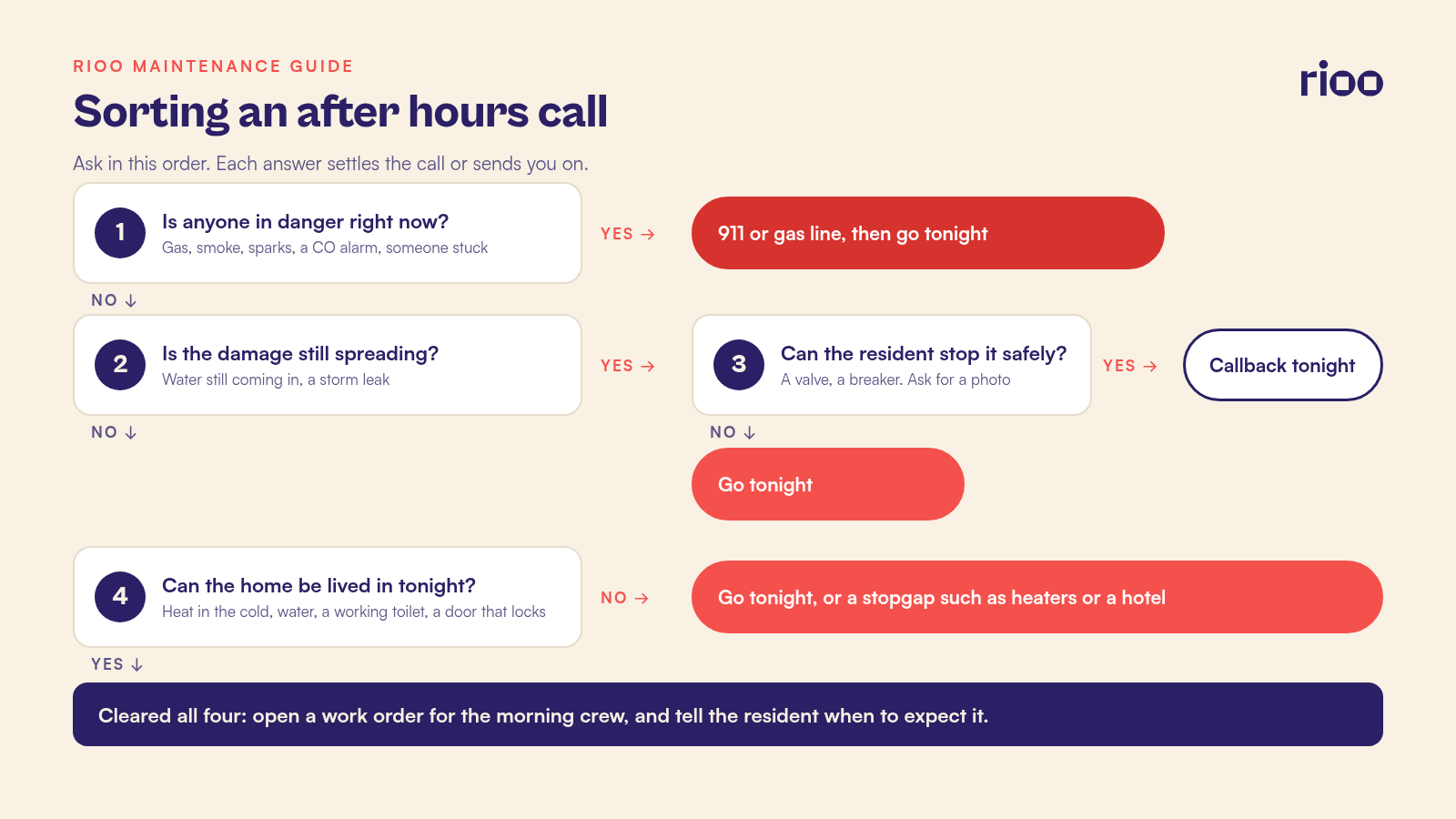
Four questions, asked in this order
Use the same order every night, whoever holds the phone. Each answer either settles the call or sends you on to the next question. A call that clears all four becomes a work order for the morning crew.
1. Is anyone in danger right now?
Gas smell, smoke, sparking outlets, a carbon monoxide alarm, someone stuck in an elevator. These calls go to 911 or the gas utility's emergency line first. You come second. Tell a resident who smells gas to leave the unit and call from outside. Do not let them hunt for the source.
2. Is the damage still spreading?
Water is the usual case. A burst supply line under a sink runs until someone closes a valve. Water coming through a ceiling from the unit above is still spreading. So is a roof leak in a storm. When a description is vague, ask one plain thing: is water coming in right now? If the answer is yes, move straight to the next question.
3. Can the resident stop it safely?
Plenty of spreading problems drop a level once the resident closes the valve behind the toilet or resets a breaker. Talk them through it. Ask for a photo once it is done. A leak stopped at the valve becomes a callback, and the work can usually wait for daylight. If the resident cannot reach the valve, or the source is in another unit, go tonight.
4. Can the home be lived in tonight?
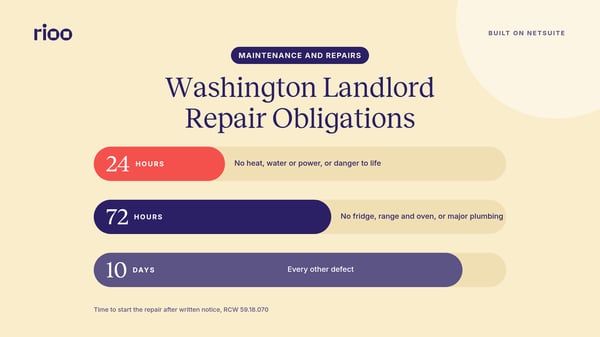
No heat when it is 22°F outside. No water at all. The only toilet backed up. The front door lock broken. Nobody is in danger this minute, but the home is not fit for the night. These calls get a technician tonight, or a stopgap tonight such as space heaters, a hotel room or a locksmith. Local codes often set deadlines too. Our guide to landlord heat requirements lists the temperature floors several cities use.
The call sheet
Print this and keep it beside the on call phone. "Tonight" means a technician or contractor goes out now. "Callback" means someone rings the resident back tonight with a plan, and the work waits for normal hours. "Morning" means an ordinary work order.
| The call | Usual response | What moves it |
|---|---|---|
| Gas smell | 911 or gas line, then tonight | Never downgrade |
| Carbon monoxide or smoke alarm sounding | 911, then tonight | A low battery chirp on a working alarm is a callback |
| Water through a ceiling | Tonight | Stopped at the source and drying: callback |
| Toilet backed up | Callback | Tonight if it is the only toilet, or sewage is rising |
| No heat | Tonight below 40°F outside | Mild night: callback |
| No air conditioning | Morning | Tonight during a heat warning, or for a frail resident |
| Outside door or window will not lock | Tonight | Board up or locksmith until the repair |
| Resident locked out | Callback | Tonight if a child is inside or it is freezing |
| Power out in one unit | Callback to check the breaker | Tonight for medical equipment; whole building: utility first |
| Refrigerator stopped | Morning | Offer a cooler and ice tonight |
| Dripping tap, noise, a light out | Morning | Nothing |
The 40°F line is our default. Pick your own number and write it on the sheet. A rule that lives in one supervisor's head changes with whoever is on call.
Weather moves the line
The same call can land in two different rows depending on the month. No heat in May waits for the morning. No heat in January sends a technician out. The call sheet should say so in plain numbers, so nobody has to guess at 2 a.m.
Freezing nights
When the forecast drops below freezing, frozen pipe calls move up a tier. Vacant units deserve a look before the cold arrives. A vacant unit with the heat off can burst a pipe and flood the unit below before anyone notices. Set vacant thermostats to 55°F and check them the day a freeze is forecast.
Heat waves
No air conditioning becomes urgent when the weather service issues a heat warning. It is urgent sooner when the resident is elderly, very young or unwell. So ask who lives in the unit. Some cities and counties now set cooling standards for rentals, so check yours before summer.
Saturday, 17 January: five calls, one technician
Here is a fictional example. A 140 unit garden community has one technician on call and a plumbing contractor for overflow. The plumber charges $225 to come out after hours plus $165 an hour. On a weekday the same visit costs $95 plus $110 an hour. The overnight low is 22°F.
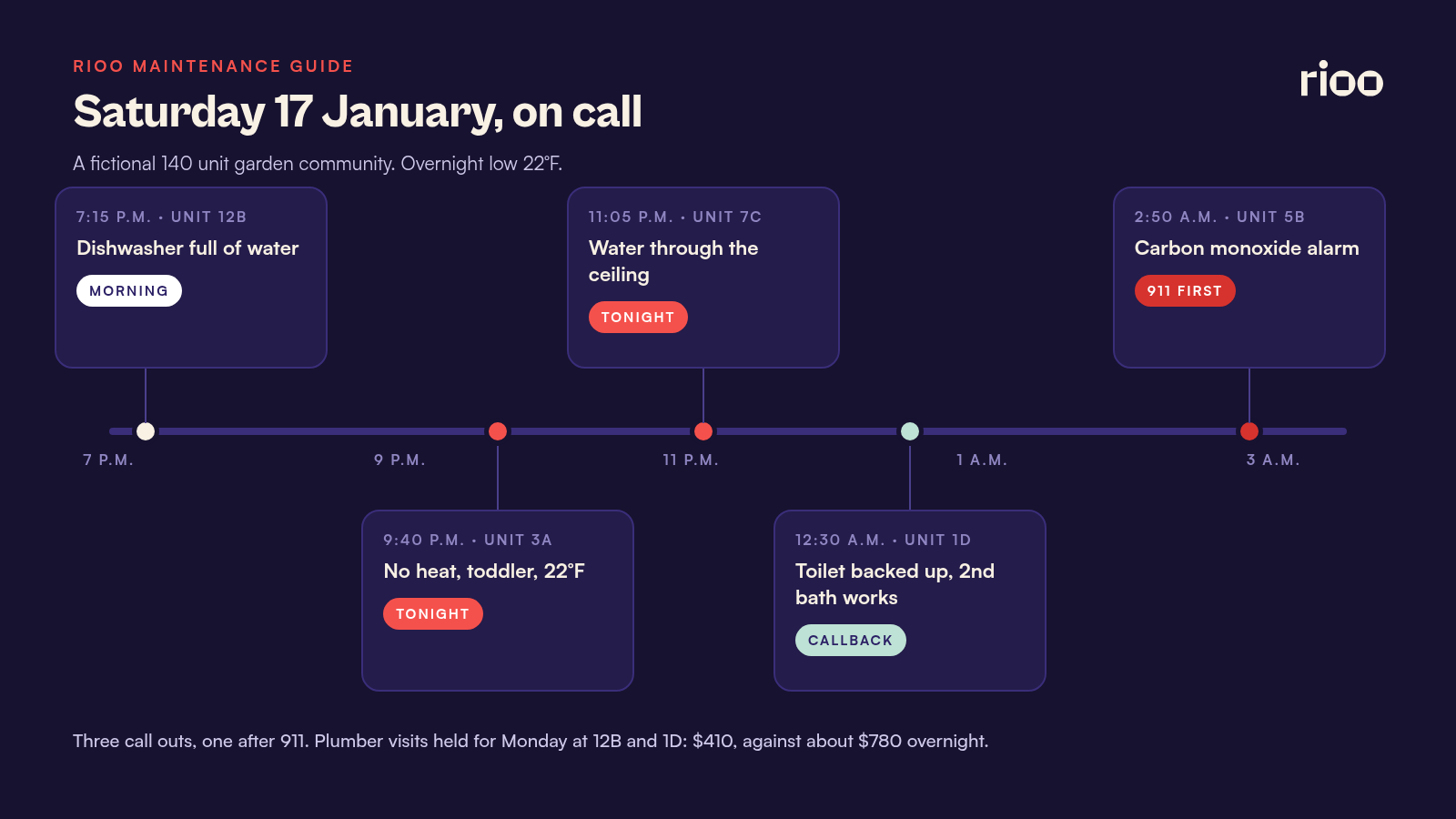
7:15 p.m., unit 12B. The dishwasher will not drain and there is standing water inside it. Nothing is leaking onto the floor, nobody is at risk and the kitchen still works. None of the four questions sends anyone out. The on call technician tells the resident to keep the door shut and opens a Monday work order.
9:40 p.m., unit 3A. No heat. The resident has a two year old. The home cannot be lived in tonight at 22°F, so the fourth question says go. The technician arrives at 10:25 p.m. and replaces a failed igniter. Heat is back by 11:10 p.m.
11:05 p.m., unit 7C. Water is dripping from the bathroom ceiling. The resident upstairs in 8C does not answer the door. Damage is still spreading, so the technician goes. He enters 8C under the lease's emergency entry clause, finds a cracked toilet supply line and closes the valve. He leaves a written note on the 8C door saying who entered, when and why.
12:30 a.m., unit 1D. A toilet is backed up and still filling. The unit has a second bathroom that works. The third question settles it.
"Is water still coming up?" the technician asks.
"A bit, yes. It's near the rim."
"There's a small valve on the wall behind the toilet, near the floor. Turn it clockwise until it stops."
"Okay. It's stopped."
"Good. Please use the other bathroom tonight and keep the lid down. The plumber will call you by 8:30 on Monday morning."
2:50 a.m., unit 5B. The carbon monoxide alarm is sounding. The first question answers itself. The technician tells the family to get outside and call 911, then drives over. The fire department ventilates the unit and the gas utility shuts off the furnace. A heating contractor comes at 9 a.m. The family spends one night in a hotel at $139.
Three of the five calls got someone on site that night, and one of those started with 911. The two that waited were 12B and 1D. Sending the plumber to both overnight would have cost about $780, at $225 plus one hour at $165 each. On Monday the same two visits cost $410. The technician went out only for calls that needed him. By February, that is the difference between an on call rotation people stay on and one they quit.
What the on call person says and writes
Good triage fails if nobody can tell later what was decided and why. Keep the call record short and the same every time.
- Take the name, unit and a callback number before anything else. If the line drops, you can still act.
- Ask the four questions in order and note each answer.
- Give one safety step where it fits: leave for gas, close the valve, reset the breaker.
- Say what happens next and by when. "The technician will call you within 30 minutes" beats "someone will be in touch."
- Log the time of the call and the time help arrived.
- Ask the resident for photos before and after.
- Review every overnight call with the maintenance lead the next morning.
The morning review is where the sheet improves. If three calls in a month were sent out and turned out minor, a row needs rewording. Our guide to managing maintenance requests covers how overnight jobs feed the daytime queue.
For water that reaches more than one home, a single ticket per unit causes confusion. Treat it as one incident, as the multiple unit water leak response explains.
RIOO and the overnight queue
In RIOO, a service request carries its priority from the moment it is logged. It might come from the resident portal, the mobile app, or a phone call the person on call types in. A high priority request becomes a work order assigned to the on call technician, who can see the unit and its asset history on the phone.
The work order keeps its status history as it moves from received to assigned to completed. That record earns its keep later. If a resident says nobody came, you can show when the request was logged, who took it and when the job was closed. After hours contractor bills post to the property's ledger in NetSuite, so the owner sees the night on the statement. The RIOO maintenance platform page shows the request to work order flow.
Questions from the on call phone
Is a lockout an emergency?
Usually it is a callback. Offer a locksmith at the resident's cost, or a key run if your policy allows one. It moves to tonight when a child is inside alone, or when standing outside is unsafe because of the cold.
Can we charge residents for a call that was not an emergency?
Some leases include a fee for after hours calls caused by the resident, or for calls that clearly fall outside the emergency list. Put any fee in the lease, apply it the same way to everyone and check state rules with counsel first.
What if the resident insists it is an emergency?
Go back through the four questions out loud. When the answers are honestly unclear, send someone. A wasted call out costs a few hundred dollars. A missed flood costs far more.
Who should answer the phone after hours?
An in house rotation, an answering service or a mix of both can work. Whoever answers needs the same call sheet and a current contractor list. Our vendor onboarding checklist includes an emergency roster you can adapt.
How fast should a technician arrive?
Set a target for tonight calls and publish it to your team. One hour is a sensible starting point for a single site. A scattered portfolio may need a longer target and more contractors. Check local rules too, because some states set repair deadlines that start when the tenant gives notice.