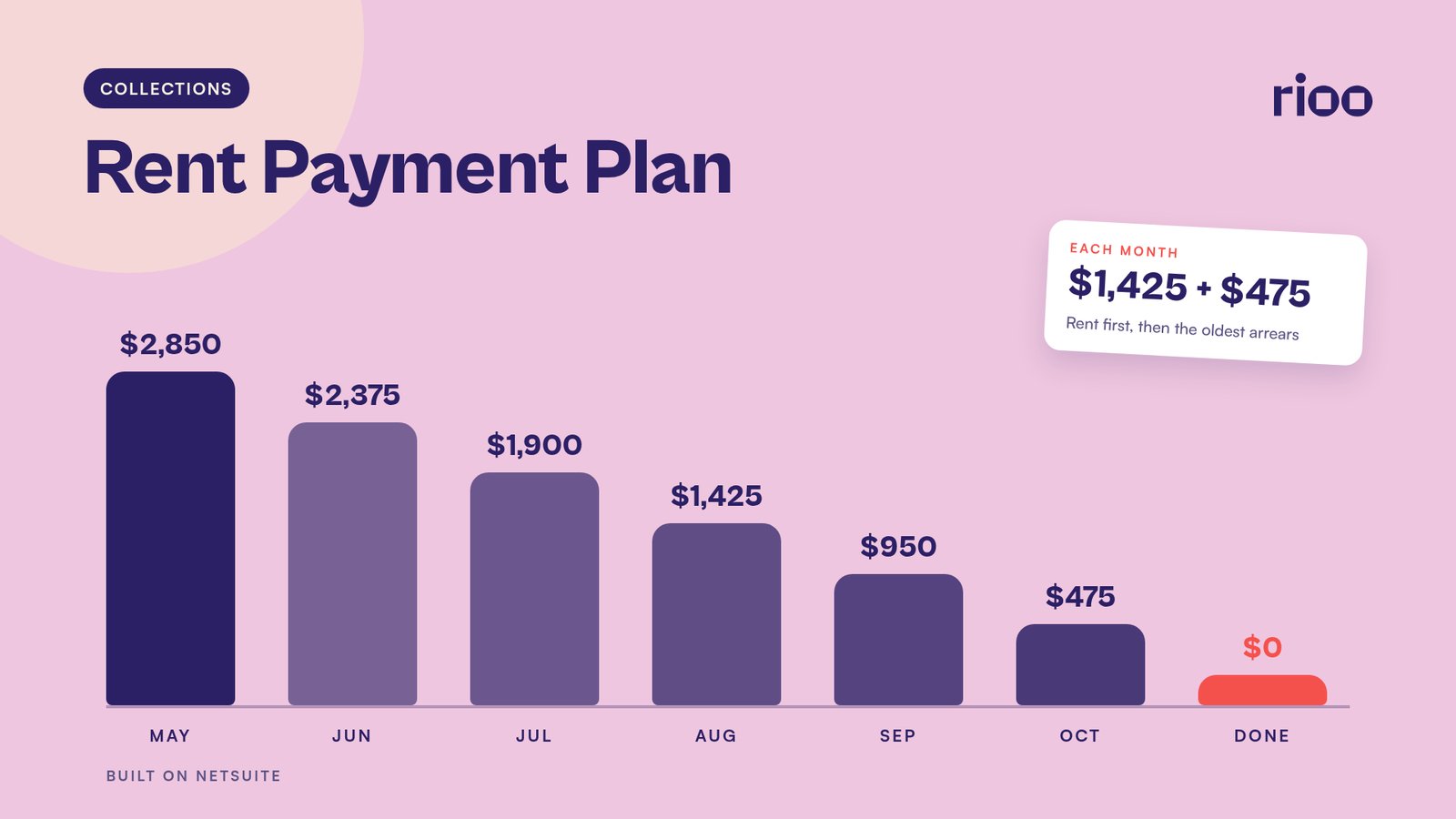
Yes, you can let a tenant pay back rent in installments, and a well built plan can recover more than an eviction would. Put it in writing before the first payment. State the exact balance, an installment paid on top of normal rent, fixed due dates, what happens to late fees and what happens if a payment is missed.
This guide walks through a rent payment plan in seven steps. It uses one fictional tenant who is $3,000 behind on a $1,425 rent. Rules on partial payments and eviction differ by state and city. Have counsel review your agreement template once before you use it.
Is a plan right for this balance?
A payment plan works when the shortfall has a cause that is ending. A new job that starts next month, a medical bill that is now paid or a benefits delay that has cleared are good signs. It works badly when the tenant's income has dropped for good and the rent no longer fits.
Size matters too. A balance of one or two months' rent can usually be cleared inside six months. A balance of five months rarely can. In that case, a plan may only delay a harder conversation. Look at the payment history as well. Three years of rent on the 1st says more than any promise made on the phone.
Offer plans on the same criteria to every tenant. A short written policy keeps the decision consistent and fair, and it protects you if a tenant later asks why a neighbour got different terms.
Step 1: Confirm the balance on the ledger
Pull the tenant ledger and split the balance by type before you talk numbers. Rent, late fees, utilities and other charges may be treated differently in the plan. If you are unsure what the ledger should show, our explainer on the tenant ledger covers it.
In our example, the tenant in unit 210 has paid on time since 2023. She lost a contract job in February. On 10 April her ledger shows:
- March rent unpaid: $1,425
- April rent unpaid: $1,425
- Two late fees at $75: $150
- Total: $3,000
Send her this breakdown before you meet. Disputes about the number are far easier to settle before the plan exists than after.
Step 2: Size the installment from her budget
Ask what she will earn once the plan starts, then work backward. Her new job starts on 20 April. Take home pay will be about $4,600 a month from May.
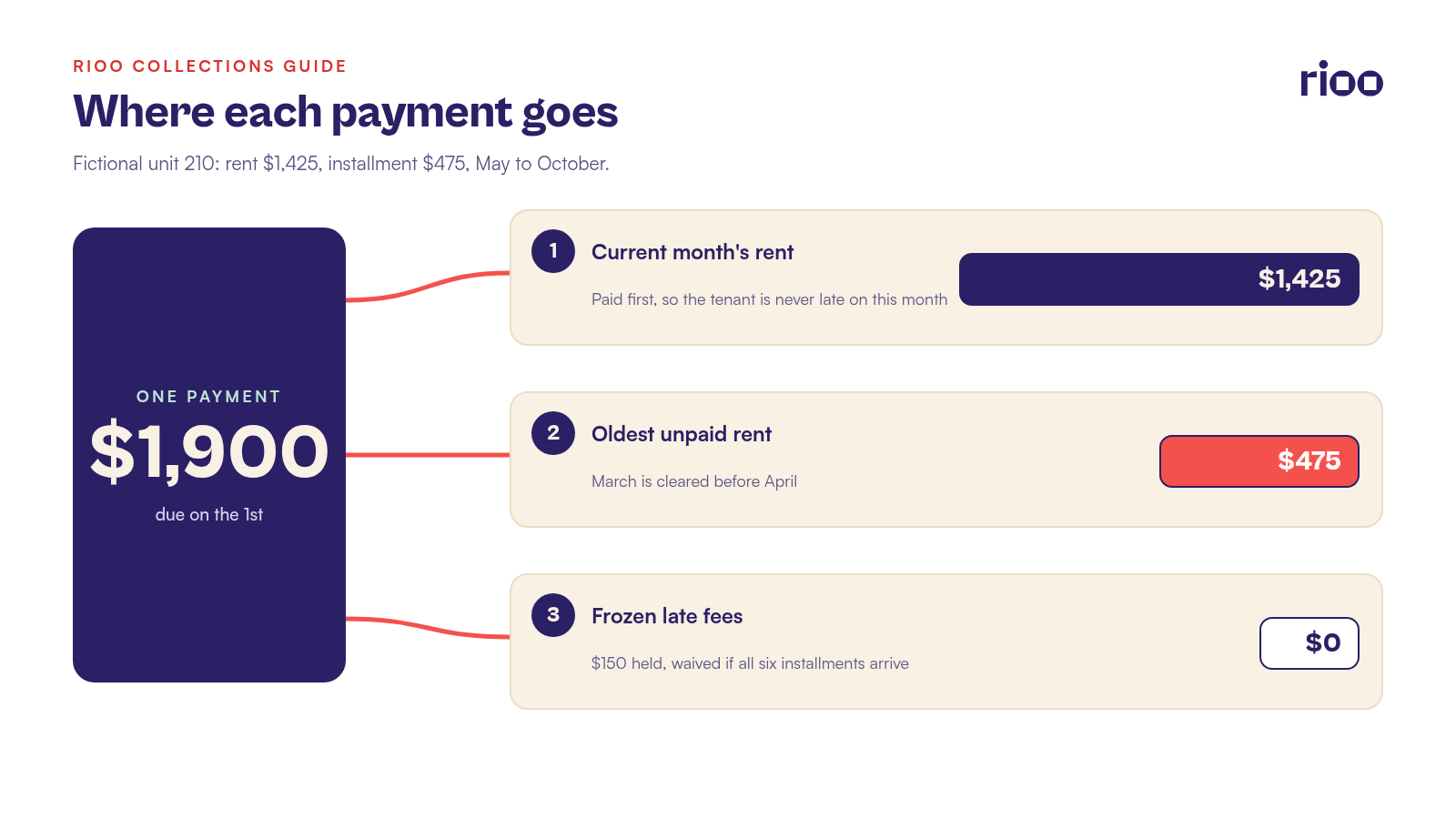
Rent plus the installment has to fit that number with room left for food and transport. An installment of $475 a month brings her monthly housing payment to $1,900. That is about 41% of take home pay. It is tight, but she agrees it works. Six installments of $475 clear the $2,850 of unpaid rent.
Avoid a plan the tenant cannot meet. One that fails in month two leaves both sides worse off than no plan at all.
Step 3: Set dates that end before the lease does
Her lease ends on 31 October. The plan should finish before then, so the renewal decision is not tangled up with old arrears. Six payments on the 1st of each month, May to October, finish exactly in time.
Put each installment on the same day as rent. One payment of $1,900 on the 1st is easier to remember than two payments on different dates. It is also easier for you to spot when it does not arrive.
Step 4: Decide what happens to late fees
You have three choices. Include the fees in the plan, waive them now, or freeze them and waive them only if every installment arrives on time. The third choice gives the tenant a reason to finish.
For unit 210, the $150 is frozen. It is waived on 1 October if all six payments are made. No new late fees accrue on the arrears during the plan. Normal late fee rules still apply to the monthly rent. Check that any fee you keep fits your state's cap, which our rent late fee rules by state guide covers.
Step 5: Write the agreement
Keep the agreement to one or two pages and attach the schedule. It should include:
- The names on the lease and the unit address
- The balance as of a stated date, broken down by type
- A table of each due date and amount
- A line confirming that monthly rent stays due on top of each installment
- The order in which payments are applied
- What happens to late fees, as decided in step 4
- What counts as a missed payment, the cure period and what happens after it
- A line confirming the lease remains in force
- Signatures and dates from both sides
The order payments are applied
Write this down. Apply each payment to the current month's rent first, then to the oldest unpaid rent, then to fees. If a payment lands on old arrears first, the current month can show as unpaid, and a tenant who is keeping the plan looks late again. Some states set their own rules on how payments are applied, so check yours.
Sample default wording
"If any payment under this plan is not received in full within 5 days of its due date, the Landlord will give written notice. If the missed amount is not paid within 7 days of that notice, this plan ends. The full remaining balance becomes due, and the Landlord may use any remedy available under the lease and the law."
Adapt this with counsel. In some places, accepting part of the rent after a notice can affect an eviction case. The wording has to fit local rules.
Step 6: Set it up so the ledger tells the truth
Do not create new charges for the arrears. They are already on the ledger. Record the plan on the tenant's file instead, with the schedule and the signed agreement attached. Each installment is a payment applied to the oldest rent.
Keep the balance visible on the aging report while the plan runs. Owners deserve to see that unit 210 owed $3,000 in April and $1,900 of rent at the end of June, with the $150 in fees still frozen. Flag the account as being on a plan so the collections team does not send a standard late notice by mistake.
For the accounting side, a plan does not change revenue already recognised. If you hold an allowance for doubtful accounts, review it as the balance falls. Our guide to tenant bad debt write offs covers what happens if a plan fails and the tenant moves out owing money.
Step 7: Act the day a payment is missed
The first missed installment tells you whether the plan is real. Call the next business day. Do not wait for the formal notice date.
On 1 July, unit 210 pays $1,425 and nothing more. On 2 July, the property manager calls.
"Your July rent came in, thanks. The $475 for the plan didn't. What happened?"
"My first paycheck from the new job was split. I'll have the rest on the 9th."
"That works, as long as it's in by the 9th. I'll note it on your account. If anything changes, call me before the 9th, please."
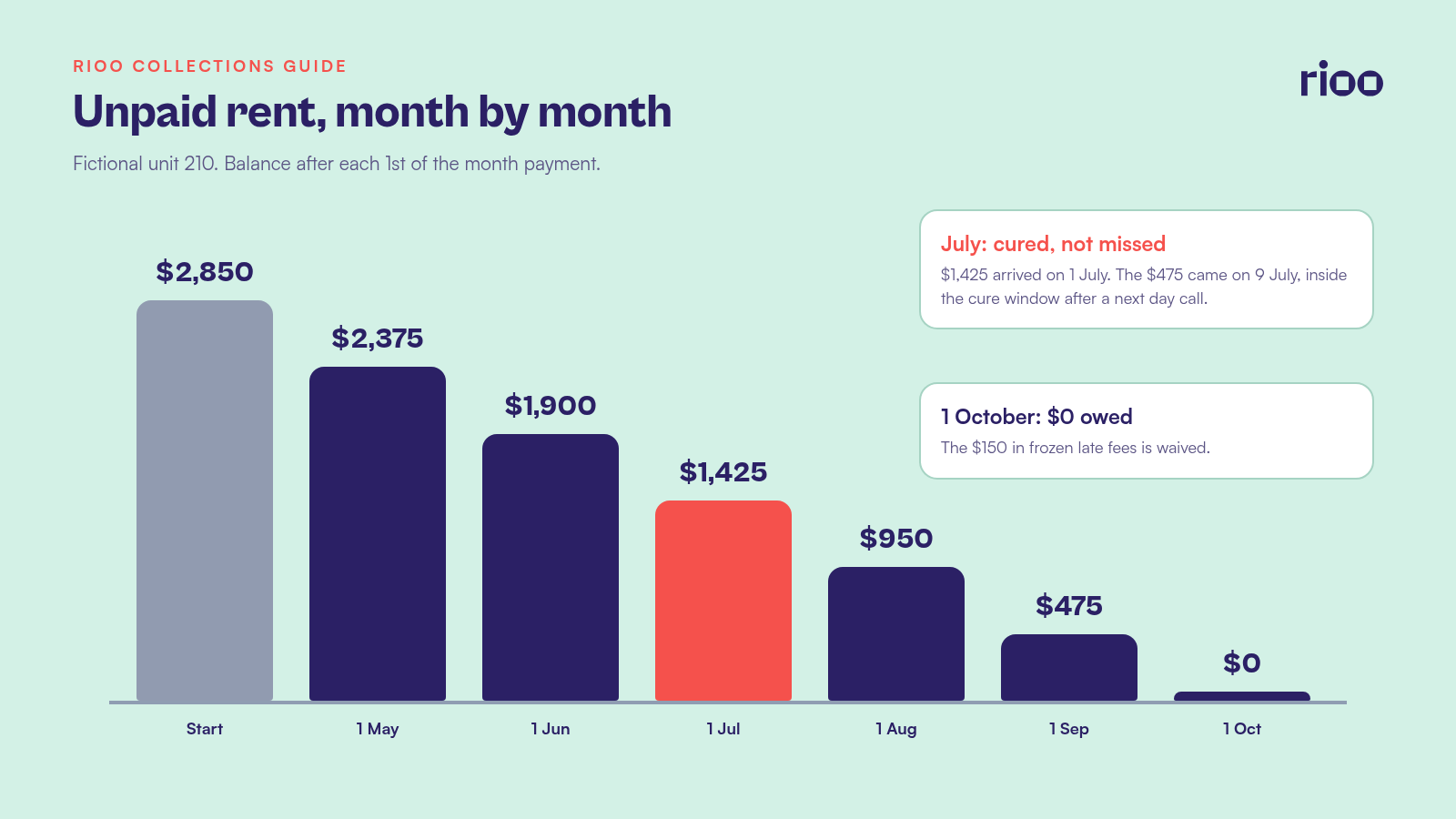
The $475 arrives on 9 July, inside the cure window. The call costs four minutes and keeps the plan alive. If the money had not come, the written notice would have gone out on 6 July, five days after the due date.
Treat a second miss differently from the first. Two missed installments usually mean the plan no longer fits. At that point, move to your normal process. The rent delinquency workflow sets out the stages that follow.
Unit 210, month by month
| Due date | Rent | Installment | Paid | Unpaid rent after |
|---|---|---|---|---|
| 1 May | $1,425 | $475 | $1,900 on 1 May | $2,375 |
| 1 June | $1,425 | $475 | $1,900 on 1 June | $1,900 |
| 1 July | $1,425 | $475 | $1,425 on 1 July, $475 on 9 July | $1,425 |
| 1 August | $1,425 | $475 | $1,900 on 1 August | $950 |
| 1 September | $1,425 | $475 | $1,900 on 1 September | $475 |
| 1 October | $1,425 | $475 | $1,900 on 1 October | $0, and $150 in fees waived |
The July payment was late but cured inside the window, so the fee waiver still applies. Your agreement should say whether a cured payment counts as on time. This one did.
Payment plan questions
Does accepting a partial payment hurt an eviction case?
It can. In some states, taking rent after serving a notice can waive that notice. Our piece on partial payments and the right to evict walks through how that happens. Ask counsel how your state treats payments under a written plan before you rely on one.
Should a payment plan charge interest?
Keep it simple and leave interest out. Interest adds paperwork and can bring lending rules into play. A frozen late fee that is waived on completion does more to keep payments coming.
Do I need a notary?
Generally no. Signatures from the people on the lease and from you or the owner are enough for an agreement like this. Electronic signatures are fine where your lease allows them.
What if the tenant asks for a second plan later?
Your written policy should answer this. A common rule is one plan per lease term. A second request soon after the first is often a sign the rent no longer fits the household.
Running payment plans in RIOO
In RIOO, the tenant ledger is a NetSuite customer record. The arrears, each installment and any frozen late fees sit in one place, and the owner statement reads from the same record. Nobody rebuilds the balance in a spreadsheet at month end.
Residents can pay through the tenant portal, the mobile app or autopay. Collections in RIOO run on reminder cadences, grace periods and late fees applied the same way to every tenant, with payment plans as one of the steps. Standard late reminders can be paused for an account on a plan, so the tenant is not chased for arrears she is already paying down. The RIOO rent collection and delinquency page shows how those steps are set up.