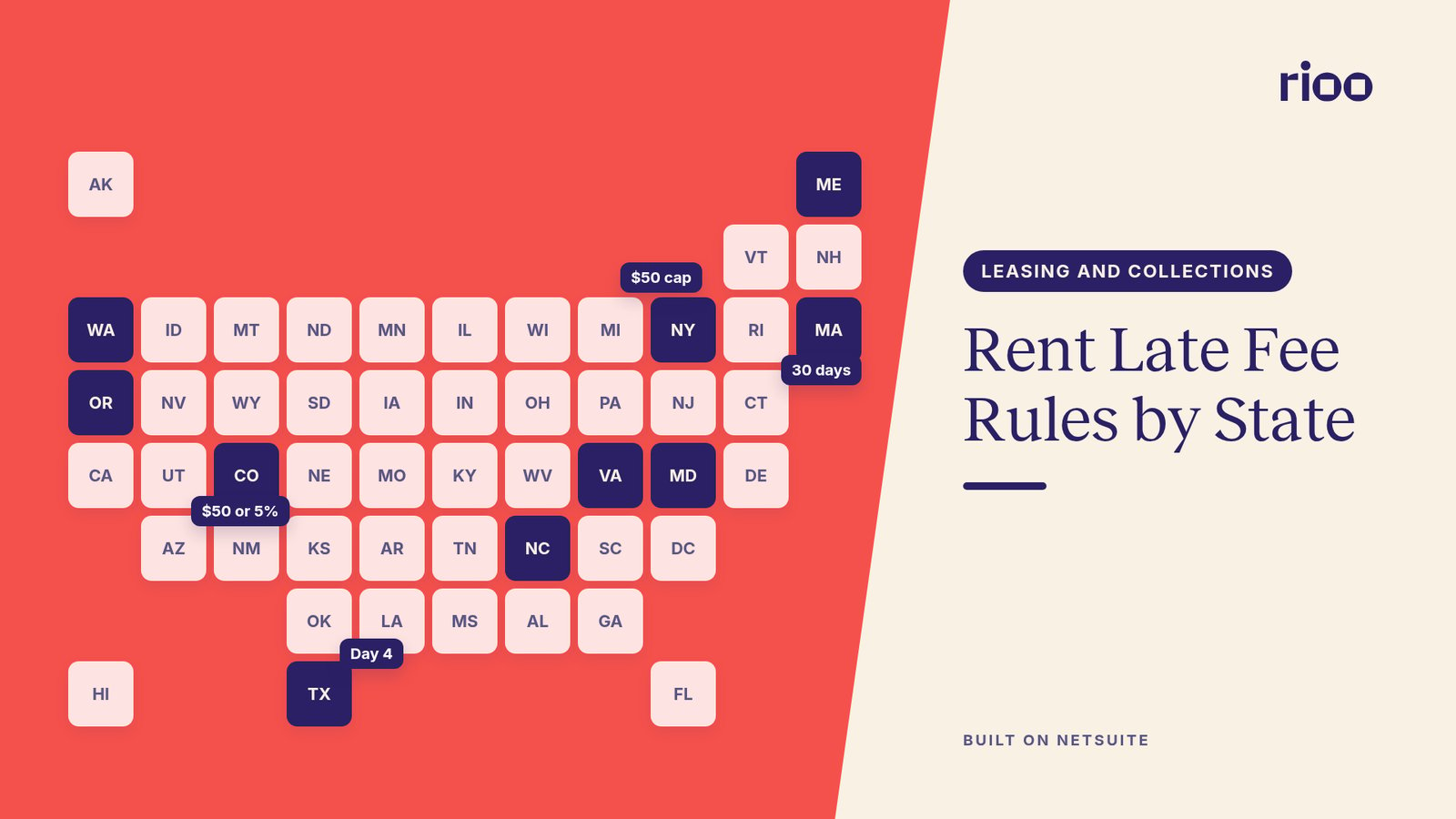
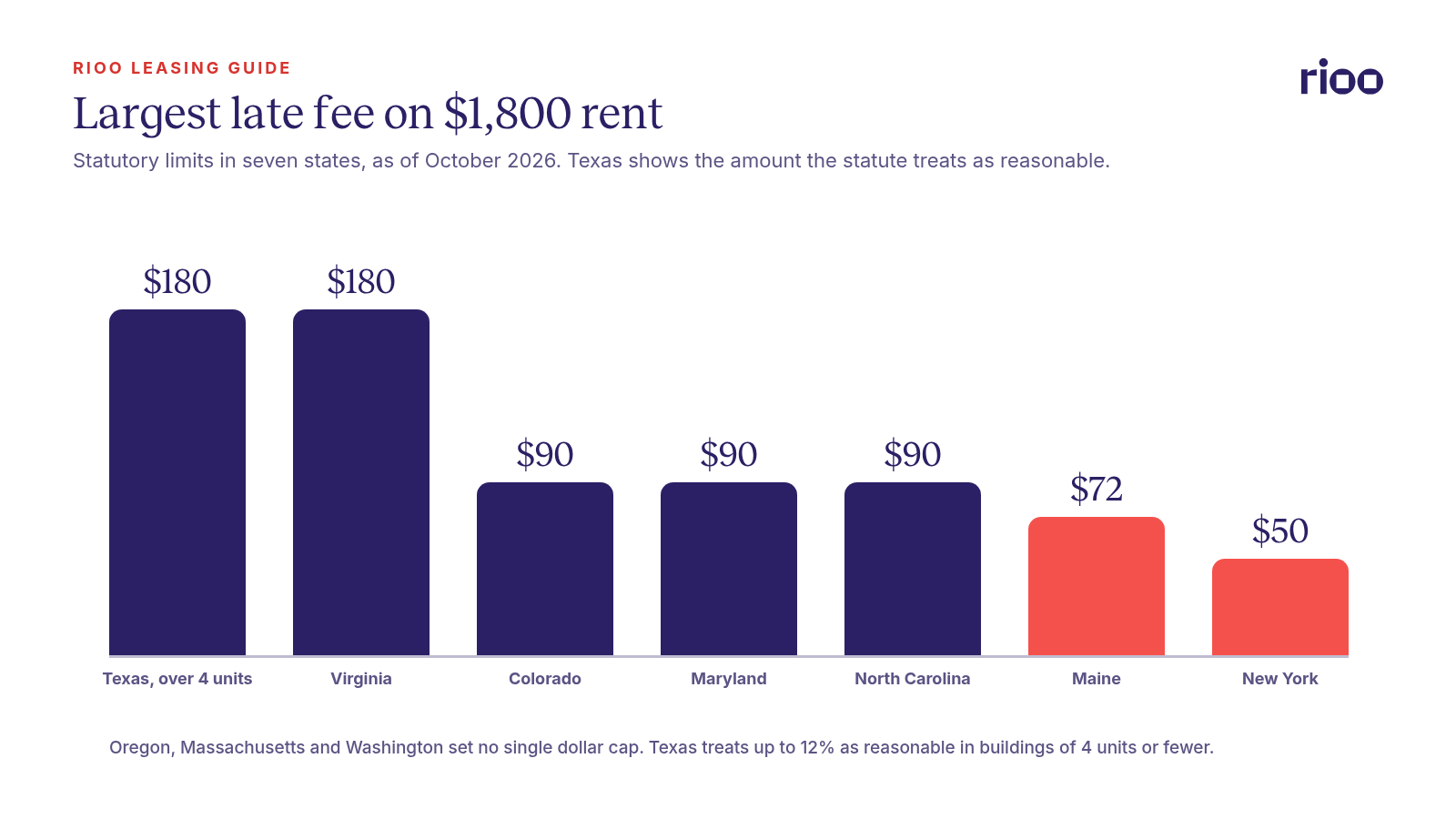
In Texas, a late fee can start on the 4th of the month. In Massachusetts, the landlord has to wait 30 days. New York caps the fee at $50 on any rent of $1,000 or more, while Virginia allows up to 10% of the rent.
A rent late fee is legal when three things line up. It is written into the lease. It starts no earlier than the state's grace period allows. Its amount stays inside the state's cap, or is reasonable where no cap exists. Some states set a number in statute. Others leave it to the lease and to a court's view of what is fair. Check your state first, then your city, then write a clause that a tenant can read once and understand. The rules below are as of October 2026 and cover residential leases. Confirm them with counsel before you change your leases.
How the grace period and the cap work together
They are two separate rules. The grace period decides when a fee can start. The cap decides how much it can be.
Count the days from the due date, not from the day you notice the rent is missing. Rent due on the 1st in New York and paid on the 6th is on time for late fee purposes. The same payment in Texas is two days past the point where a fee could apply.
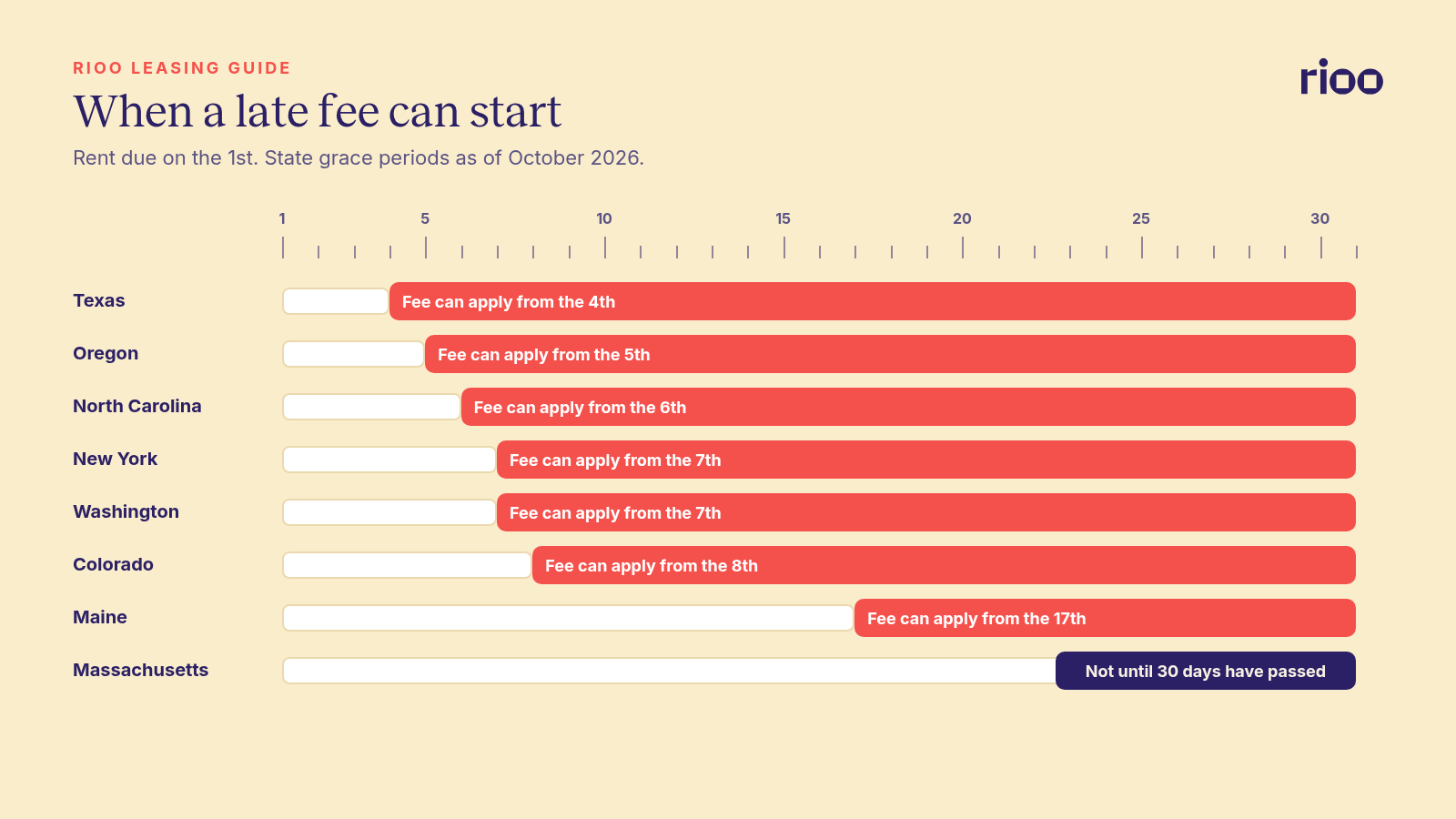
Your lease can give a longer grace period than the law requires. It cannot give a shorter one.
Ten states, side by side
These ten states set a grace period, a cap or both. Each row links to the statute or the state's own guide.
| State | Earliest a fee can apply | Maximum fee | Source |
|---|---|---|---|
| Colorado | Rent at least 7 calendar days late | The greater of $50 or 5% of the past due rent | Colorado Revised Statutes, title 38, article 12, section 105 |
| Maine | Rent not paid within 15 days of the due date | 4% of one month's rent, with written notice at signing | Maine Revised Statutes, title 14, section 6028 |
| Maryland | No statutory grace period | 5% of the unpaid rent for that period | Maryland Real Property article, title 8, section 208 |
| Massachusetts | 30 days after the due date | No fixed cap | General Laws chapter 186, section 15B(1)(c) |
| New York | Rent not paid within 5 days of the due date | The lesser of $50 or 5% of monthly rent | New York Attorney General tenant rights guide, on Real Property Law |
| North Carolina | Rent 5 calendar days or more late | The greater of $15 or 5% of monthly rent, once per late payment | North Carolina General Statutes, chapter 42, section 46 |
| Oregon | Rent not received by the 4th day of the rental period | A reasonable flat fee, or a daily fee up to 6% of that flat fee, or 5% of rent for each 5 day period | ORS 90.260 |
| Texas | Rent unpaid for two full days after the due date | Must be reasonable. Up to 12% of rent in a building of 4 units or fewer, or 10% in a larger building, counts as reasonable | Property Code 92.019 |
| Virginia | No statutory grace period for a written lease | The lesser of 10% of the periodic rent or 10% of the remaining balance | Code of Virginia, title 55.1, section 1204(E) |
| Washington | Rent paid more than 5 days after the due date | No statewide cap | RCW 59.18.170 |
Other states set limits too, and some cities add their own. If your state is not in the table, check its landlord tenant act before you assume there is no rule.
Where the statute sets no number, the fee still has to be in the lease and has to be reasonable. California is an example. Its landlord tenant statutes set no late fee figure. Still, Civil Code 1671 voids a fixed damages clause in a residential lease unless real damage would be extremely hard to fix in advance. A fee sized to your real cost of chasing late rent is easier to defend than a round number picked to deter.
Quick answers on late fees
Is there a federal limit on rent late fees?
No general federal cap applies to private rentals. Subsidized housing programs can have their own rules, so check your program agreement. In Colorado, you may not charge a late fee on the part of the rent a subsidy provider pays.
Can I charge a daily late fee?
Some states allow it within limits. Texas counts an initial fee plus daily fees as one fee when it judges what is reasonable. Oregon allows a daily fee of up to 6% of a reasonable flat fee. North Carolina allows one fee per late payment. Colorado allows more than one fee if the total stays under its cap.
Is a grace period the same as a pay or quit notice?
No. A grace period is the wait before a late fee can apply. A pay or quit notice starts the eviction timeline. Washington says so outright: you can serve a notice to pay or vacate any time after rent is due, even before a late fee can apply. Our late rent notice guide covers that notice.
Can a late fee apply to a partial payment?
Yes, and some states measure the cap on the unpaid part. Virginia caps the fee at 10% of the remaining balance if that is lower than 10% of the rent. A tenant who owes $600 of $1,800 can be charged up to $60. Colorado and Maryland also measure their 5% on the unpaid rent.
Five examples on $1,800 rent
Each example uses monthly rent of $1,800, due on the 1st. The buildings and dates are illustrations.
Colorado: $90, from the 8th
5% of $1,800 is $90. That is more than $50, so $90 is the cap. The fee can apply once rent is 7 calendar days late, which is the 8th. A tenant who pays on the 6th owes no fee. Colorado also requires written notice of the fee within 180 days of the missed due date.
New York: $50, from the 7th
5% of $1,800 is $90, but New York takes the lesser figure, so the cap is $50. A payment made within 5 days of the due date, by the 6th, carries no fee. From the 7th, the landlord may charge up to $50.
Texas: $180 in a 12 unit building, from the 4th
The building has more than 4 units, so a fee of up to 10% of rent counts as reasonable under the statute. That is $180. Say the lease sets $75 on the 4th, then $10 a day from the 5th. By the 14th the fees total $175. On the 15th, only $5 more fits before the total reaches $180. Texas treats the initial fee and the daily fees as one fee for this test. A Texas landlord who breaks the rule owes the tenant $100, three times the fee collected, and attorney's fees.
Oregon: 5% for each 5 day period
Under the third Oregon method, the fee is 5% of rent, or $90, for each 5 day period rent stays unpaid, starting on the 5th. A tenant who pays on the 12th has been late through two periods, the one starting on the 5th and the one starting on the 10th. The fee is $180. It cannot run past the end of that month's rental period.
North Carolina: $90, once, from the 6th
5% of $1,800 is $90, which beats $15, so the cap is $90. The fee can apply when rent is 5 calendar days late, counting the 2nd as day one. That makes the 6th the first fee day. The landlord may charge it only once for that late payment, however late it gets.
Where late fee clauses go wrong
- Taking the fee out of the next rent payment. If the tenant pays $1,800 and you apply $50 of it to an old fee, rent now looks $50 short. Oregon, North Carolina and Colorado forbid this.
- Evicting over fees alone. Colorado bars eviction for unpaid late fees. In Oregon, an unpaid late fee alone is not grounds for a nonpayment termination notice.
- Calling the fee rent. Colorado says a late fee is distinct from rent and a lease cannot reclassify it.
- A fee that is not in the lease. Texas, Colorado, Oregon and Virginia all require it in the written lease. Maine requires written notice at signing.
- Charging interest on a fee. Colorado forbids it. Oregon allows simple interest on an unpaid late charge at the judgment rate.
- One clause for every state. A portfolio lease that starts fees on the 4th would charge too early in seven of the ten states in the table.
For tenants who pay late because of their pay dates rather than a lack of money, a structured plan may work better than a fee. Our post on flexible rent payment plans looks at that option.
Setting late fee rules per property in RIOO
A portfolio across several states needs a different rule for each property. In RIOO, late fee rules are set per property, so fees are calculated on the right day and in the right amount for that state. Grace periods, reminders and late fees sit in the same rent collection module, and every payment posts to the tenant ledger in NetSuite.
The RIOO state law library shows how each rule maps to a setting. For the setup across many properties, see our guide to automated late fee calculations. Your team still decides the rule, with counsel. RIOO applies it the same way every month.
A late fee clause and the ledger entry behind it
A sample clause
This sample is written for New York and $1,800 rent. Change the dates and amounts for your state.
Rent of $1,800 is due on the 1st day of each month. If we have not received the full rent by the end of the 6th day of the month, a late fee of $50 is due. We charge this fee once for each late month. The late fee is not rent. We apply every payment to rent first and to fees last. We will not take a late fee out of a rent payment.
Short sentences help. A tenant should see the due date, the fee date and the amount without rereading.
The ledger
Here is how one late month looks on the tenant ledger when payments go to rent first.
| Date | Entry | Charge | Payment | Balance |
|---|---|---|---|---|
| 1 Nov 2026 | November rent | $1,800 | $1,800 | |
| 7 Nov 2026 | Late fee, rent unpaid after the 6th | $50 | $1,850 | |
| 9 Nov 2026 | Payment, applied to November rent | $1,800 | $50 | |
| 1 Dec 2026 | December rent | $1,800 | $1,850 | |
| 1 Dec 2026 | Payment, applied to December rent | $1,800 | $50 |
The $50 fee stays open as its own line. December rent is paid in full, so no new late fee applies. In the general ledger, the fee posts on 7 November as a debit of $50 to tenant receivables and a credit of $50 to late fee income. Our post on the tenant ledger explains how each line feeds that account.