A broken water heater does not let a California tenant stop paying rent the next morning. It does start a clock, though, and the tenant gains real options if you let it run.
The California warranty of habitability means every residential landlord must keep a rental fit to live in, from move in to move out. Civil Code 1941.1 lists what that requires. It covers weatherproofing, plumbing and gas, hot and cold water, heat, and safe wiring. It also covers clean and pest free buildings, garbage bins, and sound floors, stairs and railings. Leases signed, renewed or amended from 1 January 2026 add a working stove and refrigerator. Fail to repair within a reasonable time after notice, and the tenant has options. They may repair and deduct up to one month's rent, move out, or raise the defect in an eviction case. A lease cannot waive these rights. This guide reflects the law as of October 2026. Check local codes too, and talk to counsel before you act on a dispute.
Is it a habitability problem? Check the table
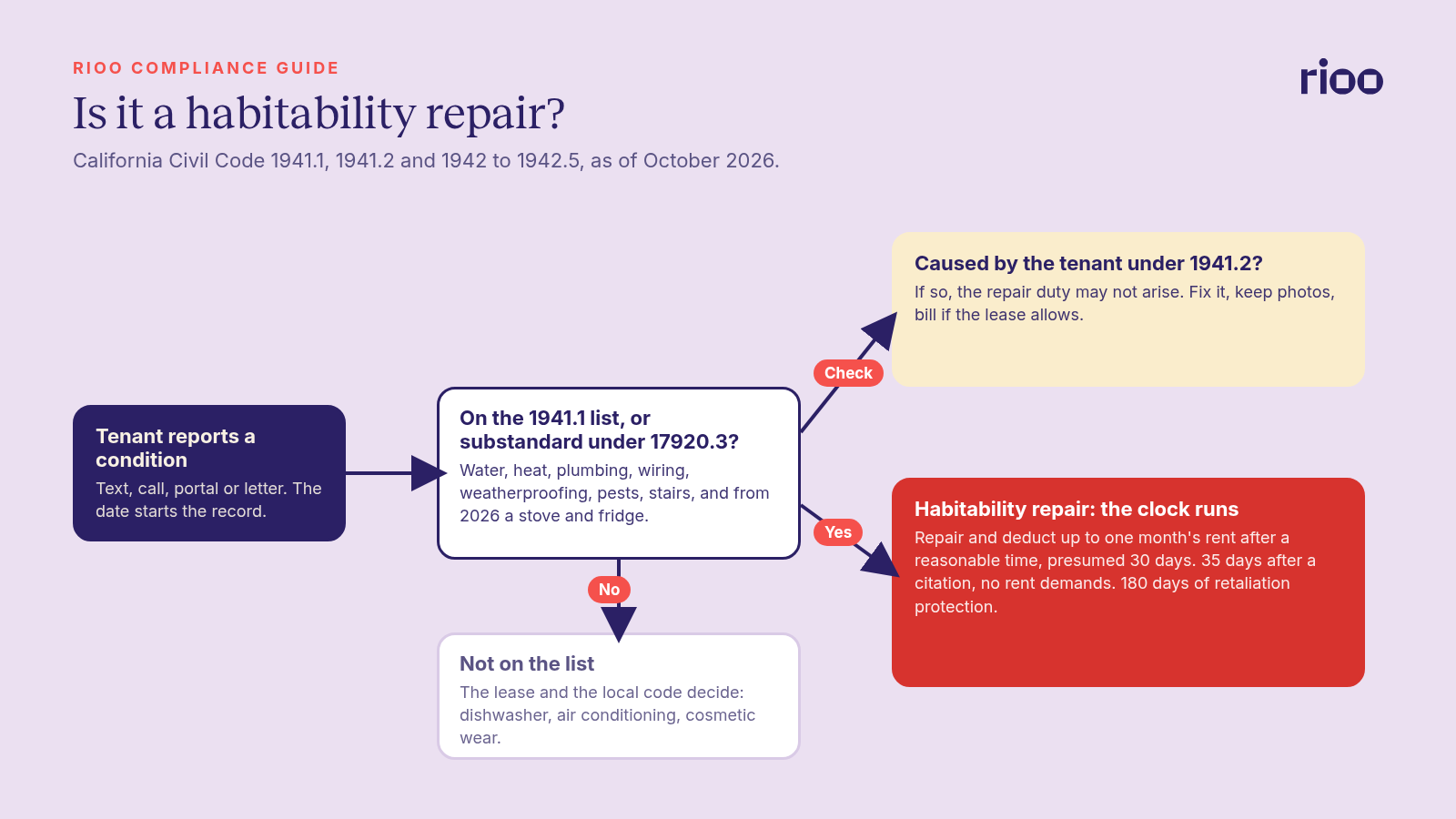
Start with what the tenant reported. The table matches common reports to the law that covers them. The response targets in the last column are our practical suggestion, not a statutory deadline.
| Tenant reports | Where the law covers it | Treat it as | Suggested response |
|---|---|---|---|
| No hot water | Civil Code 1941.1(a)(3) | Untenantable | Contact the same day, fix within 24 to 72 hours |
| No heat | 1941.1(a)(4) | Untenantable | Contact the same day, temporary heat if parts are delayed |
| Roof leak or broken window | 1941.1(a)(1) | Untenantable | Stop the water or board the window the same day |
| Gas smell or sewage backup | 1941.1(a)(2) and (a)(3) | Emergency | Immediately |
| No power to lights or outlets | 1941.1(a)(5) | Untenantable | Within 24 hours |
| Rats, mice or cockroaches | 1941.1(a)(6) | Untenantable | Pest service booked within days |
| Loose stair railing | 1941.1(a)(8) | Untenantable | Make it safe the same day |
| Stove or refrigerator not working, lease from 2026 | 1941.1(a)(10) and (a)(11) | Untenantable | Within days, and within 30 days of notice of a recall |
| Visible mold beyond a minor patch | Health and Safety Code 17920.3(a)(13) | Substandard if an inspector finds it | Inspect within days |
| Dishwasher broken | Not on the statewide list | A lease repair | As the lease says |
| No air conditioning | Not on the statewide list | Check local code and the lease | As the lease or local code says |
| Worn carpet, scuffed paint | Not on the list unless it is a hazard | Cosmetic | At turnover |
| Drain blocked by grease the tenant poured | 1941.2 | Caused by the tenant | Repair, then bill if the lease allows |
One word matters in the statute. A unit is untenantable if it "substantially lacks" one of the listed features. A dripping tap is a repair. A unit with no hot water at all is a habitability problem.
The list in Civil Code 1941.1
The full list, in plain words:
- Roof and outside walls that keep weather out, with unbroken windows and doors.
- Plumbing and gas in good working order.
- Hot and cold running water connected to an approved sewage system.
- Heating in good working order.
- Electric lighting, with wiring in good working order.
- A building and grounds kept clean and free of rubbish, rodents and vermin.
- Enough clean garbage bins in good repair.
- Floors, stairs and railings in good repair.
- A locking mailbox for each unit in a residential hotel.
- A working stove, for leases from 1 January 2026.
- A working refrigerator, for leases from 1 January 2026.
The text is on the California Legislature site. A unit is also untenantable if it is a substandard building under Health and Safety Code 17920.3. That longer list adds items such as dampness in habitable rooms, visible mold growth and general dilapidation. Our guide to responding to a rental mold complaint covers the first week after a mold report.
Conditions the list does not name
Air conditioning is not on the statewide list. Neither is a dishwasher, a garbage disposal or a washer. If the lease says you provide one, you must repair it under the lease. Some cities set their own standards, so check the local housing code for each property.
When the tenant caused the problem
Civil Code 1941.2 lists the tenant's duties. Keep the unit clean, dispose of garbage properly, use fixtures properly, and do not damage the unit or let guests do so. If the tenant's breach substantially caused the defect, your duty to repair under 1941 and 1942 does not arise. Record the cause in writing with photos. You will need that record if the tenant later disputes a bill.
What a tenant can do if you do not repair
A tenant has several remedies. Some run on a timer. Others depend on an inspector's notice.
Repair and deduct
Under Civil Code 1942, the tenant gives you written or oral notice. If you do not repair within a reasonable time, the tenant may fix it and deduct the cost from rent. The cost cannot exceed one month's rent. The tenant can use this remedy twice in any 12 month period.
A tenant who acts 30 days after notice is presumed to have waited a reasonable time. The presumption cuts one way only. A tenant may act sooner if the problem calls for it, and no hot water for a week may well qualify.
Move out
Instead of repairing, the tenant may leave. Rent stops from the day they move out.
Withhold rent and defend an eviction
A tenant who stops paying because of a serious defect can raise it as a defense if you file for eviction. Under Code of Civil Procedure 1174.2, a court that finds a substantial breach sets a reduced rent. If the tenant pays that reduced rent, you do not get possession. If a housing inspector served you a written notice and the problem lasted 60 days past it, Civil Code 1942.3 presumes you breached the warranty.
No rent demands after a citation
Civil Code 1942.4 bars you from demanding or collecting rent, raising rent or serving a three day notice to pay if all of these apply. The unit lacks a 1941.1 feature or is substandard. An inspector gave you written notice to repair. The problem lasted more than 35 days past that notice without good cause. The tenant did not cause it. The tenant can recover actual damages plus $100 to $5,000.
Retaliation
After a good faith repair complaint, Civil Code 1942.5 restricts you for 180 days. If the tenant is current on rent, you may not raise rent, cut services or end the tenancy in retaliation. You can still act for a lawful reason, but the notice must state that reason, and you must prove it if it is challenged. Punitive damages run from $100 to $2,000 for each retaliatory act where there was fraud, oppression or malice.
The stove and refrigerator rule from 2026
Assembly Bill 628 added a stove and a refrigerator to the 1941.1 list. It applies to leases entered into, amended or extended on or after 1 January 2026. A renewal counts, so the rule reaches existing tenants at their next renewal.
A tenant may choose to bring their own refrigerator. The lease must then include the statutory checkbox wording and let the tenant ask, on 30 days' written notice, for you to install one. You cannot make a tenancy conditional on the tenant supplying a refrigerator. A stove or refrigerator under a manufacturer or government recall must be repaired or replaced within 30 days of notice of the recall. Permanent supportive housing, single room occupancy units, residential hotels and units with shared kitchens are exempt.
Our checklist of California lease disclosure requirements covers the other notices to update at renewal.
Keeping the repair record in RIOO
Every remedy above turns on dates. When did the tenant give notice? When did you respond? When was the work done? A clear record answers those questions without anyone searching through texts.
In RIOO, residents submit a request in the tenant portal, and each request becomes a work order on the unit. Requests carry a priority, and RIOO's example tiers put no hot water in the urgent tier. The work order keeps the status changes, the technician or vendor assigned, the photos and the history. If the tenant caused the damage, staff can mark the request as tenant caused. Once approved, the cost is billed to that tenant's ledger, with the photos attached. See how service requests and tasks work in RIOO.
RIOO does not decide whether a condition is untenantable. That judgment stays with your team and your counsel.
Waivers, entry and air conditioning questions
Can a lease waive the warranty of habitability?
No. Civil Code 1942.1 makes a waiver of 1941 or 1942 rights void for conditions that make a unit untenantable. The parties may agree in writing that the tenant maintains stated parts of the unit as part of the rent bargain. They may also agree in writing to send habitability disputes to arbitration.
How long does a California landlord have to make repairs?
The statute says "a reasonable time" and presumes 30 days is reasonable for repair and deduct. Serious problems such as no water, heat or sewage call for a much faster response. Recalled stoves and refrigerators have a fixed 30 day limit.
Do I need to give notice before entering to repair?
Yes, outside emergencies. Civil Code 1954 presumes 24 hours' written notice is reasonable. The tenant can also agree orally to an entry for an agreed repair within one week. No notice is needed in an emergency, or if the tenant is present and consents at the time.
Is air conditioning required in California rentals?
Not under the statewide list in 1941.1. Check the lease and the local housing code. If you supplied it and the lease promises it, repair it.
Does the heat rule set a temperature?
The state housing regulations call for heating that can keep habitable rooms at 70°F. Our guide to landlord heat requirements compares this with other states.
A repair timeline: no hot water in a 1984 fourplex
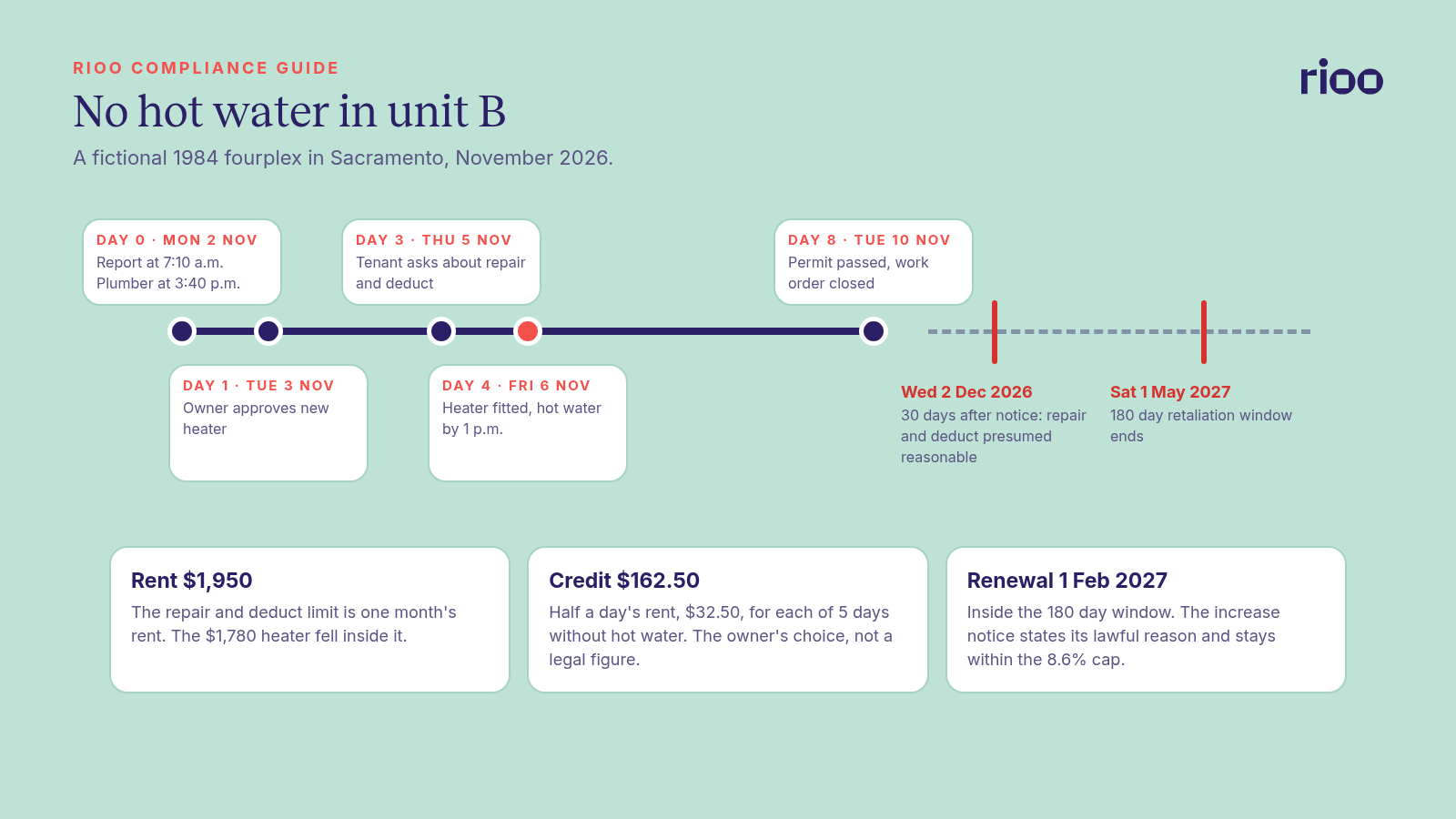
This example is fictional. The building is a 1984 fourplex in Sacramento. The tenant in unit B, whom we will call Priya, pays $1,950 a month. Her lease renews on 1 February 2027, and the owner had planned a rent increase for that date back in the summer.
Day 0, Monday 2 November 2026
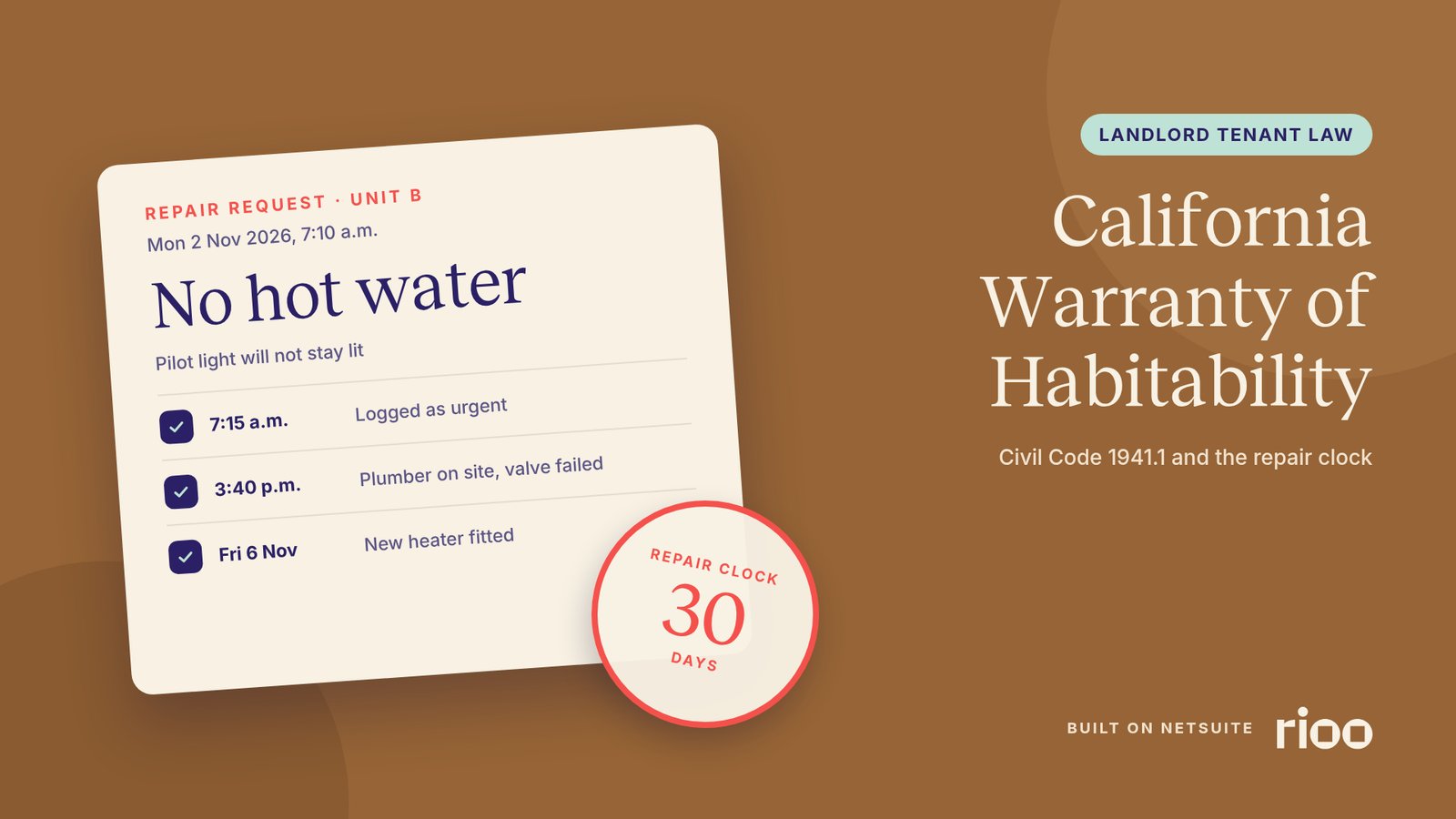
7:10 a.m. Priya texts the manager: "No hot water since last night. The pilot light won't stay lit." The manager logs it as an urgent request at 7:15 and books a plumber for 3 p.m. Priya agrees to the visit by phone, which 1954 allows for an agreed repair.
3:40 p.m. The plumber finds a failed gas control valve on the 40 gallon heater, installed in 2012. He recommends a new heater and quotes $1,780 with the permit.
Day 1, Tuesday 3 November
The owner approves the replacement at 10 a.m. The supplier says the heater arrives Friday. The manager tells Priya the plan in writing and logs the message on the request.
Day 3, Thursday 5 November
Priya asks: "If this isn't fixed by the weekend, can I hire my own plumber and take it off the rent?"
The honest answer is that she might be able to. A $1,780 repair is under one month's rent, and five days without hot water could count as long enough. The manager confirms Friday's install. He also offers a credit of half a day's rent for each day without hot water. At $65 a day, that is $32.50 a day.
Day 4, Friday 6 November
The new heater goes in at 11:30 a.m. Hot water is back by 1 p.m. The credit covers Monday to Friday: 5 days at $32.50, which is $162.50 off December rent. The law does not set this figure. The owner chose it.
Day 8, Tuesday 10 November
The permit inspection passes. The work order closes with the invoice, the permit, photos of the old and new heater, and Priya's messages.
The dates that would have mattered
The 30 day presumption for repair and deduct would have run to Wednesday 2 December. The 180 day window under 1942.5 runs from 2 November 2026 to Saturday 1 May 2027. The planned 1 February increase falls inside it. The owner can still send it, but the notice should state the lawful reason, such as an annual increase set before the complaint. It must also stay within the cap. For a 1 February 2027 increase in Sacramento that is 8.6%, under both AB 1482 and the city's own rent ordinance. Our guide to California rent control explains how the state cap is worked out.