Short answer: treat every rental mold complaint as the start of a clock. Log it the day it arrives, acknowledge it in writing, and inspect quickly. Find the moisture source before anyone cleans. Then decide who does the work, based on the size of the area and your local rules. Fix the water problem, clean or remove the damaged material, and confirm the result with the resident. Keep dated photos and notes at every step. The record you build is what protects residents and owners if the complaint later reaches a code officer or a court.
A mold complaint rarely arrives labelled as a legal matter. It comes in as a portal request about a smell in the closet, or a photo of dark spots on a bathroom ceiling. Teams that queue it behind a dripping tap can lose weeks. Teams that run a clear rental mold complaint response process can usually close it with a repair, a clean wall and a good paper trail.
This guide covers the United States. Rules differ by state and city, so use it as a working process and check the local code for each property. It is general information, not legal advice. The rules below are summarised as of October 2026, so confirm the current text and speak with your own counsel before you rely on them.
What US rules ask of landlords
There is no single federal mold standard for rental homes. Duties come from state habitability law, housing codes and a few local ordinances. A few examples show how specific the rules can get.
- California. Health and Safety Code section 17920.3 can treat a building as substandard when listed conditions endanger the health or safety of the people living there. Visible mold growth is on the list when a health officer or code enforcement officer finds it. Minor mold on surfaces that get wet in normal use, such as a shower surround, is excluded. Dampness of habitable rooms is listed too.
- New York City. Local Law 55 of 2018 applies to buildings with three or more apartments. Owners must inspect units each year for indoor allergen hazards, including mold, respond to complaints and use safe work practices. A separate rule, Local Law 61 of 2018, covers larger jobs. In buildings with 10 or more units, mold over 10 square feet must be assessed and remediated by New York State licensed workers. The assessor and the remediator must be independent of each other. The city's housing agency explains both on its indoor allergen hazards page.
- Texas. Mold assessment and remediation are licensed activities, with some exemptions. The state agency's guidance says an area under 25 contiguous square feet generally does not need a licensed company. Owners, managing agents and their employees working on residential property with fewer than 10 units are exempt whatever the size. In residential property with 10 or more units, remediation of 25 contiguous square feet or more needs a licensed remediator. The state licensing agency sets this out in its mold program FAQ.
- Maine. The state made mold and moisture an express repair issue in 2026. We covered the details in our guide to Maine landlord repair obligations.
Outside those rules, the federal EPA mold guidance is the common reference. It says to dry water damaged areas within 24 to 48 hours to prevent mold growth. It also says an area under about 10 square feet can usually be cleaned without a specialist, while larger areas call for a professional approach. When a new local rule appears, add it to the process the same way you would any new landlord tenant law.
The response process, step by step
Six steps cover the response from first report to closed file. Each one should leave something in the record.
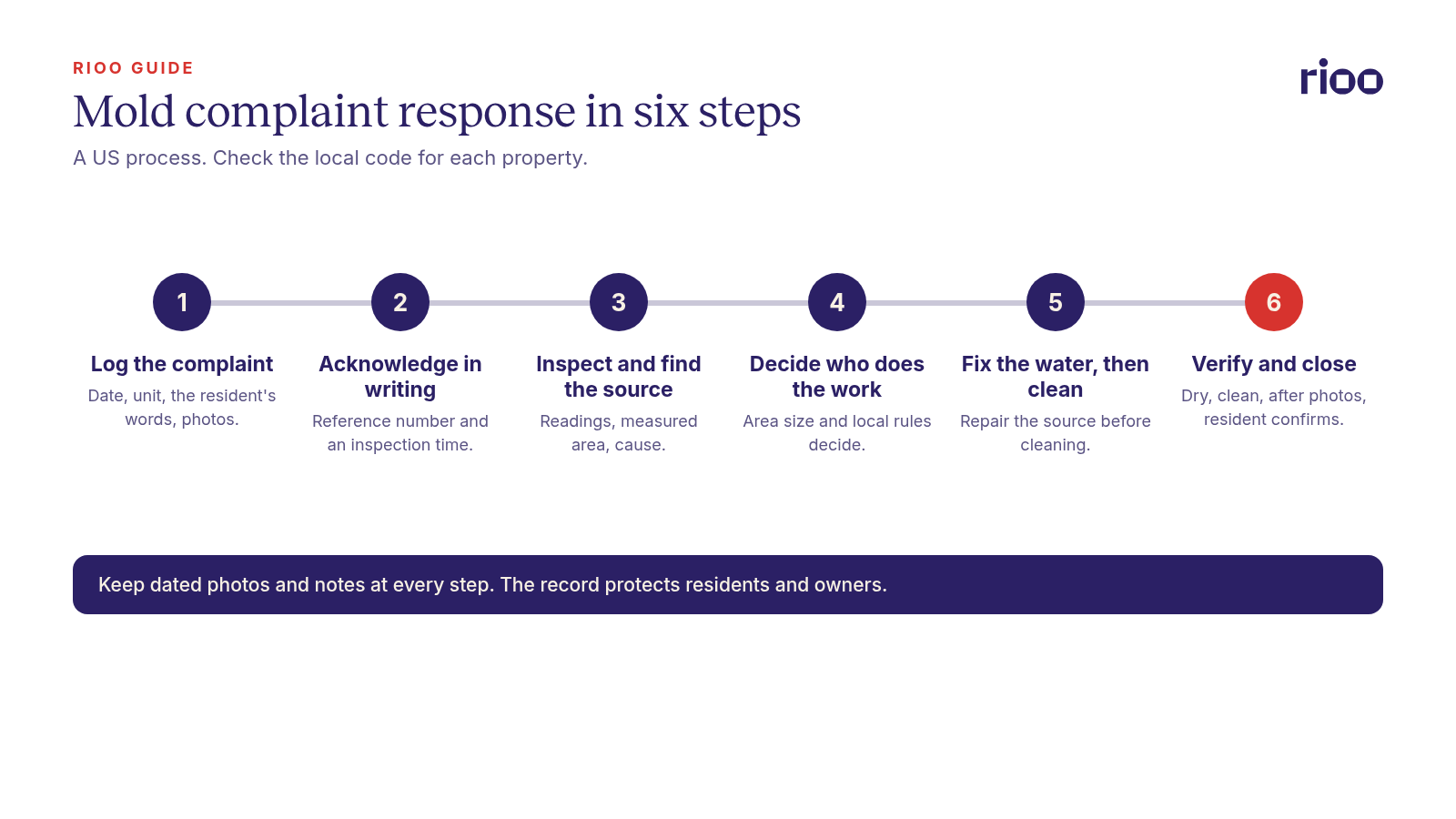
1. Log the complaint
Record the date and time, the unit, the resident's words and any photos they sent. Use one request category for mold and moisture so these cases can be found later. A complaint by phone or email should be entered by staff on the same day.
2. Acknowledge it in writing
Reply to the resident with a reference number and a proposed inspection time. Ask them to report any active leak straight away. Give simple advice in the meantime, such as running the bathroom fan and keeping furniture away from the damp wall.
3. Inspect and find the source
Mold is a symptom. The cause is water. The inspector should look for the moisture source before anything is cleaned. Common sources are a leak from the unit above, a failed seal, condensation from poor ventilation, or water coming through the building envelope. Record moisture readings, the size of the affected area and photos with a scale in the frame.
If the leak reaches more than one home, switch to your water leak response for multiple units. That way every affected unit is handled as one incident.
4. Decide who does the work
The size of the area and the local rules decide this. Small areas on cleanable surfaces can often be handled by trained staff using safe work practices. Larger areas, sewage water, mold inside an HVAC system or a resident with health concerns point to a qualified contractor. In places with licensing rules, such as New York City or Texas, check the thresholds before you assign the job.
5. Fix the water, then clean
Repair the moisture source first. Cleaning a wall while the leak continues only resets the timer. Then clean or remove the affected material. Porous materials such as soaked drywall or ceiling tiles are often removed rather than cleaned. Keep the work area isolated and limit dust.
6. Verify and close
Check that the area is dry and the surface is clean. Take after photos from the same angles as the first ones. Tell the resident what was found and what was done, and ask them to confirm. Some teams also book a short follow up visit to check that the problem has not returned. That is a policy choice, so write it down if you adopt it.
Which complaints jump the queue
Not every report needs the same speed. These signs should move a case to the front:
- An active leak or standing water.
- A resident who reports a health condition, such as asthma, or a young child or older person in the home.
- Mold covering a large area, or spreading quickly between visits.
- Suspected contamination in the heating or cooling system. EPA guidance says not to run a system you suspect is contaminated, because it can spread mold through the building.
- Water from sewage or another contaminated source.
- A complaint that has come back after an earlier repair.
What the case record should hold
If a resident later files a code complaint or withholds rent, you will need to show what you knew and when you acted. A complete record holds:
- The original complaint with its date, time and channel.
- Every message to and from the resident, including the acknowledgement.
- Inspection notes, moisture readings, the measured area and dated photos.
- The cause found and the repair made to the moisture source.
- Who did the remediation, and their licence where one is required.
- Any filings or certificates a local rule requires.
- After photos, the resident's confirmation and the close date.
- Costs, coded to the property and the right account.
A worked example
This is an illustrative case, not a real one. A resident in unit 4C of a 12 unit New York City building sends a portal request with a photo of dark spots on the bathroom ceiling.
- Day 1: the request is logged under mold and moisture. The coordinator replies with a reference number and books an inspection for the next morning.
- Day 2: the technician measures the patch at about 6 square feet and finds a high moisture reading. The source is a failed toilet seal in unit 5C above.
- Day 2: the coordinator notifies the resident of 5C and schedules the repair. The seal is replaced that afternoon.
- Days 3 to 5: the ceiling dries with a fan in place. Readings are taken each day.
- Day 6: because the patch is under 10 square feet, trained staff remove and replace the damaged section of ceiling using safe work practices. After photos are taken.
- Day 7: the resident confirms the bathroom looks fine. The case closes with the repair cost coded to the building.
Had the patch measured 15 square feet, Local Law 61 would have applied. The job would then have needed a licensed assessor and a separate licensed remediator. The process stays the same. Only the person doing step 5 changes.
Who owns each step
| Step | Owner | Output |
|---|---|---|
| Log and acknowledge | Leasing office or coordinator | Request record and written reply |
| Inspect and find source | Maintenance technician | Readings, area, photos, cause |
| Decide who remediates | Maintenance supervisor | Assignment that meets local rules |
| Fix and clean | Staff or licensed contractor | Repair notes, invoice, filings |
| Verify and close | Property manager | Resident confirmation and closed case |
| Review repeat cases | Regional manager | List of units and causes that recur |
Common mistakes
- Painting over it. Paint hides the stain for a while. The water source is still there.
- Closing on cleaning alone. If the record shows no cause and no repair, the case is not finished.
- No measurement. Without the size of the area, you cannot show the right person did the work.
- Silent gaps. Residents who hear nothing for a week assume nothing is happening, even when work is under way.
- Blaming the resident too early. Condensation can come from lifestyle, but it can also come from a broken fan or poor insulation. Check the building first.
Where RIOO fits
In RIOO, residents raise maintenance requests in the tenant portal, and requests become work orders. Technicians use property inspections with mobile checklists and photos, and issues found become work orders linked to the lease. Through work order management, the contractor's bill links to the work order and the cost posts to the property ledger. Residents and managers see status updates as you make them, so the case history sits on the unit record rather than in an inbox.
Frequently asked questions
How fast does a landlord have to respond to a mold complaint?
It depends on the state and city, and your counsel can confirm the rule for each property. Many rules use a reasonable time standard, and some local codes set specific deadlines. Acknowledge the complaint the same day and inspect as soon as you can, especially if there is an active leak.
Can maintenance staff clean mold themselves?
Often, for small areas. EPA guidance treats areas under about 10 square feet as jobs that do not usually need a specialist. Local licensing rules, such as those in New York City and Texas, can require licensed workers above set sizes.
Should we test the air for mold?
Testing is not always needed when mold is visible and the source is clear. It can help when a resident reports a smell or symptoms with no visible growth. Follow local rules and use a qualified assessor where they apply.
Who pays for mold remediation in a rental?
Usually the owner, when the cause is a building defect or a leak. If the resident caused the damage, the lease and local law decide whether a charge is allowed. Record the cause clearly before any charge is raised.
What if the resident refuses access?
Give written notice under your lease and local entry rules, and record each attempt. A clear record of refused access matters if the condition later becomes a dispute.