Short answer: unapplied cash is money you have received and recorded, but have not yet matched to a specific open charge on a tenant ledger. Clear it with a daily routine: identify who paid, match the payment to the right charges, and decide what to do with anything left over. At month end, every unapplied item should have an owner, a reason and an age. Old items should be applied, refunded or moved to a proper liability.
Every property accounting team has some unapplied cash. A tenant pays before the charge posts. A bank transfer arrives with no reference. A resident pays a round number that does not match any invoice. None of this is a problem on day one. It becomes a problem when it sits for weeks, because the tenant ledger, the aging report and the owner statement all start telling slightly different stories.
What is unapplied cash?
Unapplied cash is a receipt that has been posted to the bank and to the tenant's account, but is not linked to the invoice or charge it pays. The tenant shows a credit, and at the same time the open charges still show as unpaid. Until someone applies the payment, the aging report can show the tenant as owing money they have already paid.
Unapplied vs unidentified cash
These two are often lumped together, but they need different work.
- Unapplied cash: you know who paid, but the money is not matched to charges yet.
- Unidentified cash: you do not know who paid. The money usually sits in a suspense or clearing account until you find the payer.
Unidentified cash is the harder case, because it cannot even reach a tenant ledger. Track it on its own list with the bank date, amount and any reference text.
Why unapplied cash builds up
Most of it comes from a handful of repeat causes:
- Prepayments. The tenant pays next month's rent before the charge exists.
- Overpayments. The tenant pays more than the balance, by mistake or on purpose.
- Partial payments. The amount does not match any single charge, so nobody is sure which one to pay first.
- Missing references. Bank transfers with no unit or account number, or with the wrong one.
- Combined payments. One payment covers several units, or a corporate tenant pays for several leases at once.
- Timing. A charge was reversed and rebilled, and the payment is now matched to nothing.
- Process gaps. Receipts are posted by one team and applied by another, with no clear handover.
The daily process to clear unapplied cash
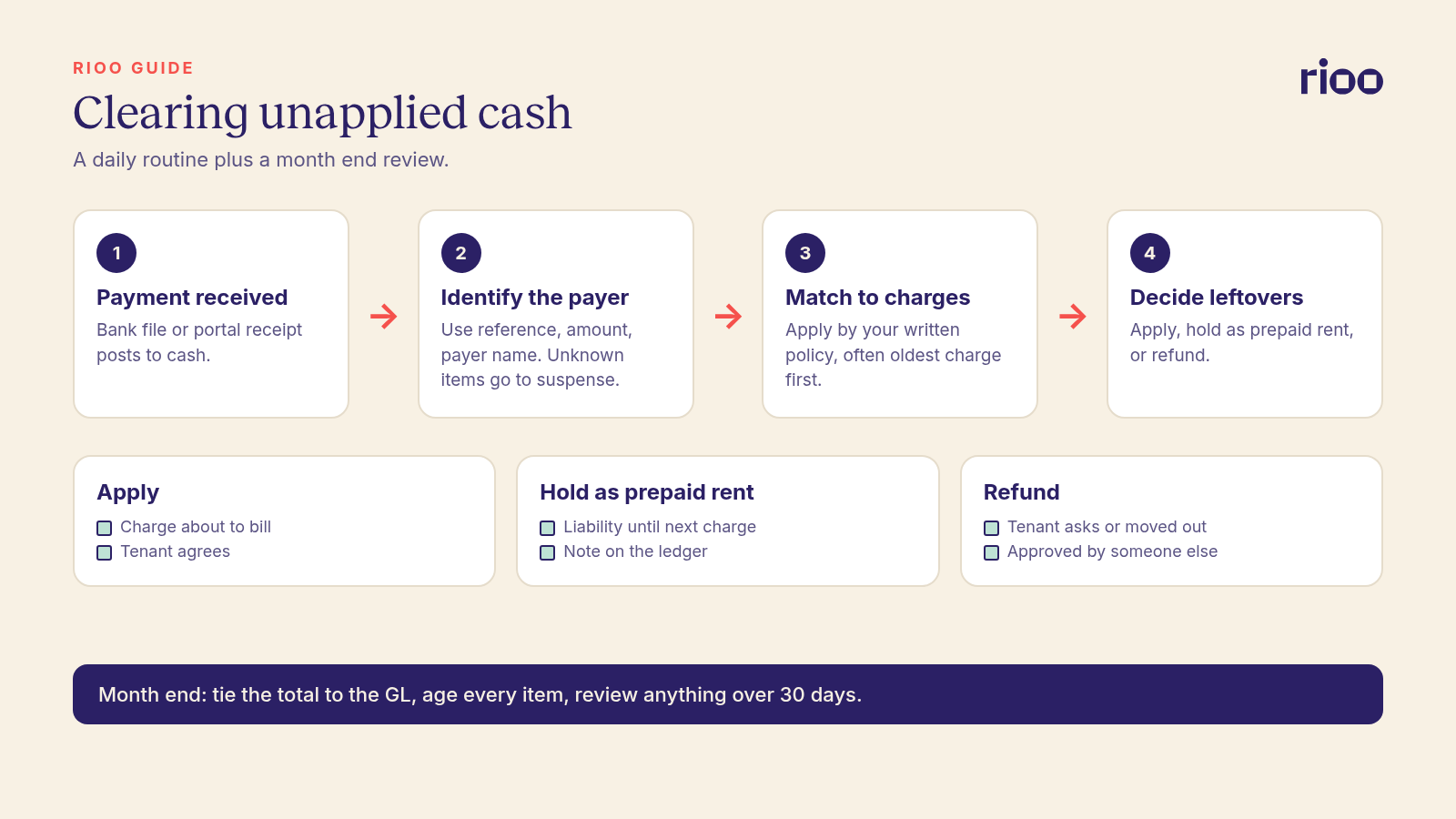
A short daily routine beats a long monthly clean up. Here is one you can run each morning.
Step 1: Pull the list
Start each day with two lists: tenant ledgers with unapplied credits, and receipts sitting in suspense. Sort both by age and amount.
Step 2: Identify the payer
For unidentified items, check the payer name on the bank file, any reference text, the amount against expected rent, and recent emails from tenants. Ask site teams if a tenant mentioned paying. Once you know the payer, move the receipt to the right tenant.
Step 3: Match to open charges
Apply the payment to the charges it was meant to pay. Use the lease or your written payment application policy to decide the order. A common order is oldest charge first, and many teams apply payments to rent before fees. Some jurisdictions have rules about how payments must be applied, so check local rules and keep the policy in writing.
Step 4: Decide what to do with leftovers
If money remains after all open charges are paid, choose one of three outcomes and record which:
- Hold it as a prepayment against next month's charge. In your books, this should sit as prepaid rent or a tenant credit liability.
- Refund it if the tenant asks, or if the tenant has moved out.
- Apply it to a new charge that is about to be billed, such as a utility recovery, if the tenant agrees.
Step 5: Log anything you cannot clear
If you cannot resolve an item today, write down why, who is chasing it, and when you will check again. An item without a note is an item nobody owns.
The month end review
At month end, unapplied cash affects three numbers: the accounts receivable balance, the aging report and the cash position by property. Add these checks to your month end close checklist:
- Tie out the total. Total unapplied credits on tenant ledgers plus suspense should agree to the general ledger accounts where they sit.
- Age every item. Use simple buckets: under 30 days, 30 to 60, 60 to 90, over 90.
- Review anything over 30 days. Each item needs a reason and a next step. The controller or a senior accountant should see the list.
- Present credits correctly. Tenant credit balances should not quietly reduce receivables from other tenants. Many teams reclassify net credit balances to a liability for reporting. Agree the approach with your auditor.
- Check owner and trust impacts. If you manage for third party owners, unapplied cash can affect owner statements and trust balances. Make sure the three way reconciliation still ties.
A worked example
A tenant owes $1,850 in rent and a $50 late fee, $1,900 in total. They send $2,000 with no note.
- Your policy is oldest charge first, with rent before fees. Both charges are from the same month, so rent is paid first, then the fee.
- That leaves $100. The tenant has not asked for a refund and is still in the unit.
- You hold the $100 as prepaid rent and apply it when next month's rent posts.
- The ledger now shows nothing past due and a $100 credit with the note "overpayment, applied to next rent".
Without the routine, this tenant could show $1,900 past due and $2,000 unapplied at the same time. The AR aging report would put them in a collections bucket they do not belong in. Someone might even send a late notice to a tenant who paid in full.
What to do with old credits
Credits that sit for months usually belong to former tenants. Treat them with care.
- Try to contact the former tenant and refund the balance.
- Offset only where the lease and the law allow, for example against move out charges that have been properly documented.
- Know your unclaimed property rules. Many US states and other jurisdictions require unclaimed balances to be reported and handed over after a set period. Check the rules where the property sits and keep a record of your contact attempts.
- Never write a tenant credit off to income without a documented reason and approval.
Controls that keep the balance small
- Give every tenant a payment reference and print it on every invoice and in the portal.
- Push tenants toward online payments that carry the account number automatically.
- Use one owner for the daily list. A shared inbox with no owner is how items reach 90 days.
- Write the application policy down and apply it the same way at every property.
- Separate duties. The person who applies cash should not be the person who approves refunds.
- Report the balance weekly by property, with the count and value of items over 30 days.
Common mistakes
- Applying a payment to the newest charge because it matches the amount, leaving an older balance aging.
- Netting one tenant's credit against another tenant's debt.
- Leaving suspense items for the auditor to find.
- Sending late notices before the daily unapplied list has been worked.
- Refunding by a different method than the tenant paid, without checking for fraud risk.
Where RIOO fits
RIOO runs property operations and accounting on one NetSuite record. Tenant ledgers are NetSuite customer records, so a receipt posted from rent collection lands on the tenant and in the general ledger in the same step. Prepayments sit as customer credits and apply to the next invoices automatically. There is no separate property system to reconcile to the books at month end. Finance and property teams look at the same open charges, the same credits and the same aging. The lease to ledger workflow shows how charges, receipts and postings connect.
Frequently asked questions
Is unapplied cash an asset or a liability?
The cash itself is an asset in the bank. The tenant's credit balance is generally a liability, because you owe the tenant either a refund or future service. Your auditor can confirm how to present it.
How often should unapplied cash be reviewed?
Daily for new items, and formally at month end with an aged list reviewed by a senior accountant.
What is the difference between unapplied cash and prepaid rent?
Prepaid rent is a deliberate decision to hold money against a future charge. Unapplied cash is money nobody has decided about yet. Moving items from unapplied to prepaid, refunded or applied is the goal.
Can I apply a payment to fees before rent?
That depends on the lease and local law. Many operators apply to rent first, and some places have rules on payment order. Put your policy in writing and check it with counsel.
What causes the most unapplied cash?
Missing payment references and prepayments are two of the most common causes. Clear references on invoices and online payments cut both.