Short answer: property management software adoption is decided in the first year after go live, not on launch day. Teams that get the value they paid for name a business owner for the system and retire old spreadsheets on fixed dates. They measure whether each workflow actually runs in the system. They review progress at 30, 60 and 90 days, then each quarter. Leaders who treat go live as the finish line usually end up paying for two ways of working.
Every property company that has changed systems knows the moment. The project team celebrates, the consultants leave, and the first month end in the new system arrives. A few weeks later, someone in finance is rebuilding a report in a spreadsheet "just to check". A site manager is keeping a list of work orders on paper "until the app settles down". Nobody decided to go back to the old way. It just happened, one small workaround at a time.
Why this matters now
Property companies now ask more of their systems. Owners want faster, more detailed reporting. Lenders and auditors want clear trails. Residents expect to pay, ask for repairs and get answers online. Many portfolios now span several entities, asset types and countries. Each of these raises the cost of running two parallel ways of working.
At the same time, many operators are moving to platforms that join operations and accounting. That kind of change touches nearly every role in the business. The software can be ready on day one. The habits, reports and decisions around it take longer.
The common belief: go live is the finish line
Many implementation plans end at go live. Budgets, consultant time and executive attention are all pointed at that date. It makes sense. Go live is visible, it has a date, and missing it is painful.
The trouble is what the plan leaves out. After go live, the people using the system are learning it while doing their real jobs. Month end is under pressure. Old reports that leaders trust have no direct match yet. When the system feels slower than the old spreadsheet, people return to the spreadsheet. If no one is clearly responsible for adoption after launch, the drift goes unnoticed until the second budget season.
The hidden cost of partial adoption
Partial adoption rarely shows up as a line in the accounts. It shows up as time and doubt.
- Double entry. Data is keyed into the system and into a side spreadsheet. Both copies drift.
- Shadow reports. Leaders keep using old reports built outside the system, so meetings start with an argument about whose number is right.
- Fragile knowledge. Key steps live in one person's workbook. When that person is on leave, the process stops. We looked at this risk in when spreadsheet dependency becomes a continuity risk.
- Lost value. Features that were the reason for buying, such as automated billing or mobile work orders, go unused, so the business carries the cost without the benefit.
- Weaker controls. Approvals and audit trails only work when the work happens in the system.
What strong operators do differently
They name a business owner for the system
This is usually a senior person in operations or finance. They own how the system is used, decide on changes, and report progress to leadership. In larger companies, each area such as leasing, maintenance and accounting also has a named lead.
They retire old tools on a date
Every spreadsheet, report and paper form that the new system replaces goes on a list with a retirement date. On that date, it is archived. If a report is still needed, it gets rebuilt in the system first. This is uncomfortable for a few weeks and then it is simply how things work.
They measure workflows, not logins
Login counts say very little. Better measures ask whether the work actually runs through the system. For example:
- Share of work orders created and closed in the system rather than by phone or email.
- Share of rent receipts applied automatically.
- Number of manual journal entries at month end, and the trend.
- Days to close the books.
- Number of side spreadsheets still in use for core processes.
They hold short, regular reviews
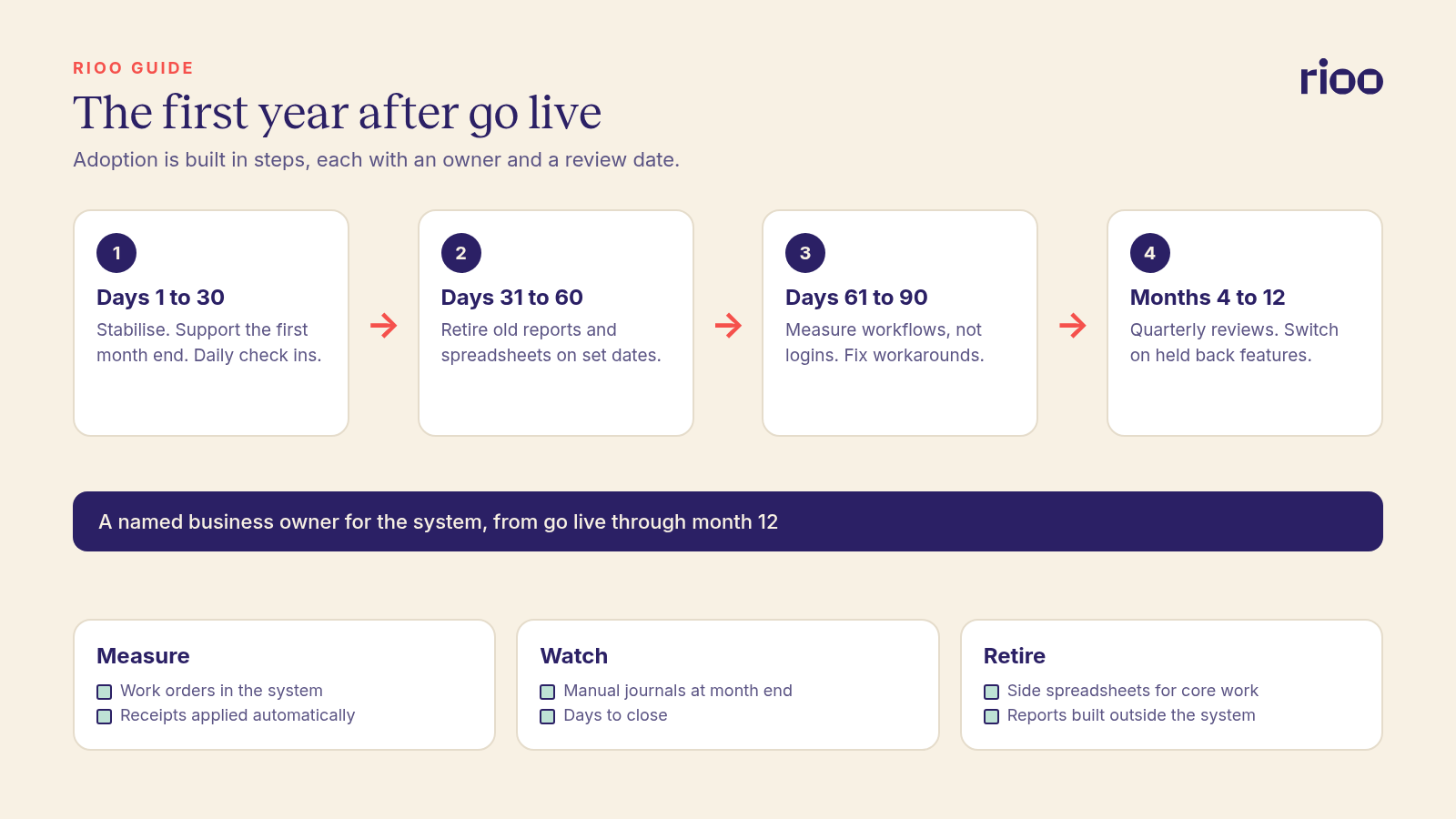
A review at 30, 60 and 90 days, then quarterly for the rest of the first year. Each review asks three things: what is working, where people are working around the system, and what will change before the next review. The answers drive training, configuration changes and process fixes.
They clean up data definitions early
Many adoption problems are really disagreements about meaning. What counts as a vacant unit? When is a lease "active"? Which properties belong to which entity? Agreeing these definitions once, and setting them in the system, removes a lot of friction. Our piece on why master data is your greatest real estate asset goes deeper on this.
They listen to the front line
Site managers and technicians spot problems first. A simple channel for feedback, and a visible list of what changed because of it, does more for adoption than another training session.
What year one can look like
Here is an illustrative first year for a mid sized operator with residential and commercial properties.
| Period | Focus | Signs it is working |
|---|---|---|
| Days 1 to 30 | Stabilise. Fix urgent issues, support the first month end, daily check ins with team leads. | First close completed in the system, issue list shrinking. |
| Days 31 to 60 | Retire the first group of old reports and spreadsheets. Rebuild the reports leaders rely on. | Leadership meeting uses system reports. |
| Days 61 to 90 | Measure workflows. Target the areas where work still happens outside the system. | Work orders and receipts mostly flow through the system. |
| Months 4 to 12 | Quarterly reviews. Switch on features held back at launch. Train new starters on the new way only. | Faster close, fewer manual journals, no side spreadsheets for core work. |
The timings will vary. What matters is that each stage has an owner and a review date.
An executive checklist for the first year
- Is there one named business owner for the system, with time in their week to do the job?
- Do we have a list of old reports and spreadsheets with retirement dates, and are we hitting them?
- Can we see, for each core workflow, how much of it runs in the system?
- Is our close getting faster and are manual journals going down?
- Do leadership meetings use reports from the system, or from somewhere else?
- Have we agreed the definitions behind our main KPIs?
- Is there budget for training and changes after go live, not only before it?
- Do front line teams know how to raise issues, and do they see things change?
Planning for adoption before you buy
The best time to plan for year one is during selection. Ask how the vendor supports customers after go live, who your contact will be, and what a typical first year looks like. Test the system on your real scenarios, as we suggest in our guide to running a property management software evaluation. Include data quality in the plan too: a clean migration makes trust in the new system much easier to earn. Our data migration guide covers what to prepare.
Looking ahead
Year two always brings new asks. An owner wants a new report. A new region comes on board. Finance wants to switch on a module that was held back at launch. Each of those is easier when the work already runs in the system and people trust its numbers. If year one ended with side spreadsheets still in use, every new request starts with a clean up.
The software project ends at go live. The operating change starts there.
Where RIOO fits
RIOO is property management software built natively on Oracle NetSuite, so leasing, maintenance, portals and accounting share one record from the start. That removes one of the biggest sources of shadow spreadsheets: reconciling a property system to a separate ledger. RIOO implementation on NetSuite maps your entities, properties and charges, migrates data with control totals and runs a parallel cycle before cutover. After go live, customer success managers with property backgrounds stay with your team as the portfolio grows.
Frequently asked questions
How long does property management software adoption take?
Most teams are working in the system within weeks. Full adoption, where old tools are retired and leaders trust the reports, usually takes most of the first year.
What is a good measure of software adoption?
Measure whether core workflows run in the system, such as work orders, receipts and month end entries, rather than counting logins.
Who should own adoption after go live?
A senior business owner in operations or finance, supported by leads in each team. IT and the vendor support them, but should not own it alone.
Why do teams go back to spreadsheets after go live?
Usually because an old report has no match yet, the new process feels slower at first, or nobody has set a date to stop using the old tool.
Should we keep the old system running in parallel?
A short, planned parallel run before cutover is useful. Keeping both running for months after go live usually slows adoption.