Short answer: a real estate portfolio review is a regular meeting, usually quarterly. Owners and managers look at every property against plan and decide what to do next. A good one runs on a pre read sent a few days ahead. Most of the meeting goes on exceptions and decisions, and it ends with a written list of actions, owners and dates. Each property gets a clear label for the next quarter, such as hold, invest, fix or review for sale.
Many portfolio reviews turn into a slow walk through every number for every building. Everyone leaves with a full notebook and no decisions. The fix is a fixed structure: the same data, sent early, with a meeting built around the few properties that need attention. This guide sets out that structure, the data to include, and the questions that turn a review into decisions.
What is a real estate portfolio review?
It is a planned review of how each property and the portfolio as a whole are performing against the business plan. It covers income, costs, leasing, capital projects, debt and risks. The audience is usually the owner or asset management team, finance, and the senior property managers. In funds, it often feeds the investor report and board pack.
It is different from the monthly property meeting. Monthly meetings deal with operations: this month's arrears, this month's turns. The quarterly review asks bigger questions. Is this property on track for its plan? Does it need money? Does it still fit the portfolio?
Before the meeting: build the pre read
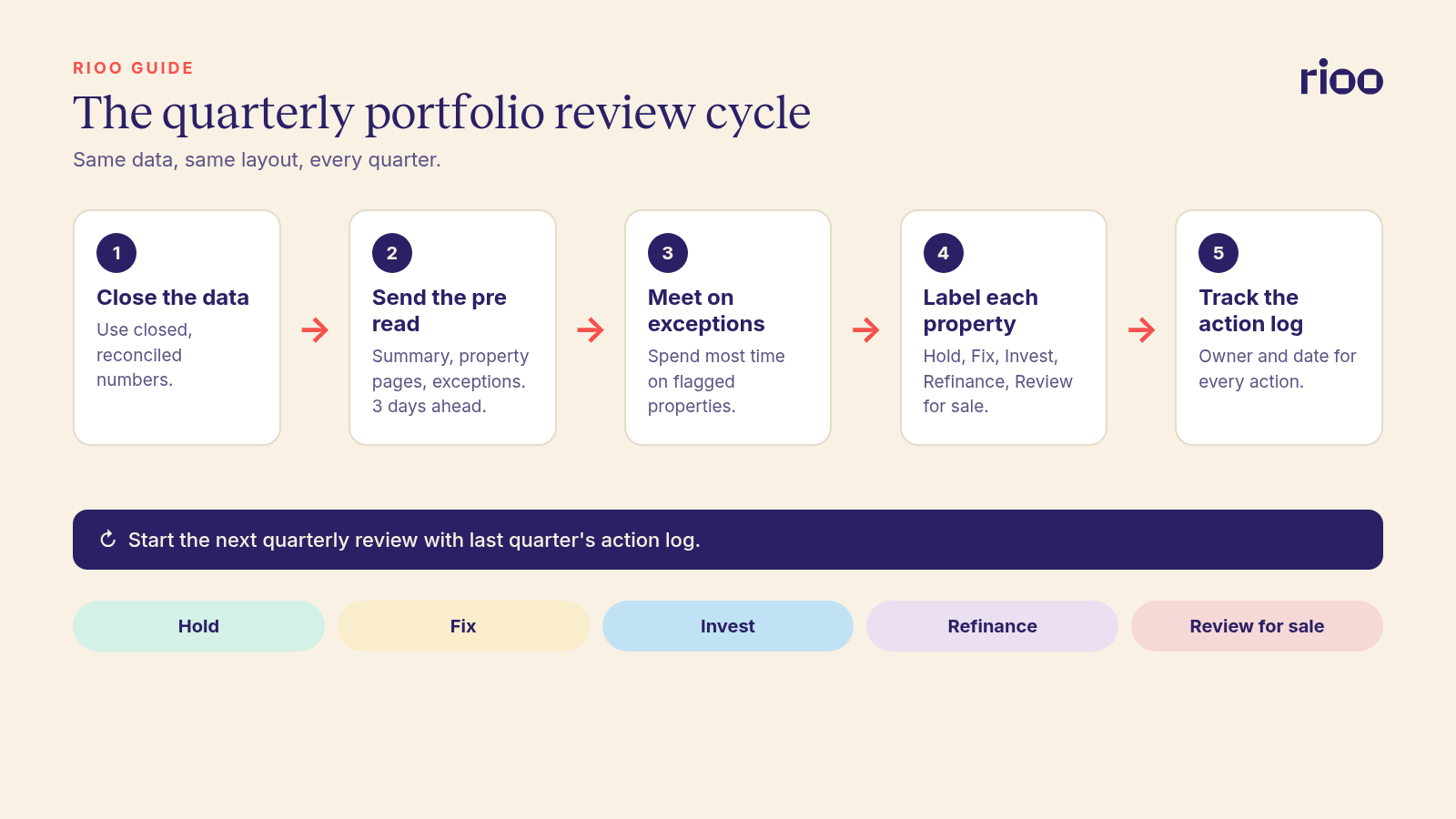
Send the pre read at least three working days before the meeting. It should use the same layout every quarter so readers know where to look.
1. Portfolio summary page
- Total NOI vs budget and vs the same quarter last year.
- Occupancy, both physical and economic. Our explainer on economic vs physical occupancy shows why you need both.
- Collections and arrears trend.
- Lease expiry profile for the next 12 to 24 months, and the weighted average lease expiry for commercial assets.
- Capital spend vs plan.
- Debt summary: maturities and any covenant headroom.
2. One page per property
Keep each page to the same blocks: NOI vs budget, occupancy, leasing activity, arrears, top three issues, capital projects, and the current label from last quarter. Add a short comment from the property manager in plain words.
3. The exceptions list
This is the most useful page. List every property that crossed a threshold you set in advance. Typical triggers:
- NOI more than 5 percent below budget for the quarter.
- Occupancy down by more than a set number of points.
- Arrears above a set level or rising for two quarters.
- A major lease expiring within 12 months with no decision yet.
- A capital project over budget or late.
- Covenant headroom below your comfort level.
Running the meeting
For most portfolios, 60 to 90 minutes is enough if the pre read did its job. A simple agenda:
| Time | Item | Purpose |
|---|---|---|
| 10 min | Actions from last review | Confirm what was done and what is still open |
| 10 min | Portfolio headline | Agree the overall picture in two or three sentences |
| 40 min | Exceptions | Discuss each flagged property and agree a decision |
| 15 min | Risks and market changes | Rates, insurance, regulation, big tenant news |
| 10 min | Decisions and actions | Read back the action log before people leave |
Do not present the pre read in the room. Assume people have read it. If they have not, the next review will go better once they see the meeting moves on without them.
The questions that lead to decisions
For each exception, work through the same short list:
- What happened? One sentence, with the number.
- Is it timing or permanent? A late invoice is timing. A lost anchor tenant is not.
- What is the plan to fix it? Who does what, and by when.
- Does it need money? If yes, how much, and what return or risk reduction do you expect?
- Does it change the label? Should this property move from hold to invest, or to review for sale?
Give every property a label
Labels make the outcome easy to read and easy to track over time. Keep the list short. One common set:
- Hold: on plan, no special action needed.
- Fix: an operating problem needs attention, such as arrears, leasing or costs.
- Invest: capital spend is planned to improve income or protect value.
- Refinance: debt terms need work in the coming year.
- Review for sale: the property may no longer fit the portfolio plan, so prepare the analysis.
A label is a starting point for work, not a final decision. A "review for sale" label, for example, should trigger a proper hold vs sell analysis by the people who own that decision.
After the meeting: the action log
Send the action log within one working day. Each line needs an action, an owner, a due date and the property. Start the next review with that log. A review where last quarter's actions are never checked will slowly lose its value.
Keep a simple history of labels by quarter as well. Over a year or two, it shows which properties keep coming back as exceptions, which is often the most useful insight the review produces.
A short example
A portfolio of 14 properties holds its third quarter review. The figures are illustrative. Twelve properties are on plan. Two are flagged:
- An office building with a tenant on two floors whose lease ends in nine months and who has not confirmed renewal. The team labels it "Fix", asks leasing to meet the tenant within 30 days, and asks finance to model the downtime and leasing costs if the tenant leaves.
- A 90 unit apartment block with arrears up for two quarters. The property manager explains that a payment plan scheme has slowed collections. The team keeps the label at "Hold" but sets a target arrears level for next quarter and asks for a weekly arrears report.
The meeting takes 70 minutes and ends with six actions, each with an owner and date.
Residential and commercial portfolios need different lenses
The structure stays the same, but the details change by asset type.
- Residential: focus on occupancy, lease trade outs on renewals and new leases, turn time, arrears and resident retention. With many small leases, trends matter more than any single tenant.
- Commercial: focus on individual tenants, expiries, renewal talks, incentives, recoveries and tenant credit. One tenant leaving can change a building's year, so the expiry schedule deserves real time.
- Mixed portfolios: keep separate pages by asset type, then combine them on the summary page so leaders see one picture without losing the detail.
Setting thresholds that fit
Start with simple, round thresholds and adjust them after two or three reviews. If almost every property is flagged, the triggers are too tight. If nothing is ever flagged, they are too loose. Aim for a list of exceptions small enough to discuss properly in the time you have, usually a handful of properties.
Common mistakes
- Changing the format every quarter. Readers cannot compare.
- Numbers that do not tie to the books. If the review shows a different NOI from the financial statements, trust disappears. Use closed, reconciled figures.
- No thresholds. Without triggers, every property gets the same time and the real problems get too little.
- No labels or owners. The meeting ends with views, not decisions.
- Building the pack by hand. If it takes two weeks to compile, the data is old by the time it is read.
How the review connects to other reporting
The same data feeds lender reports, investor updates and next year's budget. If you already produce a quarterly lender reporting package, build the review from the same closed numbers so the two never disagree. For a wider view of the discipline, see our guide to real estate portfolio management.
Where RIOO fits
RIOO keeps leases, tenants, maintenance and accounting in one NetSuite database, across residential and commercial properties and across entities. That means the occupancy, arrears, lease expiries and NOI in your review all come from the same records as your financial statements. With NetSuite SuiteAnalytics reporting, the portfolio summary and property pages can be saved searches and dashboards that refresh after close, rather than a pack rebuilt by hand. Teams focused on asset performance can learn more on our real estate asset management page.
Frequently asked questions
How often should a real estate portfolio be reviewed?
Quarterly is the most common rhythm, with a lighter monthly check on operations. Large or fast changing portfolios sometimes review monthly.
What KPIs belong in a portfolio review?
NOI vs budget, physical and economic occupancy, arrears, lease expiries, capital spend vs plan, and debt maturities and covenants cover most needs.
Who should attend?
The asset or portfolio manager, a finance lead, and the property managers for any flagged properties. Keep the group small enough to make decisions.
How long should the meeting take?
Around 60 to 90 minutes for most portfolios, if the pre read goes out a few days ahead.
What is the difference between a portfolio review and an asset management plan?
The asset management plan sets the strategy for each property. The portfolio review checks progress against that plan and decides what to change.