Short answer: a snow removal plan for commercial property is a written scope for snow and ice. It tells your contractor, your site team and your tenants exactly what happens when a storm arrives. It rests on a marked site map with priority zones and stacking areas. It also needs a defined trigger for service, separate arrival and completion times, a clear rule for ice, and a service log after every event. Sign it before the first storm, walk the site with the contractor, and agree how costs will be recovered under each lease.
The first storm of the season is a test of paperwork. A contract that says "plow as needed" leaves every question open at four in the morning. Which entrance opens first? Who salts the ramp? Where does the snow go so it does not melt across the walkway and refreeze? A good plan answers those questions in October, so nobody has to answer them during a storm.
This guide is for teams running retail centres, office parks and industrial sites.
What the plan should include
A complete plan has nine parts:
- A site map with surfaces, priorities and no pile areas.
- Service triggers for snow and for ice.
- Arrival, first pass and completion times.
- Repeat visit rules during a long storm.
- The pricing model and what it includes.
- Materials and where each may be used.
- Documentation after every event.
- Insurance and damage terms.
- Who tells tenants what, and when.
Treat it as part of the wider vendor agreement. The clocks in a good vendor SLA for property management apply here too: when the contractor must respond, when work must start and when it must be done.
Start with the site map
The map is the scope. Anything not on it is open to argument. Attach it to the contract as an exhibit and mark:
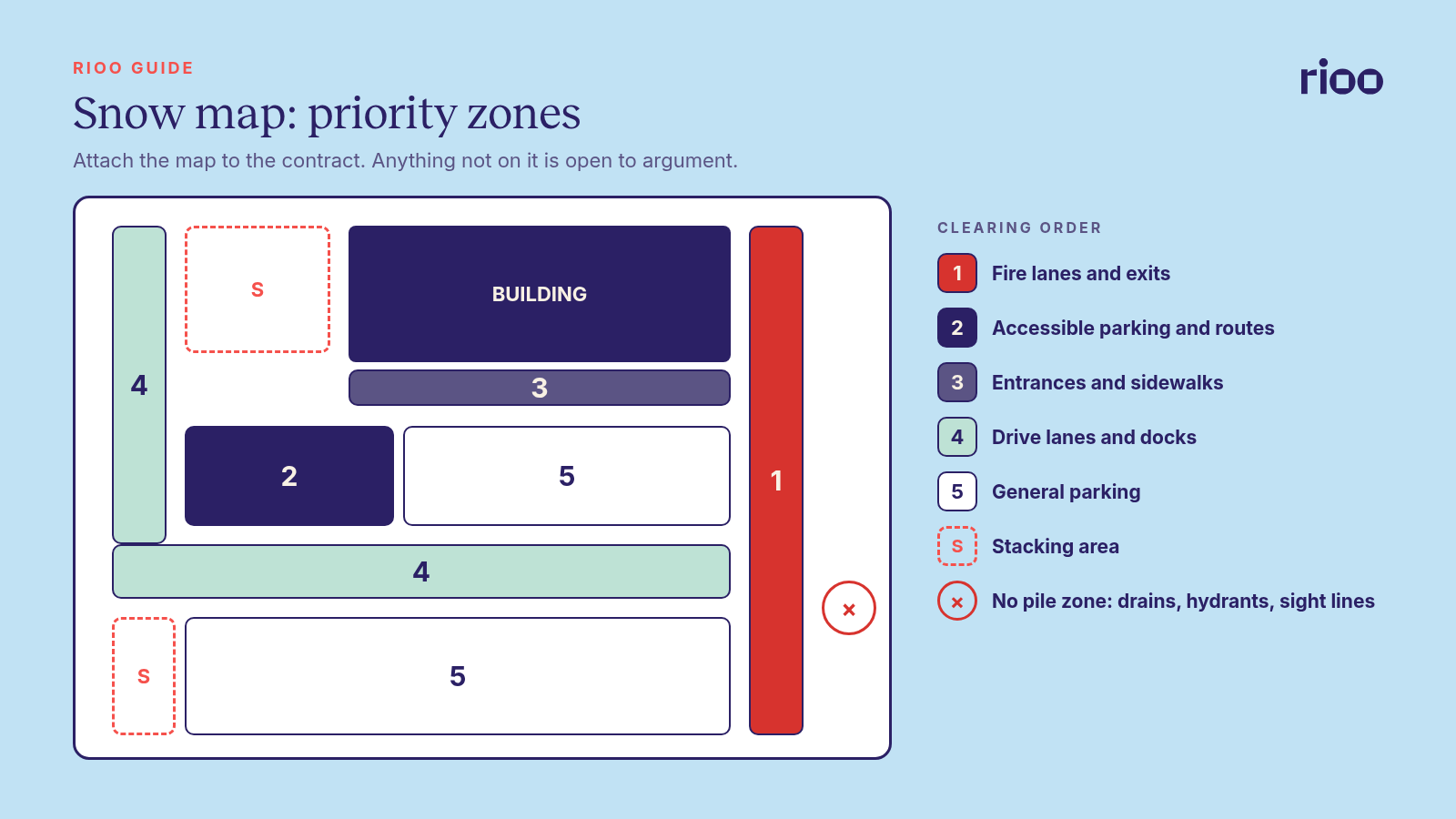
- Emergency access: fire lanes, hydrants and exit doors. These must never be blocked by plowed snow.
- Accessible routes: accessible parking spaces, access aisles, curb ramps and the route to the entrance. Clear these early, not last.
- Pedestrian areas: sidewalks, stairs, ramps and building entrances.
- Vehicle areas: drive lanes, entrances and exits, loading docks and delivery routes.
- General parking: the rest of the lot, cleared after the priority zones.
- Stacking areas: where piles go. Place them downhill of walkways and away from drains, hydrants, sight lines at exits and accessible spaces.
- Hazards: curbs, islands, bollards, gates, irrigation heads and any new concrete.
Number the zones in priority order. The contractor's crew and your site staff then share one language: "zone 2 is done, starting zone 4."
Set triggers and service times
A trigger is the condition that sends crews without a phone call. Contracts often use a snow depth, such as one or two inches. The right number depends on your opening hours and how many people walk the site. A medical office that opens at seven needs a lower trigger than a warehouse with a late shift change.
Define four clocks separately:
- Arrival: when a crew must be on site after the trigger.
- First pass: when the priority zones must be open.
- Completion: when the full map must be cleared after snowfall stops.
- Repeat visits: how often crews return while snow keeps falling.
Say whether each clock runs from the start of snowfall or the end. "Within four hours" means very different things depending on which. Also define what counts as one event. A long, slow snowfall can otherwise become three invoices.
Choose the pricing model
The pricing model decides who carries the weather risk.
| Model | How it bills | Who carries weather risk |
|---|---|---|
| Per push | A fee for each visit, often stepped by depth | The owner. A heavy winter costs more. |
| Per event | One fee per storm, however many visits | Shared. Needs a written event definition. |
| Seasonal | One fixed fee for the winter | The contractor. A light winter costs the owner more than per push would. |
| Seasonal with cap | Fixed fee up to a set number of events, then per event | Shared, with budget certainty up to the cap. |
| Time and materials | Hourly equipment and labour plus materials | The owner. Hard to budget. |
Whatever you choose, list what sits outside the base price. Hauling snow off site, de icing products and standby crews are often billed separately. Level competing bids on the same map and the same clocks, or the cheapest bid will simply be the smallest scope.
Plan ice separately
Plowing and ice control are different services. Freezing rain and refreeze after a sunny afternoon can make a lot dangerous without any new snow. The contract should say:
- Whether pretreatment before a storm is included.
- The trigger for salting or other treatment, such as any ice on a priority zone.
- Which products are used and where. Mark any areas, such as new concrete or permeable paving, where the contractor should use a different product or method.
- How often treated areas are checked after the event.
Snow plans sit alongside the rest of your cold weather work. Our winterization checklist by climate zone covers the building side, from pipes to ice dams.
Document every event
A slip and fall claim can arrive months after the storm. Your defence rests on records. Require a service log after each visit with:
- Date, time in and time out.
- Zones cleared and treated.
- Product and quantity used.
- Conditions on arrival, including temperature.
- Timestamped photos of priority zones when the crew leaves.
Take your own photos of the whole site before the season starts. They are the baseline for any damage claim against the contractor for broken curbs, scraped striping or bent bollards. Check that the contractor's insurance certificate is current and names the right parties. A certificate on file is only a start, as our guide to COI tracking for property managers explains.
Tenants, leases and cost recovery
Read the leases before the season. Some retail and industrial leases make the tenant responsible for its own sidewalk or dock area. Others leave everything with the landlord. Put the split on the site map so the contractor does not clear, or skip, an area by mistake.
Many commercial leases list snow removal as a common area maintenance cost, but whether you can recover it, and how much, depends on each lease. Read the definitions of common areas and operating expenses, any caps and exclusions, and any area the tenant maintains itself. Some leases also treat weather costs as uncontrollable, which can keep them outside a CAM cap. Our explainer on CAM caps, exclusions and controllable expenses covers the common wording. Code snow invoices to a separate account so the cost is easy to pull at year end.
Tell tenants how the plan works before the first storm. Share the priority order, the after hours contact and how they should report an untreated area.
A storm night, worked through
This is an illustrative case for a small retail centre with a two inch trigger and a 7:00 opening.
- 11:30 pm: snow starts. The contractor monitors depth.
- 2:15 am: depth reaches the trigger. A crew is dispatched without a call.
- 3:00 am: crew arrives. Fire lanes and accessible routes are cleared first, then entrances.
- 5:30 am: snow is still falling. A repeat visit clears the priority zones again and treats walkways.
- 8:00 am: snowfall stops. The completion clock starts and the full lot is cleared by the agreed time.
- Same day: the service log and photos arrive. The site manager checks them against a walk of the site and approves the invoice.
Who owns each step
| Task | Owner | Timing |
|---|---|---|
| Site map and scope | Property manager with contractor | Before contract signing |
| Bid levelling and contract | Property manager, approved by asset manager | Early autumn |
| Lease review for tenant duties | Lease administrator | Before the season |
| Event monitoring and dispatch | Contractor | Every storm |
| Log review and invoice approval | Site manager | After each event |
| Cost coding and recovery | Property accountant | Monthly and at year end |
Common mistakes
- "As needed" service. Without a trigger, you cannot show the contractor was late.
- Piles in the wrong place. Snow stacked uphill of a walkway melts across it and refreezes.
- Accessible routes cleared last. Put them in the first priority zone.
- No log, no proof. Pay invoices only against a completed service log.
- Ignoring the lease. Clearing a tenant's own area can create a cost you cannot recover.
Where RIOO fits
In RIOO, vendor bills are NetSuite transactions linked to the work behind them. Each snow event can run as a work order for the contractor, so the bill carries the property and job context. Insurance certificates are stored on the NetSuite vendor record with expiry dates, so an approver can see whether the contractor's cover is current before releasing work. At year end, CAM reconciliation draws expense pools from the property's GL lines and applies caps and exclusions per lease.
Frequently asked questions
When should a commercial snow contract be signed?
Before the season starts, ideally in early autumn. That leaves time to walk the site, level bids on the same map and fix any scope gaps.
What is a typical snow trigger depth?
Many contracts use one or two inches. Choose based on your opening hours and foot traffic, and set a separate trigger for ice.
Is per push or seasonal pricing better?
Neither is better in every case. Per push suits owners who accept cost swings. Seasonal pricing suits owners who need budget certainty. A seasonal fee with a cap on events is a common middle path.
Can snow removal be charged back to tenants?
It depends on the lease. Many leases allow it as a common area cost, but the definitions, caps, exclusions and any tenant maintained areas decide what you can actually recover. Check each lease before you include snow costs in estimates.
What records help defend a slip and fall claim?
Service logs with times, zones and products, timestamped photos, weather conditions and your own inspection notes from the same day.