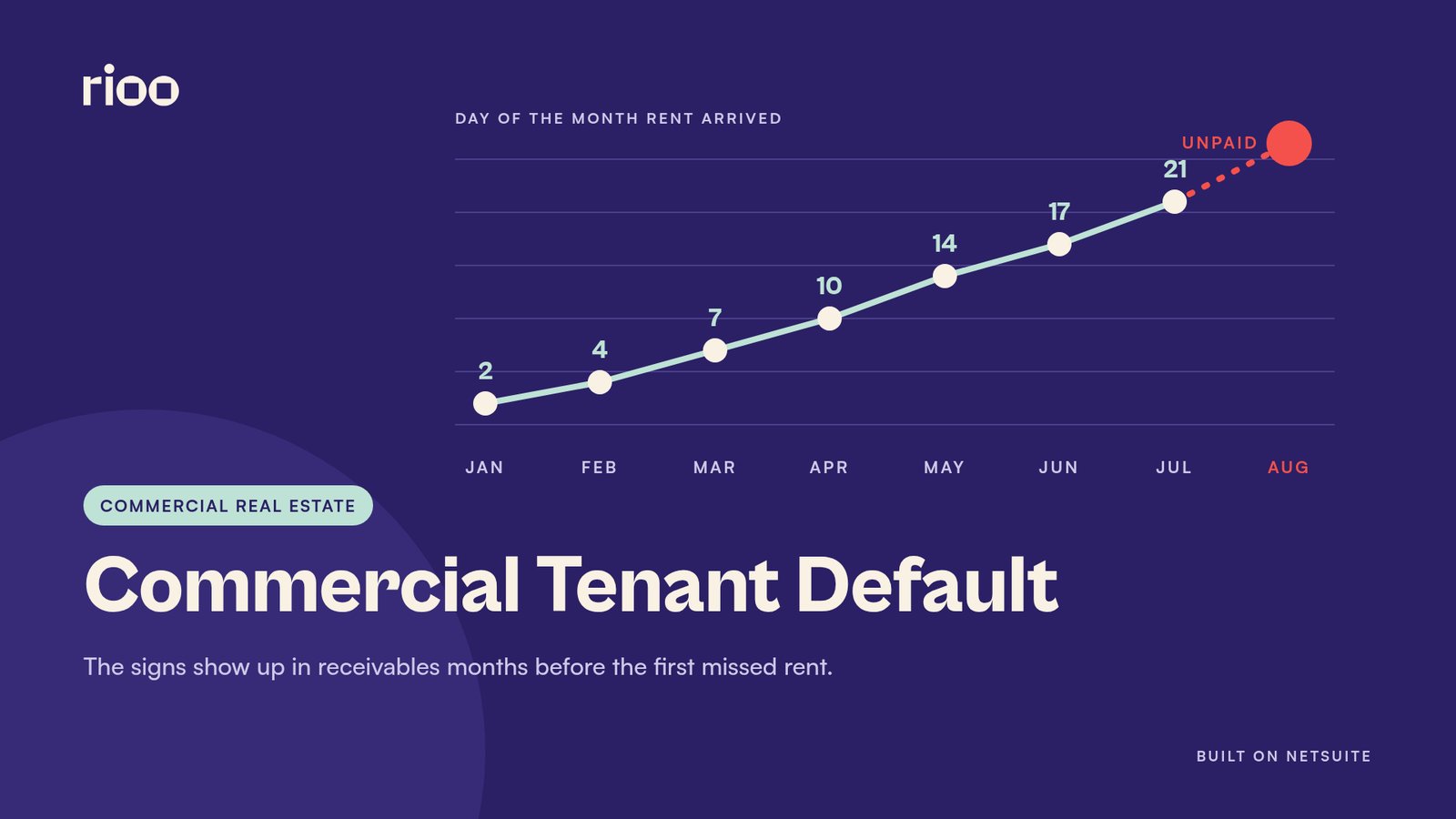
Commercial tenants seldom default out of nowhere. The signs are usually sitting in the landlord's own records months before the first missed rent. Rent arrives a few days later each month. A payment comes in as a round number. A CAM bill gets disputed for the first time in years. A sales report stops arriving. Each sign lives in a different file, so nobody puts them together.
The warning signs of commercial tenant default show up in behaviour well before the balance looks bad. Watch the day rent arrives, short or rounded payments, new disputes, missing tenant reports, requests to change terms and lapsed insurance. Score each tenant monthly. When two or more signs appear in the same quarter, call the tenant. At that stage the guarantee and the tenant's goodwill are usually still there to work with.
Why the aging report sees it last
An aging report sorts what is owed by how long it has been owed. It answers one question well: how much is late today? It says nothing about direction.
A tenant who pays on the 20th every month never reaches the 31 to 60 day bucket. At month end the account shows as current. The AR aging report is still the right tool for collections. It is the wrong tool for spotting a tenant who is running out of cash, because cash trouble shows up as timing first and balance later.
Disputes hide trouble too. A tenant that disputes a $3,400 CAM true up has a real argument on paper. It may also be buying time. The aging report tags the amount as disputed and moves on.
Six signals to score every month
Give each signal one point per month it appears. Keep the scoring simple, so a property manager can do it in five minutes per tenant.
Payment day drift
Track the day rent clears, not just whether it cleared. Rent on the 2nd, then the 4th, the 7th and the 10th is a pattern. Score a point in any month the payment lands after the lease's grace period. One late month can be a bank holiday. A run of them is a trend.
Short or rounded payments
Monthly charges are rarely round. A payment of exactly $11,000 against a $13,150 bill means the tenant paid what it had. Treat any short payment as a signal, even when the rest arrives later.
A new dispute from a quiet tenant
Some tenants question every reconciliation. That is their normal. Score a dispute when it comes from a tenant who has not raised one before, or when an old dispute reopens. Keep scoring it each month it stays open. Handle the dispute properly either way. Our guide to CAM reconciliation disputes sets out the documents to have ready.
Missing tenant reports
Retail leases often require monthly or annual sales reports. Some office and industrial leases ask for financial statements. A tenant whose sales are falling is slow to send numbers. The retail sales reporting guide covers what the lease can require and how to chase it.
Requests to change terms
Requests to defer rent, give back space, shorten a renewal or assign the lease all deserve a point. Each one can be reasonable. Together with late payments, they tell you the tenant's plan has changed.
Insurance and outside notices
A certificate of insurance that expires and is not replaced is a strong signal. So are utility shutoff notices, tax liens served on the premises and a supplier lien you hear about from a contractor. A tenant paying its insurer late is often paying other people late too.
A restaurant tenant, January to August
Here is a fictional example. A 4,800 square foot restaurant leases space in a neighbourhood shopping centre. Base rent is $11,200 a month and estimated CAM is $1,950, so $13,150 is due on the 1st. The lease gives five days' grace. The landlord holds an $11,200 security deposit. The owner's personal guarantee covers the first three years of the lease and ends on 30 September 2026.
| Month | What happened | Signals that month |
|---|---|---|
| January | Paid in full on the 2nd | 0 |
| February | Paid in full on the 4th | 0 |
| March | Paid in full on the 7th | 1 |
| April | Paid on the 10th. Disputed the $3,400 CAM true up, its first dispute since 2023 | 2 |
| May | Paid $11,000 on the 14th, $2,150 short | 3 |
| June | Paid in full on the 17th. May sales report not sent | 3 |
| July | Paid $10,000 on the 21st. Asked to defer three months of rent | 5 |
| August | Nothing paid. Insurance certificate expired on the 1st | 6 |
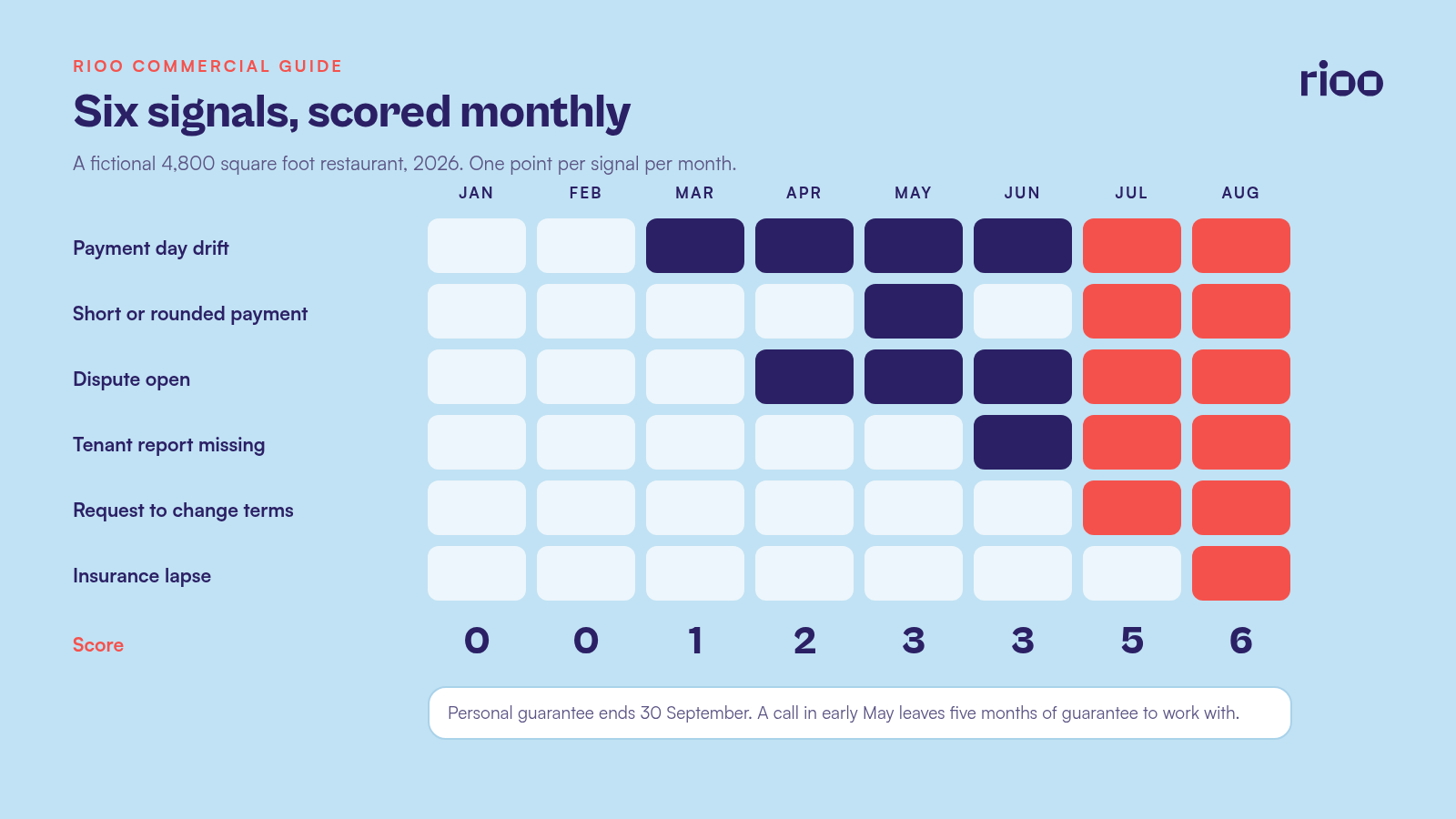
Read down the right hand column. The score went from 0 to 2 in a quarter, then kept climbing. Nothing in the first four months looked like a collections problem. Every payment came in full, and the latest was only a few days past the grace period.
On 31 May, the aging report showed $5,550 owed. Of that, $3,400 was tagged as disputed CAM. On paper it looked like an argument about one bill and a short payment. The monthly score said 3.
By 31 August, unpaid rent and CAM came to $18,450, plus the disputed $3,400. The deposit covered $11,200 of that. The guarantee had one month left to run. The landlord had spent the summer watching a tenant slide and the guarantee clock run down at the same time.
What RIOO adds to the watch
RIOO Professional keeps commercial leases, tenant ledgers and critical dates in NetSuite, in the same account as the accounting. Payment dates, short payments and disputed amounts all sit on the tenant ledger. So a saved search or dashboard can show payment day by tenant by month, instead of only the balance.
Lease dates such as a guarantee end date or an insurance expiry can be tracked as critical dates on the lease record. The commercial lease administration page shows how those dates and clauses are captured.
The score itself still needs a person. RIOO puts the evidence in one place. Someone who knows the tenant still has to read it and pick up the phone.
The call to make in May
In the example, the right moment was early May, when April showed two signals and the guarantee still had five months to run. The call should be calm and specific. Something like this:
"Rent has been arriving a bit later each month since March, and you've raised the CAM true up. I'd rather hear what's going on now than guess. How is trade?"
"Lunch is down since the office building across the road half emptied. Evenings are fine. We're cutting lunch hours to save staff."
"Thanks for telling me. Let's look at options while there's time. Can you send me the sales figures for the last six months?"
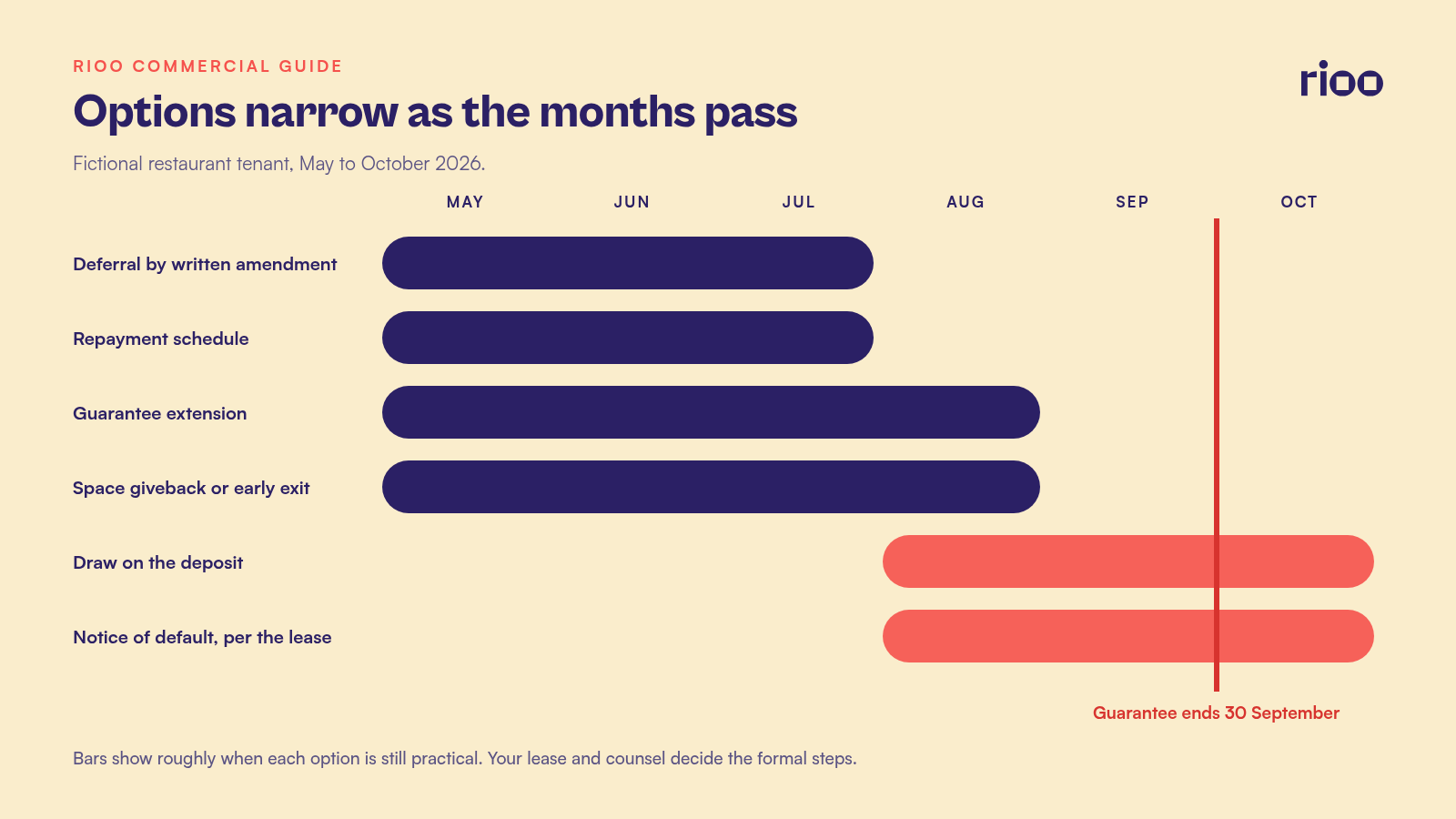
With five months of guarantee left, the landlord has real options. A short deferral can be written as a lease amendment with a repayment schedule. The guarantor might extend the guarantee in exchange. The tenant might give back part of the space, or agree an early exit with a fee. If the numbers show the business cannot recover, the landlord can prepare for a default while the guarantee still applies.
Before sending any notice of default, read the lease's default and cure clauses with counsel. Many leases require written notice and a cure period before remedies apply. Our article on lease guarantee types explains why the guarantee end date matters so much.
Questions owners ask about default
What counts as a default in a commercial lease?
The lease decides. Monetary default usually means rent or other charges unpaid after a set period. Non monetary default covers things like lapsed insurance, unauthorised alterations or going dark. Each type normally has its own notice and cure period.
How early should we contact a tenant who pays late?
As soon as two signals appear in one quarter. A friendly call at that point costs little. Waiting until the account is 60 days past due leaves fewer options.
Which tenants are worth scoring?
Start with tenants whose rent is a large share of the property's income. Add any tenant whose guarantee or letter of credit expires in the next 12 months. A centre with 20 shops can score every tenant in an afternoon each month. A larger portfolio can start with the top 20 by rent.
Should we draw on the security deposit?
Check the lease first. Many require notice before a draw and ask the tenant to top the deposit back up. A draw also signals a harder stance, so time it as part of a plan.
Does agreeing a deferral waive our rights?
It can if the paperwork is loose. Put any deferral in a written amendment that keeps the landlord's other rights in place. Have counsel draft it.
Won't tenants feel watched?
The score is an internal tool. Tenants never see it. What they see is a property manager who calls early and asks how business is going. In retail and restaurants especially, that call often lands as help.
The other choice is to wait for the aging report. By then, the conversation is about notices and lawyers, and the guarantee may have expired. A tenant in trouble will speak to whichever creditor calls first with a workable idea. The landlord should want to make that call.