"Water is coming through the bedroom ceiling. There's a bucket under it but it's filling fast." The text reached the property manager at 11:40 p.m. on a Saturday in April.
Georgia landlord repair laws put the repair on the landlord. Under O.C.G.A. section 44-7-13, the landlord must keep the premises in repair. Every residential lease signed or renewed from 1 July 2024 also carries a promise that the home is fit for human habitation. Georgia sets no fixed number of days. The landlord must repair within a reasonable time after notice, and a roof leak calls for hours, not weeks. A lease cannot waive these duties. A tenant's main remedies are a lawsuit, repair and deduct, a code complaint, or moving out if the home becomes unfit. This guide reflects Georgia law as of October 2026. Check your local housing code and speak to counsel before acting on a dispute.
Seven tenant questions, each with a next step
These are the questions that arrive by text after a storm or a burst pipe. Each answer gives the legal position, then the step a manager should take.
Does my landlord have to fix the roof?
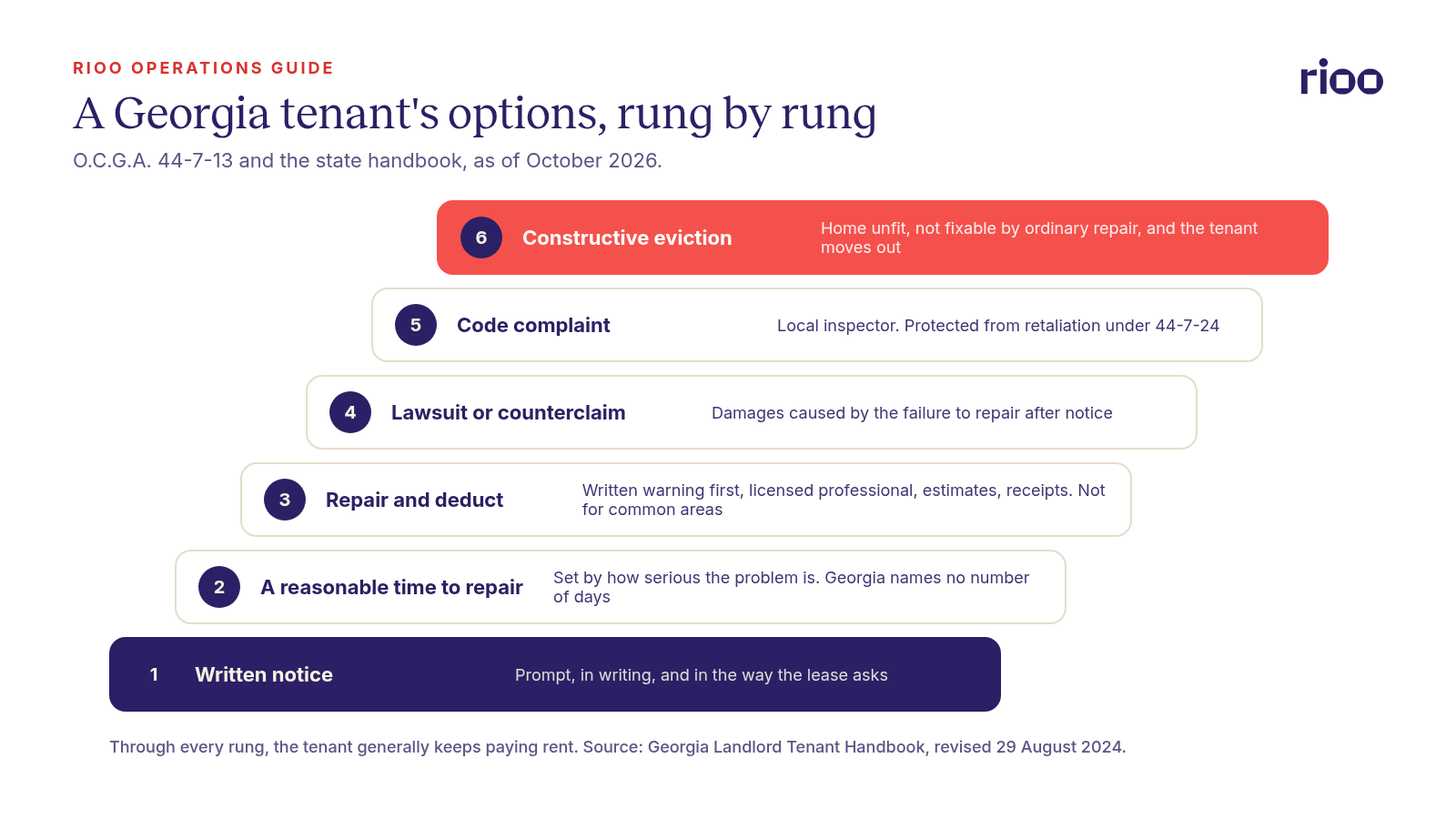
Yes. Section 44-7-13 says the landlord shall keep the premises in repair. The 2024 Safe at Home Act added the habitability promise to residential leases from 1 July 2024. You can read the signed bill, HB 404, on the Governor's site. The state's tenant handbook lists the core duties: the building structure, electric, heating, cooling and plumbing, and ordinary care to keep the unit safe.
What to do: confirm the report in writing within the hour. Say who is coming and roughly when.
How long does my landlord have to fix it?
Georgia law gives no set number of days. The Georgia Landlord Tenant Handbook says reasonable time depends on how serious the condition is and what the repair involves. A hole in the roof needs action far sooner than a broken ceiling fan.
What to do: set your own targets and keep them. Stop active water the same night or the next morning. Book the permanent repair as soon as the weather and the trade allow.
Can I stop paying rent until it is fixed?
Generally, no. The handbook warns tenants that they must keep paying rent even when repairs are late. A landlord can file a dispossessory case for unpaid rent. Our Georgia dispossessory guide covers that process. The exception is a home so unfit that the tenant moves out, covered below.
What to do: do not threaten eviction in a repair thread. If rent is late, handle it as a separate matter.
Can I hire someone and take it off the rent?
The statute does not spell this out, but the state handbook describes the remedy. The tenant should tell the landlord in writing before arranging the work. They should use a qualified, licensed professional, get several estimates, and keep receipts. Then they deduct the cost from the next rent. It cannot be used for common areas. A landlord can still argue the repair was unnecessary or overpriced.
What to do: reply with a date for your own repair, or approve the tenant's estimate in writing. Silence invites a deduction you never agreed to.
Can I break my lease over this?
Only in narrow cases. Georgia calls it constructive eviction. The failure to repair must have made the home unfit to live in. Ordinary repairs must not be able to restore it. And the tenant must actually move out. A flooded unit after an ignored roof leak can qualify. One leaking faucet will not. A tenant may also treat the lease as broken if the city or county condemns the home.
What to do: if the home cannot be lived in tonight, offer a hotel or a vacant unit. Write down what you offered and when.
Will you evict me for calling code enforcement?
Not lawfully. O.C.G.A. section 44-7-24 protects good faith repair requests and code complaints. If the landlord files a dispossessory case, raises rent, cuts services or ends the lease within 3 months, retaliation is presumed. The landlord can rebut that with a lawful reason, such as unpaid rent. A tenant who proves retaliation may recover one month's rent plus $500, court costs and possibly attorney fees, less any balance owed.
What to do: flag the file for 3 months after any repair complaint. Have a second person review any rent increase or notice in that window.
Who pays for my damaged belongings?
If the landlord repairs within a reasonable time, the tenant generally cannot recover for personal property damage. The exception is damage caused by the landlord's earlier failure or delay to repair. A renters policy may cover the rest.
What to do: photograph the damage and the source. Note the time you first heard of the leak. That time decides whether delay is even a question.
Setting your own repair clock in Georgia
Because Georgia sets no deadline, a written internal standard is strong evidence of what you treat as a reasonable time. Pick targets your vendors can meet, then measure against them. The targets below are a practical suggestion, not a legal rule.
| Condition | Examples | Suggested first response | Suggested fix target |
|---|---|---|---|
| Active danger | Gas smell, sparking outlet, sewage backup, water through a ceiling | Within 1 hour | Make safe the same day |
| Loss of a basic service | No heat in winter, no cooling in a heat wave, no water | Same day | Within 24 to 48 hours |
| Habitability, not urgent | Slow roof drip, broken window lock, pest activity | Within 1 business day | Within 7 days |
| Routine | Dripping faucet, sticking door, loose cabinet hinge | Within 2 business days | Within 14 days |
Write the standard into the lease addendum or the resident handbook, and train the on call team on it. If a job runs late, the log still shows the standard you were working to and why it slipped.
One storm, one roof, one week
This is a fictional example. Denise rents a 1962 single family house in southwest Atlanta for $2,100 a month. A hailstorm crosses the city on the evening of Saturday 18 April 2026.
At 11:40 p.m. Denise sends the text above. The manager replies at 11:52 p.m. "Roofer on call is booked for 7:30 a.m. Move anything you can out of the bedroom. If you want a hotel tonight, keep the receipt and we will reimburse it."
Denise sleeps on the sofa. The roofer arrives at 7:40 a.m. on Sunday and tarps a section of torn shingles and soft decking. The manager logs the leak as stopped at 9:15 a.m. On Monday 20 April the owner approves a $2,350 quote to replace the damaged decking and shingles.
On Wednesday 22 April Denise asks, "Can I take the ceiling stain off May rent?" The manager answers that the ceiling is on the job list. A drywall crew is booked for Thursday 30 April, after the roof is done and the cavity dries. The roof work finishes on Friday 24 April. The drywall crew opens the ceiling on 30 April, finds no mold, and replaces two sheets for $780.
The owner reimburses no hotel because none was used. He offers a $150 credit on May rent for the week without a usable bedroom. Denise pays $1,950 on 1 May. Georgia law did not require it. The owner judged it was cheaper than a dispute.
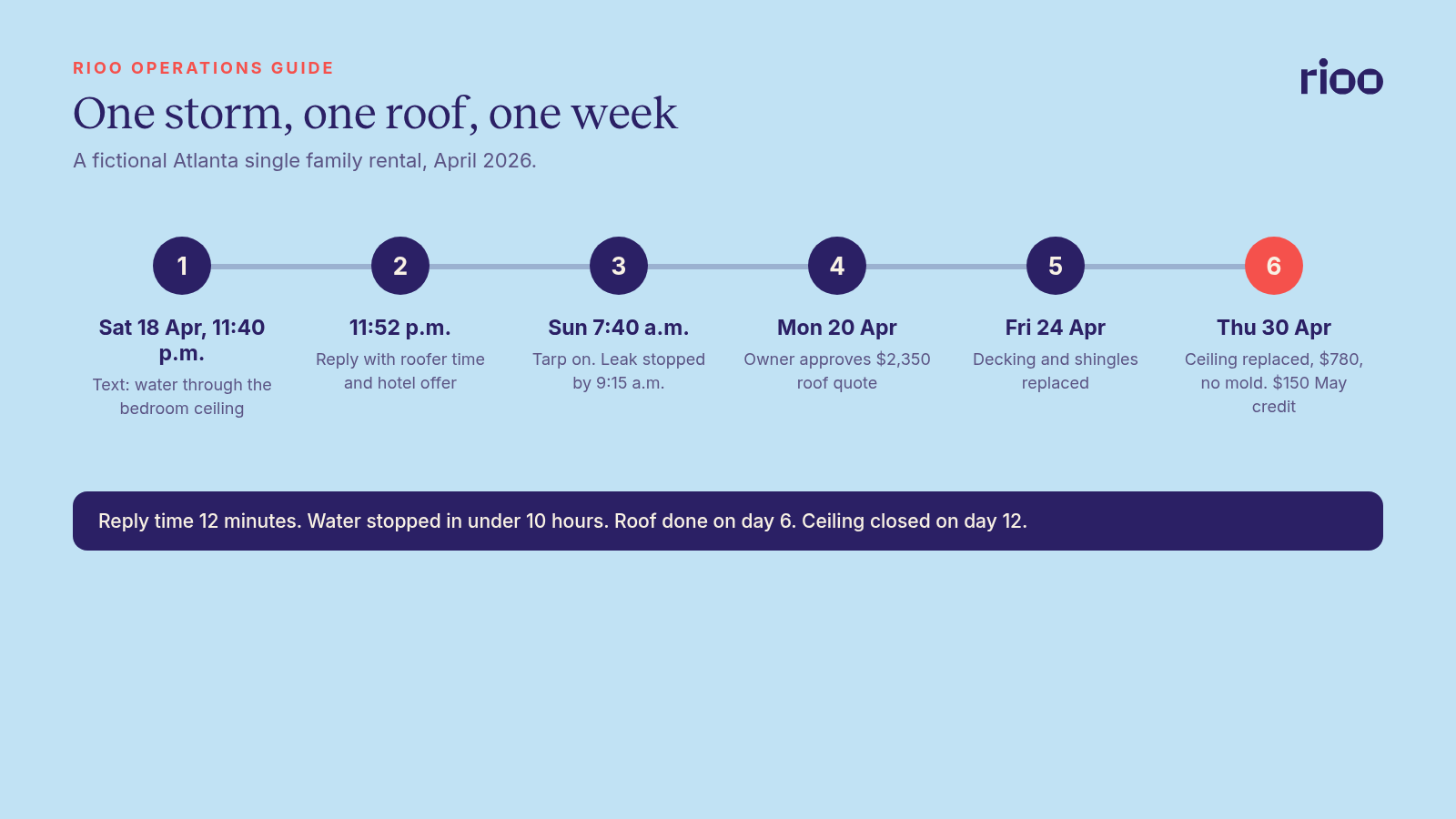
Two choices kept this case quiet. The manager answered within 12 minutes with a time and a name. And he never let the ceiling question become a rent question.
Lease clauses Georgia will not enforce
O.C.G.A. section 44-7-2 lists rights that neither side can waive in a residential lease. The repair duty under 44-7-13 is on that list. So is the landlord's liability for failure to repair under 44-7-14. The security deposit rules and the dispossessory process are on it too.
In practice, strike or rewrite these clauses in older Georgia leases:
- "Tenant accepts the home as is and the landlord has no duty to repair."
- "Landlord is not liable for any damage from leaks, whatever the cause."
- "Tenant must carry insurance, and failing to do so releases the landlord."
- An attorney fee clause that charges the tenant but not the landlord. Section 44-7-2(c) voids it unless it works both ways.
A lease can still set sensible process. It can require repair requests through the portal, name an emergency line, and make the tenant responsible for damage they cause. Our overview of Georgia landlord tenant law covers the rest of the code, and the Georgia security deposit guide covers the move out list.
RIOO and the storm file
When the tenant reports through the RIOO portal, the request becomes a work order tied to the house and the lease in NetSuite. Photos travel with it. The status history records when the request came in, who was assigned and when each visit happened. The tenant sees status changes as they happen.
The roofer's and drywall crew's bills attach to the work order and post to the property. The May credit posts to the tenant ledger. For a water event, open a linked task for the follow up mold check. Our guide to responding to a rental mold complaint sets out that first week. RIOO keeps the record. It does not judge whether a delay was reasonable under Georgia law. That stays with you and your counsel.
A Georgia repair log you can copy
Keep one row per contact or visit. Courts and code officers look for the same facts every time: when you knew, what you did and when. Here is the Atlanta example as a filled in log.
| Date and time | Source | What was reported or done | Who | Next step and date | Cost | Proof saved |
|---|---|---|---|---|---|---|
| Sat 18 Apr, 11:40 p.m. | Text from tenant | Water through bedroom ceiling after hail | Denise | Roofer at 7:30 a.m. Sunday | Screenshot of text | |
| Sat 18 Apr, 11:52 p.m. | Reply to tenant | Roofer booked; hotel offered | Manager | Confirm arrival | Screenshot of reply | |
| Sun 19 Apr, 7:40 a.m. | Site visit | Tarp over torn shingles and soft decking | Roofer | Quote by Monday | $275 | Photos, invoice |
| Mon 20 Apr | Owner approval | Decking and shingle replacement approved | Owner | Roof work by Friday | $2,350 | Signed quote |
| Fri 24 Apr | Site visit | Roof repair complete | Roofer | Drywall Thursday 30 April | Photos | |
| Thu 30 Apr | Site visit | Two ceiling sheets replaced; no mold found | Drywall crew | Close work order | $780 | Photos, moisture reading |
| Fri 1 May | Ledger | $150 goodwill credit applied | Manager | None | $150 credit | Tenant statement |
Copy the column headings into your own template. Add a row for every attempt to reach the tenant, even when no one answers. The empty rows are the ones that hurt you later.