A tenant lockout policy is a short set of written rules for letting residents back in. It says who staff may let in, how that person proves who they are, what a lockout costs at each hour, and what gets recorded. Put it in the lease or a signed rules addendum so the fees can be collected. Then train everyone who answers the after hours line.
Without one, a bad week looks like this. Three lockout calls: 11 PM Tuesday, 3 AM Thursday, and a Saturday call from a resident on their third lockout this year. The on call technician drives 90 miles for keys, and nobody charges a fee because nobody is sure the lease allows it.
This guide covers accidental lockouts only. A landlord locking a tenant out to force them to leave is a different matter, and it is illegal in nearly every state. There is a short section on that below, followed by a template you can adapt.
The rules a lockout policy needs
Keep the policy short enough that a new technician can follow it at 3 AM. Six rules cover almost every case.
| Rule | What it says | Why it matters |
|---|---|---|
| Who can be let in | Only people named on the lease or on the approved occupant list | Stops a staff member opening a door for an ex partner or a stranger |
| Identity check | Photo ID matched to the lease, before the door opens | The step that prevents the worst outcome |
| Hours and response | Office hours, after hours and overnight, with target response times | Sets expectations for residents and staff |
| Fees | A set fee per time band, written in the lease | Fees not in the lease are hard to collect |
| Two people overnight | Overnight entries need two staff or a staff member plus a security guard, where possible | Staff safety |
| Record | Time, name, ID checked, staff member, fee charged | Evidence if anything goes wrong later |
Lockouts sit inside your wider key system. If keys and fobs are not tracked, the policy has nothing to stand on. Our key control policy guide covers how master keys and fobs are stored and signed out.
Checking identity at the door
A staff member should never open a unit only because someone says they live there. The check takes two minutes.
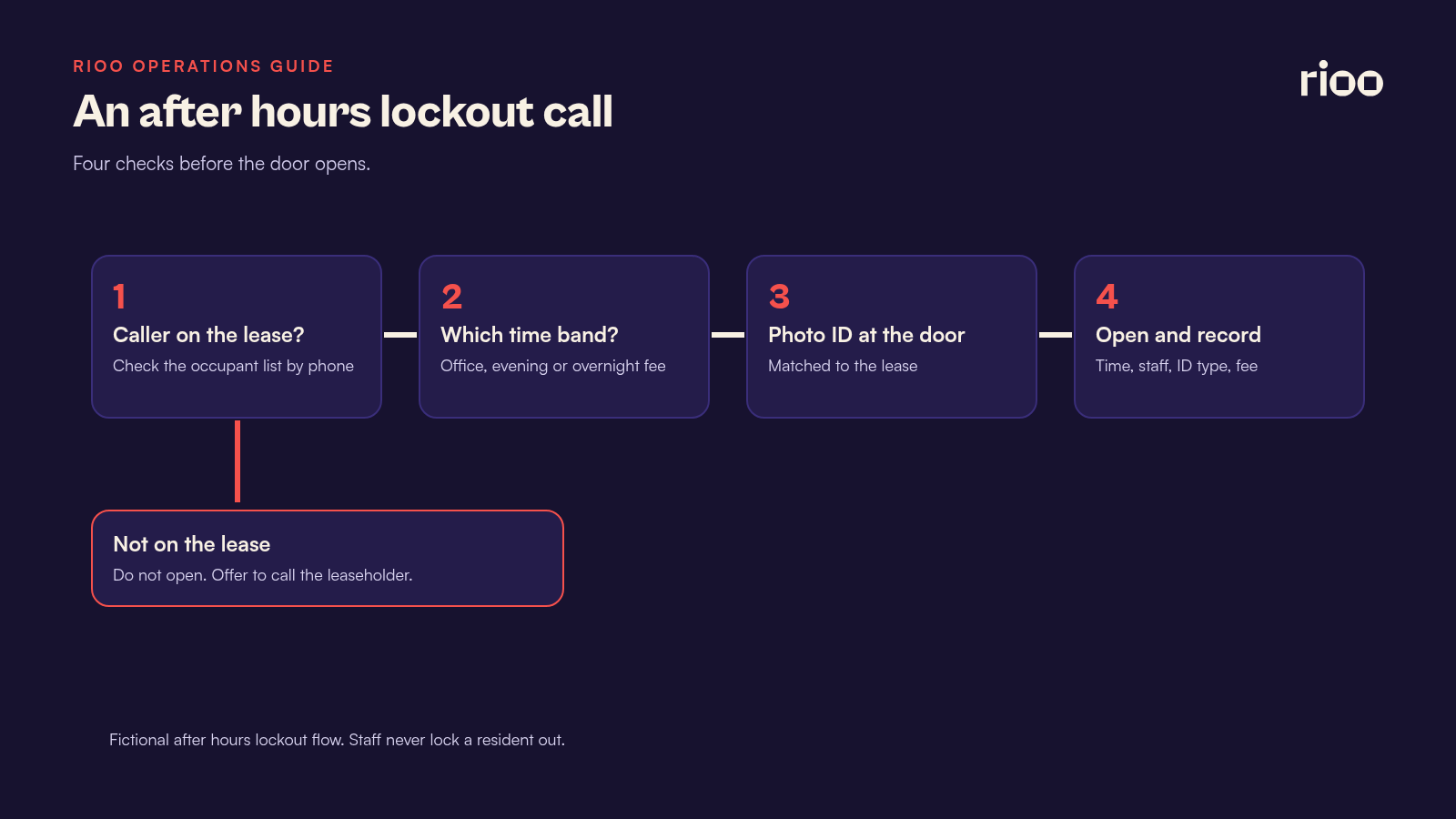
- Ask for the name and unit number on the phone, and check it against the lease or occupant list before driving out.
- At the door, ask for a photo ID. If the ID is inside the unit, open the door, and have the person show the ID right there in the doorway before going in.
- If the name is not on the lease or occupant list, do not open the door. Offer to call the leaseholder.
- If there is a court order, protective order or a note on file about a household dispute, follow it, and call the manager.
- Record the ID type and the last four digits, not a photo of the ID.
If a person who is not on the lease claims to live there, treat it as an occupancy question for the office in the morning. Do not settle it at the door.
Lockout fees and response times
A fee schedule should cover your real cost, not punish the resident. Set it by time band and put it in the lease or a signed community rules addendum. Here is a typical structure.
| Time | Response target | Example fee |
|---|---|---|
| Office hours, resident collects a spare key at the office | While they wait | $0 |
| Office hours, staff opens the door | Within 1 hour | $25 |
| Evenings, 6 PM to 11 PM | Within 1 hour | $75 |
| Overnight, 11 PM to 7 AM | Within 90 minutes | $125 |
| Lost key that requires a rekey | Next business day | Actual cost of the rekey |
The numbers are examples. Some states and cities limit fees that are not tied to actual cost, so check local rules before you set yours. Waive the fee when the lockout was your fault, for example a failed smart lock or a fob that stopped working.
If your technicians are paid to wait on call, lockouts are part of that cost. The guide on on call pay for maintenance technicians explains when waiting time counts as work time.
What fourteen calls a month cost
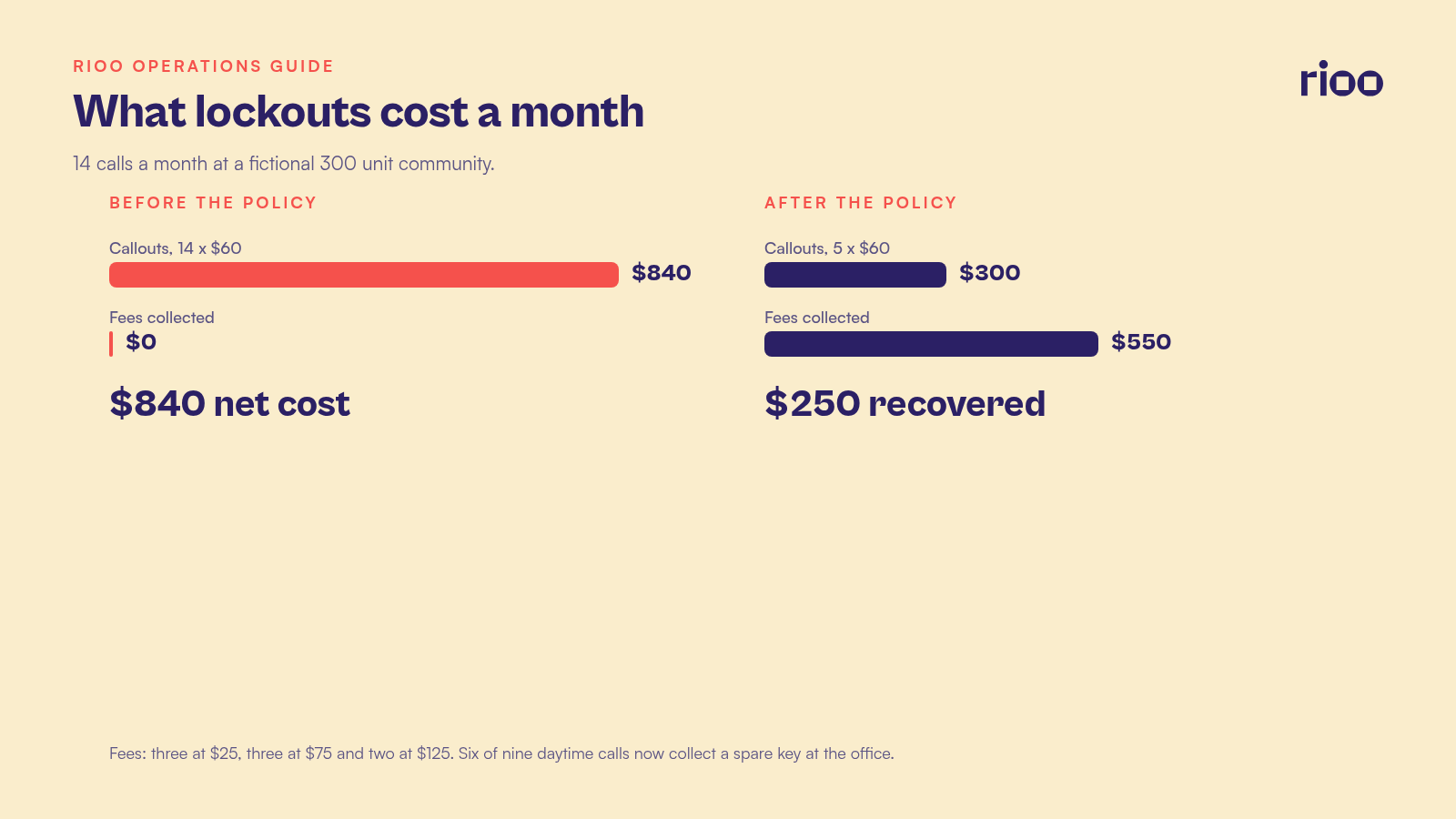
Here is a fictional example. A 300 unit community gets an average of 14 lockout calls a month. Nine are during office hours, three in the evening and two overnight. Before the policy, there were no fees and every call was handled by the on call technician.
| Line | Before the policy | After the policy |
|---|---|---|
| After hours callout cost (technician time and mileage) | 14 calls x $60 = $840 | 5 calls x $60 = $300 |
| Office hours lockouts | Technician drove out | 6 of 9 collect a spare at the office |
| Fees collected | $0 | 3 x $25 + 3 x $75 + 2 x $125 = $550 |
| Net monthly cost | $840 | $0 net, $250 recovered |
The fees alone did not make the change. Spare key pickup at the office moved six of nine daytime calls off the technician's schedule. The evening fee made residents think twice about a 10 PM call for a door the office could open at 8 AM. Repeat callers dropped from four a month to one.
Training the people who answer the call
The policy only works if the person on the phone and the person at the door follow it the same way every time. Short, practical training beats a long manual.
- Script the phone check. Name, unit, a detail from the lease such as move in month. Write it on one card.
- Role play the hard cases. A guest who is not on the lease. A former partner with a sad story. A resident with no ID on them.
- Agree the escalation. Who the technician calls when the answer is unclear. At night that should be the on call manager, not the office voicemail.
- Review the log monthly. Look for repeat callers, units with failing locks or fobs, and fees that were waived without a reason.
Repeat lockouts from one unit often point to a hardware problem, a sticking latch or a weak fob battery. Fix the hardware and the calls stop.
An accidental lockout versus a landlord lockout
Changing the locks, removing doors or cutting utilities to make a tenant leave is called a self help eviction. It is prohibited in nearly every state, and penalties can include damages and attorney fees. Your lockout policy should say plainly that staff never lock a resident out, and that removal happens only through the court process. For an example of how strict these rules are, see the Ohio self help eviction prohibition.
The same goes for a resident behind on rent who is locked out by accident. Let them in under the normal policy. Rent is a separate matter.
A lockout policy template
Copy this and adjust the hours and fees for your community.
- Who we let in: only residents named on the lease or approved occupant list, with photo ID.
- Office hours (9 AM to 6 PM): collect a spare key at the office at no charge, or a staff member opens the door for $25.
- Evenings (6 PM to 11 PM): call the after hours line. Fee $75.
- Overnight (11 PM to 7 AM): call the after hours line. Fee $125. Response within 90 minutes.
- Lost keys: we rekey at the resident's cost, on the next business day. Until then, the resident uses a spare.
- Locksmiths: residents may not change or add locks without written approval.
- No fee when a lock, fob or smart lock we provide fails.
- Staff never lock a resident out.
When a key is lost for good, follow your rekeying procedure rather than handing out another copy of the old key.
Lockouts in RIOO
In RIOO, a lockout call becomes a service request like any other, with the time, the resident, the staff member and the fee on one record. Fees post to the tenant ledger in NetSuite, so nothing is collected in cash at the door and forgotten. The occupant list the technician checks is the same one on the lease. Repeat callers and waived fees show up in the request history, which makes the monthly log review quick. See how service requests and tasks work in RIOO.
Lockout questions
Does a landlord have to let a locked out tenant in?
Many states do not set a specific rule, but the lease and good practice usually say yes, within a stated time. Refusing access for a long time can raise habitability and liability problems.
Can a landlord charge a lockout fee?
Usually yes, if the fee is in the lease and is reasonable. Some places limit fees that do not reflect actual cost.
Can a tenant call a locksmith instead?
Many leases require approval before any lock is changed or drilled. A drilled lock means a rekey at the tenant's cost.
What about smart locks and keypads?
They cut lockout calls, but they fail too. Keep a manual override, log every remote opening, and do not charge when the device is at fault.
Should one person handle overnight lockouts alone?
Where possible, no. Two staff or a staff member with security is safer, and a phone check before driving out filters out false calls.