Picture this call. The example is made up. A new resident says a stranger tried her front door at 11 p.m., and the door opened. The stranger was the last tenant's ex partner, who still had a copy of the key. Nobody had rekeyed the unit at turnover.
Rekey the locks between every tenant, before the new tenant gets keys. Rekeying swaps the pins inside a lock cylinder so old keys stop working, while the lock body stays on the door. It is cheaper than replacing locks, takes minutes per cylinder, and closes the gap that old keys, copies and lost keys leave behind. Texas makes it a legal duty within seven days of each tenant turnover. Elsewhere it is still basic practice, and it is the first thing anyone will ask about after a break in.
Rekey, replace or recode
Three options can make old access stop working. Pick by lock type and condition, not habit.
| Option | When it fits | Typical work | Watch out for |
|---|---|---|---|
| Rekey the cylinder | Lock works well and is a common brand | New pins and new keys, 10 to 20 minutes per cylinder | Master key systems need the pinning chart |
| Replace the lock | Lock is worn, damaged or a mismatched brand | New lockset, keyed to your system | Higher parts cost; keep finishes consistent |
| Change the code or credential | Keypad, smart lock or card access | Delete old codes and fobs, issue new ones | Mechanical backup keys still need rekeying |
Smart locks remove a lot of key cutting. They do not remove the step. Old codes, shared guest codes and app access all have to be revoked, and the revocation logged with a date.
The turnover rekey in seven steps
Treat the rekey as its own task in the turn, with an owner and a due date. Bundling it into "general make ready" is how it gets skipped.
Before move out
- Collect every key and credential. List what was issued at move in: unit keys, mailbox key, fobs, garage remotes. Our move out instructions letter should tell the tenant exactly what to return.
- Record what came back. Note any key not returned. A missing key does not change the plan, since you rekey anyway, but it matters for any deposit charge your lease allows.
Between tenants
- Raise the rekey work order on the day the unit is vacated, with a due date before the next move in.
- Rekey every exterior cylinder. That means the entry knob or lever, the deadbolt, and any patio, garage or side door lock. Interior closet locks can be left.
- Revoke electronic access. Delete old keypad codes, deactivate fobs and remove app users. Check shared doors such as the building entry and amenity rooms.
- Test with old and new keys. The old key must fail. The new key must turn smoothly in every cylinder.
On move in day
- Hand over and log. Record each key number and fob ID issued, and have the new tenant sign for them.
Where the work happens in the turn matters too. Our apartment make ready checklist places the rekey after painting and cleaning, so contractors are not handed the new keys.
Texas sets a seven day deadline
Texas is the clearest state rule. Under Property Code 92.156, a security device operated by a key, card or combination must be rekeyed at the landlord's expense. The deadline is the seventh day after each tenant turnover date.
The turnover date is the day a new tenant moves in after all previous occupants have moved out. So the clock starts at move in, not move out. That said, rekeying after the new tenant already holds keys means cutting a second set. Doing it during the turn is simpler.
Three more points in the Texas rules are worth knowing:
- A tenant can ask for extra rekeying at any time, at the tenant's expense, as often as they like.
- Rekeying to add or change the landlord's master key is at the landlord's expense.
- A deposit deduction for the turnover rekey needs two things. The tenant left in breach of a written lease, and the lease has an underlined or bold clause allowing it.
Outside Texas, check state and city codes before you rely on silence. Some cities set security device rules in their housing codes. Even with no rule at all, a manager who skips the rekey will struggle to explain why after a break in.
What rekeying costs at a 120 unit community
This example is fictional. It compares two ways to staff the work for one year.
A 120 unit garden community expects 48 move outs in 2027. Each unit has two exterior cylinders, a lever and a deadbolt. Two options are on the table.
| Approach | Cost per turn | Turns | Year |
|---|---|---|---|
| Outside locksmith: $65 visit plus $25 per cylinder | $115.00 | 48 | $5,520 |
| In house technician: $12 in pins and keys, 40 minutes at $32 an hour | $33.33 | 48 | $1,600 |
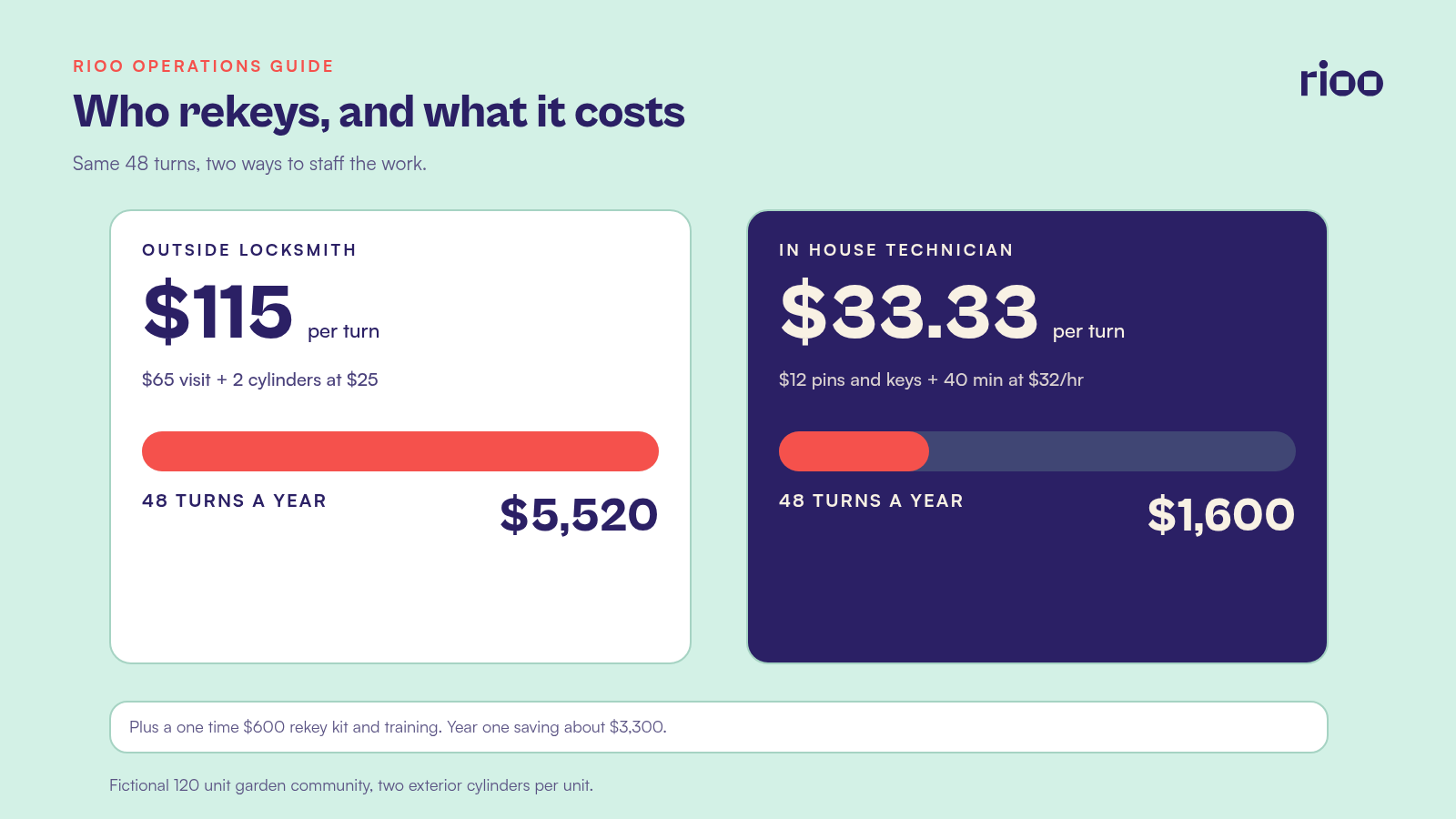
The in house route needs a rekey kit and a day of training, about $600 in this example. That still leaves roughly $3,300 saved in the first year. The community manager keeps the locksmith on call for high security deadbolts and lockouts.
Either way, the yearly cost is small next to one break in through an old key, with the repairs, the claim and possibly a resident who leaves.
Where turnover rekeys leave gaps
The front door is rarely the lock that gets missed. The usual misses are the locks nobody listed. Walk the unit and the building with this list once, then build it into the work order template.
Locks outside the unit
Mailbox locks, storage cages, garage doors and gate remotes are easy to forget. A former tenant with a working mailbox key can take a new tenant's post, including bank cards. Rekey or replace mailbox locks at the same turn, following your local postal rules for cluster boxes.
Vacancy access
During the turn, vendors and showing agents come and go. Lockbox codes get shared by text. Change any lockbox or showing code when the unit is leased. Do not leave the new tenant's keys in a box whose code half the vendor list knows.
Copies you did not cut
Tenants copy keys for cleaners, dog walkers and family. You cannot collect what you do not know about, which is why returned key counts never prove an old key is gone. The rekey is the only step that does.
When the master key is the problem
On a master keyed property, a unit rekey has to keep the master working. The technician pins the new cylinder to the chart, so keep the chart current and stored apart from the keys. If a master itself goes missing, every cylinder on that system is exposed and the job becomes a property wide rekey.
Staff changes count as well. When someone with master access leaves, decide whether the system needs rekeying and record the reason either way. Our guide to property manager turnover covers the wider handover. Sign out logs, key cabinets and audits are covered in our property management key control guide, so this post stays with the turnover rekey.
Entry with a master key is still entry. Give the notice your state and lease require, as set out in our notice of entry guide.
Rekeys as work orders in RIOO
In RIOO, turn tasks such as cleaning, repairs, keys and utilities are generated and tracked when a unit moves toward readiness. A rekey can sit in that list as its own work order with a due date before move in. Technicians close it from the mobile app, and the record stays on the unit in NetSuite. The work order management page shows how jobs are assigned and closed. The key log and the rules for your state stay in your policy.
Rekeying questions
Do landlords have to change locks between tenants?
Texas requires a rekey within seven days of each tenant turnover. Many other states have no specific statute, but rekeying is the expected standard and some city codes set rules.
Is rekeying cheaper than replacing locks?
Usually yes. Rekeying reuses the lock body and changes only the pins, so the parts cost is small. Replace a lock when it is worn, damaged or does not fit your key system.
Can I charge the old tenant for rekeying?
Generally the turnover rekey is the landlord's cost. Texas allows a deposit deduction only after a breach of a written lease and with a bold or underlined lease clause. Check your state before you charge.
How long does a rekey take?
A trained technician can usually rekey a standard cylinder in 10 to 20 minutes. Allow longer for master key systems.
Do smart locks need rekeying?
The codes and app access must be reset. If the smart lock has a mechanical key backup, that cylinder needs rekeying too.
Should I rekey when a roommate moves out but the lease continues?
It is good practice when a named occupant leaves, especially after a dispute. Agree in writing who pays. In Texas, a tenant can ask for a rekey at any time at the tenant's expense.
What records should I keep?
Keep the work order with the date completed, who did it, the cylinders rekeyed and the new key numbers. Keep the signed key receipt from move in. Together they show the rekey happened before the new tenant had access.