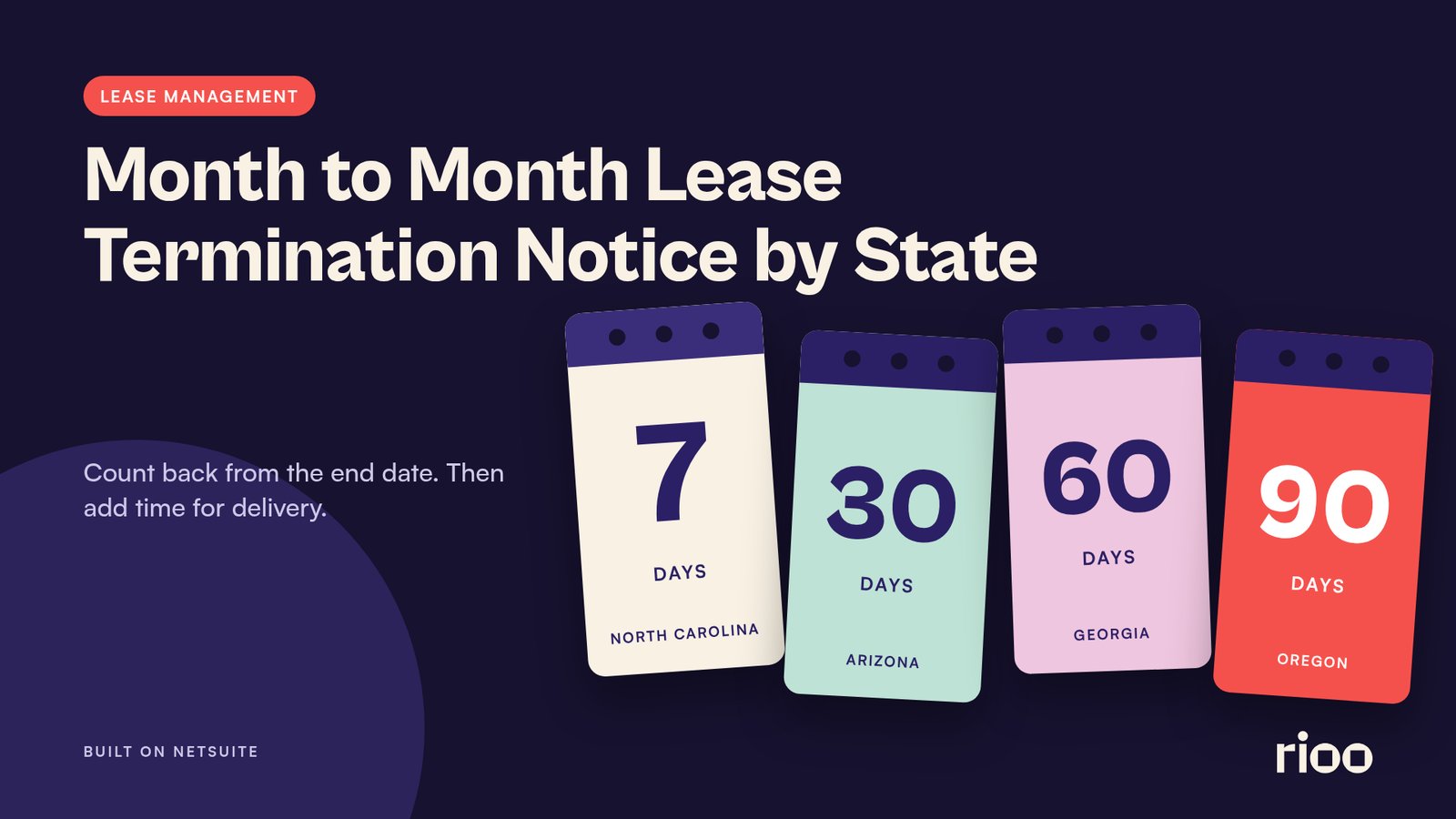
A landlord ends a month to month lease by giving the tenant written notice before the end of a rental period. State law sets the length. In the ten states below, the basic rule runs from 7 days in North Carolina to 60 days in Georgia. California, New York and Oregon ask for 60 or 90 days once a tenancy runs longer.
In some places, notice alone is no longer enough. Washington, Oregon after the first year, much of California, and New York units under the Good Cause Eviction Law all expect a reason the statute accepts. Check both questions before you send anything: how many days, and whether you need a reason.
Notice periods in ten states
The table covers the landlord's side of a residential month to month tenancy as of November 2026. Tenants usually owe a shorter or equal notice. Local rules can add to these, so treat the table as the floor and confirm with counsel before you rely on it.
| State | Landlord notice | Tenant notice | Where to read it |
|---|---|---|---|
| North Carolina | 7 days before the end of the monthly period | Same | G.S. 42-14 |
| Arizona | 30 days before the rental date named in the notice | Same | A.R.S. 33-1375(B) |
| Florida | 30 days before the end of a monthly period | Same | Fla. Stat. 83.57(3) |
| Texas | One month, unless both signed a different period | Same | Property Code 91.001 |
| Illinois | 30 days in writing | Not set by this section; leases often say 30 days | 735 ILCS 5/9-207 |
| Georgia | 60 days | 30 days | O.C.G.A. 44-7-7 |
| California | 30 days if a tenant has lived there under a year, otherwise 60 days | One rental period | Civil Code 1946.1, plus 1946.2 for just cause |
| New York | 30, 60 or 90 days, based on how long the tenant has lived there | Not set by this section; check the lease | Real Property Law 226-c |
| Oregon | 30 days in the first year; after that, a stated reason and usually 90 days | 30 days | ORS 90.427 |
| Washington | No ending without a cause listed in the statute | 20 days before the end of a period | RCW 59.18.650 |
Two rows need a second look. Texas lets the parties agree a different notice period in a signed lease, so read the lease first. Illinois sets the landlord's 30 days statewide, while Chicago adds longer periods for longer tenancies under its own ordinance. Our Chicago fair notice guide has those numbers.
Counting the days without losing a month
Pick the end date first. Then count backwards to find the last day the notice can reach the tenant. This order avoids the usual mistake, which is counting forward from the day the letter is printed.
Line the end date up with the rent cycle
Several states tie the notice to the rental period. Florida and North Carolina say the notice must come before the end of a monthly period. Arizona says 30 days before the rental date named in the notice. If rent is due on the 1st, the clean end date is the last day of a month.
Miss the cutoff by one day in those states and the tenancy usually rolls into the next full month. That costs the owner a month of delay. It also creates a muddle about whether a second notice is needed.
Allow for delivery
States set out how notice can be served, though not always in the same section. Florida's 83.57 does not name a method. Many managers follow 83.56(4), which covers other Florida notices. It allows mailing, hand delivery, or leaving a copy at the home if the tenant is away. California allows the methods in Code of Civil Procedure 1162 or certified mail. Washington requires service consistent with RCW 59.12.040.
If you mail, build in extra days and keep proof. If the case reaches court, the judge will ask when the tenant received the notice. The day you wrote it does not matter. Hand delivery with a signed receipt removes the argument.
Watch the money after notice
Accepting rent for a period after the end date can undo the notice in some states. Bill rent up to the end date only. If the end date falls in the middle of a month, prorate it. Our prorated rent guide shows the daily rate methods.
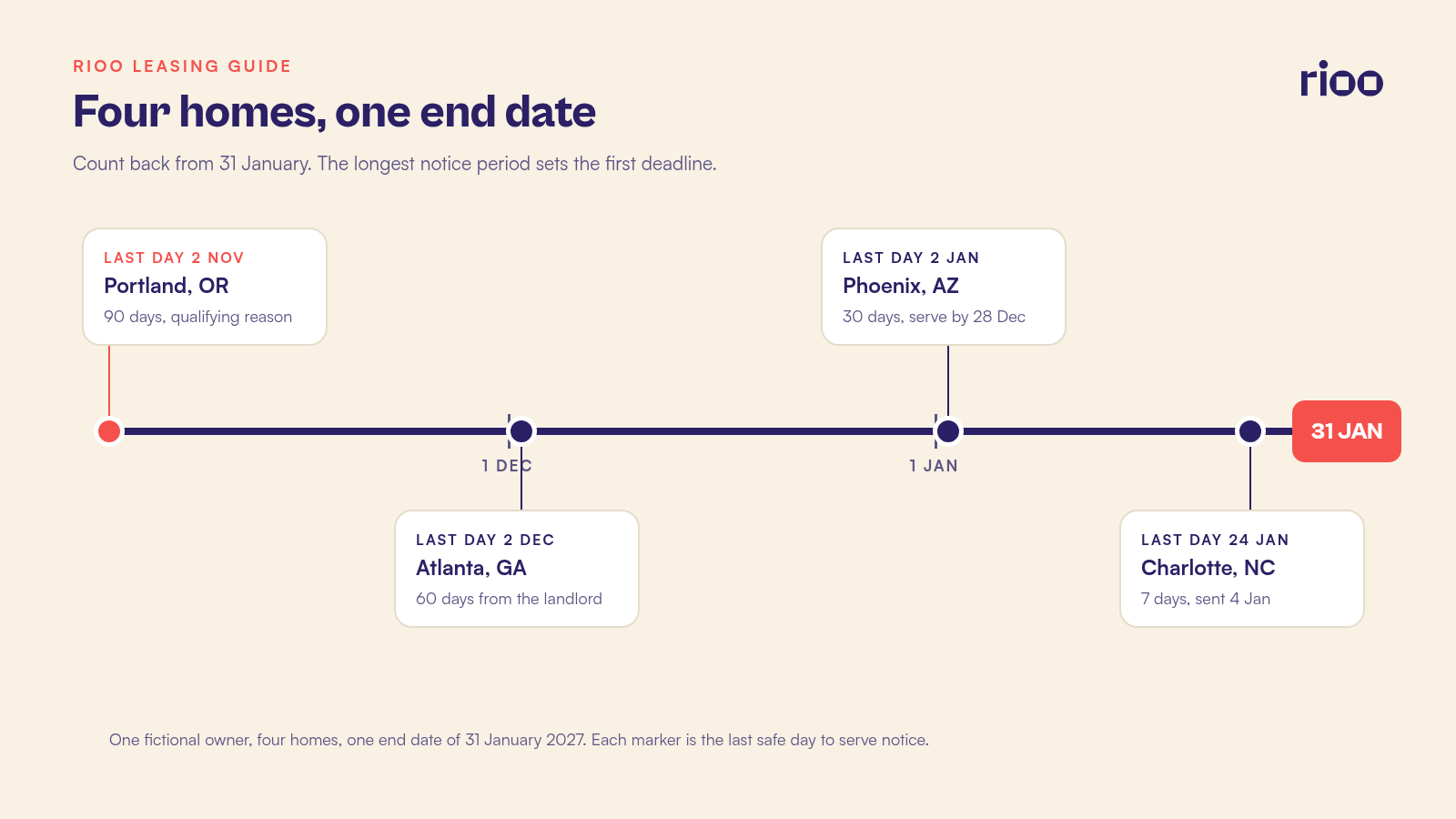
Four homes, one end date
This example is fictional. It shows how one decision turns into four different deadlines.
On Monday 2 November 2026, an owner tells her property manager she wants four single family homes empty by Sunday 31 January 2027. She plans to renovate all four and sell two. Each home is on a month to month tenancy with rent due on the 1st.
| Home | Tenant has lived there | Rule that applies | Last day for notice |
|---|---|---|---|
| Charlotte, North Carolina | 2 years | 7 days before the period ends | Sunday 24 January 2027 |
| Phoenix, Arizona | 8 months | 30 days before the 1 February rental date | Saturday 2 January 2027 |
| Atlanta, Georgia | 4 years | 60 days | Wednesday 2 December 2026 |
| Portland, Oregon | 3 years | Qualifying landlord reason, 90 days | Monday 2 November 2026 |
The Portland home sets the pace
The Oregon tenant has lived there for three years, past the first year. A no reason notice is not available. The renovation can count as a qualifying reason if the home will be unsafe or unfit to live in during the work. That reason needs at least 90 days' written notice, and the notice must state the reason and the supporting facts.
Ninety days before 31 January is 2 November. That is today. The manager drafts the notice that afternoon and hand delivers it at 5:30 p.m. with the reason and the planned work described.
There are two payment rules. Oregon law generally requires one month's rent with a qualifying reason notice, but exempts a landlord with an ownership interest in four or fewer Oregon dwelling units. This owner has one Oregon home, so the state payment does not apply.
Portland is stricter. Under City Code 30.01.085, a qualifying reason termination inside city limits triggers relocation assistance unless the city has granted an exemption. The amount runs from $2,900 for a studio to $4,500 for three bedrooms or more, and the notice must state the amount and the tenant's rights. The home has three bedrooms, so the manager budgets $4,500 and asks counsel to confirm the payment date before the notice goes out.
The other three can wait, but not for long
Georgia needs 60 days, so that notice must be delivered by 2 December. The manager schedules it for 23 November to leave room for a missed visit. Arizona's 30 days run back from the 1 February rental date, which lands on 2 January, a Saturday. The manager plans delivery for Monday 28 December instead.
North Carolina's 7 days could go out as late as 24 January. The manager sends it on 4 January anyway. Three weeks gives the family time to book movers, and a planned move is easier to hold to the date.
One call comes back. The Atlanta tenant phones on 24 November. She asks whether the family can stay through February if they keep paying rent. The manager says the owner will consider a written extension, and that the end date stands until a new agreement is signed. Nothing is promised on the phone.
When a reason is required
In these states the reason matters as much as the date. A notice without a lawful reason can fail even when the timing is right.
Washington
RCW 59.18.650 says a landlord may not end a periodic tenancy except for causes the statute lists. Those include unpaid rent after notice and a substantial lease breach that is not fixed. They also include the owner or family moving in, or the sale of a single family home, each with 90 days' notice. Each cause has its own notice period and content rules. The notice must give the facts behind the cause.
Oregon
Under ORS 90.427, a landlord can end a month to month tenancy without cause only during the first year of occupancy, with 30 days' notice. After that, the landlord needs a tenant cause or one of four qualifying landlord reasons. Two are demolition or conversion, and repairs that make the unit unfit to live in. The other two are the owner or family moving in, and a sale to a buyer who will live there.
California and New York
California's Tenant Protection Act, in Civil Code 1946.2, requires just cause for many tenancies once a tenant has lived there 12 months. Several exemptions apply, including some single family homes when the right notice was given. Check the exemption before you use the 60 day notice.
In New York, Real Property Law 226-c sets the 30, 60 or 90 day notice. Units covered by the Good Cause Eviction Law also need a lawful basis for not renewing, and the notice must say whether the unit is covered. New York City is covered, and other places can opt in.
For the full Oregon rules, see our Oregon just cause guide.
What the notice should say
Keep it short and specific. A good notice to end a month to month tenancy includes:
- The tenant names exactly as they appear on the lease, and the full address with unit number
- A plain statement that the tenancy ends, and the end date as a calendar date
- The statute or lease clause you rely on
- The reason and supporting facts, where your state requires one
- Any wording the state requires, such as California's notice about reclaiming abandoned property
- How to return keys and where to send a forwarding address for the deposit
- Your name, signature, date and contact details
Our written notice to move out guide covers the tenant's side, and the letter wording that works for both parties.
Tracking month to month tenancies in RIOO
Month to month leases are easy to lose track of. Nobody is counting down to a lease end, because there isn't one. In RIOO, each lease sits on the unit and tenant records in NetSuite, so periodic tenancies show up beside fixed term leases instead of in a side spreadsheet.
When notice goes out, the team can note the end date and delivery method on the lease and keep a copy of the notice with it. The move in to move out workflow then picks up the move out inspection, the deposit and the final statement from the same record. The state rules themselves still come from your counsel and your policies.
Questions landlords ask
How much notice do I need to end a month to month lease?
It depends on the state. North Carolina needs 7 days. Arizona, Florida and Illinois need 30, and Georgia needs 60. New York and California scale it to how long the tenant has lived there. Check local ordinances too.
Can I end a month to month lease without giving a reason?
In many states, yes. Washington does not allow it. Oregon allows it only in the first year. California and New York require a reason for many covered units.
Does the notice have to end on the last day of the month?
In states that tie notice to the rental period, such as Florida, North Carolina and Arizona, the end date should match the end of a period. Elsewhere it is still the cleanest choice for rent and proration.
Can I raise the rent instead of ending the tenancy?
Usually yes, with written notice. In Georgia, a rent change for a tenant at will generally needs the same 60 days' notice as ending the tenancy. Rent control and good cause rules can cap the increase.
What if the tenant stays after the end date?
The tenant becomes a holdover, and you file for possession through the court process. Never change locks or remove belongings yourself. Arizona, for example, allows extra damages only when the holdover is wilful and not in good faith.