"We paid for it, so it leaves with us." Landlords hear this in the last month of a lease, usually about walls, plumbing or cabinetry. For anything attached to the building, the lease and state fixture law often point the other way.
Leasehold improvements paid by the tenant are used by the tenant during the lease and are often carried on the tenant's own books. When the lease ends, work attached to the building generally stays with it, unless the lease says the tenant must remove it. Trade fixtures, the equipment a tenant uses to run its business, can usually come out before the lease ends. The alterations and surrender clauses decide everything in between, so read them first.
Stays, goes or the landlord decides
Sort every item of tenant work into one of three outcomes. The table shows the usual answer and what to check before you rely on it. Fixture law differs from state to state, so confirm the position with counsel when the lease is silent.
| Type of work | Usual outcome at lease end | What to check |
|---|---|---|
| Trade fixtures: chairs, shelving, ovens, salon stations, free standing equipment | Tenant removes them before the lease ends and repairs any damage | Removal deadline, and whether anything left after it counts as abandoned |
| Attached improvements: walls, doors, ceilings, lighting, plumbing runs, ductwork | Stay with the building | Whether the lease lets the landlord require removal |
| Specialty alterations: vaults, lead shielding, kitchen hoods, raised floors | Landlord often chooses to keep them or have them removed | The notice the landlord must give, and by what date |
| Cabling and signage | Often removed, with holes and walls repaired | The restoration standard the lease sets |
The table is a starting point. A well written lease overrides it. When the tenant spent its own money, the tenant will read every word of those clauses at the end, so the landlord should too.
Year ten of a dental suite
This example is fictional. It shows how the clauses play out with real dates and money.
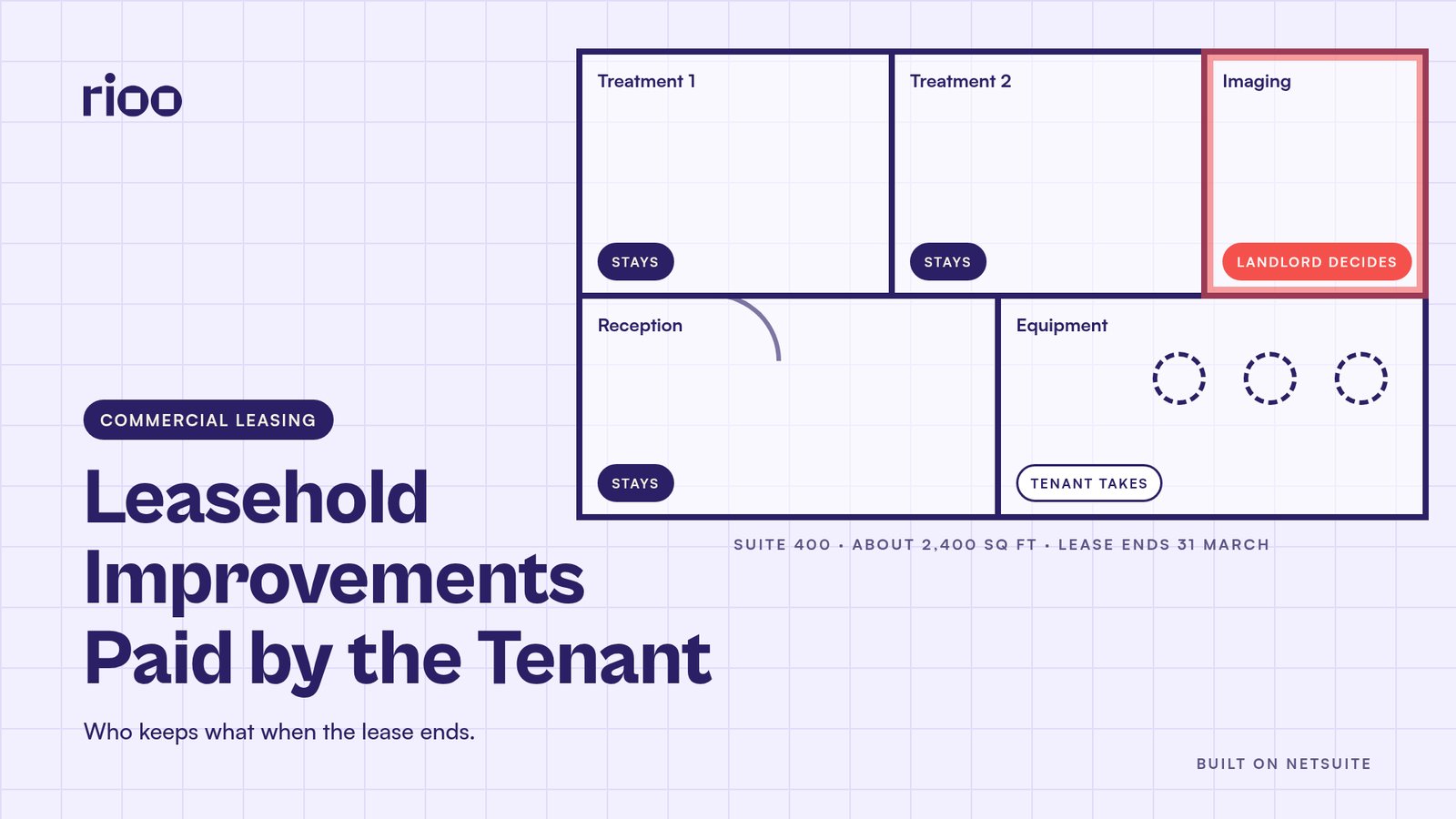
A dental practice leased Suite 400, about 2,400 square feet in a three storey medical office building, from 1 April 2016 to 31 March 2026. The landlord gave no improvement allowance. The practice paid for its own build out in the first months of the lease.
What the tenant built
| Item | Tenant cost, 2016 | Category under the lease |
|---|---|---|
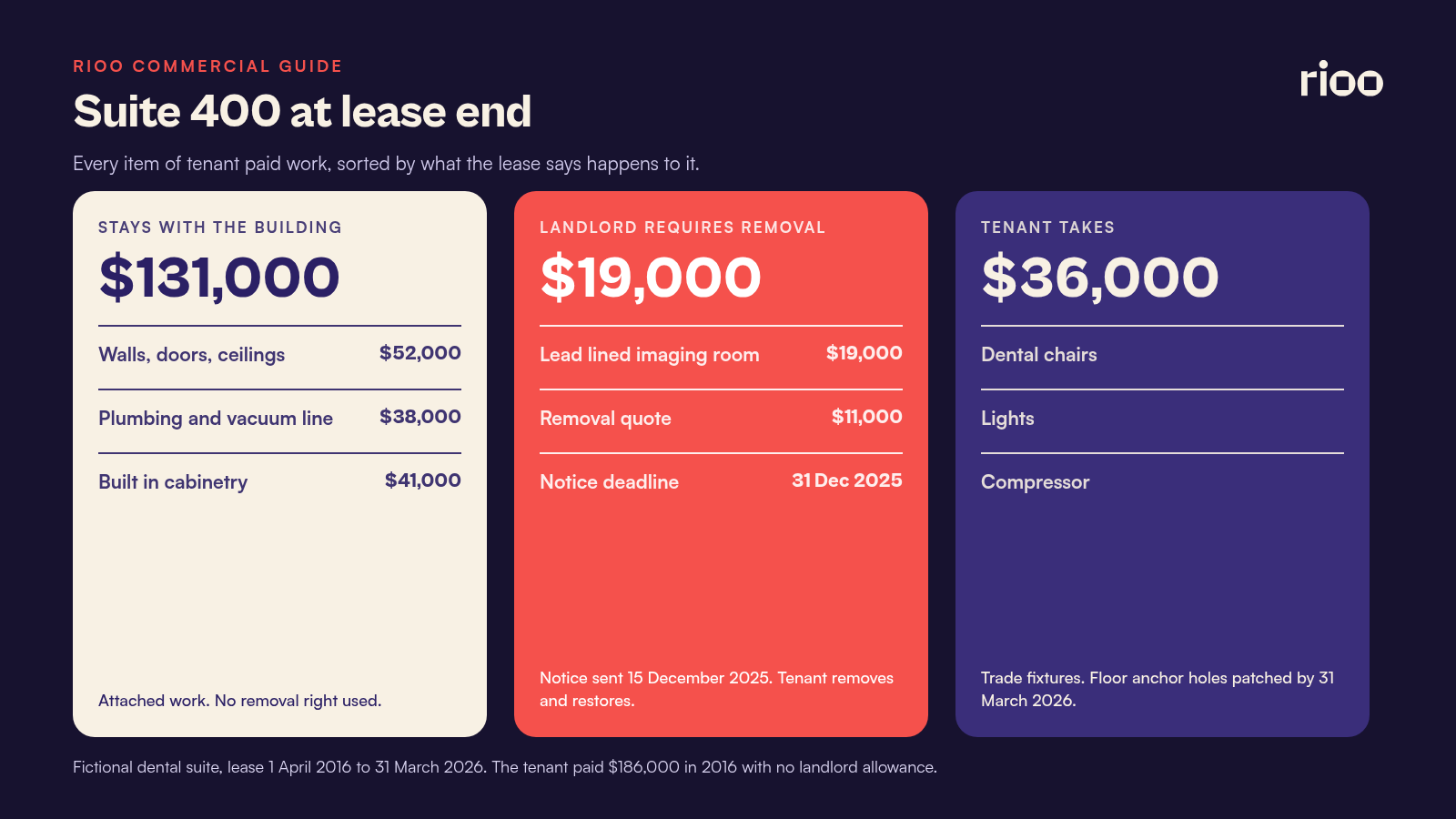
| Interior walls, doors and ceilings | $52,000 | Alteration, stays |
| Plumbing to each treatment room and a vacuum line | $38,000 | Alteration, stays |
| Built in cabinetry | $41,000 | Alteration, stays |
| Lead lined walls for the imaging room | $19,000 | Specialty alteration, landlord's choice |
| Dental chairs, lights and a compressor | $36,000 | Trade fixtures, tenant removes |
| Total | $186,000 |
The lease says the landlord may require removal of any specialty alteration by written notice at least 90 days before the lease ends. For a 31 March 2026 expiry, the last day for that notice is 31 December 2025.
The landlord's call
In November 2025 the asset manager walks the suite with a leasing broker. The likely next tenant is a physical therapy clinic. It would keep the walls and the sinks. It has no use for a shielded imaging room, and the lead lining makes that room hard to reuse.
The removal quote for the lead lined walls is $11,000. If the landlord waits and does it after the lease ends, the landlord pays. So on Monday 15 December 2025, the landlord sends notice requiring the tenant to remove the lead shielding and restore that room to plain drywall. Everything else in the "stays" rows remains with the building.
The tenant's office manager calls a week later. "We spent $186,000 in there. Can we at least take the cabinets?" The property manager reads her the alterations clause. The cabinets are built in, so they stay. The chairs, lights and compressor are hers to take, as long as the floor anchor holes are patched by 31 March.
Clauses that settle it before the work starts
The time to decide is before the tenant's contractor starts. An alterations clause that answers these points saves an argument ten years later.
- Consent and plans. The tenant needs written approval of drawings before work begins. Small cosmetic work can be exempt up to a stated cost.
- Contractors and insurance. Licensed contractors, certificates of insurance naming the landlord, and permits in hand.
- Lien protection. Lien waivers from each contractor with every payment, and a duty on the tenant to clear any lien filed against the building.
- Ownership. A plain statement that attached improvements become part of the building at the end of the lease.
- The removal election. Which items the landlord may require the tenant to remove, and the notice date. Many landlords make the election when they approve the plans, so nobody is surprised later.
- The restoration standard. What the room must look like after removal: patched, painted, ceiling tiles replaced, outlets made safe.
- Abandoned property. What happens to trade fixtures left behind after the removal deadline.
- As built drawings. A copy of final drawings and warranties when the work is done.
Removal at lease end ties into the wider exit. Our guide to lease end dilapidations covers the inspection and cost recovery side.
On the landlord's books during the lease
Start with one question: whose asset is the improvement? The answer drives everything else. Under ASC 842, the facts of the lease decide it, including whether the lease requires the work and whether the tenant can remove it.
When the improvement is the tenant's asset, the landlord usually records nothing for it during the lease. The tenant capitalizes the cost and spreads it over the shorter of the useful life and the lease term. In the dental suite, the practice wrote its $150,000 of attached work and shielding down over the ten year term. The landlord's ledger shows rent and nothing else.
When the improvement is the landlord's asset, the picture changes. Payments the tenant makes for work the landlord will own are generally treated as lease payments. The landlord then accounts for them with the rent over the lease term. A common case is a lease that requires the tenant to build something general purpose, such as a new roof section or a central plant. The landlord would use that work with any tenant.
The facts differ deal by deal, so agree the treatment with your auditor when the lease is signed. If the landlord funds part of the work with an allowance, that money has its own rules. Our guide to tenant improvement allowance accounting covers how to record and amortize it.
The tax line at lease end
Under federal income tax law, a landlord generally does not count the value of tenant improvements it keeps as income when the lease ends. Section 109 of the Internal Revenue Code excludes that value from gross income, other than rent.
There is a catch on the other side. Under Section 1019, the landlord's tax basis does not go up for that excluded value. The dental suite's walls, plumbing and cabinetry stay in the building, but the landlord has no basis in them to depreciate.
The exclusion does not apply when the improvements are really rent paid in kind. The Treasury regulation under Section 109 says the exclusion stops to the extent the work stands in for lease rentals. A lease that gives a low rent in exchange for a building the tenant must leave behind needs a tax adviser's review. State tax rules can differ, so confirm the position for each property.
Keeping the improvement file in RIOO
RIOO keeps the lease and the money on one NetSuite system of record. That suits tenant improvement work, where a decision made in 2016 has to be found again in 2026.
In RIOO's commercial lease administration, critical dates, options and abstracts sit on the lease. The removal election date can be one of them, with a reminder well before it falls due. Certificates such as the contractor's insurance can be tracked with their expiry dates. When the landlord does own an improvement, RIOO works with NetSuite Fixed Asset Management, so the improvement can be tracked as an asset with its own depreciation.
Questions landlords and tenants ask
Can a tenant take improvements it paid for?
Trade fixtures, yes, usually before the lease ends. Attached improvements generally stay with the building unless the lease lets the tenant remove them. The lease wins over the general rule, so read the alterations and surrender clauses.
Can the landlord make the tenant remove improvements it approved?
Yes, if the lease gives the landlord that right and the landlord follows its notice terms. Approving the plans usually leaves that right in place, though some leases waive it for approved work. Check the clause.
Does the landlord owe the tenant anything for improvements left behind?
Usually not, unless the lease or a separate agreement says so. Some leases give a credit or buyout for specific items. Without one, the work simply stays with the building.
Is a tenant paid improvement taxable to the landlord?
Under Section 109, the value at lease end is generally excluded from the landlord's income, unless the work stands in for rent. Ask a tax adviser about the details for your lease.
What if the tenant leaves early?
The same clauses apply at an early termination or a default. Set the removal notice date from the actual end date, and check that the termination agreement covers improvements and fixtures in writing.
An improvement register you can copy
Keep one row per item of tenant work, opened when the plans are approved and closed when the lease ends.
| Field | Dental suite example |
|---|---|
| Item and location | Lead lined walls, imaging room, Suite 400 |
| Paid by and amount | Tenant, $19,000 |
| Date approved and completed | 20 February 2016; 28 April 2016 |
| Lease category | Specialty alteration |
| Whose asset on the books | Tenant |
| Removal election deadline | 31 December 2025 |
| Decision and date sent | Remove and restore, notice sent 15 December 2025 |
| Restoration standard | Plain drywall, painted, ceiling tiles replaced |
| Closed out | Inspection after 31 March 2026, photos on file |
For the build out stage itself, with draws and lien waivers, see our tenant improvement build out guide.