Set a waterfront vacation rental's nightly rate from the five or six listings a guest would compare it with. Weight homes with the same kind of water access above the rest, then adjust for what yours adds or lacks. Charge more on weekends and in peak weeks, use minimum stays to protect those nights, and show guests the total price with every mandatory fee included.
Guests book a lake house for the water, so start with how they get to it. A cabin with its own dock and a cabin across the road with a lake view sell to different guests at different prices, even with the same bedrooms. Bedroom count comes second.
Which listings should you compare against?
Compare against homes a guest would put side by side with yours for the same dates. Pull them from the listing sites your guests use, for the exact nights you are pricing, and write down the rate each one shows for a weeknight.
Sort by water access first
Group every listing by how a guest gets to the water. Four groups cover nearly every lake or beach market.
- Frontage with a private dock or beach. Guests walk from the deck to the water.
- Frontage without a dock. The yard reaches the shore, but launching a kayak means wading in.
- Water view. The lake is visible, often across a road, and access is somewhere else.
- Shared access. A community beach or boat launch a short walk away.
Your real comparables come from your own group. The other groups are still useful. They tell you what the water itself is worth in your market.
Then match size and season
Within the group, keep homes that sleep within two guests of yours and have the same number of bedrooms. Drop anything much newer or much larger. A five bedroom house with a hot tub tells you little about a three bedroom cabin.
Check the comparables for the same week you are pricing. A lake in the north woods and a Gulf beach peak in different months. Rates taken in February for a July stay may also be old by May.
What does the water add, and what does it cost you?
Water access adds nights guests will pay more for, and it adds costs a house in town does not have. You need both sides before you pick a number.
On the income side, look at what guests can do from the property. A dock, a swim area, kayaks or paddleboards, a fire pit at the shore and a west facing view at sunset all show up in reviews. List what you offer next to each comparable so you can see which ones you beat.
On the cost side, waterfront homes carry extra lines. Insurance may need to cover the dock and any watercraft you provide. Docks and boat lifts go in each spring and come out each fall in cold climates. Life jackets wear out. Shoreline and erosion work is expensive when it comes. These costs belong in your floor, which we come to below.
How do you set the base weeknight rate?
Take the median weeknight rate of your true comparables, then move up or down for the differences that guests notice. Use the median, so one overpriced listing does not pull you up.
Adjust for reviews, the kitchen, the beds, the dock and the view. Keep each adjustment small and write down why you made it. When you review the rate later, you will know which assumption to test.
Know your floor before you choose
Your floor is the average rate you need across the season to cover the house. Add up a year of fixed costs, leave out the mortgage, and divide by the nights you expect to book. If the season average drops below that line, the house is losing money on operations. Single slow nights can sit below it. The season as a whole should not.
How much more for weekends, holidays and peak weeks?
Set three or four price tiers and give each night one of them. Tiers are easier to manage than a separate price for every night, and easier to explain to an owner.
- Base: Sunday to Thursday nights in the main season.
- Weekend: Friday and Saturday nights in the main season.
- Holiday: long weekends and local events, such as a regatta or a fireworks night over the water.
- Shoulder: the weeks before and after the season, when the water is cold but the views are still there.
Set the weekend and holiday premiums from your comparables. Look at what the same homes charge on a Saturday against a Tuesday, and let your own market set the size of the gap.
Minimum stays protect the expensive nights
A one night booking on a peak Saturday can block a three night stay that was worth far more. In the main season, ask for at least three nights over weekends. Over a holiday, ask for the whole holiday. In the shoulder weeks, two nights is usually enough.
Minimum stays also leave gaps. A free Tuesday and Wednesday between two bookings will rarely sell at a three night minimum. Lower the minimum for those nights, and consider a lower rate too.
What does this look like for one lake house in July?
Here is a worked example. The house and every figure in it are fictional, chosen to show the method. They are not market rates for any lake.
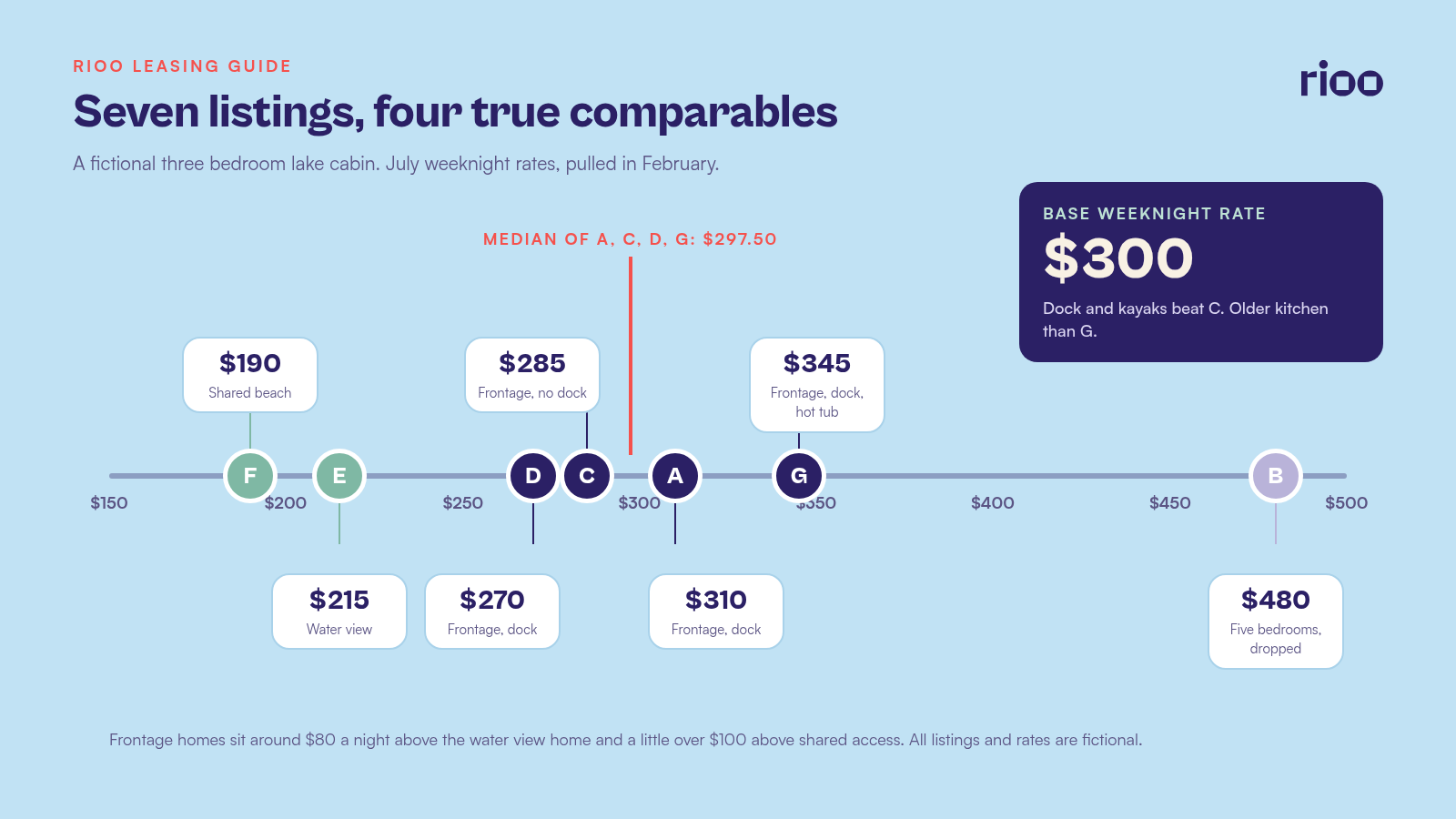
Heron Point is a three bedroom cabin on a lake in the upper Midwest. It sleeps eight, has a private dock and two kayaks, and holds a 4.8 rating. Its manager is setting July 2027 rates in February. She pulls seven listings for a Tuesday in mid July.
| Listing | Water access | Bedrooms | July weeknight | Use |
|---|---|---|---|---|
| A | Frontage, private dock | 3 | $310 | Comparable |
| B | Frontage, private dock | 5 | $480 | Too large, dropped |
| C | Frontage, no dock | 3 | $285 | Comparable |
| D | Frontage, private dock | 3 | $270 | Comparable |
| E | Water view across the road | 3 | $215 | Reference |
| F | Shared beach, five minute walk | 3 | $190 | Reference |
| G | Frontage, private dock, hot tub | 3 | $345 | Comparable |
The four true comparables are $270, $285, $310 and $345. The median sits halfway between the middle two, at $297.50. Heron Point has a dock and kayaks, which beats C. Its kitchen is older than G's. She sets the base weeknight rate at $300.
The reference listings show what the water is worth here. Frontage homes sit around $80 a night above the water view home and a little over $100 above shared access. That gap is why she does not lower her rate to match E, even though E has better photos.
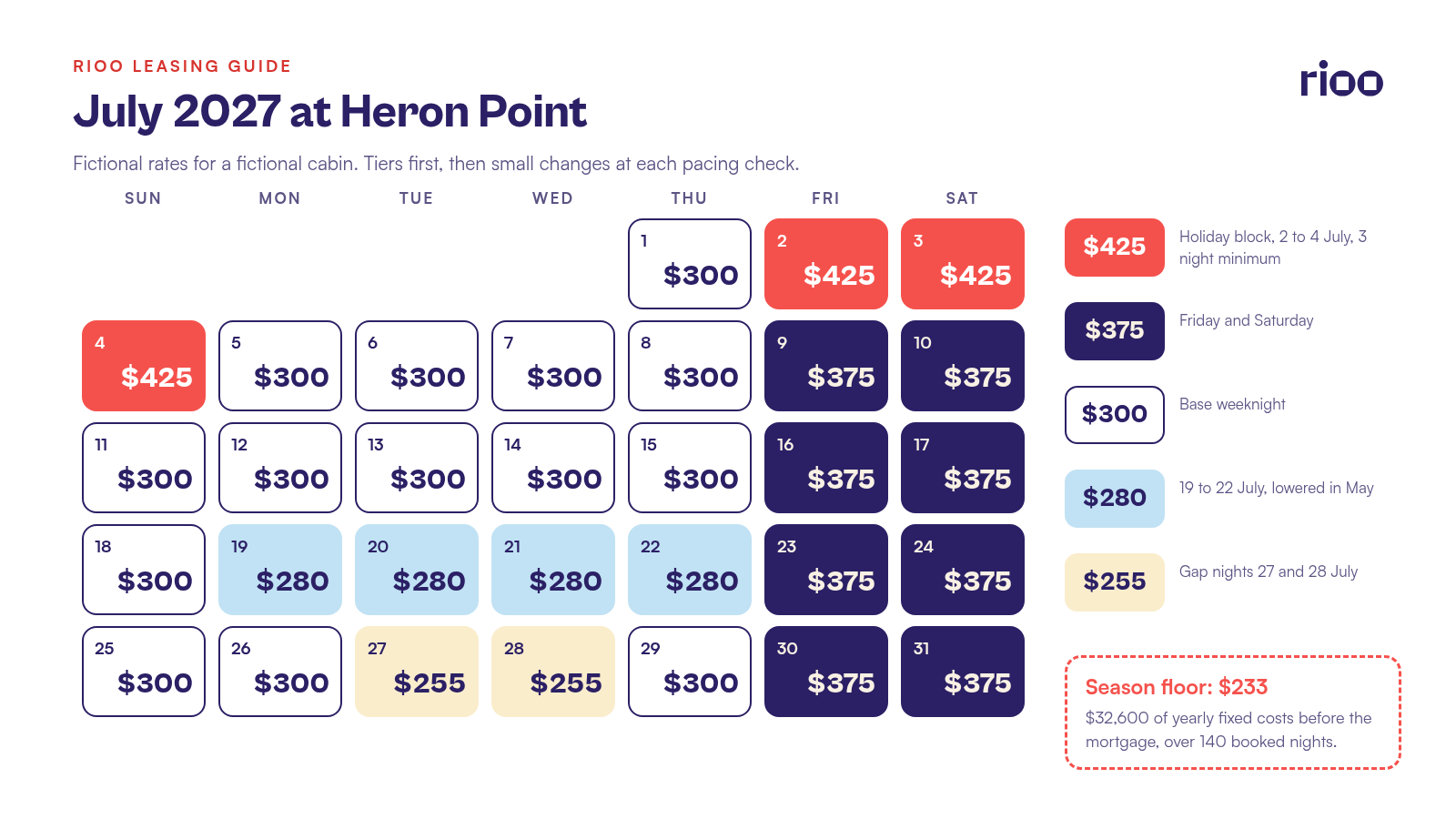
Next come the tiers. Weekend nights are $375, which is the base plus a quarter. In her comparable set, Saturday rates run 20 to 30 percent above Tuesday rates, so that sits in their range. The Fourth of July falls on a Sunday in 2027. She treats Friday 2 July to Sunday 4 July as the holiday block at $425 a night, with a three night minimum.
Then the floor. Her yearly fixed costs, before the mortgage, come to $32,600. That covers property tax, insurance including the dock, utilities and internet, putting the dock in and taking it out, upkeep and a repair reserve. She expects 140 booked nights. The floor is $32,600 divided by 140, or about $233 a night across the season.
A guest who books Thursday 15 July to Sunday 18 July stays three nights. That is $300 for Thursday and $375 each for Friday and Saturday, so $1,050 in rent. The cleaning fee is $210, which every guest must pay. The total price before taxes is $1,260, or $420 a night.
Should the cleaning fee be inside the nightly rate?
You can keep a separate cleaning fee, but the price guests see must include it. Since 12 May 2025, a federal rule on unfair or deceptive fees has covered short term lodging, including vacation rentals.
Under 16 CFR Part 464, any advertised price must come with the total price, shown more prominently than other pricing information. The total includes every mandatory fee. Taxes and other government charges, and optional extras the guest can decline, may be left out. Those excluded amounts must still be disclosed before the guest pays.
For a lake house, that means a mandatory dock fee or lake access fee belongs in the total. A pontoon rental the guest can say no to does not. Some states add their own rules. Our guides to vacation rental fee transparency and rental fee laws by state cover the detail. If you are unsure whether a charge counts as mandatory, the guide to classifying mandatory and optional fees walks through it.
Price with the total in mind. Heron Point's guest compares $420 a night against the other homes' totals, and that is the number that decides the booking.
When should you change the price?
Check how fast each month is filling against the same point last year, at fixed dates. Ninety, sixty, thirty and fourteen days out work well for a summer lake market.
In early May, about 60 days before July, Heron Point has 17 of 31 July nights booked. Last year at the same point it had 23. The weekends are full. The gaps are all Sunday to Thursday nights.
So she leaves the weekend rate alone. She cuts the July weeknight minimum to two nights and lowers 19 to 22 July to $280. A Tuesday and Wednesday gap on 27 and 28 July goes to $255 with a two night minimum. Each change is small, and each one is written down with the date and the reason.
Questions to ask at each check
- Which nights are empty, and are they weekend or weekday nights?
- Did a comparable drop its rate, or sell out?
- Is the season average still above the floor?
- Did a review mention something that changes what the house is worth?
What do owners ask about lake and beach rates?
How much more can I charge for waterfront than for a water view?
Your comparables answer that for your market. Price a frontage home, a view home and a shared access home of the same size for the same night, and the gaps show you. Avoid copying a percentage from another market.
Should I lower the rate when the water is cold?
Move those weeks to a shoulder tier and shorten the minimum stay. Guests still book for the quiet, the views and the fall colour. Fewer of them will pay a July rate for it.
Can I charge more for the dock or the boats?
Yes, either inside the nightly rate or as an optional extra. If every guest must pay it, it is mandatory and belongs in the total price you show.
How often should I recheck my comparables?
Once before the season and at each pacing check. Listings change rates, sell out and drop off the market, and a stale comparable set leads to stale prices.
Is the floor the lowest price I can ever accept?
The floor applies to the season average. A slow Tuesday at a lower rate still helps if the alternative is an empty night.
Where RIOO fits
The pricing method in this guide runs in your listing and booking tools. RIOO sits behind them, in the books. RIOO is built natively on Oracle NetSuite, so income and operating costs post by property and by portfolio.
That matters for the floor in this method. Dock service, insurance, utilities and repairs are recorded against the property as they happen. Budget against actual by property shows whether the season average is clearing the line. Owners who also hold long term rentals see every property in the same ledger, and our monthly owner statement guide shows what that report should hold.