A rental turnover needs one rule for utilities. Every service at the unit should have a named account holder on every day of the year. While the lease runs, that is usually the tenant. From the day after the lease ends until the next tenant takes over, it is the owner or the management company. Gaps happen when nobody owns a date.
Utility transfer in a turnover means three handoffs. The outgoing tenant keeps service through the last day of the lease. The owner's account starts the next day, set up when notice arrives rather than after the keys come back. The incoming tenant opens accounts in their own name and shows proof before keys are handed over. Meter readings with photos mark each handoff, so each bill lands with the right person.
A January gap in Minneapolis
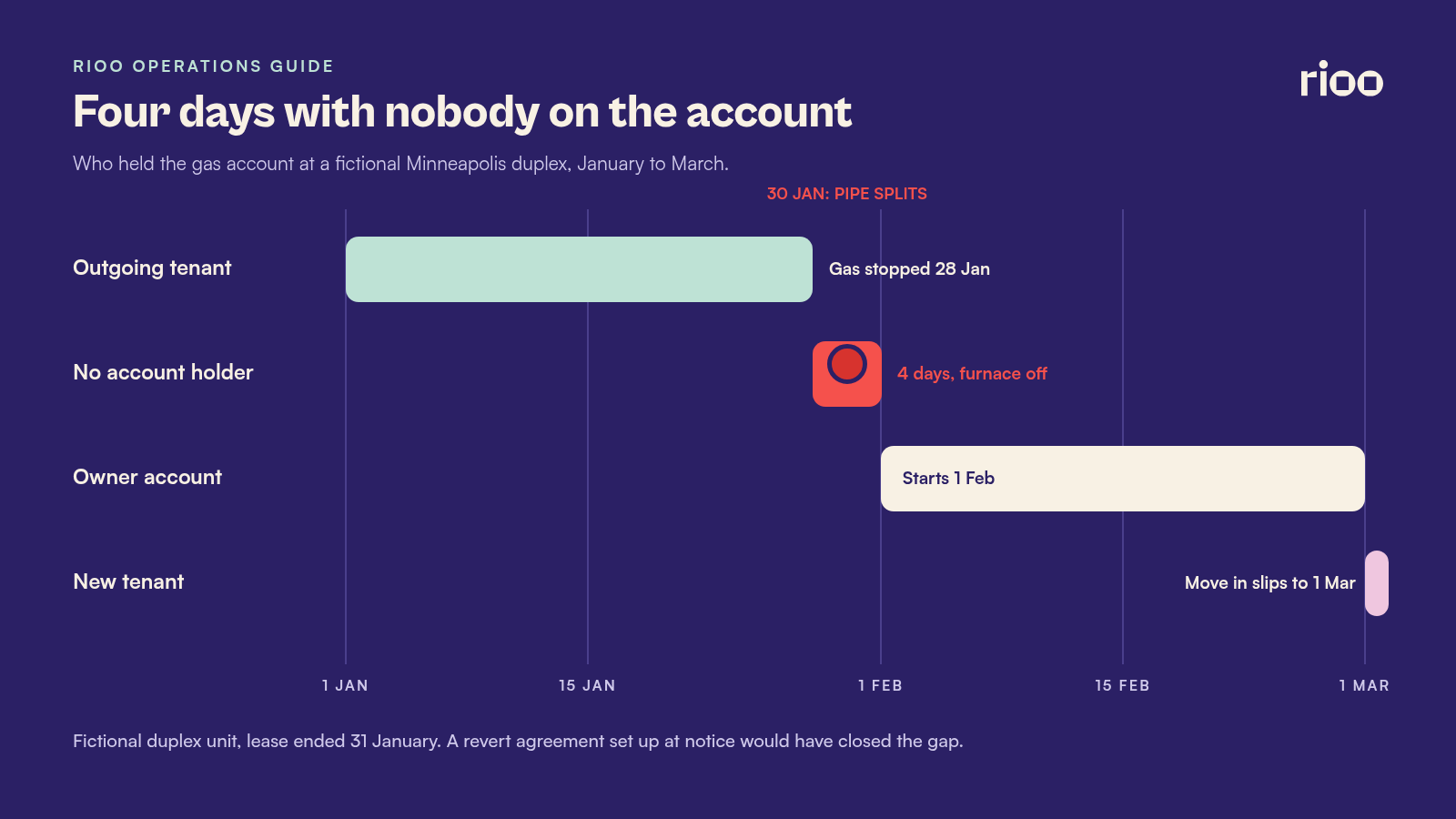
Here is a fictional example of what a gap costs. A tenant in the upper unit of a duplex has a lease ending on 31 January. Rent is $1,450. She finishes packing early and calls the gas company on 28 January to stop service that day. Nobody has set up an owner account to start, because the manager planned to do it after the walkthrough on 1 February.
The furnace stops on 28 January. Overnight lows that week reach about 8°F below zero. On 30 January a pipe in an outside wall freezes and splits. The walkthrough on 1 February finds water through the kitchen ceiling of the lower unit.
The repair, drying and drywall come to $7,400. The new tenant was due to move in on 15 February. The move in slips to 1 March, so half a month of rent, $725, is lost. The owner's insurer may cover part of the damage. The deductible, the lost rent and a tense call with the downstairs tenant land on the owner anyway.
The manager's checklist had the right steps. They were just in the wrong week. Notice had arrived in December. Had the manager signed the gas company's landlord revert agreement that week, service would have moved to the owner the moment the tenant stopped it on 28 January. A line in the move out letter asking her to keep gas on through 31 January might have prevented the early stop altogether. Either way, the heat stays on for a few dollars a day.
Who holds each account
Your lease and local rules decide which services the tenant pays. List every service for each unit once, then use the list at every turnover.
| Service | During the lease | Vacant days | New lease |
|---|---|---|---|
| Electric | Tenant, if separately metered | Owner account, from the day after lease end | New tenant, from the lease start date |
| Gas or heating oil | Tenant or owner, per the lease | Owner, heat kept on | New tenant, if the lease says so |
| Water and sewer | Often the owner, or billed back | Owner | Owner or tenant, per the lease |
| Trash and recycling | Often the owner | Owner | Per the lease |
| Internet and cable | Tenant | Nobody needed | New tenant |
Water deserves extra care. In some cities, an unpaid water bill can become a lien on the property, whoever ran it up. Keep water in the owner's name, or check each final bill before you close the file.
When notice arrives
This is the step that matters. Do the utility work the week notice comes in. Waiting until the tenant leaves is how gaps start.
Book the owner's start date
Call or log in to each provider and set the owner account to start on the day after the lease ends. If the lease ends 31 January, the owner's start date is 1 February. Many electric and gas companies offer a landlord revert agreement. Under one, service switches to the owner automatically when a tenant stops it. Sign up for it where it exists. Then still confirm the date for each move out, because revert programs have their own rules.
Tell the tenant in writing
Put the rule in the move out letter. The tenant keeps every service in their name through the last day of the lease, even if they hand in keys early. Our guide to the move out instructions letter shows where this line fits with the other steps. A short version works:
"Please keep electric and gas in your name until 31 January, the last day of your lease. We have arranged for service to move to the owner on 1 February. Please do not ask the provider to stop service earlier."
Running it across many units
One turnover is easy to remember. Thirty in a busy summer are not. Once a month, pull every lease ending in the next 60 days. For each unit, mark which services need an owner start date and whether each one is booked. A unit with notice in hand and no booked date goes to the top of the list.
Say a 120 unit portfolio has 11 leases ending in July. Eight units are on providers with a revert agreement, so the manager confirms those eight online in under an hour. The other three need calls. Booking all eleven before 1 July costs a morning. Missing one can cost a frozen pipe in winter or a dark unit on a showing day in summer.
The week before move out
Call the tenant or send a reminder. Ask which day they have told each provider to stop service. If they give a date before the lease end, ask them to change it. Note the answer in the unit file.
Book the turnover vendors at the same time. Cleaners, painters and the make ready crew all need power and water. Our make ready checklist lays out the order of work once the unit is empty.
Move out day and the readings
At the walkthrough, photograph every meter with the date showing, along with the meter number. Write the readings on the inspection form. These readings settle any later argument about who used what.
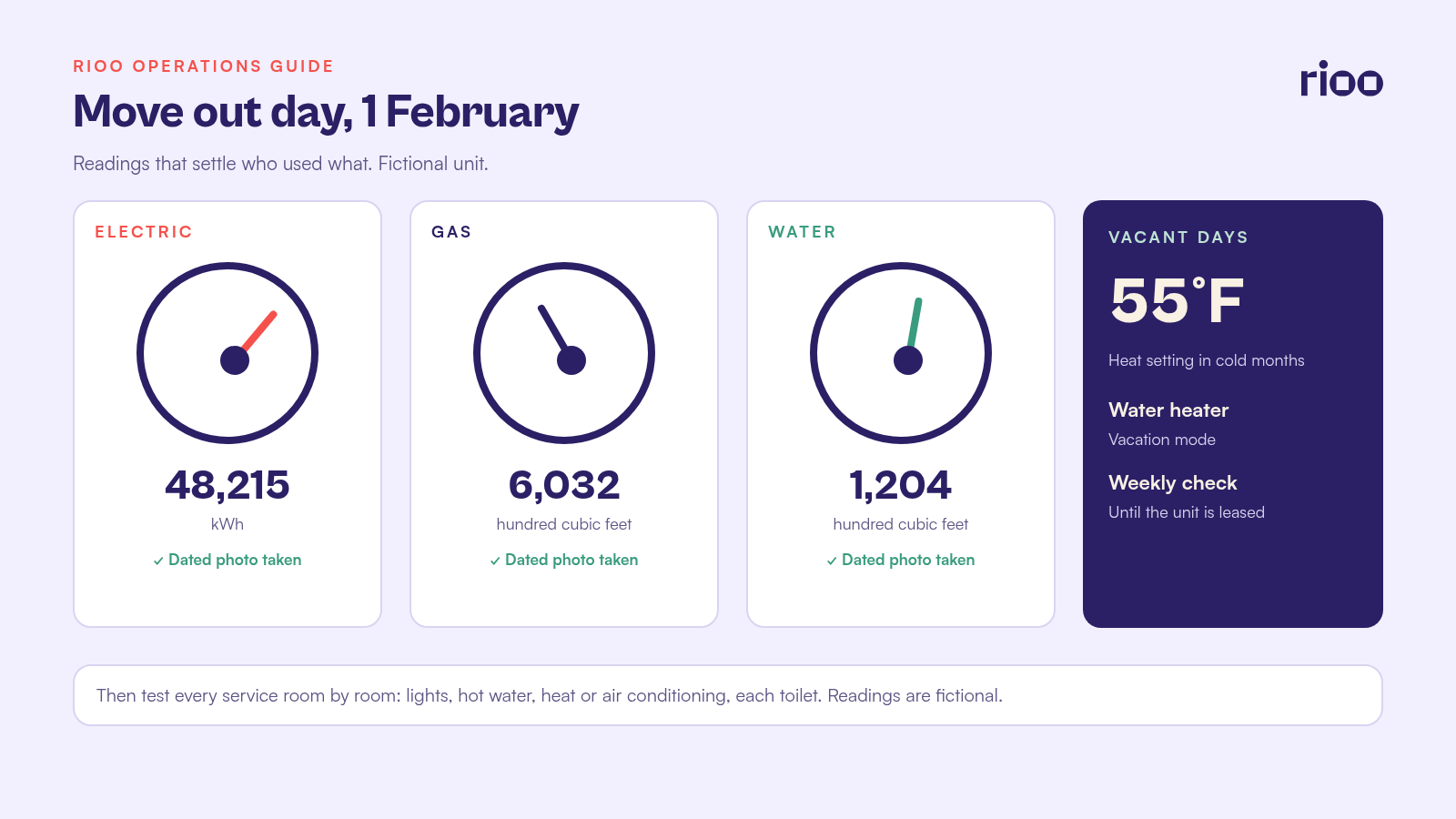
Then test each service room by room. Turn on the lights, run hot water, start the heat or air conditioning and flush each toilet. If a service is off, find out now, while there is still time to fix it.
The vacant days
Keep the unit safe and cheap to run while it is empty. In cold months, set the heat to about 55°F. Put the water heater on vacation mode if it has one. Shut off the water supply to the washer if the unit has a hookup. Check the unit each week until it is leased. Our guide to landlord heat requirements covers the temperatures owed to tenants in occupied units.
Bills for the vacant days go to the owner. Code them to the unit and the turnover, so the owner statement shows what the vacancy really cost.
Never shut off or let utilities lapse to push a tenant out. Shutting off a tenant's utilities to force a move is illegal in many states, and it is never part of a normal turnover.
From lease signing to keys
Send the new tenant a list of providers the day the lease is signed. Include the service address exactly as each provider writes it, and the date the tenant's account must start. The tenant welcome packet is a good home for this list.
Ask for proof before keys. A confirmation number or a screenshot of the new account is enough. If the new tenant has not opened an account by move in day, keep the owner account running and set a follow up for 48 hours later. Then end the owner account on the date the new tenant's account starts, and record it in the unit file.
Disputes still happen. A tenant may question a final bill, or a bill may arrive for days the owner held the account. Our utility billing dispute workflow explains how to work through them with the readings in hand.
Utility handoffs in RIOO
RIOO is property management software built natively on Oracle NetSuite. Move outs in RIOO run from the lease record. Readiness tasks, inspections, deductions and final statements sit in one flow, as the move in and move out page describes. Each step is a tracked task on the unit and the lease. A team can add an owner start date for each utility as a task the day the departure notice is recorded. Meter data sits in the unit's asset history, and the vacant day bills land as costs by property, unit and vendor. For properties that bill utilities back to tenants, RIOO also covers meter reads, submetering and RUBS recharges.
Turnover questions
When should utilities be transferred to the landlord after a tenant moves out?
On the day after the lease ends. Book that start date with each provider when the tenant gives notice. A landlord revert agreement, where a provider offers one, helps cover a tenant who stops service early.
Who pays utilities while a rental is vacant?
The owner, in almost every case. The manager may pay the bills from the owner's funds and show them on the owner statement.
Can a tenant turn off utilities before the lease ends?
The lease should say no. If a tenant stops service early and damage follows, the owner may be able to recover costs under the lease. Ask local counsel before you charge the tenant.
How do I prove a final meter reading?
Take a dated photo of each meter at the walkthrough, with the meter number in the frame. Record the reading on the inspection form, and keep both in the unit file.
Should the new tenant show proof of utilities before move in?
Yes. Ask for a confirmation number or screenshot for each service in their name before you hand over keys.