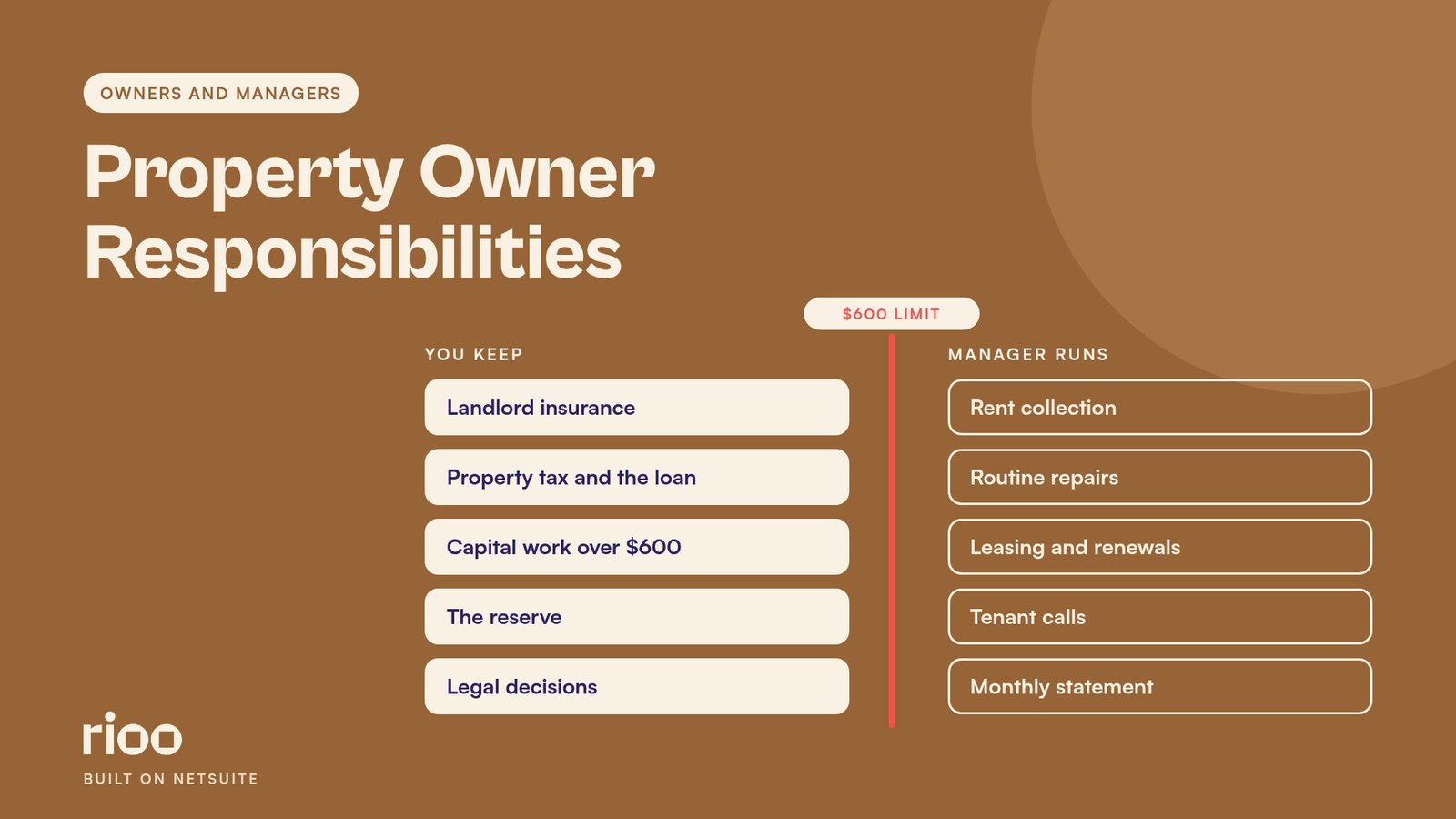
When you hire a property manager, you hand over the daily work of running the rental. You keep the title, the insurance policy, the tax return, the loan and the legal liability. The manager collects rent, handles repairs and deals with tenants. You still approve big spending, set the reserve, keep the property insured and answer for anything done in your name.
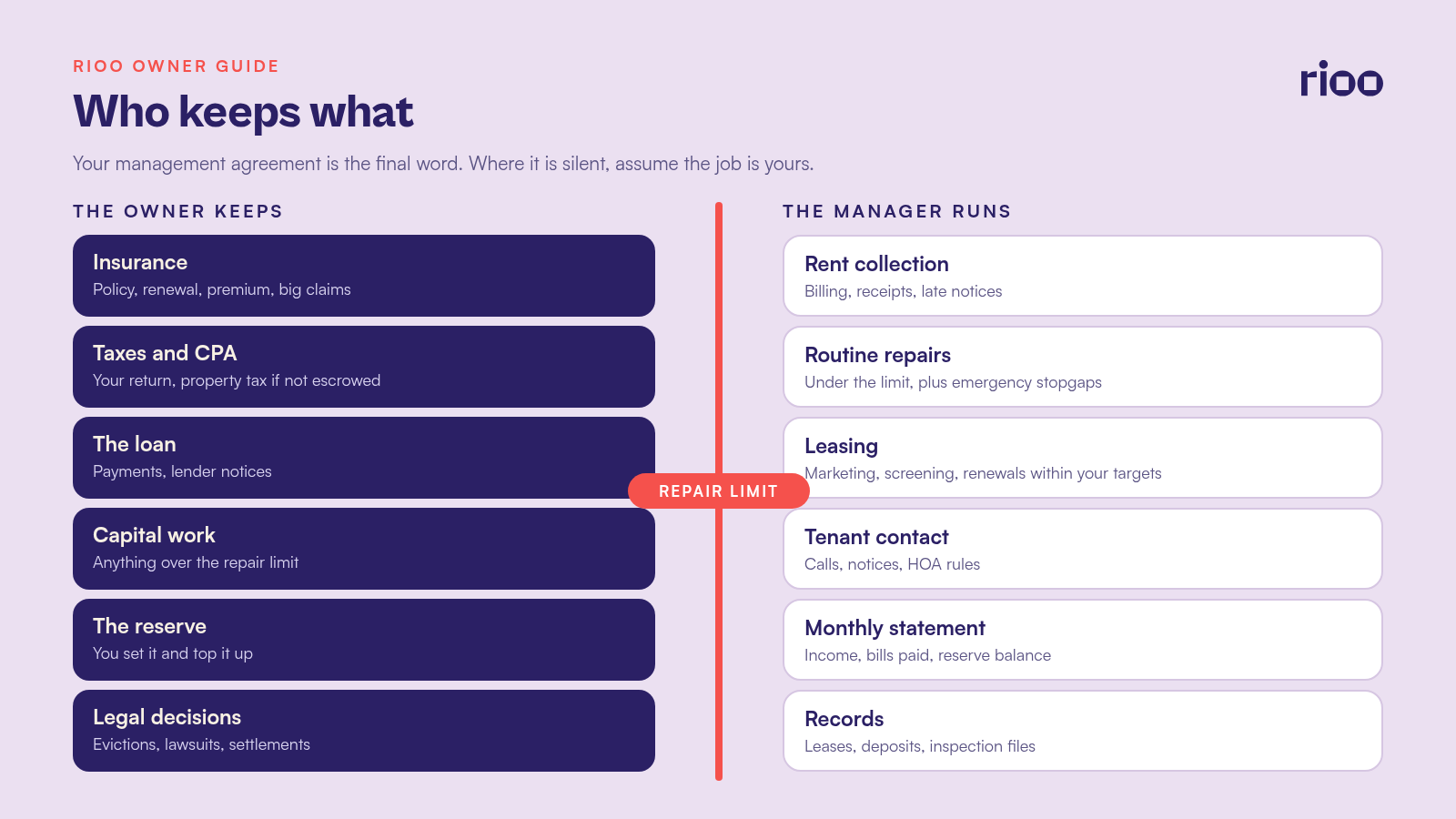
The clean way to split it is simple. If a task happens every week, it usually belongs to the manager. If it happens once a year, touches the deed or the loan, or costs more than the repair limit in your agreement, it usually stays with you. The table below shows where each common job lands. The calendar near the end shows when each owner task comes due.
I work with owners of small residential buildings who are handing over for the first time. The same few gaps come up again and again, so this guide is written from the owner's side of the desk.
The split at a glance
Your management agreement is the final word. Read it with this table open. Where the agreement is silent, assume the job is still yours.
| Area | Stays with the owner | Usually run by the manager |
|---|---|---|
| Insurance | Buying the landlord policy, renewing it, paying the premium, filing large claims | Collecting tenant renters insurance proof, reporting incidents to you fast |
| Taxes | Property tax bills not paid through the lender, your income tax return, choosing a CPA | Year end owner statement and the 1099 the manager files for rents it collected |
| Loan and lender | Mortgage payments, escrow shortfalls, lender notices and covenants | Sending rent roll or occupancy data if you ask for it |
| Repairs | Approving work over the repair limit, roofs, boilers, capital projects | Routine repairs under the limit, emergency stopgaps, vendor scheduling |
| Money held back | Setting the reserve amount and topping it up | Paying bills from the reserve, telling you when it runs low |
| Rent and leasing | Signing off on rent targets and lease policy | Marketing, screening, showings, lease signing, renewals within your targets |
| HOA or condo | Dues if not paid by the manager, voting, reading board notices | Passing on HOA rules to tenants, handling violation letters |
| Legal | Final say on evictions and lawsuits, answering claims made against you | Serving notices, keeping records, working with your attorney |
Two items in the table go wrong in handovers more often than the rest: insurance and the repair limit. Both get their own section below.
Money that stays in your name
Some bills never move to the manager, even if the manager pays them for you. The account is in your name, and so is the penalty when a payment is missed.
The landlord insurance policy
The policy belongs to you. Your agent or carrier sends renewal notices to you, at the address on the policy. If you moved, or used an old email when you bought the building, those notices may never reach anyone. Many management agreements ask you to add the management company as an additional insured. That protects the manager. It does not make the manager responsible for keeping your policy active.
Ask your agent for the renewal date and write it on your owner calendar. Then send the manager a copy of the declarations page each year. A good manager will chase a missing copy. It still won't pay a premium it was never asked to pay.
Property tax and the mortgage
If your lender escrows property tax, the lender pays it and adjusts your monthly payment. If not, the bill comes to you. Some owners ask the manager to pay the tax bill out of rent. That works only if the agreement says so and the manager has the bill in hand before the due date. Your loan also stays yours. A missed payment or a lender notice about vacancy goes to you, not the manager.
Your income tax return
The manager reports the rent it paid over to you. In the US, the IRS instructions for Form 1099 MISC say a property manager must report that rent in box 1. For payments made from 2026 on, the reporting threshold is $2,000 a year. Your copy is due by 31 January. That form is a summary. Your return, your depreciation schedule and your deductions are your job and your CPA's job. Our guide on which EIN to use when an LLC owns the rental covers the name and number questions that come up.
Decisions the agreement keeps for you
A management agreement gives the manager authority to act for you within limits. Read the authority section closely. Our guide to what a property management agreement should include lists the clauses to check. Three of them shape your week as an owner.
The repair limit
A typical agreement sets a dollar figure, such as $500 or $750 per job, below which the manager can approve work without asking. Above it, the manager needs your yes. Emergencies are usually an exception, so the manager can stop water or restore heat first and call you after.
Set the limit with care. Too low, and every dripping tap waits two days for your reply. Too high, and you learn about a $2,400 water heater from the statement. For a small building, a limit of roughly half to one month of one unit's rent is a sensible place to start.
Capital work and the reserve
Roofs, parking lots, boilers and full unit renovations are your decisions. The manager can get quotes and recommend. You decide whether, when and with whom. The reserve is the cash the manager holds back from your distribution to pay bills between rent cycles. You set the amount. Our guide to setting owner reserves explains how much to hold and when to top it up.
Rent targets and legal action
You set the rent strategy and the tenant selection rules. The manager applies them. Evictions and lawsuits are filed in your name, so the agreement should require your approval before a case is filed. Settling a claim against you is also your call, with your insurer and attorney.
Legal duties you cannot hand over
An agent acts for you, so many legal duties stay with you as the owner.
Fair housing is one. Under the HUD rule at 24 CFR 100.7, an owner can be held liable for a discriminatory housing practice by their agent. That holds even if the owner never knew about it. Choose a manager with a written screening policy, and read it.
Lead paint disclosure is another. For housing built before 1978, landlords must disclose known lead based paint and lead hazards before a lease is signed. Agents must make sure it happens. A few cases are exempt, such as leases of 100 days or less. The EPA lead disclosure page sets out the rule. Give your manager every report you have.
Local rental registration, licensing and inspection rules often name the owner too. Ask your manager which ones apply to your city and who files them.
A fourplex handover in March
Here is a fictional example. Priya buys a fourplex in Columbus, Ohio. Each unit rents for $1,350, so the building brings in $5,400 a month. She signs with a management company on 1 March. The agreement sets an 8% fee, a $600 repair limit and a $1,500 reserve.
Her landlord policy renews on 15 March. The renewal notice goes to her old apartment, because she never updated the address after closing. Priya assumes the manager is handling "the building stuff". The manager assumes the owner has insurance, because the agreement says she must. The policy lapses on 15 March.
On 2 April a supply line under a kitchen sink in unit 3 bursts. Water runs into unit 1 below. The manager does the right things. A plumber stops the leak that night for $380, inside the repair limit. A drying company starts the next morning. The manager then calls Priya:
"The drying and drywall in units 1 and 3 will come to about $8,900. Can you send me the claim number from your carrier?"
"I'll call them now."
An hour later: "They say the policy lapsed on 15 March."
The $8,900 comes out of her pocket. The reserve pays the first $1,500. April rent, after the $432 fee and the $380 plumber, leaves $4,588, and all of it goes to the drying bill. Her April distribution is zero. She still has to send $2,812 of her own money and rebuild the $1,500 reserve.
A careful manager would have asked for the declarations page at onboarding. The policy was still Priya's to keep. A one line entry on her calendar, and a copy of the declarations page sent on 1 March, would have caught it. The same handover is also the time to confirm the tax bill route, the lender contact and the HOA account. Our checklist on owner onboarding in the first thirty days shows what a manager should ask for in the first month.
Where RIOO fits
RIOO is property management software built natively on Oracle NetSuite. It cannot renew your insurance for you. It can make the dates hard to miss. The compliance and certificate tracking in RIOO keeps a register of certificates, licences and other obligations for each property, with expiry dates and reminders before they lapse. A policy renewal date can sit in that register next to the rest. Approval chains in RIOO route spending over a set limit to the right person and keep an audit trail of who said yes. Budget versus actual reports by property show spending against plan. For an owner, that means fewer surprises in the statement and a clear record of each decision you made.
Your year, month by month
Dates vary by policy, county and lender. Replace each month below with your own dates the week you sign.
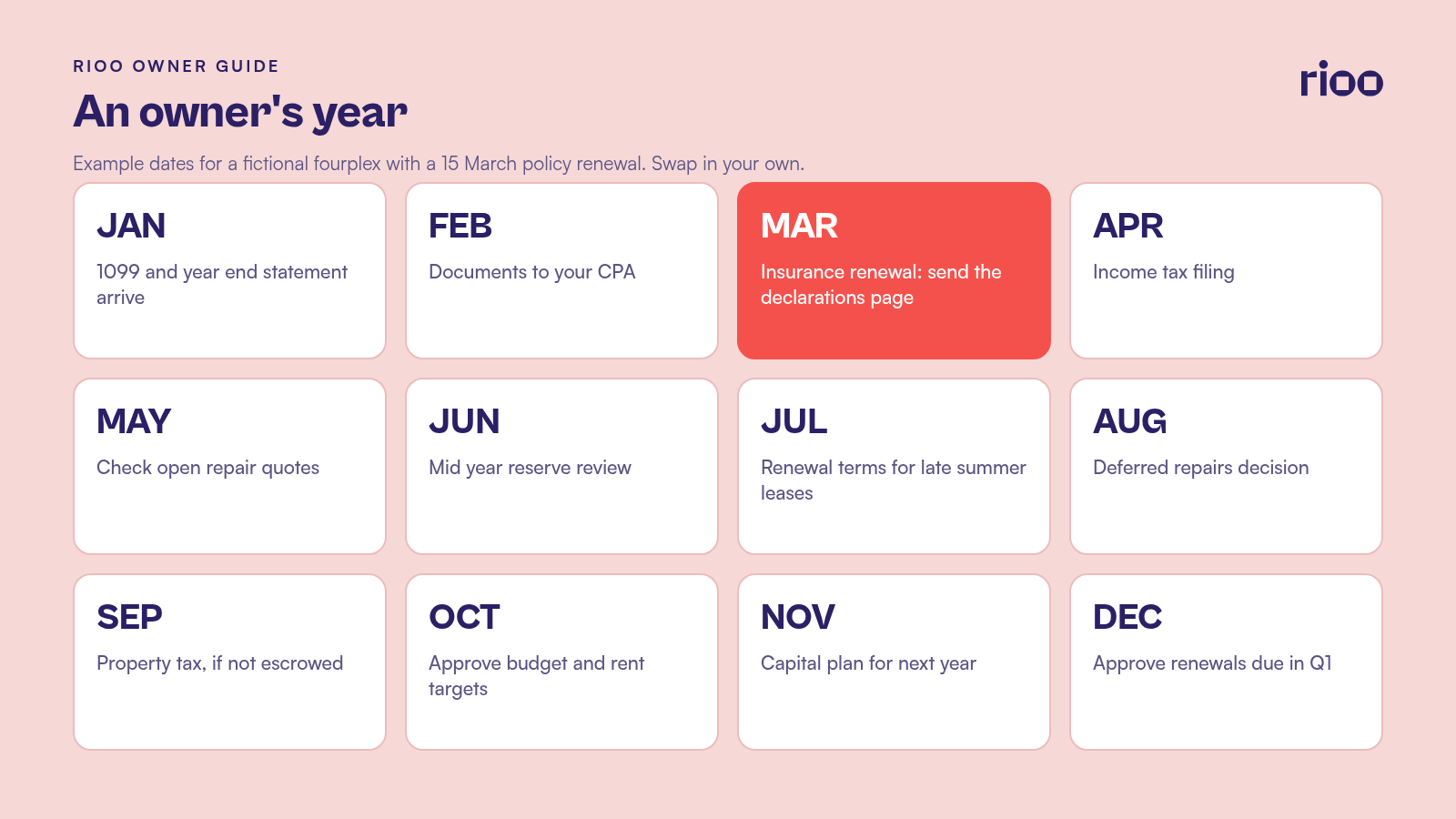
| When | Owner task | What you need from the manager |
|---|---|---|
| January | Check the 1099 and year end statement against your records | The 1099 by 31 January (next business day if that is a weekend), plus the annual statement |
| February to March | Send documents to your CPA | Expense detail and any capital invoices |
| Policy renewal month | Renew the landlord policy and send the declarations page | Incident log for the year, renters insurance status |
| Mid year | Review the reserve and any deferred repairs | A list of open repair quotes over the limit |
| Tax due dates | Pay property tax if the lender does not escrow it | Nothing, unless the agreement says the manager pays it |
| October | Approve next year's budget and rent targets | A draft budget and market rents |
| 60 to 90 days before each lease end | Approve renewal terms | The renewal recommendation for each unit |
Each month, read the owner statement when it lands. Our guide to the owner statement explains which lines to check first.
Owner questions, answered
Is the property manager responsible for insurance?
No. In a standard agreement the owner buys and keeps the landlord policy. The manager may ask to be named as an additional insured and may check that tenants carry renters insurance. The owner's own policy stays the owner's job.
Who pays the property tax when I have a manager?
You do, either through your lender's escrow or directly. A manager pays it only if the agreement says so and you have arranged for the bill to reach the manager in time.
Can a property manager make repairs without my approval?
Yes, up to the repair limit in your agreement, and in an emergency that threatens people or the building. Above the limit, the manager should get your approval in writing before work starts.
Am I liable if my property manager breaks fair housing rules?
You can be. Federal rules allow liability for an agent's discriminatory housing practice. That is why it pays to read the manager's screening policy before you sign and to keep a copy.
What should I give a new property manager on day one?
Start with the insurance declarations page, the loan servicer contact and the property tax account. Add HOA documents, leases, deposit records, keys and warranties. Include any lead paint reports and a list of known repair issues.