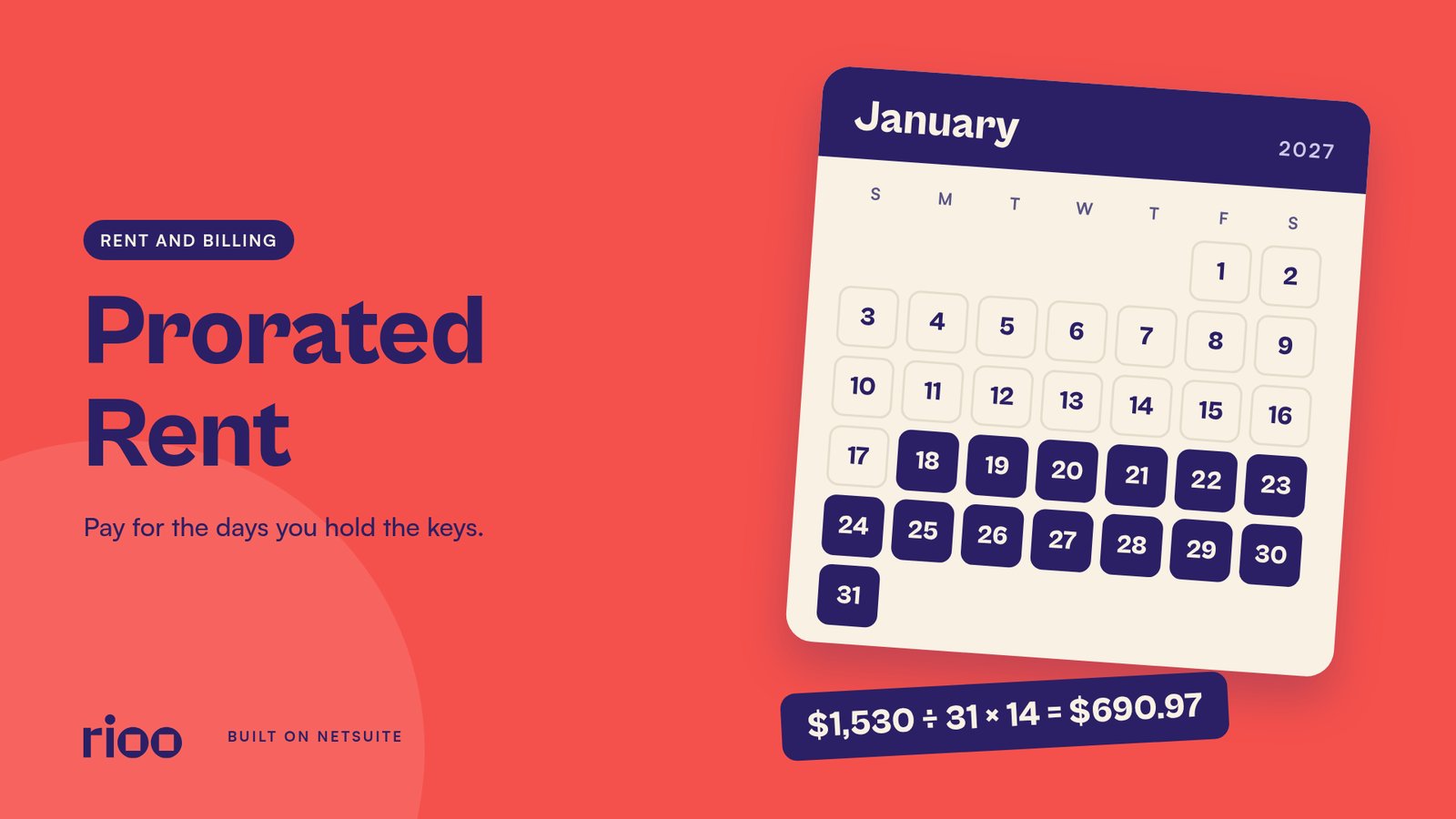
A tenant signs for $1,530 a month and gets the keys on Monday 18 January. What do they owe for January? Under one common method the answer is $690.97. Under another it is $714.00. Both numbers get called prorated rent, and both can be defended.
Prorated rent is the part of a month's rent a tenant pays for the days they actually hold the unit. To work it out, find a daily rate and multiply it by the days occupied, counting the move in day. The daily rate depends on the method your lease names: the actual days in that month, a 365 day year, or a flat 30 day month. Pick one, write it into the lease, and use it every time.
Three ways to get a daily rate
Every proration starts with one number: what a single day of rent is worth. The three methods below are all in common use. They give different answers because they divide by different things.
Actual days in the month
Divide the monthly rent by the number of days in that calendar month. January has 31 days, so $1,530 divided by 31 is $49.3548 a day. Fourteen days, from 18 to 31 January, comes to $690.97.
This method is easy to explain to a tenant. A day in February costs more than a day in January, though, because the same rent is spread over fewer days.
A 365 day year
Multiply the monthly rent by 12, then divide by 365. That gives $18,360 divided by 365, or $50.3014 a day, in every month of the year. The same 14 days in January come to $704.22.
Its appeal is consistency. The daily rate never moves, so a day of rent is a day of rent whether it falls in February or in July.
A flat 30 day month
Divide the monthly rent by 30, whatever the month. That is $51.00 a day here, and 14 days come to $714.00. Some people call it the banker's month.
The math is simple enough to do on a phone during a showing. That is why it often turns up in leasing quotes. The catch is that it overcharges slightly in 31 day months and undercharges in February.
One lease, three months, nine answers
Here is the same $1,530 lease with a move in on the 18th of three different months. Each count includes the move in day and runs to the last day of the month.
| Move in | Days owed | Actual days | 365 day year | 30 day month |
|---|---|---|---|---|
| 18 January | 14 of 31 | $690.97 | $704.22 | $714.00 |
| 18 February | 11 of 28 | $601.07 | $553.32 | $561.00 |
| 18 September | 13 of 30 | $663.00 | $653.92 | $663.00 |
Look at February. The actual days method charges $601.07 for 11 days, while the 365 day year charges $553.32. The gap is $47.75 on a single move in. In September, a 30 day month, two of the methods agree to the cent.
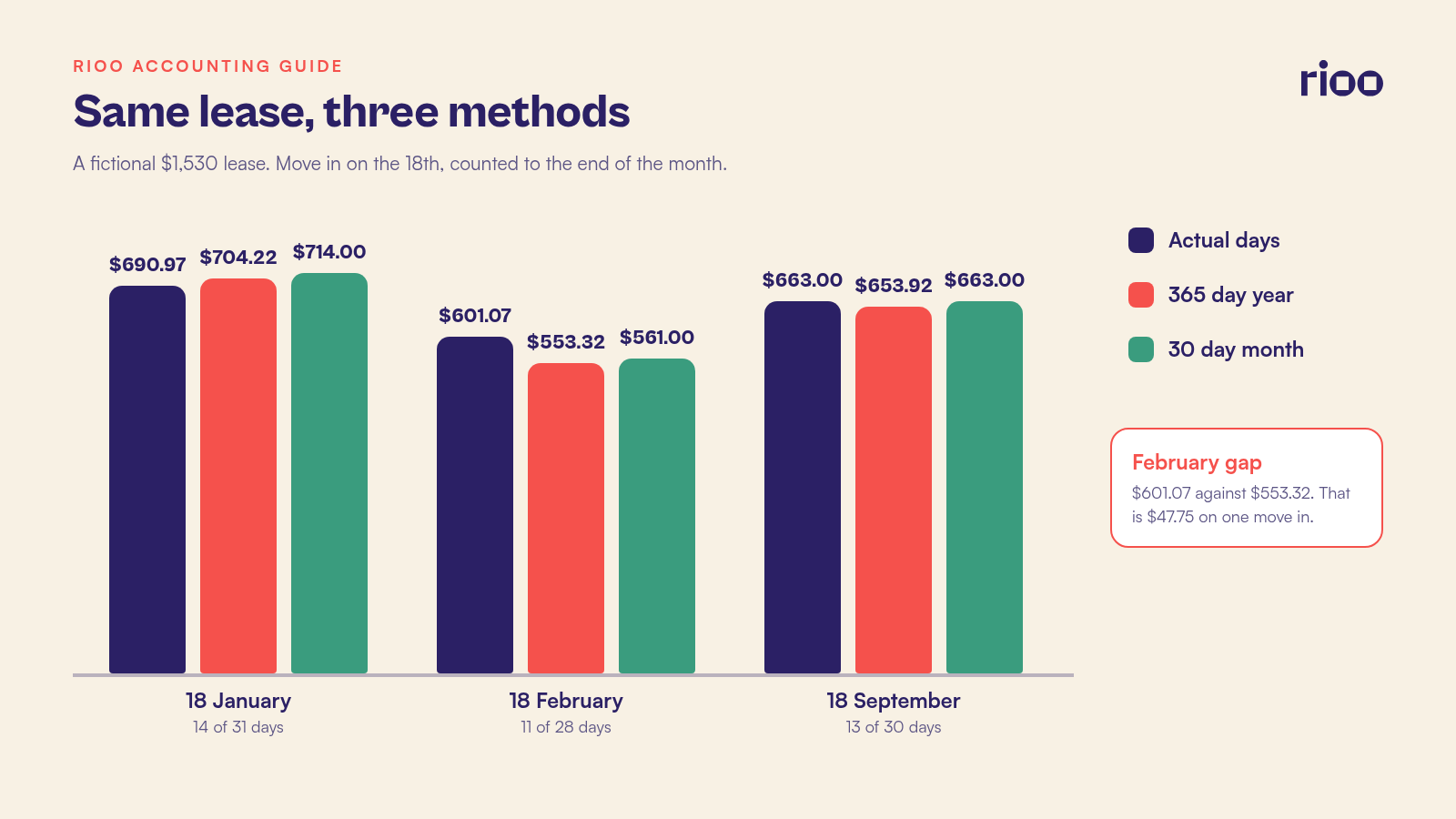
None of these is wrong. The problem starts when two people in the same office use two different methods.
What went wrong at a 60 unit building in Tucson
This is a fictional example, though plenty of offices will recognise it.
Dana tours a two bedroom on 6 January and signs for a move in on Monday 18 January. The leasing agent quotes the January rent on her phone: $1,530 divided by 30, times 14 days, is $714.00. Dana pays $714.00 at signing, plus the deposit.
The accounting system was set up with the actual days method. It bills January at $690.97. Dana's ledger now shows a credit of $23.03, and the receipt she gets by email does not match the number she was quoted.
On 3 February she writes to the office: "Why does my account say I overpaid? Am I getting that back, or is it going against February?" Nobody in the office has a quick answer. The agent says the quote was right. The bookkeeper says the bill was right. Both are telling the truth.
The quick fix took ten minutes. The credit went against February rent, and Dana got a short note explaining why. The real fix took longer. The manager wrote one method into the lease template. Leasing got a printed table of daily rates for each floor plan. Then she checked that the billing setup used the same rule.
Across 30 move ins a year, a $23 gap is not a lot of money. The trust it costs in the first week of a tenancy is harder to win back.
The late month rule: two charges at signing
When a tenant moves in near the end of a month, a prorated charge can be tiny. Many managers then collect the partial month and the next full month together at signing. A common cutoff is the 25th, though the date is a policy choice.
Take a move in on Tuesday 26 January. That is six days, so the actual days method gives $296.13. February's rent of $1,530 is due a few days later anyway. Collecting both at signing means $1,826.13 up front, and the tenant does not face a second bill on 1 February.
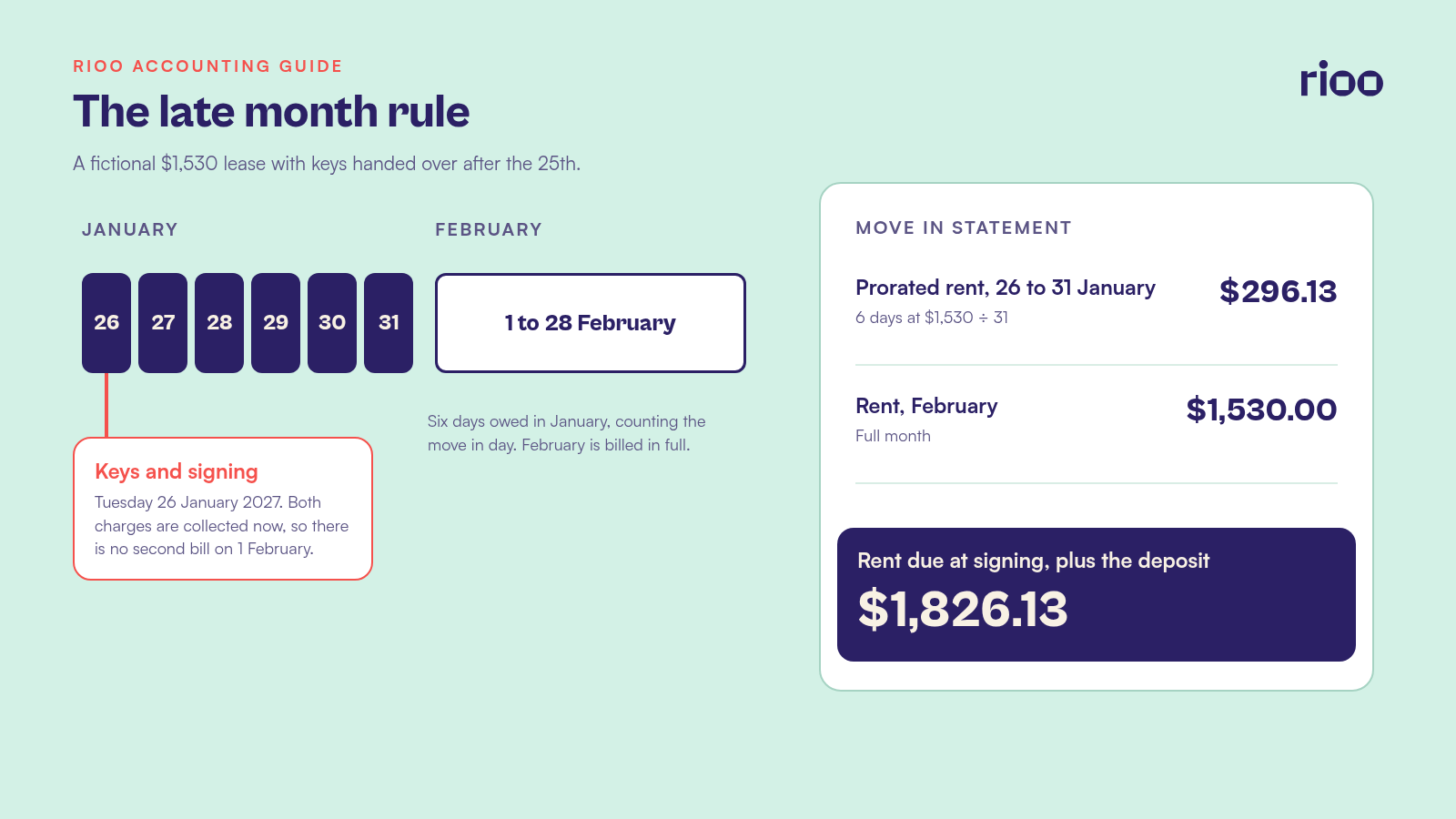
Tell the applicant about this at the approval stage, in writing. A surprise $1,826 at key handover sours the start. Put the total due at move in on the approval letter, next to the deposit, and add it to your move in checklist.
When you skip proration on purpose
Some owners let the first few days go free and start rent on the 1st. That is a concession, and it should be recorded as one. If it is left off the ledger, the rent roll shows a lease that started on the 1st when the tenant had the keys on the 26th.
Prorating the last month at move out
The same math runs in reverse when a lease ends partway through a month. Say a lease ends on 9 March. The tenant owes nine days. Using actual days, that is $1,530 divided by 31, times 9, or $444.19.
Whether you prorate at move out depends on the lease and on local law. Month to month tenancies need extra care, because some states tie the notice to the end of a rental period. Florida asks for at least 30 days' notice before the end of any monthly period (Florida Statutes section 83.57). Washington asks a tenant for at least 20 days' written notice before the end of a month or period (RCW 59.18.200).
Under rules like these, a tenant who leaves on the 9th may still owe rent to the end of that period. The details vary by state and can change, so check the current rule before you promise a prorated final bill. Our guide to written notice to move out walks through examples from several states.
If you do prorate, put the daily rate and the day count on the final statement. A tenant who can see "9 days at $49.3548" can check the bill in a minute. A single unexplained number is far more likely to start a dispute.
Parking, pets and the other lines on the ledger
Rent is rarely the only monthly charge. Pet rent, a parking space, storage and a flat utility fee all start and stop with the lease. Prorate each one with the same method and the same day count as the rent.
Mixing methods across lines is how a ledger ends up a few cents out every month. It looks small until someone tries to reconcile a tenant who has been in place for three years. A clean tenant ledger shows each prorated charge as its own line with its own dates.
Round once, at the end. If you round the daily rate first, $49.35 times 14 gives $690.90, seven cents off the $690.97 you get from the full rate. Seven cents is trivial on one lease. It is not trivial when an auditor asks why two units on the same rent were billed differently.
Transfers and rent changes in the middle of a month
A tenant who moves between units on the 12th needs two prorations: the old unit up to the 11th and the new unit from the 12th. The same applies when a renewal rate starts on a date other than the 1st. Our apartment unit transfer policy guide covers the paperwork side of a mid month move.
Lease wording you can adapt
A single clause settles the method before anyone has to argue about it. Have your attorney review the wording for your state.
If this lease begins or ends on a day other than the first or last day of a calendar month, rent for that month will be prorated. Prorated rent equals the monthly rent divided by the number of days in that calendar month, times the days the Resident has possession. Both the first and last day count. The same method applies to all monthly charges under this lease.
Prefer the 365 day year? Then the daily rate becomes "the monthly rent times 12, divided by 365" in the second sentence. Whichever you choose, use the same sentence in the lease, the approval letter and the billing setup.
How RIOO carries the first and last charge
In RIOO, the lease drives the money. A signed lease becomes charges, invoices and GL entries in NetSuite, as our lease to ledger workflow shows. First and prorated rent post as income in the move in period. Tenant ledgers sit in NetSuite alongside the bank reconciliation, and pricing strategies hold recurring charges such as storage and parking. At move out, deductions and the final statement close the tenancy.
That still leaves one decision with you: which proration method your leases use. Agree it once, put it in the lease template, and set up billing to use the same rule.
Prorated rent questions
Is a landlord required to prorate rent?
There is no single national rule. The answer usually comes from the lease, and at move out it can also depend on your state's notice rules. If the lease is silent, decide on a method and apply it the same way to every tenant.
Does the move in day count as a full day?
In common practice, yes. The tenant has the keys that day, so it is counted. The last day of possession at move out is counted too. State this in the lease so nobody has to assume.
How do I prorate rent for February?
Use the same method you use the rest of the year. With actual days, divide the rent by 28, or by 29 in a leap year. With the 365 day year, the daily rate does not change. Expect February to show the biggest difference between methods.
Which method is fairest to the tenant?
Each one is fair if it is disclosed and applied consistently. The 365 day year treats every day the same across the year. The actual days method is easier to explain on a receipt. The 30 day month is the simplest, but it slightly overcharges in 31 day months.
Can I charge a full month and skip proration?
Only if the lease says so and your state allows it. A cleaner option is to start the lease on the 1st and handle any early access as a short, separate agreement or a recorded concession.