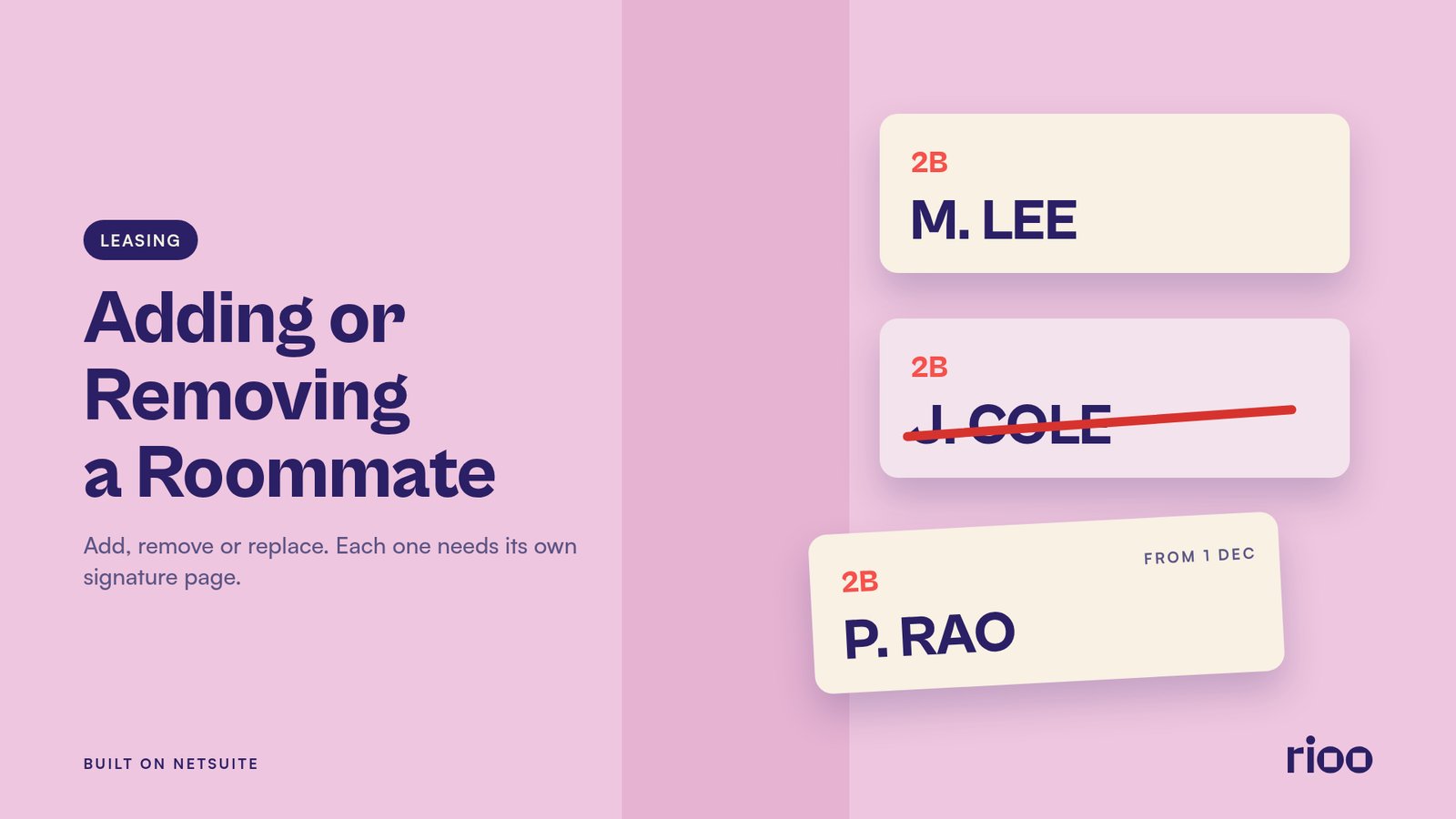
Roommate changes arrive as three different requests, and each needs different paperwork. A tenant wants to add someone. A tenant wants to leave while the other stays. Or one roommate wants to swap out for a new person. Treat all three the same way and you get trouble. Someone lives in the unit who never signed anything. Or someone is still on the hook for a unit they left a year ago.
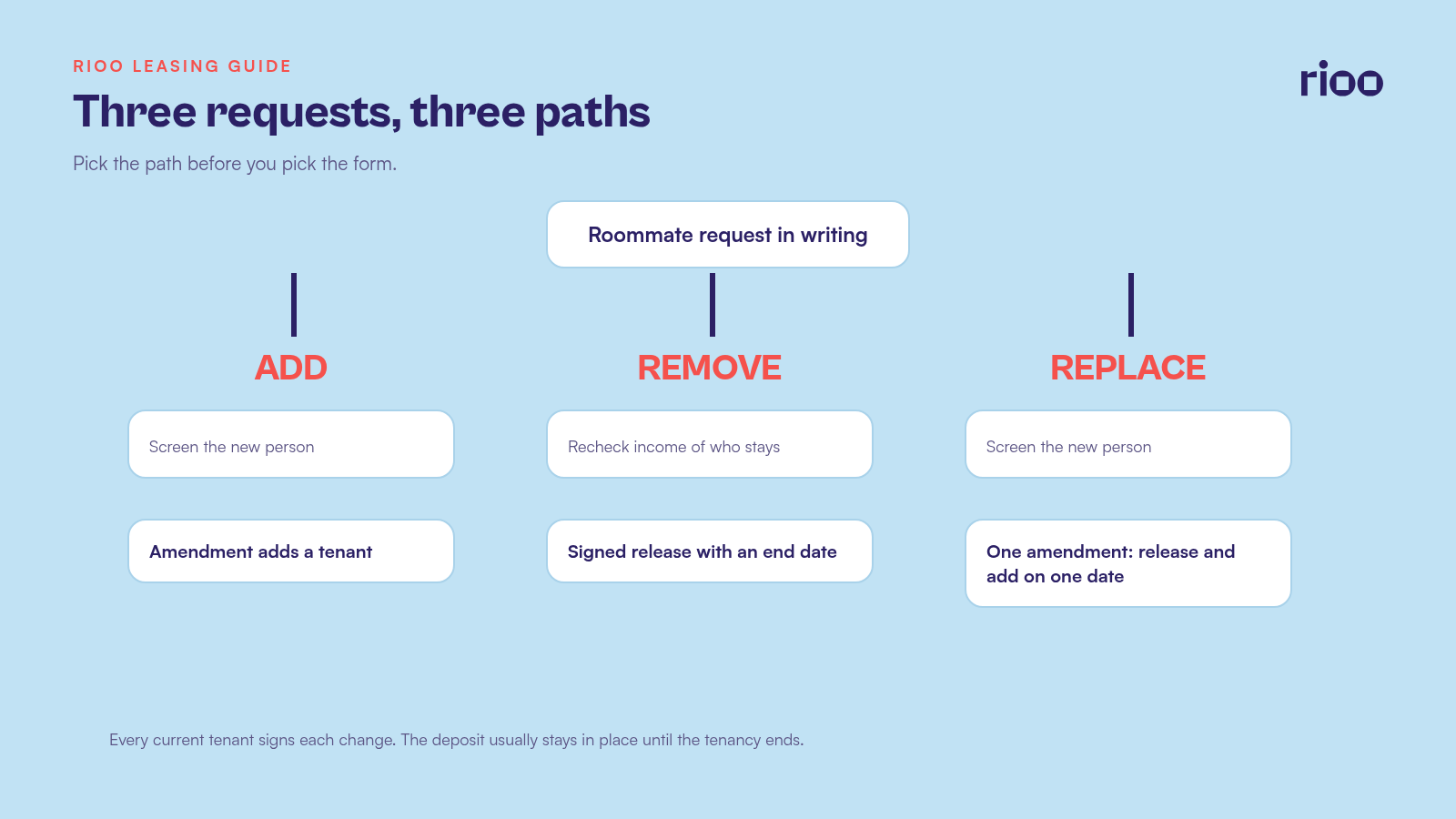
The short answer: to add or remove a roommate, the landlord and every current tenant sign a written change to the lease. Adding someone means screening them first and adding their name by a lease amendment or a new lease. Removing someone means a release that ends their obligations from a set date, signed by the landlord and the tenants who stay. The security deposit usually stays in place until the whole tenancy ends, and roommates settle their shares between themselves.
I work on leasing and renewals at RIOO. This guide gives you a decision path for each request and a worked deposit example. It also covers the New York rule that lets some tenants add an occupant without asking, and the questions leasing teams hear every week. Local law can change the details, so check yours.
Which request is this?
| Request | Who signs | Screen? | Document |
|---|---|---|---|
| Add a roommate | Landlord, all current tenants, the new person | Yes, same criteria as any applicant | Lease amendment adding a tenant, or a new lease |
| Remove a roommate | Landlord, the leaving tenant, all tenants who stay | Recheck that the people who stay can carry the rent | Release and amendment with an end date for the leaving tenant |
| Replace a roommate | Landlord, leaving tenant, staying tenants, new person | Yes, for the new person | One amendment that releases one name and adds another on the same date |
| A guest who is staying longer | Depends on the lease guest clause | If they become an occupant | See the unauthorized occupant guide |
Adding a roommate
Treat the new person as an applicant. Use the same written screening criteria you use for everyone, so the decision is consistent and easy to explain.
Steps
- Get a written request from the current tenants, with the new person's name and planned move in date.
- Take a full application and run the same checks you would for a new lease.
- Decide whether income is tested on the household or on each person. Write it down and apply it the same way every time.
- Sign a lease amendment that adds the new tenant and states that all tenants are jointly responsible for the full rent.
- Update the rent roll, keys, parking, the portal login and any utility account.
When you can say no
You can decline a new roommate who fails your written criteria or would push the unit past a legal occupancy limit. You cannot decline for a reason fair housing law protects, such as familial status or national origin. A policy that applies one standard to every applicant is your protection.
Removing a roommate
The hard part is money. A lease signed by several tenants usually makes each of them liable for the whole rent. Letting one leave means the people who stay carry the full amount.
Before you release anyone, check that the remaining household meets your income standard on its own. If it does not, you can ask for a guarantor, ask the leaving tenant to stay on until a replacement is found, or decline the release. A release is a choice, and the lease usually does not require you to give one.
The release should name the date the leaving tenant's duties end, say who keeps the deposit rights, and confirm that the staying tenants accept the full rent. Have every remaining tenant sign it. If they do not, they can later argue they never agreed to carry the rent alone.
Replacing a roommate, with a worked deposit
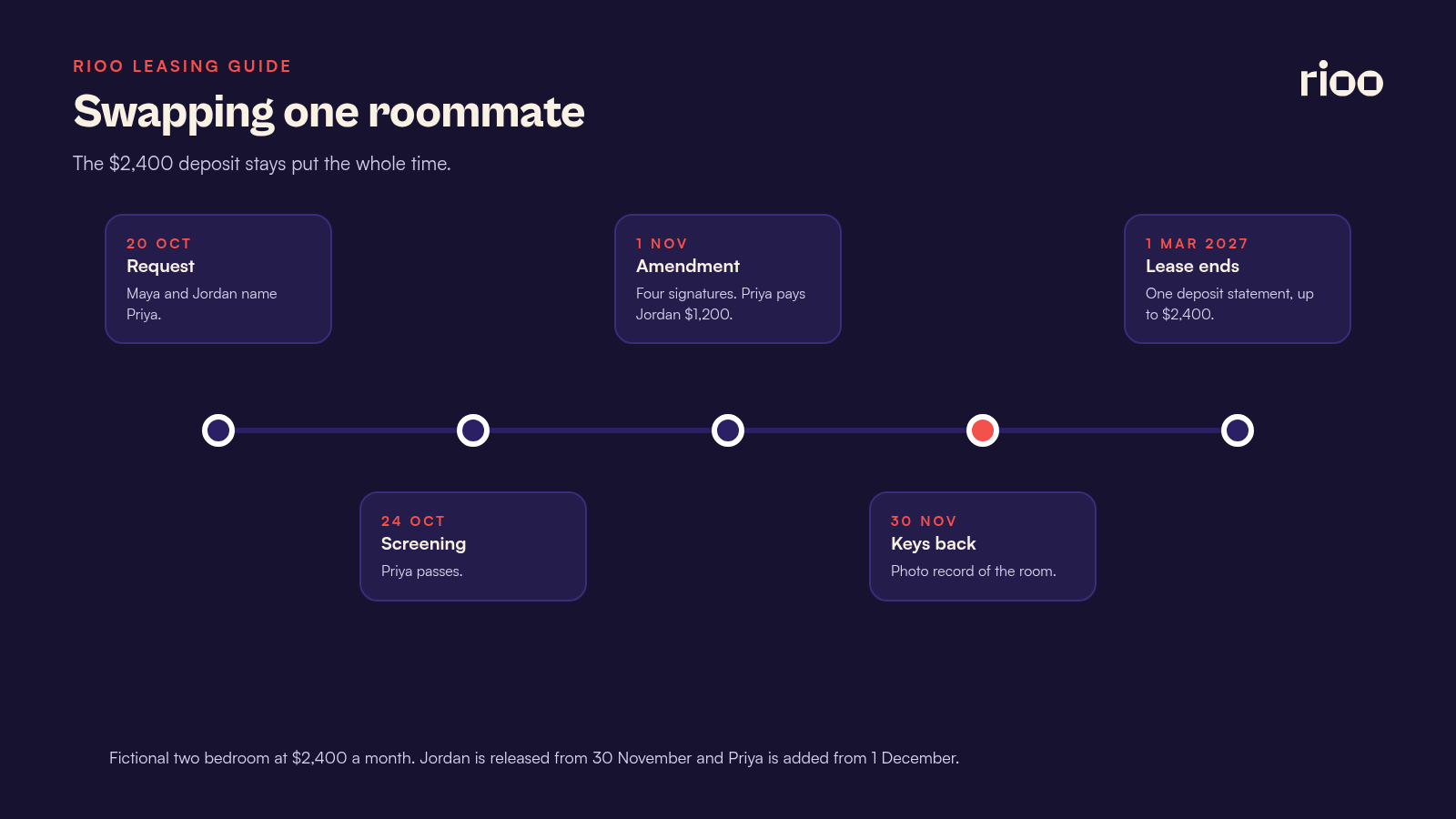
A fictional two bedroom rents for $2,400 a month with a $2,400 deposit. Maya and Jordan signed a 12 month lease on 1 March 2026 and each paid $1,200 toward the deposit. In October, Jordan takes a job in another city. Priya wants to take the room from 1 December.
| Date | Step | Money |
|---|---|---|
| 20 Oct | Written request from Maya and Jordan naming Priya | None |
| 24 Oct | Priya applies and passes screening | Application fee as allowed in your state |
| 1 Nov | Amendment signed by all four parties: Jordan released from 30 Nov, Priya added from 1 Dec, rent stays $2,400 | Lease change fee of $150, if the lease allows one |
| 1 Nov | Priya pays Jordan $1,200 for his share of the deposit, directly | $1,200 between roommates |
| 30 Nov | Jordan hands in his keys. A quick photo record of his room is added to the file. | None |
| 1 Mar 2027 | Lease ends. One move out inspection. The deposit statement goes to Maya and Priya. | Up to $2,400 back, less any lawful deductions |
The landlord's deposit stays at $2,400 the whole time. No partial refund, no second inspection standard, and no question later about whose damage was whose. The amendment simply records that Priya now holds the deposit rights Jordan had. If Jordan and Priya cannot agree a price, the landlord can decline to manage their side deal, but should not release Jordan until the paperwork is signed.
Some states set rules for how a deposit is returned when there are several tenants. Virginia, for example, says the refund goes as one check payable to all tenants unless they agree otherwise in writing, under Va. Code 55.1-1226. Check yours in security deposit laws by state.
What to update after the paperwork is signed
Signing the amendment is only step one. The change has to reach every system and person that uses the tenant list. Use this list on the effective date.
- Rent roll and tenant ledger. The names on the account change on the effective date. Payments from the leaving roommate after that date need a note.
- Keys, fobs and parking. Collect the leaving roommate's set. If keys were copied, consider rekeying at the tenant's cost if the lease allows.
- Portal and payment logins. Close the leaving tenant's access so they no longer see the account.
- Renters insurance. If your lease requires it, ask for proof that the new tenant is covered.
- Utilities. Where the account is in a tenant's name, remind the household to move it.
- Emergency contacts. Replace the leaving tenant's details with the new person's.
When a roommate leaves without a word
Sometimes one tenant simply moves out and stops paying. They are still on the lease, and still liable for the full rent with the others. Do not take their name off just because the remaining tenant asks. Ask the household in writing whether a release or replacement is wanted, and keep billing the full rent to the account until the paperwork is done.
The New York roommate rule
New York's Real Property Law section 235-f limits how far a lease can stop a tenant from sharing. Where a lease names one tenant, that tenant may share the home with immediate family, one additional occupant and the occupant's dependent children. The tenant or their spouse must live there as a primary residence. The tenant must tell the landlord the occupant's name within 30 days of move in, or within 30 days of the landlord asking. The occupant does not become a tenant and gets no lease rights. Read the text on the New York Senate site.
So in New York, you may not be able to refuse an occupant, but you can still decline to add them as a tenant on the lease.
Questions leasing teams get
Can a tenant just move a roommate in without asking?
Usually no. A typical lease names the people allowed to live in the unit. New York's roommate law is a major exception. Elsewhere, check your lease guest and occupant clauses.
Does the leaving roommate get their share of the deposit back?
Usually not from the landlord. The deposit is usually held until the tenancy ends. The incoming roommate often pays the leaving one directly.
Can the landlord raise the rent when a roommate changes?
Not during a fixed term unless the lease allows it. Signing a new lease is different, and normal rent increase rules then apply.
Is a roommate change the same as a sublet?
No. A subtenant rents from the tenant and has no lease with you. A new roommate added by amendment is your tenant. Sublets follow their own approval process.
Where RIOO fits
In RIOO, a roommate change is a lease amendment on the existing contract, not a new tenancy built by hand. The new applicant goes through the same tenant acquisition and screening steps. The amendment records who is on the lease from which date. The tenant ledger and deposit stay on one record in NetSuite. When the lease ends, the deposit statement goes to the tenants named at that date.
Sources: New York Real Property Law 235-f (nysenate.gov), Va. Code 55.1-1226. As of November 2026. General information only; confirm local rules with counsel.