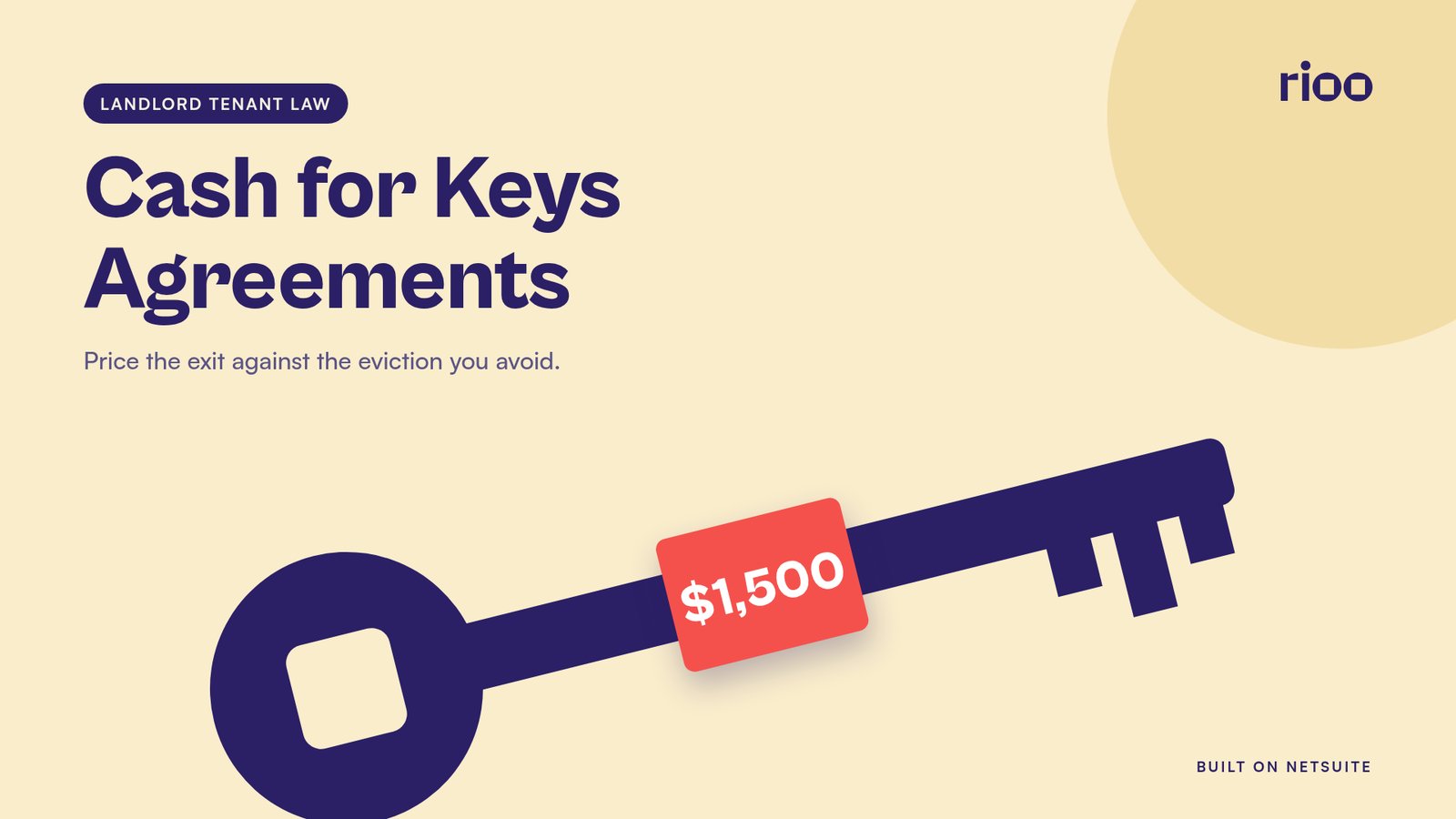
Say a tenant owes $2,700 in back rent and the eviction will take about ten weeks to reach a lockout date. Add the rent you will not collect in that time, court fees, a process server and some attorney time. The eviction route can cost about $5,100 out of pocket, before the back rent you may never see. Offering $1,500 to leave clean in 21 days costs less and ends sooner. That gap is the whole case for cash for keys.
Cash for keys is a written deal where the landlord pays a tenant to move out by a set date and hand back the keys. The unit is usually left empty and broom clean. In return the tenant gives up the right to stay, and both sides usually release some claims. It is a voluntary agreement, so the tenant can say no. A few cities, such as San Francisco and Los Angeles, regulate these deals with required notices and a cancellation window.
I write about landlord tenant law for RIOO. This guide covers when an offer makes sense, how to price it and what the agreement should say. It also covers the city rules to check as of November 2026, and the tax form many landlords forget. Rules vary by state and city, so confirm the details with local counsel before you sign.
Run the numbers before you make an offer
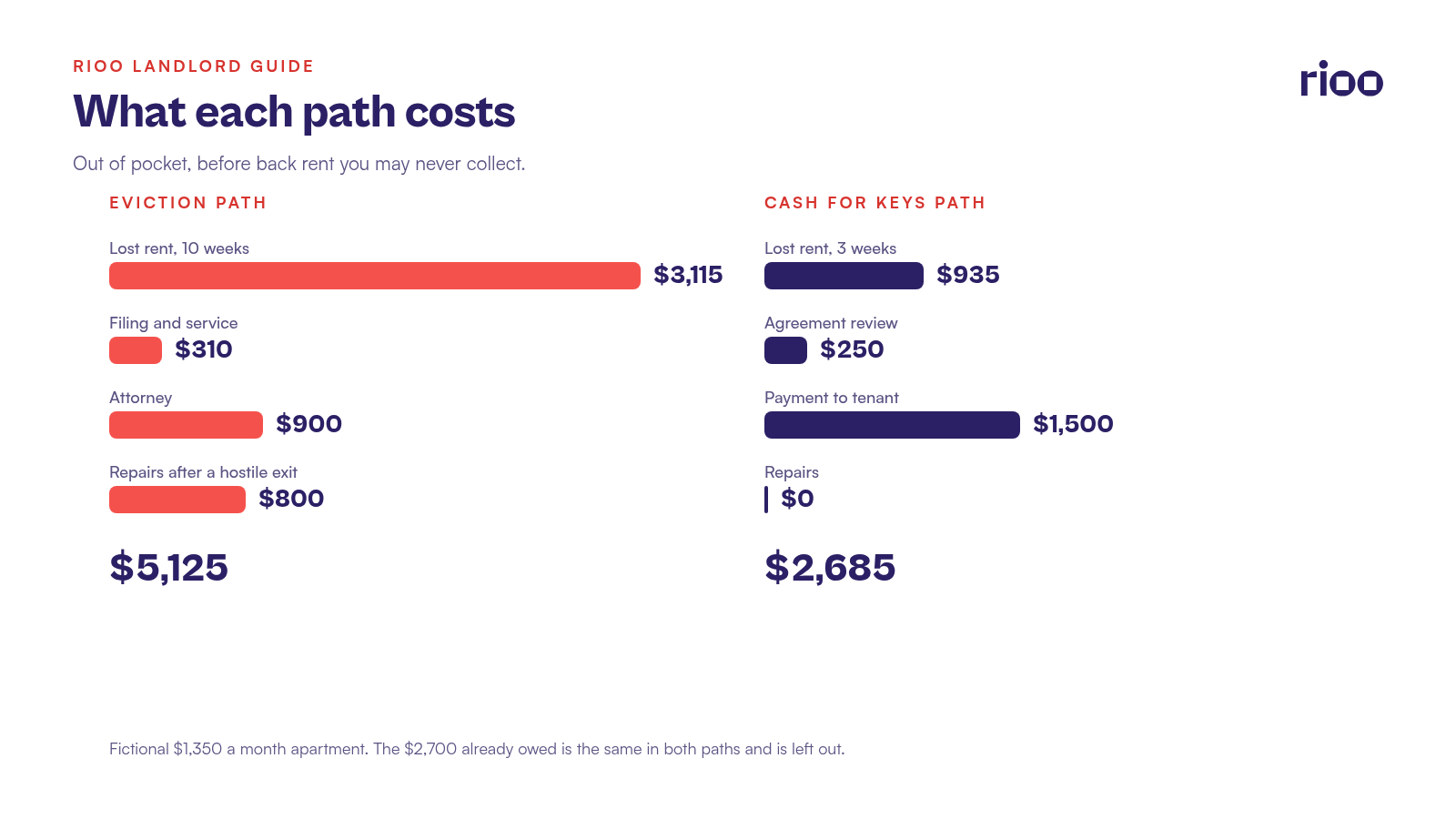
An offer only makes sense when it costs less than the realistic eviction path. Put both on one page. Here is a fictional example for a $1,350 a month apartment in a state where an uncontested eviction for nonpayment takes about ten weeks.
| Cost line | Eviction path | Cash for keys path |
|---|---|---|
| Rent lost until the unit is empty | $3,115 (10 weeks) | $935 (3 weeks) |
| Filing fee and service | $310 | $0 |
| Attorney time | $900 | $250 to review the agreement |
| Payment to tenant | $0 | $1,500 |
| Extra cleaning or repairs from a hostile exit | $800 (a guess, but a common one) | $0 if the unit passes the walk through |
| Back rent you expect to collect | Often little, even with a judgment | Waived in this deal |
| Out of pocket | $5,125 | $2,685 |
The $2,700 already owed is the same in both columns, which is why it is left off the totals. The honest question is how much of it you would ever collect. If the answer is very little, the agreement saves about $2,440 and seven weeks of vacancy in this example.
When an offer is a poor idea
- The tenant is in a protected period, such as a court ordered stay. Or a local rule makes any pressure to leave risky.
- The eviction is nearly done. If the lockout is ten days away, paying now buys little.
- You suspect the tenant will take the money and stay. Then you need payment at the door, not up front.
- Your real reason for wanting the unit back is one that a fair housing or retaliation claim could reach. Speak with counsel first.
How much to offer
Offers often land between a few hundred dollars and one or two months of rent. Price it from three inputs you can defend.
- The cost you avoid. In the table above, the gap is about $2,440. Your offer should sit well under it.
- What the tenant needs to move. A truck, a deposit on the next place and the first week of overlap. For a one bedroom that might be $1,200 to $2,000.
- The date. Pay more for a fast exit. Some landlords offer $1,500 for 14 days and $1,000 for 21.
Keep the offer in writing and keep it short. A two page letter a tenant can read in five minutes gets signed. A dense contract gets put in a drawer.
What the agreement must say
A cash for keys agreement is a contract. If a point is not written down, you cannot enforce it. Cover each of these:
| Clause | What to write |
|---|---|
| Parties and unit | Every adult on the lease, the full address and unit number. |
| Move out date and time | For example, 5:00 PM on 24 November 2026. |
| Condition | Empty of belongings and trash, broom clean. Normal wear and tear is fine. |
| Keys and devices | Every key, fob, garage remote and mailbox key, counted. |
| Payment | Amount, method and timing. Paying at the walk through, after keys are returned, is the safest timing. |
| Security deposit | Whether it is returned as normal, applied, or folded into the payment. Say which. |
| Back rent | Waived, reduced, or still owed. Say which. |
| Releases | What each side gives up, usually claims for rent and claims about the tenancy. |
| Pending case | If an eviction is filed, how it will be dismissed or paused. |
| Left property | That anything left after the date is treated under the state's abandoned property rules. |
| Tax form | That you need a Form W-9 from the tenant before payment if a Form 1099 will be issued. |
Avoid a release so broad it tries to waive rights the law says cannot be waived. Courts can strike it, and some cities treat it as a violation in itself.
City rules that change the process
Many states have no special rule for these deals. Several cities with rent control do. Two examples:
San Francisco
Under Rent Ordinance Section 37.9E, the landlord must give each tenant the Rent Board's Pre Buyout Negotiations Disclosure Form before any talks begin. The landlord then files a declaration of service with the Rent Board. The agreement cannot be signed until 30 days after talks start. The tenant can cancel up to the 45th day after everyone signs. The landlord then files the signed agreement with the Rent Board between day 46 and day 59. A settlement of an eviction case that is already filed is not a buyout agreement under this section. See the SF.gov buyout agreements page.
Los Angeles
For units under the Rent Stabilization Ordinance, LAMC 151.31 requires a signed RSO Disclosure Notice before an offer is made. The agreement must be in the tenant's primary language and must say in bold that the tenant can cancel within 30 days. It must be filed with LAHD within 60 days. See the LAHD tenant buyout program page.
If you manage in another rent controlled city, search its housing department site for "buyout" before you make the first call. A missed notice can let the tenant cancel at any time.
A 21 day timeline that works
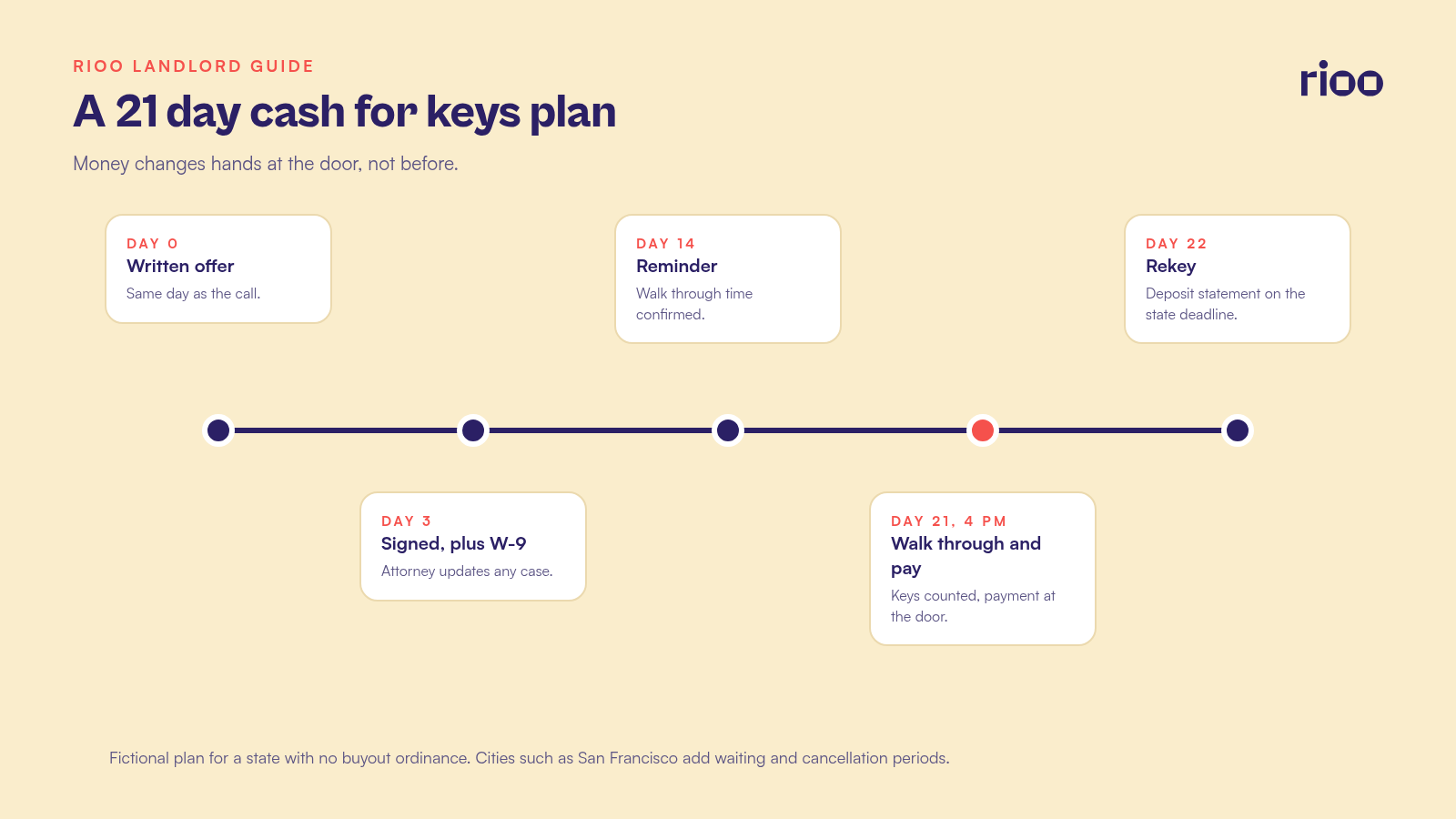
This sequence suits a state with no buyout ordinance. Adjust it where a city adds waiting periods.
- Day 0. Call or meet the tenant, then send the written offer the same day. Keep the tone plain. You are offering a choice.
- Day 3. Signed agreement back, with a Form W-9 if you will issue a Form 1099. If an eviction is filed, ask your attorney to handle the case as the agreement says.
- Day 14. A short reminder with the walk through time. Confirm who will bring the keys.
- Day 21, 4:00 PM. Walk through with the tenant. Photograph each room. Count the keys.
- Day 21, at the door. Hand over the payment by cashier's check or a same day transfer once the unit passes. Have the tenant sign a one line receipt.
- Day 22. Rekey the locks and start the deposit statement on your normal state deadline, if the deposit is still being handled separately.
Taxes: the Form 1099 many landlords miss
The IRS treats a cash for keys payment as taxable income for the tenant, reported as other income. If you pay it in the course of your rental business, it generally goes in box 3 of Form 1099-MISC. That applies once your payments to that person reach the threshold. For payments made in 2026, the threshold rose to $2,000. It will be adjusted for inflation from 2027, according to the IRS instructions for Forms 1099-MISC and 1099-NEC.
So a $1,500 payment made in 2026 would usually fall under the line, and a $2,500 one would not. For the landlord, the payment is generally a deductible rental expense. Ask your accountant how it applies to your entity.
Questions landlords ask
Is cash for keys legal?
Yes. It is a voluntary contract between landlord and tenant. Some cities add disclosure, waiting and filing rules, and harassing a tenant to accept an offer can break local tenant protection laws.
Should I pay before the tenant moves out?
Pay at the walk through, after the keys are back and the unit is empty. If the tenant needs money for the move, a small part up front with the balance at the door is a common compromise.
What if the tenant takes the money and stays?
The agreement does not let you remove anyone yourself. You still need the court process. That is why payment at the door is the safer design.
Does the tenant keep the security deposit?
Only if the agreement says so. If it is silent, handle the deposit under your state's normal return rules and deadline.
Can I offer cash for keys during an eviction case?
Yes, and many cases settle this way. Have your attorney write the dismissal or stipulation terms into the agreement so the court record matches the deal.
Where RIOO fits
A cash for keys deal touches the lease, the tenant ledger, the deposit and the vendor payment at the same time. RIOO is built on NetSuite. The agreed back rent waiver posts to the tenant ledger as a credit with a note, and the payment goes out as a recorded transaction. The move out runs through the same workflow as any other exit, so the deposit statement and rekey work order are not forgotten. When year end comes, your accountant finds the payment in the same books used for Form 1099 reporting. See how contracts and renewals work in RIOO.
Before you pick up the phone
- Check for a city buyout ordinance and any required notice.
- Write the cost comparison, with your honest estimate of the back rent you would collect.
- Set the payment for the walk through, not before.
- Have the walk through checklist from your move out instructions letter ready.
- Decide how the deposit and any wear and tear versus damage questions will be handled.
- Already in court? Read the eviction notice steps and the note on partial payments that can waive an eviction before you take money from the tenant.
Sources: San Francisco Rent Ordinance Section 37.9E (SF.gov), LAMC 151.31 (LAHD), IRS Instructions for Forms 1099-MISC and 1099-NEC (2026). As of November 2026. This is general information, not legal or tax advice.