Four checks on the October bank reconciliation have been outstanding for more than a year. Three are security deposit refunds to former tenants. One is $41.60 in interest on a deposit. Nobody has called about any of them. The money still sits in the trust account, and it does not belong to you or to the owner.
Here is the short answer. An uncashed security deposit refund check is still the former tenant's money. You cannot keep it, move it to income or give it to the owner. After a waiting period set by state law, often one to three years, it becomes unclaimed property. You then try to reach the tenant one last time and, if that fails, report and send the money to the state's unclaimed property office. The tenant can claim it from the state later.
I build reports for property finance teams. Stale checks turn up on nearly every messy reconciliation I see. This guide covers how to treat them in the books and the state timelines worth knowing as of November 2026. It ends with a year end routine that keeps the list short. Confirm your own state's rules with its unclaimed property office or your accountant.
Why the check goes uncashed
Stale deposit checks usually come from one of four places. Knowing which one helps you pick the fix.
- The tenant left no forwarding address, so the check went to the old unit or to a guess.
- The check was made out to two roommates and one of them moved abroad.
- The amount was small, so the tenant never got round to it.
- The tenant disputed the deductions and refused to cash a partial refund on principle.
A forwarding address at move out solves the first three. Ask for it in your move out instructions letter and again at the walk through. Your state's deposit statute may say what to do when none is given, so check the rules in security deposit laws by state.
State timelines: when the money becomes unclaimed
Each state sets its own dormancy period and reporting date. These five show the range.
| State | When a deposit refund is treated as unclaimed | Source |
|---|---|---|
| California | Security deposits are listed with a 3 year dormancy period. A notice to the owner is due 6 to 12 months before the property becomes reportable. | State Controller's Office |
| Oregon | For real estate licensees, security deposit refunds older than 2 years are dormant. Reports are filed between 1 October and 1 November each year. | Oregon Real Estate Agency |
| Nebraska | If the mailed refund is returned undeliverable, or stays outstanding for 1 year, it is abandoned property to report to the State Treasurer. | Neb. Rev. Stat. 76-1416 |
| Virginia | With no forwarding address, the landlord may hold the deposit. One year after the 45 day return period ends, it may be sent to the State Treasurer as unclaimed property. | Va. Code 55.1-1226 |
| Maryland | An unclaimed check is generally reportable after 3 years. Businesses generally report by 31 October for the year ending the previous 30 June. | Comptroller of Maryland |
Two points catch people out. The clock usually runs from the date the check was issued or the deposit was due, not from the end of your fiscal year. And the state that gets the money is usually the state of the tenant's last known address, which can differ from the state of the property.
How to record it, step by step
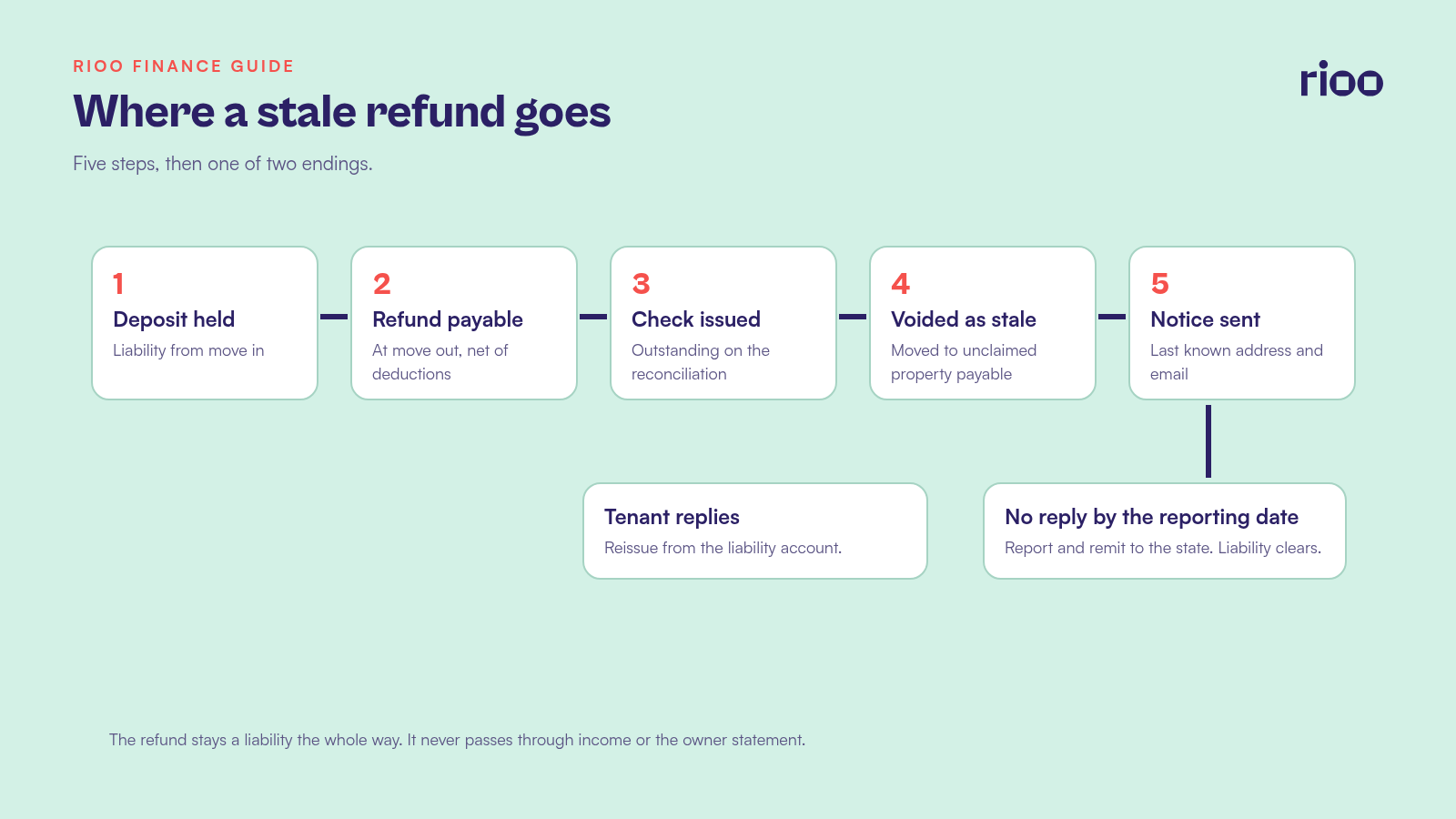
The money stays a liability from move out until the state receives it. It never passes through income.
- At move out. The deposit liability moves from "security deposits held" to "deposit refunds payable" for the tenant, net of any deductions on the itemized statement.
- When the check is issued. The payable is cleared and cash is credited. The check now sits on the bank reconciliation as outstanding.
- When the check goes stale. Banks often decline checks older than six months. Void the check, reverse the cash entry, and record the amount in a liability account such as "unclaimed property payable", tagged to the tenant.
- Due diligence. Send the notice your state requires to the last known address and email. Log the date and the reply, if any.
- If the tenant replies. Reissue the refund from the liability account. Done.
- If not. At the reporting date, file the report and remit the cash. The liability clears. Keep the file for the period your state requires.
A worked year end clean up
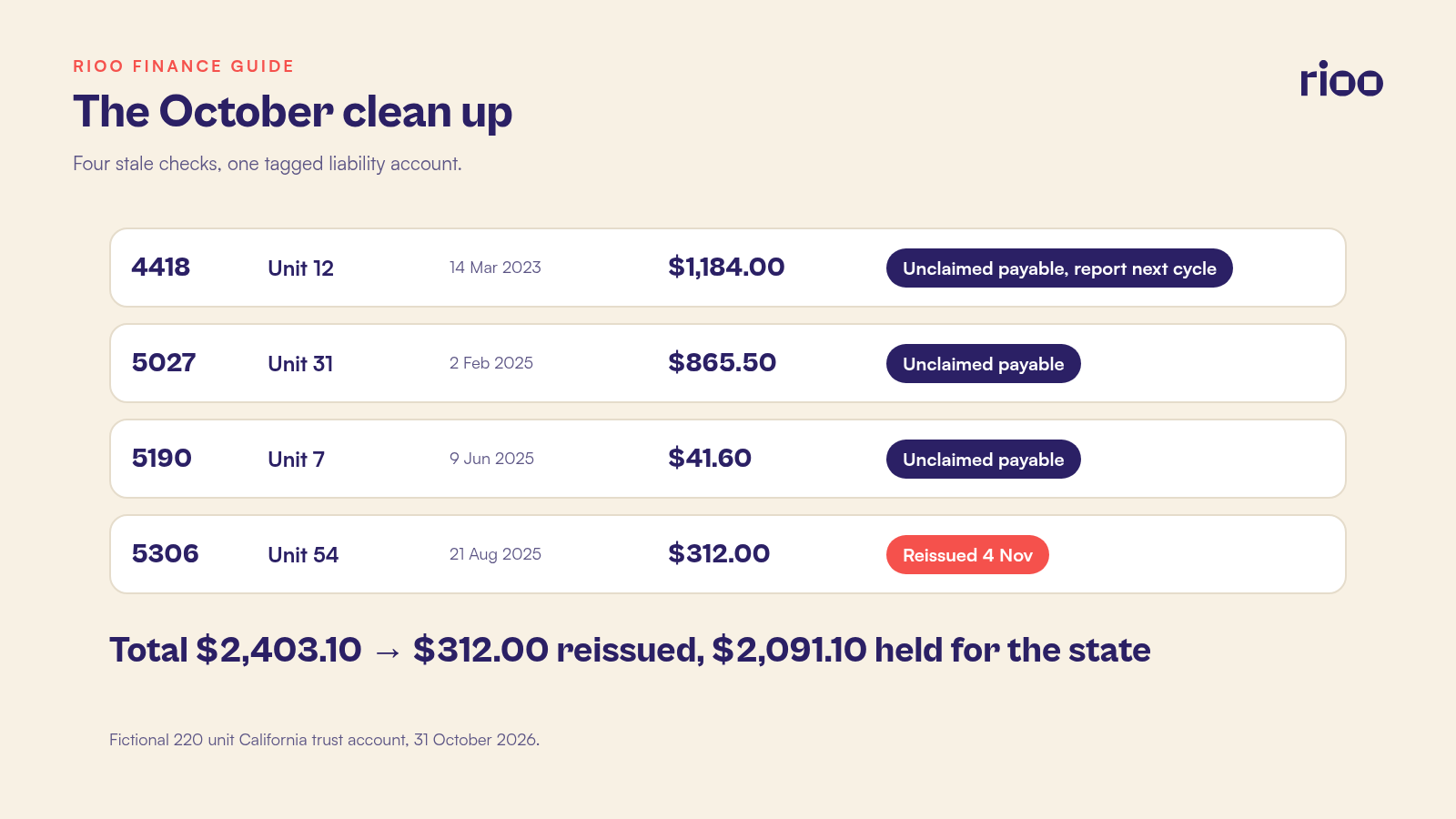
A fictional manager runs 220 units in California from one trust account. On 31 October 2026 the reconciliation shows these outstanding checks:
| Check | Payee | Issued | Amount | What happens |
|---|---|---|---|---|
| 4418 | Former tenant, Unit 12 | 14 Mar 2023 | $1,184.00 | 3 years have passed. Void it, move it to unclaimed property payable, send the notice now, and report it in the next cycle. |
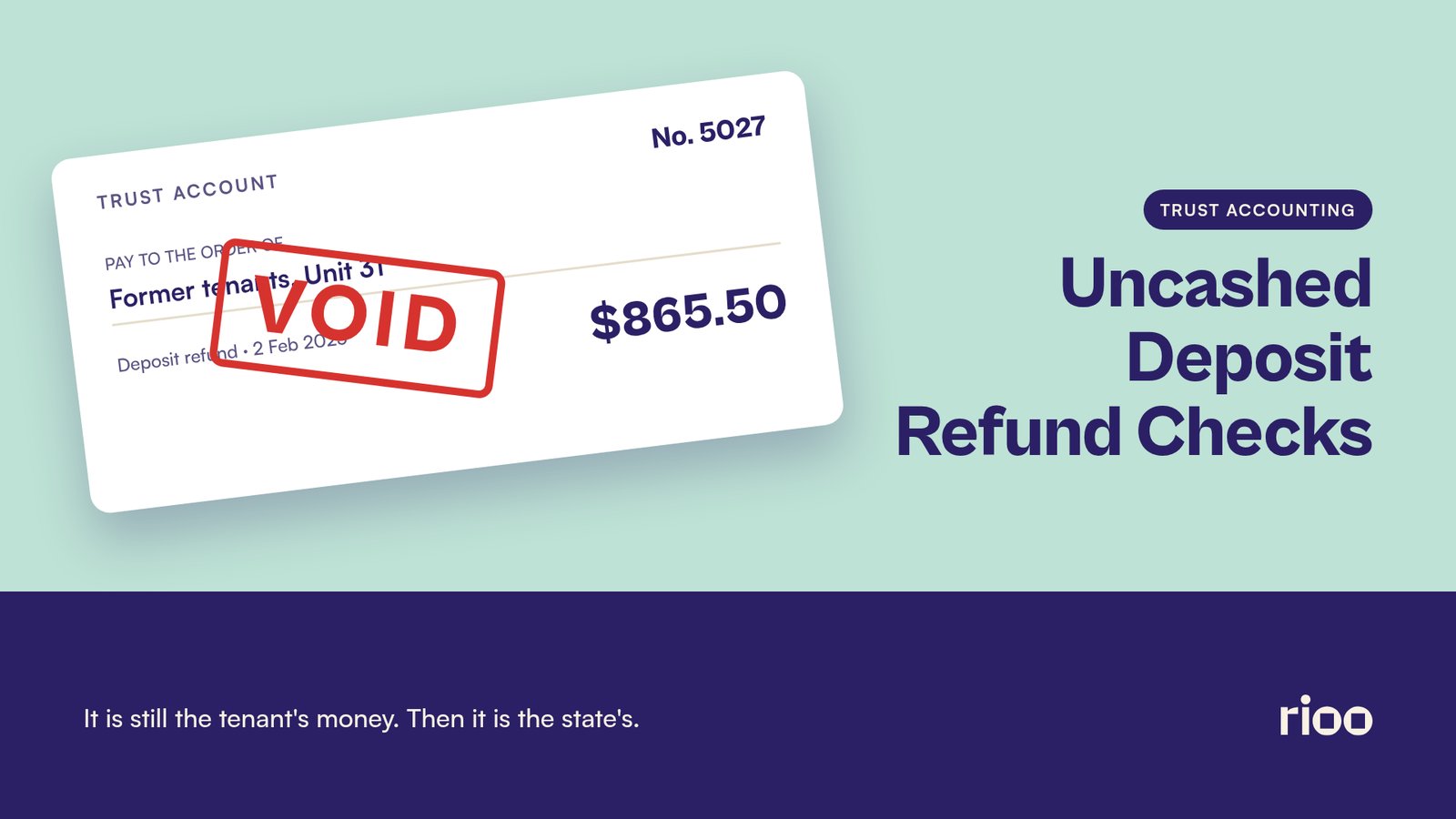
| 5027 | Former tenants, Unit 31 (two names) | 2 Feb 2025 | $865.50 | Void as stale. Move to unclaimed property payable. Email both tenants. Reportable in 2028 if nobody answers. |
| 5190 | Former tenant, Unit 7 | 9 Jun 2025 | $41.60 | Interest on a deposit. Same treatment as 5027, even though it is small. |
| 5306 | Former tenant, Unit 54 | 21 Aug 2025 | $312.00 | The tenant answers the email and gives a new address. Reissue on 4 November. |
Before the clean up, $2,403.10 of outstanding checks kept the bank balance above the book balance with no clear reason. After it, $312.00 is reissued and $2,091.10 sits in one tagged liability account with a dated note for each tenant. The reconciliation has no item older than six months. The owner statements do not change, because none of this money was ever the owner's.
A due diligence letter you can adapt
Keep it short and plain. The tenant should understand it in one read. Check your state's required wording first, because some states set a heading or a font size. California, for example, asks for a set heading on holder notices.
| Part | Example wording |
|---|---|
| Opening | We are holding a security deposit refund for you from 18 Pine Court, Unit 31. |
| Amount and date | The refund of $865.50 was issued on 2 February 2025 and has not been cashed. |
| What happens next | If we do not hear from you by 30 June 2027, state law requires us to send it to the state's unclaimed property office. |
| How to claim | Reply to this email or call 555 0142 with your current address. We will send a new check within 10 business days. |
| Identity check | We will ask you to confirm the unit and your move out date. |
Send it by first class mail to the last known address and by email if you have one. Save a copy of the letter and the date it went out. If a reply arrives after you have remitted, point the tenant to the state's claim site. The money is safe there, and the tenant can claim it for free.
Mistakes that cost money later
Writing the check off to income
It is tempting with small amounts. It is also the error auditors look for. The state can ask for the money years later, plus interest and penalties in many states.
Handing it to the owner
The owner never had a right to the refund. If an owner asks for it, show them the state rule and the liability line.
Mixing it with owner funds
Keep stale refunds in the trust account under their own liability line until they are remitted. Our note on deposits and owner funds in one trust account explains why the lines matter.
Skipping the notice
Many states require a letter before you report. Without it, the report can be rejected or the tenant can complain that no one tried.
Where RIOO fits
RIOO runs the tenant ledger, deposits and bank activity inside NetSuite. A refund check stays tied to the tenant record from move out until it clears or goes stale. You can run a saved search of outstanding refund checks by age during the trust account month end close. Then void and reclassify them with a note, and keep the due diligence letters on the same record. Bank matching across entities is covered in automated bank reconciliation for multiple entities, and the reporting side on the dashboards and reports page.
FAQ
Can a landlord keep an uncashed security deposit refund?
No. The refund belongs to the former tenant. After the state's dormancy period it must be reported to the state as unclaimed property.
How long before an uncashed deposit check goes to the state?
It depends on the state. Nebraska treats an outstanding refund as abandoned after 1 year, Oregon licensees report deposit refunds after 2 years, and California lists security deposits at 3 years.
Should I stop payment on a stale check?
Void it in the books and stop payment with the bank before you reissue it, so the tenant cannot cash both. Keep the money in a liability account.
Which state do I report to?
Usually the state of the tenant's last known address. If there is no address, it is usually the state where your company is formed. Ask the unclaimed property office if you are unsure.
What about a small refund, like $5?
Small amounts still count. Many states let you report items under a set amount together in one line, but they are still reported.
Sources: California State Controller's Office dormancy table, Oregon Real Estate Agency, Neb. Rev. Stat. 76-1416, Va. Code 55.1-1226, Comptroller of Maryland Business Tax Tip 19. As of November 2026. General information only; confirm with your state's unclaimed property office or your accountant.