









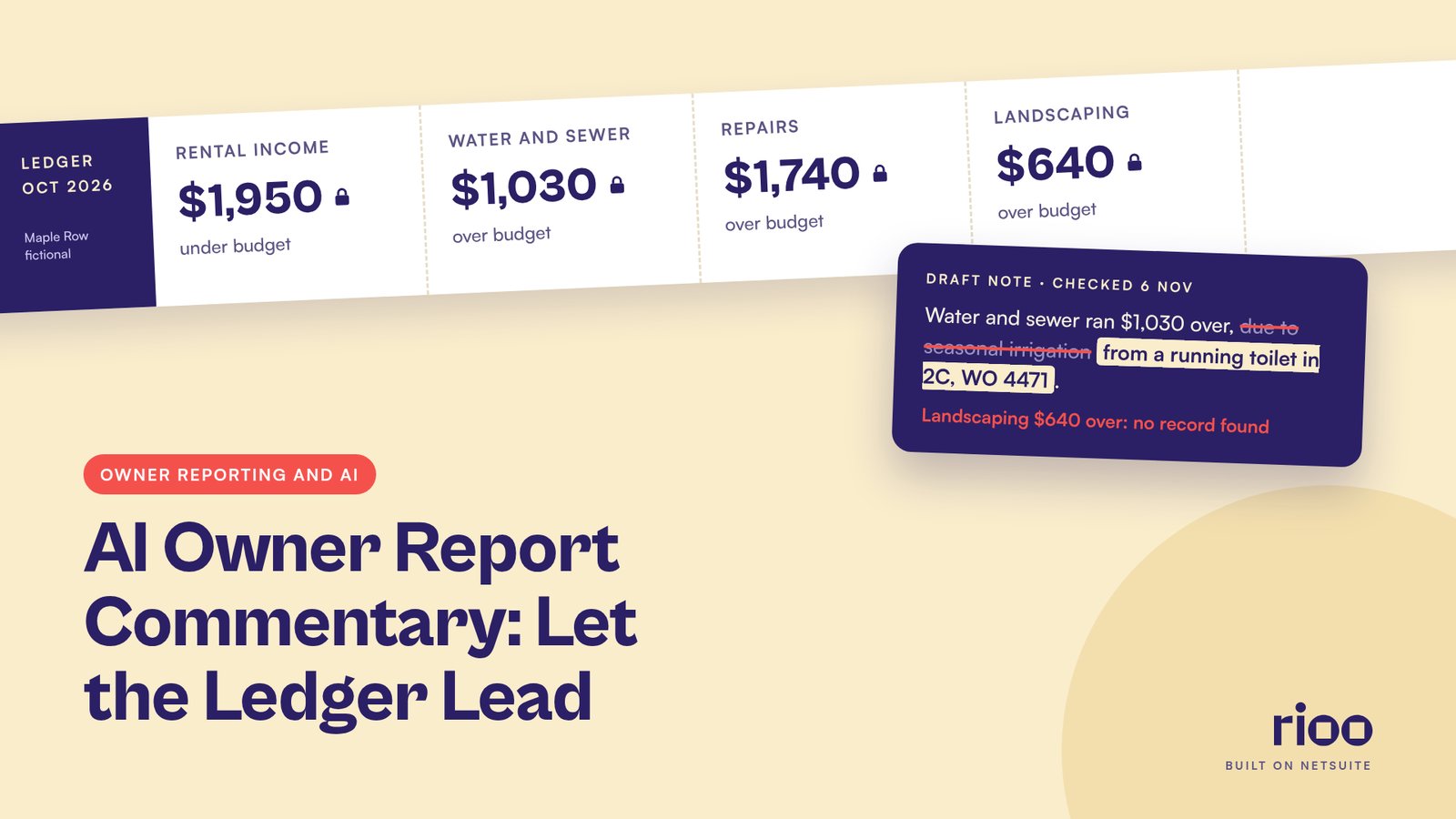
The risk in AI written owner commentary is a sentence that sounds right and has no record behind it. Owners forgive a late report more easily than a confident wrong reason. You can still let a model draft the words around your numbers and save real time each month. It has to draft only from records you hand it. A person then checks every sentence before the owner sees it.
The working rule: the model never calculates, changes or rounds a figure. It repeats the figures you approved, links each change to a work order, invoice or lease event, and writes "no record found" when it cannot. Your accountant or property manager edits the draft and sends it. The owner still gets your judgment. You spend less time typing it.
Which parts a model may draft
Split the report by risk. Anything that moves money or states a fact the owner will rely on stays with a person. Anything that turns approved facts into readable sentences can start as a draft.
| Part of the report | Model may | A person must |
|---|---|---|
| Statement totals, NOI, distributions | Quote them as given | Approve them in the ledger first |
| Budget versus actual lines | List lines over your threshold, with both amounts | Confirm the list is complete |
| Reason for each variance | Pull the reason from a linked record | Check the record says what the draft says |
| Lines with no record | Flag them in plain words | Find the cause or hold the line for a call |
| Leasing and vacancy notes | Summarize move ins, move outs and days vacant | Remove anything about a tenant as a person |
| Recommendations and capital asks | Nothing | Write them |
| Sending | Nothing | Send it, or pick up the phone instead |
Recommendations stay human on purpose. A suggestion to replace a roof or raise rents is advice, and the owner will treat it as yours. For the wider case on what the report is for, see why owner reports are a trust instrument.
Build the packet before you ask for a draft
A model writes from whatever you give it. Give it a thin packet and it fills the gaps with guesses that sound reasonable. Give it a complete packet and the draft mostly repeats your records in better order.
The approved statement
Export the owner statement only after the month is closed and reviewed. If a journal entry is still pending, wait. A draft written against figures that later change is worse than no draft.
A variance list with a threshold
Agree the threshold with each owner. A common setup is any line that moves more than $500 or 10% from budget. Produce that list from the ledger, outside the model, so the selection of lines is never the model's choice. If you are still settling the method, budget versus actual variance reporting covers thresholds and line structure.
The record behind each line
Attach the work order, vendor invoice, utility bill or lease event for every listed line. Include the dates. A water bill covering 9 September to 8 October explains a different story than one covering October.
The owner's preferences
Some owners want three sentences. Others want every line explained. Keep a short note per owner on length, tone and what they always ask about. Feed it in with the packet.
Where the packet comes from in RIOO
The packet is only as good as the records behind it. In RIOO, owner statements show income, expenses and distributions for each owner. Budget versus actual shows variances by property and category, with commentary. NOI is reported by property. All of it sits on the same NetSuite records your team closes the month on. Every figure opens the transactions behind it. Maintenance requests become work orders linked to the unit and asset, and their costs flow to accounts payable. So the person building the packet can go from a variance line to the work order or invoice that explains it without leaving the system. RIOO does not write the commentary for you. See dashboards and reports in RIOO.
Instructions to reuse every month
Write the instructions once and keep them with your reporting procedures. Change them only when a review shows a repeated error. These are the lines that matter.
- Use only the figures in the attached statement. Do not calculate new figures.
- For each line in the variance list, state the line name, budget, actual and difference, copied exactly.
- Give the cause only if an attached record states it. Name the record, such as the work order number.
- If no record explains a line, write "No record found. Under review."
- Do not use words like seasonal, normal, expected or one time unless a record says so.
- Describe units, dates and amounts. Never describe a tenant's family, health, background or reasons for moving.
- Keep it under 250 words. Plain language, no sales tone.
Rule 5 targets the error reviewers see again and again. The phrase "seasonal increase" is the classic invented cause. It sounds harmless and it is often wrong.
Maple Row, October close: one draft, three fixes
Here is a worked example. Maple Row is a fictional 42 unit building. The October books closed on 6 November 2026. The owner's threshold is $500 or 10%. Four lines crossed it.
| Line | Budget | Actual | Difference | Record in the packet |
|---|---|---|---|---|
| Rental income | $79,800 | $77,850 | $1,950 under | Unit 3B vacant all of October, rent $1,950 |
| Water and sewer | $2,150 | $3,180 | $1,030 over | Bill for 9 Sep to 8 Oct; WO 4471, running toilet in 2C, closed 19 Oct |
| Repairs | $3,500 | $5,240 | $1,740 over | WO 4490, boiler circulator pump, invoice $1,610 |
| Landscaping | $900 | $1,540 | $640 over | None |
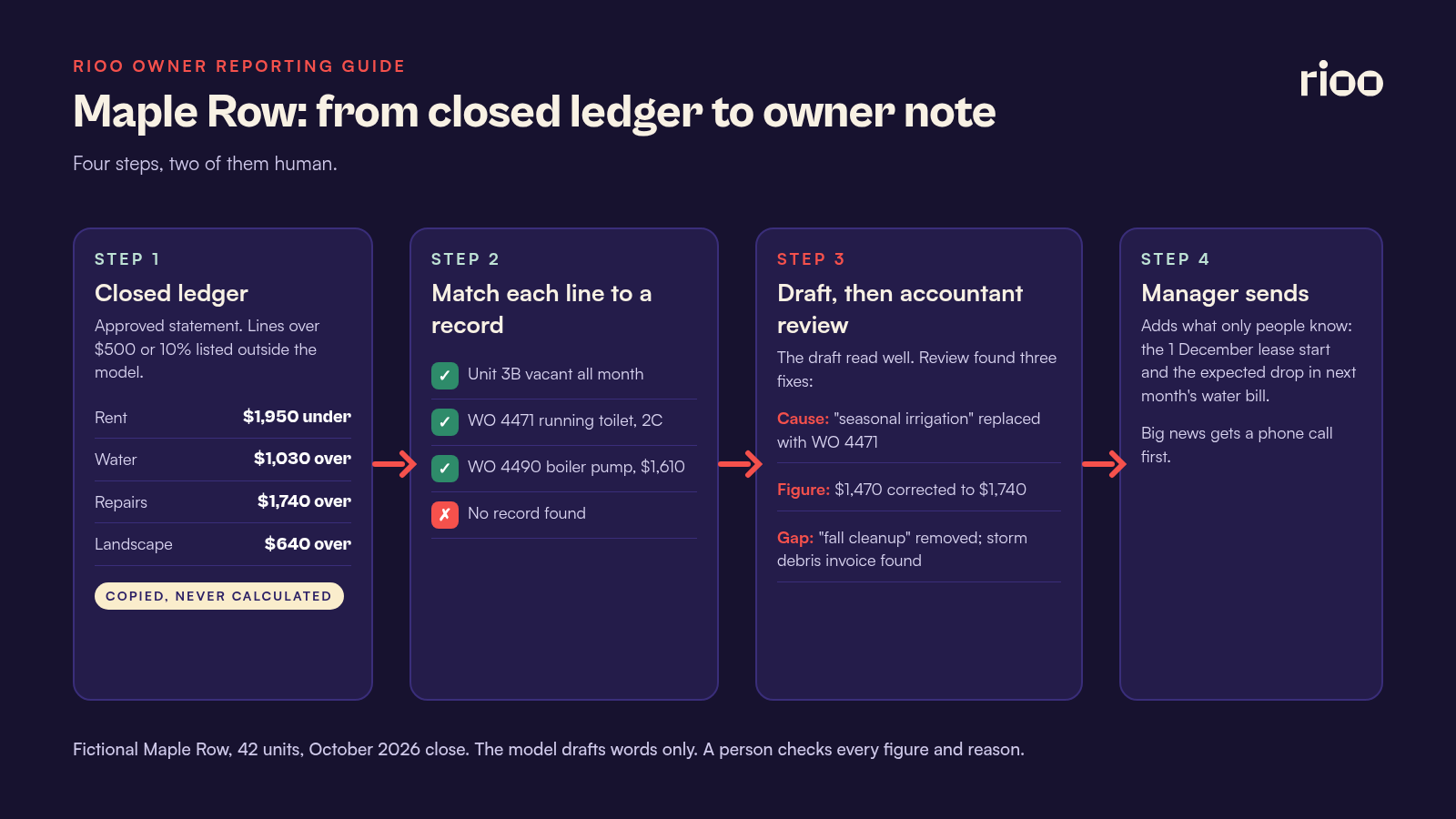
The first draft came back in seconds. It read well. It had three problems.
- An invented cause. It said water rose "due to seasonal irrigation." The building has no irrigation. The record said a running toilet in 2C.
- A wrong figure. It said repairs ran "$1,470 over budget." The statement said $1,740. Two digits had swapped.
- A filled gap. It called the landscaping overage "fall cleanup." No work order or invoice said that.
The accountant caught all three in about ten minutes. The figure and the cause were quick fixes. The landscaping line went to the property manager, who found a vendor invoice for storm debris removal after the 21 October wind. That invoice had been coded but never attached. The edited note read:
"Rental income was $1,950 under budget because unit 3B was vacant all of October. A new lease starts 1 December. Water and sewer ran $1,030 over. The bill covers 9 September to 8 October and includes a running toilet in 2C, fixed on 19 October under work order 4471. We expect the next bill to drop. Repairs were $1,740 over, mainly the boiler circulator pump at $1,610 (work order 4490). Landscaping was $640 over for storm debris removal after the 21 October wind. Invoice attached."
Notice what the person added. The 1 December lease start came from the leasing team. "We expect the next bill to drop" is a judgment the manager is willing to stand behind. The model could not supply either one.
Reviewing the draft against the statement
Treat the draft like a junior analyst's work. Read it against the statement, never on its own.
| Check | Compare against | What it catches |
|---|---|---|
| Every figure | The approved statement | Swapped digits, rounded amounts, figures from last month |
| Every cause | The named record | Invented reasons, wrong unit numbers |
| Every listed line | The variance list from the ledger | Lines dropped because they were awkward |
| Every sentence about people | Your fair housing rules | Tenant details that should never reach an owner |
| Tone | The owner's preference note | Spin on a bad month, or alarm over a small one |
Some news should not go out as a paragraph at all. A large unplanned repair or a long vacancy is often better as a phone call first. The written note then confirms what you already said. How to tell an owner they had a bad month covers that call.
Tenant data, privacy and fair housing
Owner commentary is a place where tenant details leak. A sentence like "the family in 3B left because of a new baby" tells the owner something they have no need to know. It also puts familial status into a business record. Describe units and dates. Leave people out.
- Strip tenant names, contact details and payment account numbers from the packet. The model does not need them to explain a variance.
- Never paste leases, bank details, Social Security numbers or full tenant files into a public chatbot. Use tools your company has approved for financial data.
- Do not let a draft explain vacancy or arrears through a tenant's background, health, disability, family or national origin. Explain it through dates, rent and actions taken.
- Keep the packet and the final note together in the property file. If an owner asks later why a line moved, you can show the record.
The reviewer who signs off owns the note, whoever typed the first draft. Who owns a decision AI helped make goes further into that question.
How to tell it is working
Measure your own results for three months before you decide anything. Four numbers are enough.
- Corrections per report. Count every fix the reviewer makes. It should fall as you tighten the instructions. If it does not, the packet is missing records.
- Lines flagged "no record found." This is a filing measure. Each one means an invoice or work order was not attached when it should have been.
- Days from close to send. Note the day each report goes out. Faster is the point, but only with the corrections count steady or falling.
- Owner follow up questions. Log the questions that arrive after each report. Fewer "why did this go up?" emails means the notes are doing their job.
Keep a correction log for the first two months. When the same mistake shows up twice, change the instructions or the packet. Fixing it by hand every month means the same error keeps coming back.
Questions from the reporting team
Can AI write the whole owner report?
It can draft the commentary. The figures should come straight from your approved statement, and a person should review and send the report. Anything else it produces stays a draft until a person signs off.
What threshold should trigger a variance note?
Agree it with each owner. Many teams use a dollar amount and a percentage together, such as $500 or 10%. Set the list in the ledger so the model never decides which lines to explain.
What if the model gives a reason that sounds right?
Check it against the record anyway. A plausible reason with no record behind it is the error that reaches owners. Ask for the record number in every cause sentence.
Is it safe to put tenant data into the tool?
Only into tools your company has approved for that data, and only what the draft needs. Variance notes need units, dates and amounts. They rarely need a tenant's name.
Should owners know a draft tool was used?
That is a policy choice for your firm. What matters more is that a named person reviewed the report and stands behind it. Put that person's name on it.