









Many office and retail leases carry a paragraph that lets the tenant stay another five years at a rent nobody knows yet. That paragraph is the option to renew. It gives a commercial tenant the right to extend the lease for a set term. To use it, the tenant gives written notice inside a set window and meets the conditions in the clause. The clause also sets the new rent: a fixed figure, an index, or fair market rent agreed between the parties or decided by appraisers.
The date is where options are won and lost. Courts in many states treat the exercise deadline strictly. A notice that is a day late or sent to the wrong address can mean the option is gone. What follows is the operations view of the clause, from the person who has to diary the dates. Have your lawyer read your actual clause.
Reading a sample renewal clause
Here is a typical renewal option, split into its working parts. The wording is a sample. Leases vary a great deal.
| Sample wording | What to check |
|---|---|
| "Tenant shall have one (1) option to extend the Term for five (5) years" | How many options, and how long each one runs. Two five year options are common in office and retail leases. |
| "by written notice given not earlier than fifteen (15) months nor later than nine (9) months before the Expiration Date" | Both ends of the window. A notice sent too early can fail just as a late one can. |
| "delivered in accordance with Section 24 (Notices)" | The notice address, the delivery method and any copy to counsel. An email to the property manager may not satisfy it. |
| "provided Tenant is not then in default beyond any applicable cure period" | Whether default is tested on the notice date, the start of the new term, or both. |
| "at Fair Market Rent, determined under Exhibit F" | The rent method, and whether the tenant can withdraw once the number is known. |
| "This option is personal to the original Tenant named herein" | Whether an assignee or subtenant can exercise it. Personal options often die on assignment. |
Read the definitions too. "Expiration Date" may move if the commencement date slipped. A lease that started six weeks late often ends six weeks late, which moves the whole window.
Three ways the new rent gets set
The rent method decides how much work the renewal takes and how much room there is for a dispute.
A fixed figure or a set increase
The clause names the rent, or a step such as 3% over the last year's rent. Nothing is left to argue about. The risk sits with whoever guessed wrong about the market. A tenant locked into a fixed step in a falling market overpays, and a landlord in a rising market undercharges.
An index
Rent moves with a consumer price index between two dates. There is often a floor and a cap, such as no less than 2% and no more than 5% a year. Check which index series, which months and what happens if the index is discontinued.
Fair market rent
This is the method that causes disputes. A good clause defines what market means. Does it use renewal deals or new leases? Does it account for free rent, improvement allowances and broker fees in comparable deals? Is there a floor at the current rent?
The usual process runs in stages. The landlord proposes a rate within a set time after the notice. The tenant accepts or disputes it within, say, 30 days. The parties negotiate for a fixed period. If that fails, appraisers decide. There are three common versions.
- Single appraiser. One agreed appraiser sets the rate.
- Three appraisers. Each side picks one, and those two pick a third. The rate is often the average of the two closest figures.
- Baseball. Each side submits a final number, and the appraiser must pick one of them. This pushes both sides toward realistic numbers.
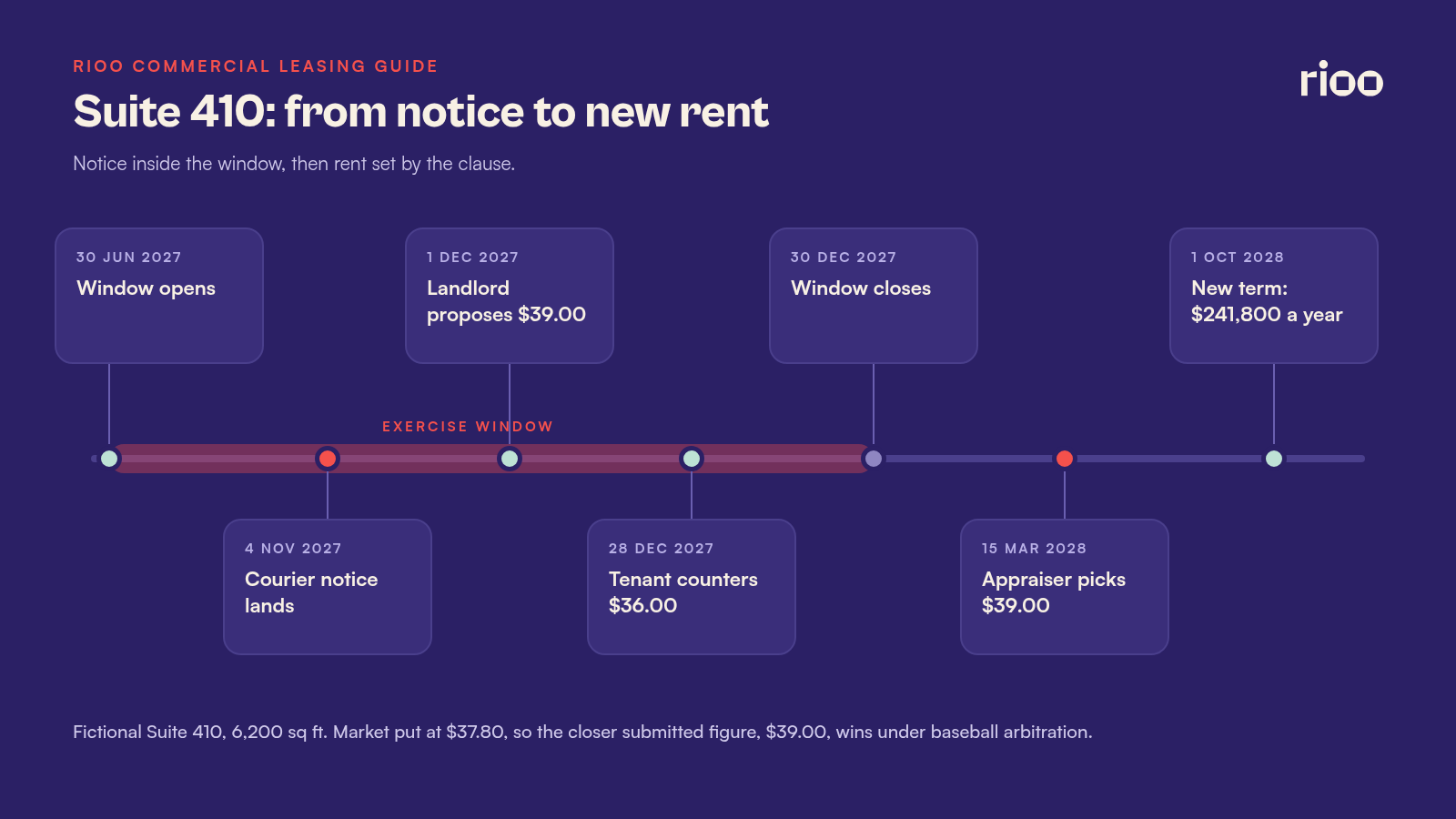
Harbor Point Suite 410: from notice to new rent
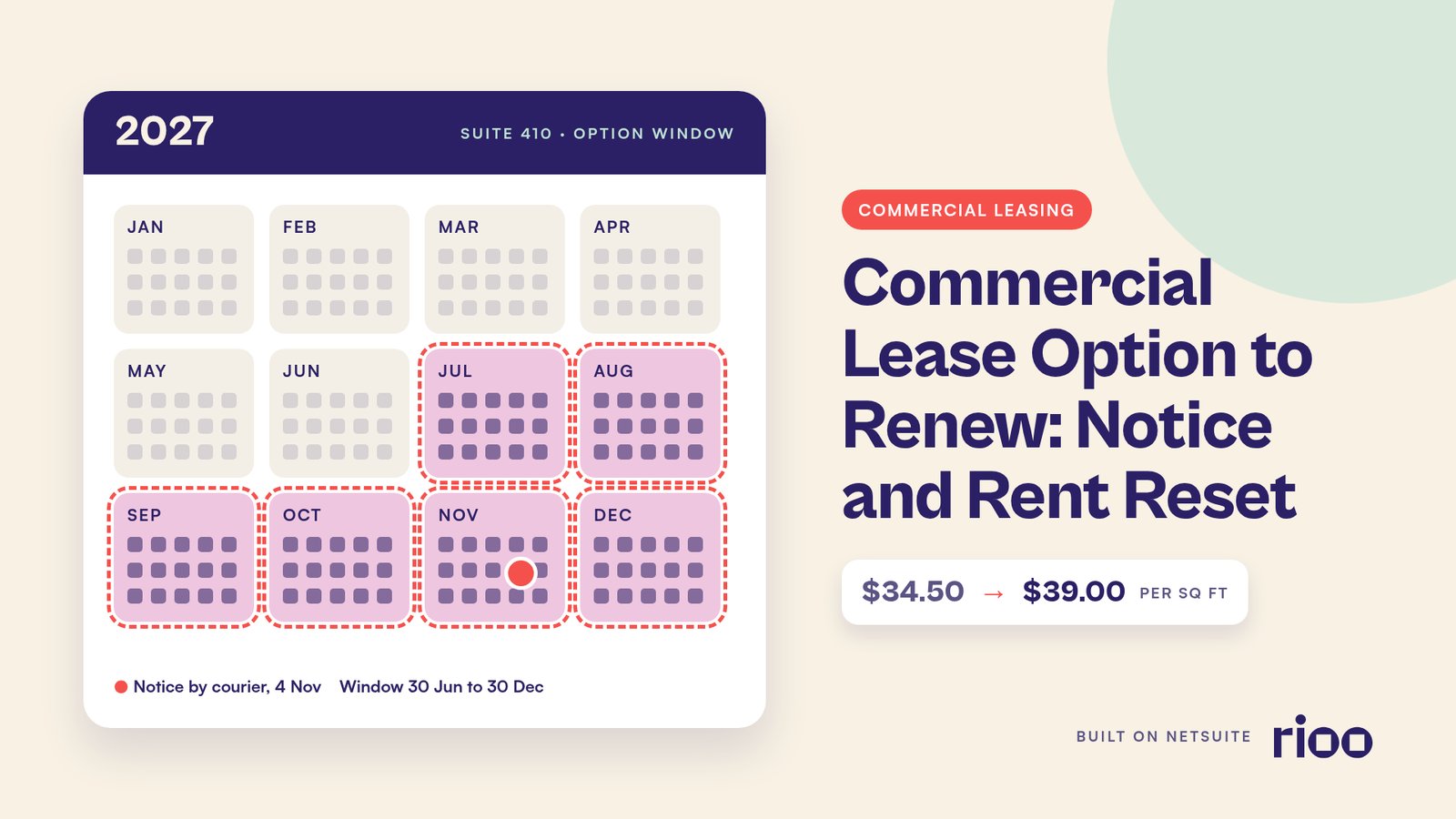
Here is a fictional renewal that shows how the dates and numbers interact. Suite 410 at Harbor Point is 6,200 square feet of office space. The lease runs from 1 October 2021 to 30 September 2028 at $34.50 per square foot, or $213,900 a year. It has one five year option at fair market rent, with the window and baseball method from the sample clause.
| Date | Event |
|---|---|
| 30 June 2027 | Window opens, 15 months before expiry. The lease administrator sends the tenant a courtesy reminder. |
| 18 August 2027 | The tenant pays a CAM true up invoice 12 days late. It is cured within the 30 day cure period, so there is no default beyond cure. |
| 20 October 2027 | The tenant's facilities manager emails the property manager: "We plan to renew." The landlord's counsel replies that formal notice must go to the notice address in Section 24. |
| 4 November 2027 | A signed exercise notice arrives by courier at the notice address. The option is exercised, 56 days before the window closes. |
| 1 December 2027 | The landlord proposes $39.00 per square foot. |
| 28 December 2027 | The tenant disputes and counters at $36.00. |
| 27 January 2028 | The 30 day negotiation period ends with no deal. |
| 15 March 2028 | The appraiser puts market at $37.80 and must choose a submitted figure. $39.00 is $1.20 away and $36.00 is $1.80 away, so $39.00 wins. |
| 1 October 2028 | The renewal term starts at $241,800 a year, or $20,150 a month. |
The increase is $27,900 a year, about 13%. The tenant's figure sat $0.60 further from market than the landlord's. A counter at $37.00 would have been $0.80 from market and won. That is how baseball works. The side closer to the appraiser's view takes everything.
The October email is the part worth noticing. Had the tenant relied on it, the option could have lapsed on 30 December. Counsel's reply was the right move: it pointed to the clause and gave the tenant time to send proper notice.
When the notice is late or wrong
Treat a missed window as a lost option unless your lawyer says otherwise. Some states give relief in narrow cases, for example where the delay was short, the landlord suffered no harm and the tenant would lose large improvements. Those cases are uncertain and expensive. Nobody should plan around them.
If a tenant's notice is late, a landlord should answer in writing and say whether it treats the option as exercised, lapsed, or open to a negotiated renewal. Silence followed by rent accepted at the old rate after expiry invites a holdover argument. If the notice is early, the same logic applies. Reply and ask for a notice inside the window.
The landlord's calendar from 18 months out
- 18 months before expiry. Pull the lease abstract. Confirm the expiration date against the actual commencement, the window, the notice address and the rent method.
- 15 months. Window opens. Send a courtesy reminder if that is your policy. Commission a market rent view so your proposal is ready.
- Notice received. Log the arrival date and method. Check the default condition. Diary the date your rent proposal is due.
- Window closes. Record the option as exercised or lapsed. If lapsed, move the suite into the leasing pipeline that week.
- Rent settled. Sign an amendment with the new rent, the new term and any changes to improvements or recoveries, and update billing before the new term starts.
For portfolio wide date control, see how to track critical lease dates across a portfolio. Industrial landlords face longer runways, covered in our guide to the industrial lease renewal timeline.
Option windows on the RIOO lease record
In RIOO, the lease abstract is the lease record on NetSuite, with critical dates, renewal and break options, rent steps and recoveries stored as data. A renewal option notice window can carry an owner, the way the 18 month calendar above needs one. When the new rent is agreed, the amendment is attached to the lease with its effective date, and the abstract and billing schedules change from that date forward. Earlier terms stay visible. See commercial lease administration in RIOO.
What to settle at signing
Every one of these points is cheap to agree in the first draft and costly to argue about in year seven.
- A reminder safety net. Tenants ask that the option cannot lapse until a set number of days after the landlord sends a reminder. Landlords often resist, or agree to a short grace period.
- The market definition. Spell out which deals count as comparable and how concessions are treated.
- A floor. Landlords ask that renewal rent cannot fall below the rent in the final year.
- A withdrawal right. Tenants ask for a few days to rescind once the appraised rent is known. Landlords may agree if the tenant pays the appraisal costs.
- Transfer rules. Decide whether an assignee or a related company can exercise the option.
- Part of the space. Decide whether the tenant can renew part of the premises, and which part.
Renewal options often sit next to other tenant rights, such as a right of first refusal on adjacent space. Check that the two clauses do not clash on timing.
Option to renew FAQ
Is an option to renew the same as an option to extend?
In everyday use, people treat them as the same. Strictly, some leases use "extend" to mean the same lease keeps running and "renew" to mean a new lease on the same terms. Read what your clause says happens.
Does the landlord have to remind the tenant?
Not unless the lease says so. Many landlords send a courtesy reminder anyway, because a good tenant who renews is cheaper than a vacancy.
Can a landlord refuse a valid exercise?
If the tenant met the window, method and conditions, the option binds the landlord. A dispute then is usually about rent, which is why the rent method matters so much.
Can the tenant exercise the option while in default?
It depends on the wording. Many clauses bar exercise during an uncured default. Check whether the test applies on the notice date, the start of the new term, or both.
Who pays the appraisers?
The clause decides. A common split is that each side pays its own appraiser and they share the third.