








New York landlords must keep every rental, and the shared areas around it, fit to live in and free of conditions that are dangerous to health or safety. That duty is the warranty of habitability in Real Property Law section 235-b. It is part of every residential lease, written or oral, and a tenant cannot sign it away.
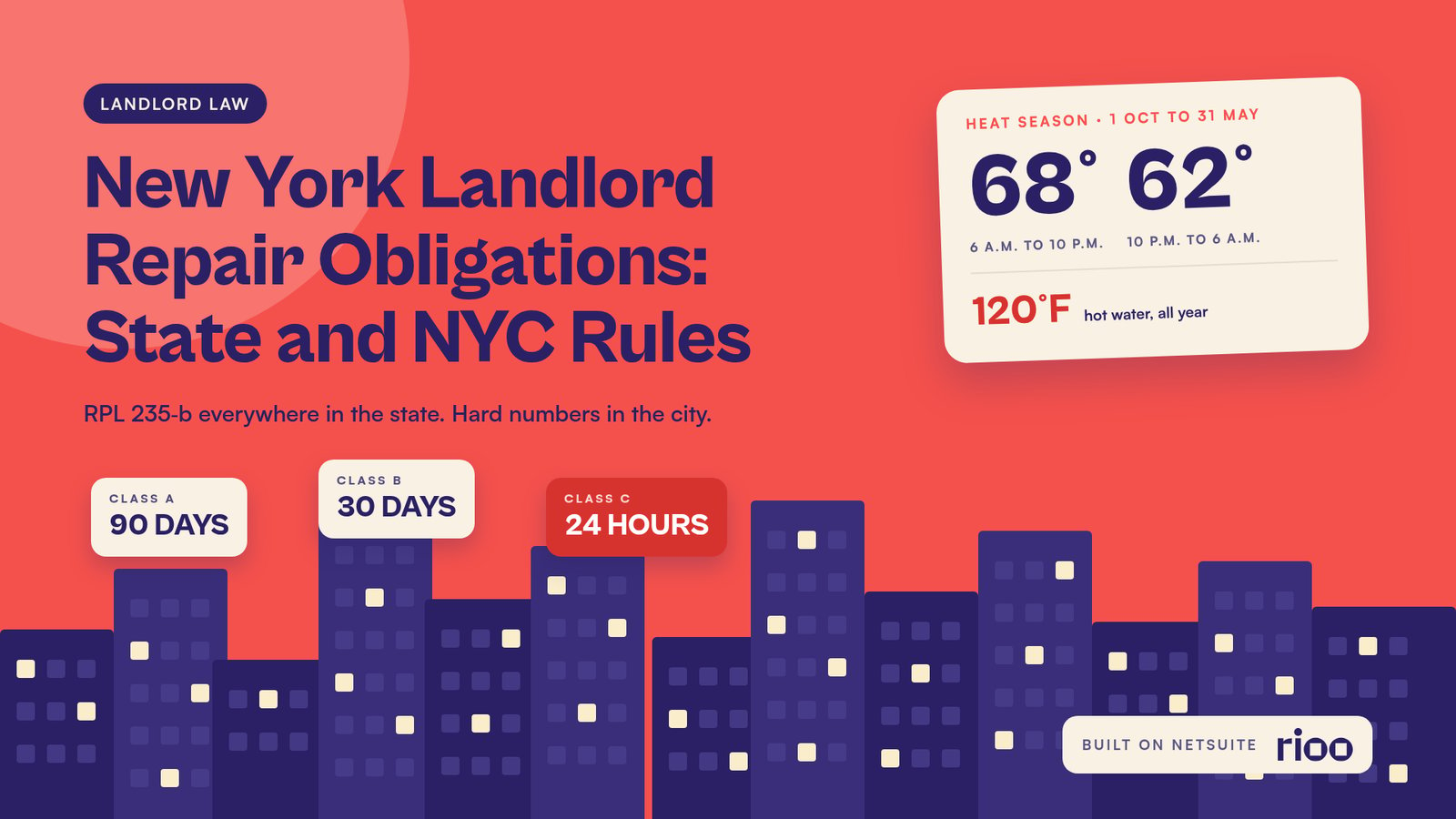
In New York City, the Housing Maintenance Code and related local laws add hard numbers on top. Heat runs by the clock, hot water stays at 120°F all year, and violations come with fixed correction deadlines from 24 hours to 90 days. This guide sets out both layers, what tenants can do when a repair stalls, and how to run repairs so your records hold up. It reflects official sources as of November 2026. Rules change, so confirm details with counsel.
Statewide rules and NYC rules side by side
Think of New York repair law as two layers. The state warranty applies everywhere. NYC buildings also answer to city code and to HPD, the city's housing agency.
| Topic | Statewide | New York City adds |
|---|---|---|
| Core duty | Fit for human habitation, no conditions dangerous to life, health or safety (RPL 235-b) | Detailed Housing Maintenance Code standards, enforced by HPD inspectors |
| Heat | Covered by the general warranty | Set indoor minimums from 1 October to 31 May |
| Hot water | Covered by the general warranty | At least 120°F, every day of the year |
| Repair deadlines | No fixed number of days. Courts look at what is reasonable | 24 hours to 90 days, by violation class |
| Mold and pests | Covered by the general warranty | Annual inspections in buildings with three or more units |
| Owner contact details | No statewide registry | Yearly HPD registration for covered buildings |
Outside the city, local housing and property maintenance codes set the detailed standards. Check the code your city, town or village enforces.
What section 235-b says
The key sentence is short. In every residential lease, the landlord warrants that the premises and shared areas are fit for human habitation.
The landlord also warrants that occupants "shall not be subjected to any conditions which would be dangerous, hazardous or detrimental to their life, health or safety."
You can read the full text on the New York State Senate site.
Five details matter in practice:
- Common areas count. Hallways, stairs, laundry rooms and the boiler that serves everyone are all inside the warranty.
- Tenant caused damage is excluded. A condition caused by the tenant, or by people under their control, is not a breach. The tenant has to fix it.
- Waivers are void. A lease clause that trims the warranty has no effect.
- No expert needed. A court can set damages without expert testimony.
- Rent regulated units. If DHCR, the state housing agency, already ordered a rent reduction for the same problem, a court award is reduced by that amount.
The statute does not list items such as locks or appliances. The state Attorney General gives examples of a breach. One is failing to provide heat or hot water on a regular basis. Another is failing to get rid of an insect infestation.
The NYC Housing Maintenance Code in numbers
NYC owners work to specific figures. Here are the ones that drive daily repair work.
Heat and hot water
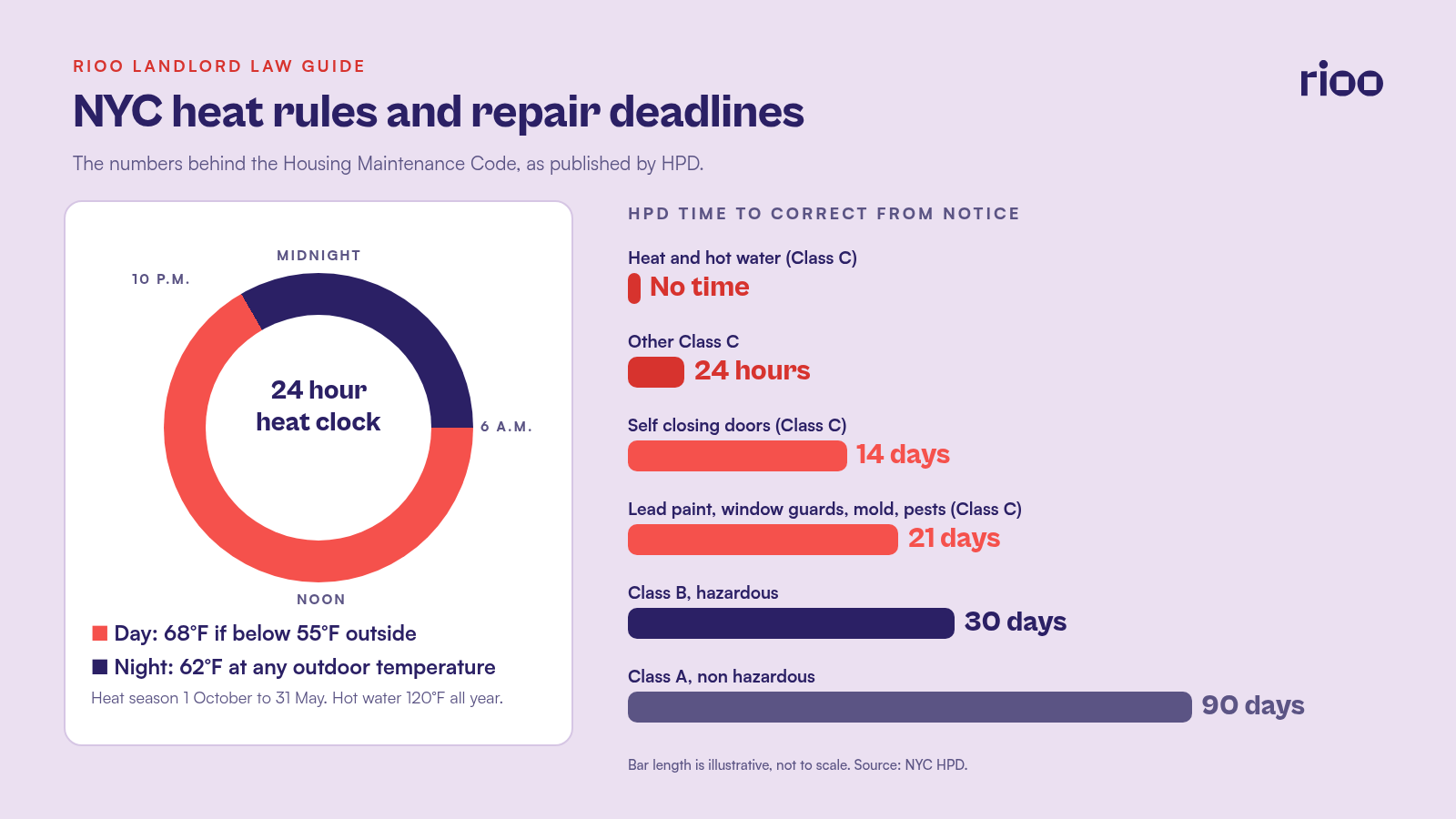
Heat season runs from 1 October to 31 May. Between 6 a.m. and 10 p.m., if it is below 55°F outside, the apartment must be at least 68°F. Between 10 p.m. and 6 a.m., it must be at least 62°F whatever the outdoor temperature. Hot water must be at least 120°F all year. These figures come from HPD's heat and hot water page. For how other states set heat rules, see our guide to landlord heat requirements.
Violation classes and correction deadlines
HPD sorts violations by hazard. The deadline is how long the owner has to correct a violation before civil penalties apply, if HPD seeks them in Housing Court.
| Class | Type | Time to correct from notice |
|---|---|---|
| A | Non hazardous | 90 days |
| B | Hazardous | 30 days |
| C: lead paint, window guards, mold, mice, cockroaches and rats | Immediately hazardous | 21 days |
| C: self closing doors | Immediately hazardous | 14 days |
| C: heat and hot water | Immediately hazardous | No time |
| C: all others | Immediately hazardous | 24 hours |
Source: HPD penalties and fees. Heat and hot water penalties can run daily from the date the notice is posted at the building. Certify a correction only after the work is done. HPD may audit certifications, and a false one leaves the violation open.
Mold and pests under Local Law 55
Owners of buildings with three or more units must inspect every occupied unit for mice, cockroaches, rats and mold at least once a year. They must inspect again when a tenant complains or when they should have known of a problem. Vacant units must be cleaned and free of pests and mold before a new tenant moves in. Each lease needs the HPD notice and the city's fact sheet. Pest work must follow integrated pest management, and any pesticide must be applied by a state licensed professional.
In buildings with 10 or more units, mold covering more than 10 square feet calls for a licensed mold assessor and a separate licensed remediator. Details are on HPD's mold and pests page.
Registration
Buildings with three or more units must register with HPD every year. So must one and two family homes where neither the owner nor their immediate family lives. HPD mails violation notices to the registered managing agent. A stale registration means notices go to the wrong person while correction clocks run.
What tenants can do when a repair stalls
New York gives tenants several routes. Knowing them helps you see where a slow repair can lead. The Attorney General's guide to habitability and repairs sets them out.
- Call 311. In NYC, a complaint can lead to an HPD inspection and a violation.
- Sue for a rent reduction. The reduction is the rent minus the estimated value of the unit without the missing services. The landlord must have actual or constructive notice of the condition.
- Withhold rent. The landlord may then sue for nonpayment, and the tenant may counterclaim for breach of the warranty.
- File with DHCR. Rent regulated tenants must first notify the landlord in writing. They can file no sooner than 10 days and no later than 60 days after that notice.
- Repair and deduct. This is limited to extenuating circumstances. The Attorney General's example is a broken door lock that a landlord knew about and willfully left unfixed.
- Ask Housing Court to order repairs. NYC tenants can start a case asking the court to direct the owner to correct conditions.
Retaliation is also covered. Real Property Law section 223-b sets a one year window after a good faith complaint. If the landlord serves a notice to quit, starts an eviction or substantially changes the lease terms in that window, a court presumes retaliation. The landlord can rebut it. Our guides to the New York eviction process and Good Cause Eviction in New York cover how this plays out in court.
A January repair in Queens, dated
This example is fictional. A 30 unit building in Astoria has a tenant in unit 5D paying $2,600 a month.
- Monday 11 January 2027, 9:40 p.m. The tenant submits a portal request. The bedroom radiator is cold and a thermometer reads 60°F at 10:15 p.m. The night minimum is 62°F, so the coordinator treats it as urgent.
- 10:30 p.m. The super bleeds the radiator. No change. The boiler is running, so the problem is in the unit. He logs a stuck supply valve and a photo of the reading.
- Tuesday 12 January, 7:00 a.m. It is 30°F outside and 64°F in the bedroom. The daytime rule needs 68°F, so the unit is still out of compliance. A plumber is booked for 1 p.m.
- 1:00 p.m. The plumber replaces the valve for $340. At 3 p.m. the room reads 70°F. The super uploads a dated photo.
- Wednesday 13 January. An HPD inspector arrives after a 311 call made on Monday night. Heat is restored. The tenant mentions a stain on the bathroom ceiling.
- Thursday 14 January. The super traces a slow leak from 6D and opens a work order. About 4 square feet of mold sits on the 5D ceiling. That is under the 10 square foot trigger, so trained staff fix the leak and clean the area using HPD's safe work practices. The cleanup is logged as a Local Law 55 investigation.
Now suppose the valve had taken six days to fix. One illustrative way to size a rent reduction claim: $2,600 times 12, divided by 365, is about $85.48 a day. If a court found the unit lost 30% of its value, that is $25.64 a day. Six days comes to about $153.86. Courts decide each case on its facts, so treat this as a sizing exercise only. The larger risk was the daily heat penalty.
What protected the owner here was the record. It showed the request time, the readings, each visit and the fix, all tied to unit 5D.
Repair habits that protect a New York owner
- Timestamp every request, whether it comes by portal, phone or a note under the door.
- During heat season, log indoor and outdoor readings with each heat call.
- Acknowledge urgent requests the same night, even when the fix waits for morning.
- Check open HPD violations for each building every month, and track each correction deadline.
- Keep the HPD registration and managing agent details current.
- Run the Local Law 55 inspections on a calendar, and file the results by unit.
- For rent stabilized units, remember that service problems can feed DHCR complaints. Our NYC rent stabilization guide explains the rules.
Where RIOO fits
Repair disputes turn on dates and evidence. In RIOO, residents submit requests in the portal, and each request becomes a work order linked to the property, unit, asset and lease in NetSuite. Status changes are visible to the resident. Costs such as the $340 valve flow to accounts payable against the same unit. You can see how this works on our service request and task management page.
When HPD asks what happened, or a tenant's lawyer asks for the history, the timeline is already on the unit record. You don't have to rebuild it from texts.
Questions New York landlords ask about repairs
How long does a New York landlord have to make repairs?
State law sets no fixed number of days. Repairs must happen within a reasonable time, and urgent hazards need fast action. In NYC, HPD violation deadlines range from no time for heat and hot water to 90 days for Class A.
Can a tenant withhold rent in New York?
Tenants can withhold rent, but the landlord can sue for nonpayment. The tenant can then raise the warranty as a counterclaim, and the court can reduce the rent owed.
Does the warranty of habitability apply to condos and cooperatives?
Tenants and subtenants in both can raise it. According to the Attorney General, cooperative apartment owners can raise it, but condominium owners cannot.
Is the landlord responsible for damage the tenant caused?
No. A condition caused by the tenant, or by people under the tenant's control, is not a breach of the warranty. The tenant is responsible for fixing it.
Does the warranty apply outside New York City?
Yes. Section 235-b covers residential leases across the state. The NYC heat figures, violation classes and Local Law 55 rules apply inside the city.